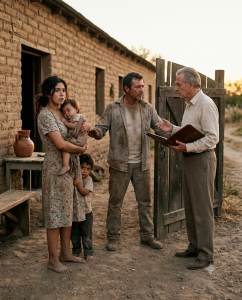
A young woman with nothing arrived at a ranch asking for water, and before the night was over, she was standing in the middle of a fight over two grieving children, a widower on the edge of collapse, and a secret powerful enough to destroy the fragile shelter she had just found.
By the time Consuelo Barra saw the gate to San Isidro del Monte, she was no longer thinking about dignity. Only water.
The road had chewed through the soles of her huaraches. Dust clung to the hem of her skirt. Her lips were cracked from the heat, and every breath scraped her throat. She had spent three days riding where she could, walking when she had to, and keeping her eyes lowered around men who thought a woman alone on the road was an invitation.
She had not set out with a plan grander than reaching Tonalá and hoping someone needed a pair of willing hands.
Instead, she stepped through the open gate of a ranch that looked too quiet for late afternoon and heard no laughter, no clatter from the kitchen, no voice calling workers in from the fields.
Only the thin, unnatural hush of a place where something had gone wrong and stayed wrong.
Then she saw him.
A man sat on the corridor floor with a small boy in his arms. The child was burning with fever, his tiny body jerking with weak tremors, but he made no sound. Beside them, on an old blanket, a little girl slept in a damp haze, cheeks flushed red, curls pasted to her forehead. The man holding the boy looked rough and unshaven, his shirt wrinkled and stained, his eyes bloodshot with exhaustion.
He didn’t look like the owner of a prosperous estate. He looked like someone who had been abandoned inside his own life.
Consuelo forgot she was a stranger.
“The boy hasn’t had water, has he?” she asked.
He lifted his head sharply, like a wounded animal deciding whether to trust a hand near its face.
“Who are you?”
“Someone who knows what fever looks like. Where’s the clean water?”
He hesitated, then nodded weakly toward the kitchen.
“In the big clay jug.”
The kitchen told the story before he did. Grease-caked dishes. Sour food. Children’s cups left where they fell. A home not neglected by indifference but shattered by grief.
When she returned with water, she knelt beside the boy and tipped it gently to his mouth. He drank greedily, still without crying. That silence unnerved her more than any scream would have.
“Thank you,” the man whispered.
“How long?”
His eyes moved toward the yard.
“My wife died six weeks ago.”
He said it flatly, like a fact that had repeated itself so many times it no longer resembled speech.
Her gaze went to the little girl. “And these are yours?”
“Twins. Isidro and Paloma. They turned three a month before…” He stopped.
Consuelo understood enough.
She had seen grief before. Buried both her parents before she was twenty. Worked in homes where sorrow made people cruel and others where it made them vanish into themselves. At twenty-three, she knew more than she should have about how quickly a woman could become unwelcome, unsafe, or invisible.
But those children were feverish. The father was unraveling. And there was food rotting in a kitchen while no one in the house had strength left to care.
“My name is Consuelo Barra,” she said. “I can cook. I can keep house. I know children. Give me food and a place to sleep, and I’ll stay a few days. Long enough to help you get them through this.”
He stared at her in disbelief.
“I can’t pay you.”
“I’m not asking for money.”
“I don’t know you.”
She looked at the little boy asleep against his chest. “You don’t have to know me to know you need help.”
That was how it began.
He gave her the back room. She built a household back out of ashes.
That first evening she emptied the spoiled pot, scrubbed dishes until her shoulders ached, boiled water, and made thin atole for the children. She cooled Paloma’s fever with cloths and coaxed Isidro to sip broth. When the little girl woke crying for her mother, Consuelo sat by her pallet and sang a song her own grandmother used to sing in Oaxaca. The child cried herself back to sleep clutching Consuelo’s fingers.
Cipriano Leal watched all of it with the stunned expression of a man witnessing rain after a season of drought.
By the third day, the children’s fevers began to break. By the fifth, Paloma was speaking again in sleepy little bursts, and Isidro had stopped flinching every time a door closed. By the eighth, the house smelled of tortillas and herbs instead of sour grief. Clean shirts fluttered on the line. The floor had been swept. The kitchen had regained its shape.
Cipriano came back from the fields each evening quieter than before, not because there was less to say, but because he was beginning to understand the magnitude of what she had done. She had not merely cooked. She had returned rhythm to a house where time had snapped.
One afternoon he found her crouched beside the children in the yard, showing them how to press wildflower petals into the dirt to make colors. Paloma laughed for the first time since her mother’s death. Isidro did not laugh, but he leaned against Consuelo’s shoulder as if he had forgotten she was ever a stranger.
Cipriano stood under the shade of the corridor and felt something painful move inside him.
Relief first. Then gratitude. Then fear.
Because relief can be dangerous when it arrives wearing a human face.
The town noticed quickly.
Palo Quemado was small enough for every stare to carry meaning. At the market, women went quiet when Consuelo approached. Men pretended not to look too long. A widower with a young woman in his house invited suspicion even when the truth was simpler than scandal.
One morning Doña Rosario, who sold beans and gossip with equal devotion, let her voice rise just enough for others to hear.
“Some women don’t waste time finding opportunity.”
Another woman snorted. “The wife barely turned cold.”
Consuelo set down the basket of chiles she was buying and turned slowly.
“That’s strange,” she said. “I don’t remember seeing either of you at that house when the children were hungry.”
A hush fell over the market.
“We only say what everyone can see,” one of them said.
“No,” Consuelo replied. “You say what dirties people because it’s easier than helping them.”
She should have walked away then, but she was tired—tired from work, tired from whispers, tired from the old familiar judgment that followed poor women as faithfully as their own shadows.
“Feeding motherless children costs hands and sleep,” she said. “Standing here inventing filth costs nothing.”
Cipriano had heard the exchange from a neighboring stall. On the ride home, he held the reins while the sacks of flour and corn shifted in the wagon and the twins drowsed between them.
“You didn’t have to do that,” he said.
She kept her eyes on the road. “I didn’t do it for you.”
He glanced toward the children.
“I know.”
That night, while the twins slept and the lantern cast a low circle of gold in the corridor, something changed between them.
Not a confession. Not a touch. Just a long, quiet look after she handed him a cup of coffee. A look that lingered a fraction too long to be accidental.
He saw then how young she still was under the weariness. She saw then how grief had stripped him down to the truest parts of himself. Neither said a word. Both felt it.
And that was exactly when trouble arrived.
The carriage at the gate was polished enough to seem insulting in a yard that still carried the dust of hard labor. The man who stepped down wore city tailoring, clean boots, and the expression of someone who had come to judge before he had come to ask.
Don Abundio Saavedra.
Perpetua’s older brother.
Cipriano’s entire body stiffened when he saw him.
Abundio did not remove his gloves. He carried a folder under one arm and looked around the ranch as if every board and beam had already failed inspection.
“I’ve come for the children,” he said.
Consuelo, standing near the kitchen door, felt Isidro move instinctively toward her leg before the adults had even raised their voices.
Cipriano stepped forward. “You came without notice.”
“I came because notice gives men time to hide things.”
His gaze slid to Consuelo.
Then, with deliberate cruelty: “And by tomorrow, a judge will know what kind of woman you’ve brought into this house.”
Paloma began to whimper from the shock in the air. Consuelo lifted her while Isidro buried himself in her skirt, clutching the fabric with both fists.
Cipriano’s voice deepened. “Watch yourself.”
Abundio ignored him. “My sister’s children will not be raised in a house already soaked in scandal.”
Consuelo met his stare. “The only thing this house has been soaked in is grief.”
He gave her a thin smile. “And what would you know about honor?”
The insult was not casual. It was aimed like a blade.
She had spent enough of her life reading men’s intentions to know when contempt was being sharpened for use.
“I know enough,” she said, “to tell the difference between concern and convenience.”
Abundio’s expression cooled even further.
Then he did something that made the room tilt.
He opened the folder.
“I made inquiries,” he said. “Consuelo Barra worked in a merchant’s home near Tepatitlán. Left in the middle of the night. By morning, money and jewelry were missing.”
Cipriano turned to her.
The children were suddenly crying hard now, reacting to tones they didn’t understand but feared all the same. Consuelo could feel Paloma shaking against her chest. Isidro was holding so tightly to her skirt it hurt.
“I didn’t steal from that house,” she said.
Abundio gave a low, dismissive laugh. “Convenient.”
Cipriano held out his hand. “Let me see it.”
He read the paper in silence, and what passed over his face gutted her—not immediate belief, not even anger, but hesitation. That terrible pause where trust and doubt first meet.
“Why didn’t you tell me?” he asked quietly.
Because no one ever asks poor women for their past in order to understand them. Only to decide whether they deserve shelter.
Because she had just begun to feel safe in a place that was never truly hers.
Because speaking certain truths out loud could make them feel dirty all over again.
“I didn’t tell you,” she said, “because some stories stop being yours once men decide what they mean.”
Abundio stepped closer. “Then tell it now.”
She looked at Cipriano. He was waiting, tense and torn open, but waiting. Not condemning. Not rescuing. Waiting for the truth.
So she gave it.
“The merchant I worked for came to my room after midnight,” she said. “He told me no one would believe a servant over him.”
No one moved.
Even Abundio seemed caught for a moment by the bluntness of it.
“He locked the door,” Consuelo continued, her voice low but steady. “He put his hand over my mouth when I tried to shout. I bit him hard enough to make him let go. He hit the wall, and his wife woke up in the next room. I opened the door and ran.”
Her throat tightened, but she didn’t stop.
“When she saw him bleeding and me half dressed, she didn’t ask what happened. She screamed that I had seduced him. By morning they said jewelry was missing too.”
Cipriano stared at her.
“Was it?”
“No.” Her eyes flashed for the first time. “But he had to accuse me of something. If he admitted the truth, he lost more than money.”
Abundio recovered fast. “A clever lie.”
Consuelo swung toward him. “Then why did I leave without shoes? Why did I leave my shawl? Why did I spend two nights hiding in a chapel yard? Because I’d stolen earrings?”
That landed.
Even men like Abundio prefer their accusations neat. Fear is messy. Her details were too jagged to sound invented.
Cipriano stepped toward her. “Why didn’t you go to the authorities?”
She laughed once, a short broken sound.
“With what name behind mine? With whose protection? A servant girl against a respected merchant? I would’ve been the one jailed.”
The silence after that was different.
No longer the silence of accusation.
The silence of seeing.
Abundio sensed the room turning and struck again before it could fully leave him.
“Whatever story she tells, the law still favors blood. My sister’s children belong with her family.”
At that, Paloma lifted her face from Consuelo’s shoulder and cried, “No!”
It was the first clear, forceful word she had spoken in days.
Then Isidro, who had always been the quieter twin, moved around Consuelo’s skirt and wrapped both arms around her leg.
“I stay,” he said hoarsely.
Those two tiny acts cracked the entire confrontation open.
Cipriano looked at his children, then at the man threatening to take them, then at the woman who had kept them alive.
“You came too late,” he said.
Abundio’s mouth tightened. “I came lawfully.”
“No,” Cipriano said. “You came when you thought grief had made me weak enough to surrender.”
Abundio took a step toward him. “You think a judge will leave them with a father who has already replaced their mother with a stray?”
Cipriano moved so fast that even Consuelo flinched. He stopped inches from his brother-in-law, his voice cold enough to scrape.
“You will not speak about my wife like that in front of my children. And you will not call the woman who saved this house a stray.”
Abundio looked from one to the other and realized, perhaps for the first time, that he had misjudged the center of power in that home. It wasn’t simply legal. It wasn’t simply male. It was emotional, lived-in, earned day by day at the stove, beside sickbeds, in the spaces where real devotion leaves marks.
He tucked the papers back into his folder with rigid precision.
“This isn’t over.”
“No,” Cipriano said. “It isn’t.”
Abundio left in a fury polished enough to resemble dignity, but everyone in that corridor knew the fight was not finished. He would go to court. He would spread rumors. He would use the town’s appetite for scandal and the law’s distrust of women like Consuelo.
When the sound of the carriage finally vanished, the ranch fell strangely quiet.
Paloma was still crying softly. Isidro still had not let go.
Consuelo knelt to soothe them, but her own hands had begun to shake now that the danger had passed. Not passed, she corrected herself. Only changed shape.
Cipriano crouched in front of her.
“Why didn’t you tell me any of that before?”
She looked exhausted suddenly, not young at all, just worn thin by surviving.
“Because every time I’ve told the truth, it became another reason to blame me.”
He held her gaze for a long moment.
Then he did something she never expected.
He reached for the crying little girl in her arms, settled Paloma against his shoulder, and with his free hand gently loosened Isidro’s grip from Consuelo’s skirt—not to pull him away, but to take her trembling fingers into his own.
“I believe you,” he said.
Three words.
Simple. Quiet. Vast enough to undo something tight and old inside her chest.
She looked down, and tears she had denied herself for months finally spilled over.
Not because the danger was gone. It wasn’t.
Not because life had suddenly become easy. It hadn’t.
But because someone had heard the ugliest part of her story and had not stepped back.
In the days that followed, the legal threat remained real. Abundio sent notices. He visited officials. He tried to stir the town with whispers. But now the ranch stood differently.
Cipriano hired a proper advocate in the district seat. Workers gave statements about Consuelo’s care of the children. The local priest, who had seen the twins before and after her arrival, spoke on her behalf. Even two women from the market, ashamed after seeing the children cling to her, admitted under questioning that rumor was all they had ever had.
The hearing came three weeks later.
Abundio argued blood, respectability, inheritance, and appearances.
Cipriano argued continuity, attachment, and the welfare of the children.
And when the magistrate asked who had fed them, bathed them, treated their fevers, calmed their nightmares, and become the person they sought when frightened, the answer was impossible to ignore.
The children would remain at San Isidro del Monte.
With their father.
Abundio left that day with his pride wounded and his plans broken. He did not speak to Consuelo as he passed her. He did not need to. Men like him reserve their harshest punishments for the moments they can no longer control.
But control had shifted.
Life, slowly, stubbornly, resumed.
Not into a fantasy. Into something harder and better.
There were still difficult mornings. Still moments when Paloma cried for her mother. Still evenings when Isidro would go silent for long stretches. Still corners of the house where Perpetua’s absence felt like a physical chill. Consuelo never tried to erase her. She brushed Paloma’s hair while telling stories about the mother who loved ribbons. She helped Isidro place flowers beneath the small framed portrait in the sitting room. She kept Perpetua present without letting grief rule the house.
Cipriano noticed all of it.
One night after the children had fallen asleep, he found Consuelo on the back steps shelling peas into her apron.
“You gave this house back its breath,” he said.
She smiled faintly. “The house did that itself. It only needed someone to open the windows.”
He sat beside her.
For a while, neither spoke.
Then he said, “The first day you came here, you asked for water.”
She nodded.
“I should have offered you more than that.”
“You offered me a room.”
“I offered you necessity.” He looked out into the dark fields. “What I feel now is not necessity.”
She went still.
When he turned to her, there was no grand speech in him, no polished romance, only the plain honesty she had come to trust.
“Stay,” he said. “Not for a few days. Not until things are easier. Stay because this is your home now, if you want it. Stay because my children already know what my heart took too long to admit. Stay with us. Stay with me.”
Consuelo lowered her eyes. She had spent years preparing to leave places before they could reject her. No one had ever asked her to remain as though her presence were not useful but beloved.
“Are you asking me for gratitude?” she asked softly.
“No.”
“For the children?”
“They love you. So do I. But I’m asking for you.”
She looked at him then, really looked. At the grief still in him, at the steadiness that had returned, at the man who had once been drowning and now stood before her with open hands instead of demands.
“Yes,” she whispered.
He exhaled like someone who had been holding his breath for weeks.
Inside, one of the twins stirred in sleep.
They both laughed quietly at that, and the sound felt almost sacred.
Later, people in town said many things. Some insisted it had happened too fast. Others admitted it had happened exactly when it was meant to. A few never stopped gossiping, but gossip weakens when happiness survives it.
Consuelo married Cipriano beneath a white cloth canopy in the yard she had once entered as a stranger asking for water. Paloma scattered petals with solemn concentration. Isidro clung to Cipriano’s hand until Consuelo knelt and opened her arms, and then he went to her as if that choice had been made long before the ceremony.
Years later, some would remember the scandal.
The whispers.
The accusation.
The dead wife’s brother with his papers and his contempt.
But the people who truly knew the story remembered something else.
A feverish child who didn’t cry.
A woman with blistered feet who stopped for water and stayed to rebuild a broken home.
And a man wise enough, at last, to recognize the difference between a scandal and a miracle.
Even so, the question lingered in quiet hearts long after the story was over: what was the bigger danger all along—the woman everyone distrusted because she arrived with nothing, or the respectable people who waited until children were useful before calling it love?