When Valentina Sosa decided to invite her housemaid to the most exclusive charity ball in the city, she wasn’t trying to be kind.
She was trying to make a point.
In Valentina’s world, humiliation worked best when it arrived dressed as generosity. You didn’t insult people directly if you had money and breeding. You offered them something they could not carry with dignity, then stood back and watched them collapse under the weight of it. That was how women like Valentina protected the invisible borders of their class. Not with screaming. With elegance sharpened into cruelty.
So when she stepped into the ironing room three days before the San Jacinto Charity Ball and told Daniela Osei she had an extra seat at her table, she already knew exactly what she was doing.
Daniela had been folding white tablecloths when Valentina entered with her two closest friends, Claudia and Marcela.
Steam lifted from the iron and dampened the air. Daniela’s sleeves were rolled to the elbow. A line of clean linen waited beside her in neat stacks. She looked up at the sound of heels on tile.
“Daniela,” Valentina said in her smooth, social voice, “this Saturday there will be a charity ball at the Palacio de San Jacinto. I happen to have an extra seat.”
Daniela straightened. “Would you like me to work that night, ma’am?”
“No,” Valentina replied. “I want you to attend as a guest.”
Claudia bit the inside of her cheek to stop herself from laughing.
“The seat costs eight thousand pesos,” Valentina continued. “But don’t worry, that’s already covered. Just wear something nice. Something appropriate. I’m sure you can find something decent among your things.”
It was the word decent that revealed the real intention. It always was. That polished little word women used when they wanted to sound kind while reminding someone of their rank.
Daniela held Valentina’s gaze for a second longer than expected. “Thank you for thinking of me, ma’am.”
Valentina smiled. “Sometimes it’s good for a person to see other worlds.”
The moment the three women left the room, laughter broke loose in the hallway.
Daniela looked back down at the tablecloth and continued folding.
A few minutes later, Doña Esperanza, the housekeeper, appeared in the doorway, already furious on Daniela’s behalf.
“Don’t go,” she said. “That woman didn’t invite you. She set a trap.”
Daniela’s hands moved over the linen, aligning the corners with quiet precision. “I know.”
“Then why say yes?”
Daniela paused, then answered with the calm that always made people underestimate her.
“Because some traps also show who tied the rope.”
Doña Esperanza stared at her, unsettled by the certainty in her voice. Daniela had been in the house for eight months, and from the beginning there had been something about her that didn’t fit the role Valentina wanted her to play. She worked hard. She followed instructions. She never raised her tone. But she carried herself with an old, private dignity that no one had been able to punish out of her.
Valentina hated that.
She hated the fact that Daniela never rushed to prove gratitude. She hated the way Daniela’s silence sometimes felt like judgment. She hated most of all that the young woman never looked broken, not even while polishing silver in a house where every object cost more than her yearly wages.
That night, Daniela returned to her small apartment and sat on the edge of her narrow bed, staring at a number saved in her phone.
She had promised herself she would only use it if necessary.
After several seconds, she called.
The line clicked open to the faint background rhythm of sewing machines and distant conversation in several languages.
“Mom,” Daniela said.
There was warmth in the answer, but also alertness. “Daniela?”
“I need the closing dress.”
Silence.
Then, very softly: “Did they hurt you?”
Daniela looked at the paint peeling near her window and thought of Valentina’s smile in the ironing room.
“They tried.”
When Adisa Osei spoke again, the tone had changed. In that moment she was no longer just a mother checking on her daughter. She was Adisa Osei, founder of one of the most influential couture houses in the world—a woman whose work had crossed runways, palaces, museums, and private collections.
“The white one?” she asked.
“Yes.”
“It will arrive tomorrow.”
The delivery came the next afternoon in a black car that looked out of place on Daniela’s narrow street. Four assistants carried a long garment case into her apartment with reverent hands. No one asked questions.
When the case was opened, even the room seemed to inhale.
The gown was ivory silk and hand-cut crystal, fluid and sculptural at once. It had closed the Lux Africana collection in Milan, a show critics had called historic. The dress had become instantly famous, not only for its craftsmanship but for the story stitched into it—motifs inspired by the Osei family’s Ghanaian lineage, beadwork echoing inherited ceremonial patterns, modern couture carrying ancestral memory.
A museum in Amsterdam had offered three million dollars to acquire it.
Adisa had refused.
“She is not for sale,” she had said at the time, and no one was entirely sure whether she meant the dress or the legacy inside it.
Tucked into the garment case was a note in Adisa’s handwriting.
You were never invisible. You were only learning who deserved to see you.
Daniela read it twice and closed her eyes.
For eight months she had remained in Valentina Sosa’s home under a shortened version of her name, answering questions only when necessary, never volunteering more than she had to. She had her reasons. After years of living under the glare of other people’s expectations, she had wanted a life stripped of performance, a season in which no one valued her because of family influence, wealth, or the glittering surname attached to her mother’s empire.
She wanted to know who people became when they thought she had nothing.
Now she knew.
On the night of the ball, the Palacio de San Jacinto shimmered under crystal light and social hunger. Guests arrived in gowns and tuxedos, exchanging air kisses and donor promises beneath gold ceilings. Valentina moved through the room like a queen in her own court, greeting people by name, accepting praise, allowing admiration to settle on her like perfume.
At 9:07 p.m., Daniela’s chair at Valentina’s table remained empty.
“She’s not coming,” Marcela said.
Valentina lifted her champagne. “Then perhaps she understood.”
A moment later, somewhere across the ballroom, a glass slipped from a waiter’s hand and shattered.
The crack was tiny.
The silence that followed was enormous.
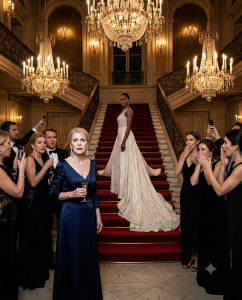
One by one, heads turned toward the grand staircase.
Daniela stood at the top.
For a suspended second, nobody seemed able to process what they were seeing. The gown occupied the landing like moonlight given structure. A long train spilled over the steps in waves of ivory and silver. Crystals flashed under the chandeliers with a brilliance so controlled it felt almost dangerous.
Daniela didn’t pose. She didn’t smile. She simply stood there with calm shoulders and steady eyes, as if she had never entered a room expecting permission.
Phones rose across the ballroom. Whispers multiplied.
“That dress—”
“It can’t be.”
“Is that archival couture?”
Valentina stared as though the floor had shifted beneath her. Claudia clutched her arm.
“Tell me that isn’t your maid.”
But Valentina had gone still for another reason. She had finally connected the surname.
Osei.
She had heard it before in interviews, society columns, fashion coverage, collector conversations. Adisa Osei. International icon. Untouchable. Brilliant. Mythic in certain circles.
Daniela descended slowly.
At the bottom of the staircase, the crowd parted on instinct. That was the moment Valentina’s humiliation became irreversible. Wealth recognizes power quickly when it sees it. And the room had already decided Daniela belonged at the center.
When she stopped in front of Valentina, the air around them tightened.
“Mrs. Sosa,” Daniela said gently, “thank you for the invitation. You told me to wear whatever I had. I hope I didn’t dress too simply.”
The line landed with surgical grace.
Several people gasped. A few tried to hide smiles. Claudia looked stricken. Marcela suddenly found the floor fascinating.
Valentina forced a brittle laugh. “Daniela, you look… different.”
Different was all she could manage.
Before Daniela could answer, a man’s voice rang out nearby.
“My God. That’s the Osei archival piece from Milan.”
Arturo Villareal, chairman of the charity board and a serious collector, approached with disbelief written openly across his face.
“I saw private review images of this gown,” he said. “It was never expected to leave the family archive.”
He looked at Daniela as though a painting had stepped out of a frame.
Daniela reached into her ivory clutch and withdrew a cream card edged in silver.
“It came with the dress,” she said.
Arturo took it from her. The moment he read the signature, his expression changed.
“This is from Adisa Osei,” he said.
The surrounding guests went still.
“It says the gown is being worn tonight by her daughter.”
The sentence spread through the ballroom like a shockwave. Faces changed. Postures changed. Calculations rewrote themselves in real time. Daniela had not borrowed status for a single evening. She had arrived carrying a life Valentina had failed to imagine.
Valentina’s mouth parted. “Daughter?”
For the first time all night, she looked truly afraid.
Arturo turned the card over, frowned at a handwritten line on the back, and glanced at Daniela. She gave a slight nod.
He cleared his throat.
“It also says,” he read aloud, “that Ms. Daniela Osei is attending tonight not only as family of the designer, but as the primary donor behind the educational grant being announced after the auction.”
Now the room exploded.
The San Jacinto board had spent weeks whispering about an anonymous benefactor who had pledged a massive contribution toward domestic workers’ education, legal aid, and scholarship access. No one had known the donor’s identity. Valentina had bragged at dinner two nights earlier that people of “real class” were the ones who shaped the future through philanthropy.
Now every eye in the room returned to Daniela.
Arturo, visibly stunned, continued reading.
“The fund was created in honor of women whose labor is seen every day and valued too rarely.”
No one even pretended not to understand the insult hidden inside that elegance.
Valentina’s face went white. “This is absurd.”
But it wasn’t absurd. It was documented. Board members were already murmuring. One woman near the stage confirmed she had seen the donor paperwork. Another man whispered that the legal name had been withheld pending the public announcement. Arturo himself looked ready to apologize on behalf of the entire city.
Valentina tried a different tone. Softer. Desperate. “Daniela, if there’s been some misunderstanding—”
Daniela finally interrupted her.
“There hasn’t.”
The single word was quiet, but it carried.
She did not raise her voice. She did not dramatize. That only made the truth harsher.
“I came to your house because I wanted one year without introductions,” Daniela said. “No headlines. No family name. No advantage. I wanted to know how people behave when they believe a woman has nothing to offer them except labor.”
Nobody moved.
“I learned a great deal.”
Claudia lowered her eyes. Marcela’s cheeks burned.
Valentina swallowed. “If you were testing people, that’s hardly fair.”
A flicker crossed Daniela’s face then—not anger, but recognition. As if Valentina had finally said something honest.
“Fair?” Daniela repeated softly. “You invited me here hoping three hundred wealthy strangers would laugh at me before I even sat down.”
A murmur rippled through the guests.
Valentina’s composure cracked. “I was trying to help you.”
“No,” Daniela said. “You were trying to place me where you believed I belonged.”
The orchestra had stopped completely now. At the far side of the room, waiters stood frozen with silver trays in hand.
Then, from the back of the ballroom, another voice entered the silence.
“Enough.”
Everyone turned.
A tall woman in a black structured gown had just stepped inside the ballroom, her presence commanding immediate recognition even among those who had only ever seen her in magazines. Adisa Osei moved with the unshakable stillness of a woman who had spent decades making rooms reorient around her.
Valentina visibly lost color.
Adisa crossed the floor and stopped beside her daughter.
For one brief second, the two women simply looked at each other. Then Adisa touched Daniela’s cheek with unmistakable tenderness before facing the room.
“My daughter asked for anonymity,” Adisa said. “I disagreed with her choice, but I respected it. Tonight I see she was wiser than I hoped.”
No one spoke.
Adisa turned her eyes on Valentina. It was not a dramatic glare. It was worse than that. It was a cool assessment, the kind reserved for something already judged.
“You mistook access for superiority,” she said. “You mistook service for smallness. And you mistook silence for powerlessness.”
Valentina opened her mouth, then closed it again.
The charity board president hurried forward, apologizing, stammering, trying to contain a scandal that was already too large to contain. Guests stepped away from Valentina almost imperceptibly, as wealthy people do when abandoning a sinking ship without wanting to appear cruel. In less than five minutes, the woman who had entered the ball at the center of the room was standing strangely alone.
Daniela did not smile.
That, more than anything, made the scene unforgettable. She did not gloat. She did not savor revenge. She simply watched truth do its work.
Before the formal announcement began, Arturo asked Daniela whether she still wished to proceed with the fund launch.
“Yes,” she said. “Especially now.”
When she took the stage, the entire ballroom rose to its feet.
Some applauded out of admiration. Some out of guilt. Some because crowds always know when history has just chosen a side.
Daniela spoke briefly. She dedicated the fund to women whose names are forgotten inside homes they keep standing. She spoke about labor without dignity, about how invisibility is often enforced by comfort, about how generosity without respect is only vanity in expensive clothing.
No one checked their phones.
When she finished, the applause was louder, deeper, and more genuine.
Valentina left before dessert.
The next morning, photographs of the ball spread everywhere. Not the staged donor shots. Not the celebrity arrivals. Daniela on the staircase became the image everyone shared. By noon, gossip columns had already identified the social humiliation no one could stop discussing. By evening, the Sosa foundation released a stiff, carefully worded statement about “private matters” and “misinterpreted intentions.”
It made things worse.
Within a week, two board appointments associated with Valentina quietly dissolved. Three invitations disappeared from her calendar. Claudia and Marcela stopped appearing in public beside her. Doña Esperanza resigned from the Sosa household and accepted a position managing operations for Daniela’s new scholarship initiative. She cried when she signed the contract.
Daniela never gave a revenge interview. She never mocked Valentina publicly. She simply moved on with the frightening elegance of someone who had never needed the last word to win.
Months later, when asked at a press event why she had worked as a domestic employee in the first place, Daniela answered, “Because people tell the truth fastest when they think you cannot afford to remember it.”
The quote circulated for days.
As for the dress, it returned to the archive after one final professional cleaning. Adisa insisted it be preserved exactly as it had been that night, with every crystal intact.
“History touched it,” she told the conservators.
People argued for a long time about what had happened at San Jacinto. Some said Valentina had been monstrous. Others said she had only revealed what many wealthy people quietly believed. A few insisted Daniela’s test had been unfair. But those arguments always thinned when confronted with the same simple fact:
Valentina had been prepared to enjoy a woman’s humiliation until she discovered the woman had status she recognized.
That was the red flag no diamonds could soften.
And maybe that was why the story stayed alive—because beneath the glamour, beneath the couture, beneath the savage satisfaction of seeing arrogance collapse in public, it forced a more difficult question into the light:
How many people are treated with dignity only after someone powerful confirms they deserve it?