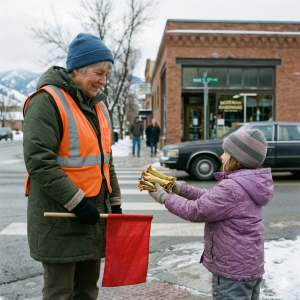
Every morning for three weeks, Dottie Marsh stood at the corner of Cottonwood and 5th with her orange flag and her sensible shoes, and every morning, the little girl in the purple coat was already waiting.
Most kids came in clusters. Laughing. Shoving. Arguing about nothing.
This one came alone.
She never said her name. Never said much of anything. She’d stand just close enough to Dottie to be in her shadow, watch the traffic light like it owed her something, then cross in careful, deliberate steps — like she was counting each one.
Her name was Gracie. Dottie learned that from the teacher drop-off sheet she had no business looking at.
Second grade.
Seven years old.
And something about the way she held her backpack straps — both hands, white-knuckled, like she was keeping herself tethered to the earth — made Dottie’s chest do a thing it hadn’t done since Harold passed.
So on a Tuesday in October, Dottie tucked a Nature Valley bar into the front pocket of that little backpack while Gracie was watching a pigeon.
Peanut butter. The crinkly gold wrapper. Nothing fancy.
Just something.
Gracie didn’t say thank you. Didn’t react at all, really. Just walked across the street with those careful steps and didn’t look back.
Dottie figured that was that.
But the next morning, she slipped another one in.
And the morning after that.
It became a quiet ritual between them. No words. Dottie would tuck the granola bar into the pocket, Gracie would watch the pigeons, and then she’d cross.
It felt like something. Dottie couldn’t have told you what.
Then, on a Thursday, Gracie’s backpack swung open when she turned to check for cars.
And Dottie saw them.
Three granola bars.
Gold wrappers. Still sealed. Arranged in a careful row at the bottom of the bag — not tossed in, not forgotten — but placed. Deliberately. Side by side, all facing the same direction.
Like something precious.
Like something being saved.
Dottie’s flag dropped an inch before she caught herself.
She didn’t say anything. Neither did Gracie. The light changed, and those careful little feet carried her across the street, and Dottie stood there in the cold Bozeman morning with her heart beating somewhere in her throat.
She told herself the girl just wasn’t hungry.
She told herself a lot of things that week.
But the next time she saw inside that backpack, there were four bars.
Same careful row.
Same deliberate arrangement.
Like an altar.
Like an offering.
Like a child who had learned — somewhere, somehow — that you don’t consume the things that matter.
You keep them.
You guard them.
You wait.
Dottie started paying closer attention. Gracie’s coat was clean but the same one every day. Her shoes were a size too small — Dottie could tell by the way she walked. She always arrived before the other kids, which meant she was walking from somewhere close, or leaving somewhere early, or both.
There was no parent. No carpool. No older sibling.
Just Gracie, and her backpack, and those three — then four, then five — untouched granola bars lined up like she was building something.
Dottie asked Mrs. Pellegrino, the front office secretary, if everything was okay with Gracie’s family.
Mrs. Pellegrino got quiet in a way that answered the question without answering it.
“We’re keeping an eye on things,” she said.
Dottie kept tucking in granola bars.
Gracie kept saving them.
Two weeks passed like that. The row grew. The weather got colder. And every morning, the little girl in the purple coat stood in Dottie’s shadow and watched the traffic light like it owed her something.
Then one Friday, a man appeared at the crosswalk.
He looked like he hadn’t slept in all of October. Hollow-eyed. Unshaven. Wearing a jacket too thin for the temperature, standing a little apart from the other parents like he wasn’t sure he had the right address.
He was holding a folded piece of paper in both hands.
Gracie saw him before Dottie did.
She didn’t run. She didn’t shout. She just stopped walking and stood very still, the way a child stands when she’s been hoping for something so hard and for so long that she’s afraid to believe it’s real.
The man looked at his daughter.
Then he looked at Dottie.
And something crossed his face — recognition, grief, gratitude, shame — all of it at once, all of it too big for one expression to hold.
He said, “Are you the woman from the crosswalk?”
Dottie said she was.
He unfolded the piece of paper with shaking hands.
It was a drawing. Crayon. A woman in an orange vest holding a flag. Stick arms, yellow hair, a smile that took up half her face.
At the bottom, in careful second-grade handwriting:
She gives me bars. She will come find us if I save them.
Dottie’s hand went to her mouth.
The man looked at her with those hollow, exhausted eyes and said:
“She told me if she saved enough of them, you’d come find us.”
And that’s when Dottie noticed the granola bars.
Gracie had taken them out of her backpack.
She was holding all seven of them, still wrapped, still in their careful row — extended toward Dottie in both small hands.
Like she was finally ready to be found.
Dottie Marsh had been a crossing guard for eleven years. She had helped children across that intersection in hail and in August heat and one memorable morning when a cow from the Hennessey property had somehow ended up in the turning lane. She had seen a lot. She thought she was past being undone.
She was wrong.
She crouched down — knees complaining the way they always did in the cold — until she was level with Gracie’s face. This close, she could see that the girl’s eyes were the particular gray-green of the Gallatin River in October. Serious eyes. Old eyes, the kind that have been doing a child’s job that they never should have been assigned.
Dottie didn’t take the granola bars.
Instead, she put her hands gently around Gracie’s hands. All of them together — the bars and the small cold fingers and Dottie’s own rough ones.
“I’m right here,” Dottie said. “You found me.”
Something in Gracie’s face cracked open then, not dramatically, not the way it happens in movies. It was smaller than that. The jaw unclenched. The shoulders fell half an inch. Her eyes got bright and then she blinked it back and she nodded, very seriously, like a person completing a transaction that has been pending for a long time.
The man’s name was Ryan. Ryan Cho. He’d been working a job site in Billings since September, sending money home, calling every night. Then the calls stopped connecting. Then Gracie’s mother — his ex-wife, Becca — stopped picking up entirely. He’d driven back to Bozeman on a Thursday night to find the apartment on Mendenhall unlocked, Becca gone, and Gracie asleep on the couch in her purple coat with a box of crackers and the television on.
He sat in the Denny’s on North 7th and told Dottie all of this over coffee, still wearing that too-thin jacket, while Gracie ate a short stack across the table and watched them both.
He hadn’t known about the crossing guard. Hadn’t known about the granola bars. When he sat down with Gracie that first morning and asked her what she needed, what she wanted, whether there was anyone she trusted — she had pulled the drawing out of her backpack and handed it to him without a word.
He’d driven to the school. He’d found Cottonwood and 5th.
He’d found Dottie.
“She didn’t talk much the first couple days,” he said, wrapping both hands around his mug. “Wouldn’t tell me she was scared. Wouldn’t cry. But she kept that drawing folded up. Kept it safe.”
He glanced at his daughter.
“She learned that from somewhere. Keeping things safe.”
Dottie looked at Gracie, who was currently constructing a small dam out of syrup with her fork, utterly focused.
“Smart kid,” Dottie said.
“Yeah.” His voice went rough. “Yeah, she really is.”
The situation with Becca turned out to be complicated in the way these things always are — not a clean story, not a villain, just a woman who had gotten lost in something bigger than herself and hadn’t found her way out yet. Ryan wasn’t angry, or if he was, he kept it somewhere private. What he was, mostly, was tired and present. He showed up at the crosswalk the following Monday, standing just behind Gracie, nodding at Dottie like they were old colleagues on the same shift.
He was there Tuesday too. And Wednesday.
By Thursday, Gracie had started talking.
Not a lot. Not in the way some kids talk, like they’re afraid of silence. In her own way, which was deliberate and considered and usually worth waiting for.
On Thursday she told Dottie that pigeons were actually very smart and that people underestimated them.
On Friday she said that peanut butter was her favorite but that she also liked the oat and honey kind if Dottie ever wanted to mix it up.
Dottie told her she would take that under advisement.
Gracie nodded like that was the appropriate response.
The granola bars — all seven of them — had ended up back in the backpack that day at Denny’s. Dottie had suggested it. She said Gracie had earned them, that they were hers, and that she could eat them whenever she was ready. Gracie had considered this for a moment, then zipped them carefully back into the front pocket.
It took her until the following Wednesday to eat the first one.
She ate it at the crosswalk, right there at the corner of Cottonwood and 5th, while the light was red. She didn’t make a production of it. Just unzipped the pocket, took it out, peeled back the wrapper, and ate it in four neat bites.
Then she looked up at Dottie with those river-gray eyes and said, “It’s good.”
“I know,” Dottie said.
“You could have one,” Gracie said. “I have more.”
Dottie Marsh, who had not cried at Harold’s funeral because she’d been too busy making sure everyone else was all right, who had not cried in eleven years at a crosswalk no matter what the weather did, felt her eyes go warm and stupid.
“Thank you,” she said. “I’d like that very much.”
The light changed.
They crossed together, Gracie in her careful counted steps and Dottie with her flag, and on the other side Gracie unzipped the pocket and handed over a peanut butter Nature Valley bar with the gravity of someone presenting a medal.
It was, Dottie thought, about the best thing she’d ever tasted.
Winter came to Bozeman the way it always does, without asking permission. The corner of Cottonwood and 5th got cold enough that Dottie switched to her heavy gloves and the kids started arriving in puffy coats that made them look like a flock of quilted birds.
Gracie got a new coat in November. Bright red this time, with toggle buttons. Ryan had taken her shopping on a Saturday and she’d picked it out herself.
She still wore the purple one sometimes, on days when the red one was in the wash.
Dottie loved her for that. For being seven years old and already understanding that you don’t have to erase the things that held you together just because something better came along.
They weren’t a sad story, Dottie thought, as she watched the girl cross that intersection day after day through the Bozeman winter. They never had been, not exactly.
They were a story about a child who needed to believe that someone would come, and so she built herself a signal and she tended it and she waited.
And the thing she had chosen as her signal — the thing she had decided was powerful enough, meaningful enough to summon help — was the kindness of a stranger who had never asked for anything in return.
Dottie’s flag caught the morning sun.
Gracie raised one hand in a wave from the other side of the street, the way she always did now.
Dottie waved back.