For three years, Valeria cleaned the floors of a mansion that should have belonged to her.
By the time she learned the truth, she had already bled for it in a hundred invisible ways.
She had scrubbed marble on her knees until her back spasmed at night. She had polished silver she would never touch at a dinner table. She had washed crystal glasses worth more than a month of her mother’s medicine. And every morning, before sunrise, she had stood outside the servants’ entrance with her lunch in a worn cloth bag and told herself the same thing:
Just survive today.
Everything in her life had narrowed into survival.
Her mother, Elena, had been ill for years. What began as weakness and exhaustion had become medications, specialist visits, unpaid tests, and long stretches of fear every time her breathing changed. They lived in a cramped apartment that trapped heat in summer and cold in winter. The ceiling leaked when it rained. The refrigerator rattled so loudly at night it sometimes woke them both. But it was all Valeria could afford.
She worked at Don Arturo’s mansion because it paid slightly better than the other houses. That was the cruel joke. The place that crushed her spirit most efficiently was also the place that kept her mother alive.
Don Arturo was one of those men whose name opened doors and silenced mouths. Old money. Powerful friends. Charitable galas. Newspaper photos with politicians and priests. The kind of reputation that looked polished from a distance and rotten up close.
Inside the mansion, he ruled by humiliation.
He rarely struck anyone. He did not need to. His cruelty was more refined than that. He liked to break people in front of witnesses. He liked to reduce them with a sentence, a look, a slow smile that said he knew exactly how trapped they were.
Valeria became one of his favorite targets.
Maybe because she never answered back. Maybe because he saw fear in her and mistook it for weakness. Maybe because some buried corner of him recognized her features and hated the existence of what they meant.
She never knew.
She only knew how he treated her.
“You missed a spot.”
“Are you blind?”
“Move faster.”
And when guests were close enough to hear, he became worse.
One morning, while she knelt in the main corridor wiping mud from the imported tiles, he stopped in front of her with two business associates beside him. He looked down at her as if she were an insect.
“You are a starving wretch,” he said. “You are only good for cleaning my trash and nothing else.”
The men laughed politely. Not because it was funny, but because rich men teach other rich men which laughter is expected.
Valeria lowered her head and kept scrubbing.
That afternoon, the head cook slipped half a loaf of bread into Valeria’s bag without speaking. That was how sympathy worked in the mansion. Quiet. Hidden. Never brave enough to become resistance.
At home that night, Elena noticed the redness in her daughter’s eyes.
“Bad day?” she asked softly from the bed.
Valeria smiled the smile she always used when she lied to protect her mother.
“Just tired.”
Elena studied her for a moment. She had once been beautiful in the effortless, warm way that makes strangers trust you. Illness had thinned her face, but not her gentleness.
“You don’t have to carry everything alone,” she said.
Valeria sat beside her and sorted the pills for the week. “I know.”
But she did carry it alone. Because there was no one else.
The gray Tuesday began like any other. Tea on the stove. Medicines counted. Elena still asleep when Valeria kissed her forehead and left before dawn.
At the mansion, tension drifted through the staff like smoke. Don Arturo had allegedly left that morning on a business trip. The housekeeper relayed his instructions with unusual stiffness.
“His study must be deep-cleaned today,” she told Valeria. “Personally. Top to bottom.”
Valeria looked up, startled. “His study?”
The older woman nodded but would not meet her eyes. “Those were his exact orders.”
That room was almost sacred in its restrictions. No servant entered alone unless specifically summoned. Dusting was done carefully and quickly. The desk remained untouched. The drawers remained closed. The shelves were not to be disturbed.
Valeria felt a flicker of unease.
Still, refusing was impossible.
The study sat at the far end of the second floor, behind a dark wooden door heavier than any other in the house. Inside, the room seemed to absorb sound. Thick curtains muted the daylight. Leather chairs sat like silent judges around a low table. The desk was enormous, carved and severe, facing the windows as if the man who sat behind it believed the world existed to be surveyed.
Valeria began with the obvious surfaces. She dusted the frames, polished the brass, straightened the books that had drifted out of line. She worked methodically, trying not to think about how vulnerable she felt there.
After nearly an hour, she dragged a wooden stool to the tallest bookshelf.
The upper shelf was thick with dust. That struck her immediately. Don Arturo noticed everything. Dust left untouched for years inside his most guarded room made no sense.
She climbed carefully, one hand steadying herself against the shelf, the other moving the cloth across the wood. Her fingers brushed the back panel.
Then something solid.
She frowned and leaned farther. Hidden deep behind a row of old ledgers was a wooden box, dark with age and so covered in dust it had nearly merged with the shelf itself.
Her pulse jumped. She should have left it there.
Instead, curiosity won by an inch.
She stretched a little farther.
The stool slipped.
The next seconds came in violent fragments. The scrape of wood. The lurch in her stomach. Her shoulder striking the shelf. The box tipping outward. Then impact—hard, blinding, explosive.
She hit the floor, and the box shattered beside her.
For one stunned second, the whole room rang.
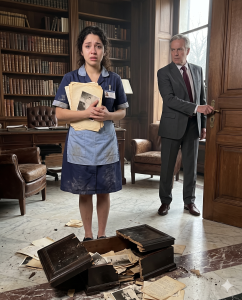
Then papers rained around her.
Photographs skidded across the carpet. Envelopes burst open. Official-looking documents fanned beneath the desk and under the armchair.
“No, no, no…”
She scrambled to her knees, ignoring the pain in her shoulder. Her first instinct was panic. If anyone heard that crash, if anyone saw what she had broken, her job was over.
She reached for the nearest photograph.
And forgot how to breathe.
It was an old image, faded and bent at the corners. A little girl stood beside a woman on a garden path. The woman wore a simple dress and held the child’s hand. The girl had wide dark eyes, a crooked ribbon in her hair, and a serious expression that looked uncannily familiar.
Because it was her.
Valeria stared as if the picture might rearrange itself into something sensible.
It didn’t.
Her hand shook as she grabbed another paper. A birth certificate. Original seal. Original signatures. Her name. Her mother’s name. Then another name connected to theirs in a way she had never known.
Arturo.
A roaring filled her ears.
She opened another document—a will, old and formal, bearing the family name and notarized with final authority. Her eyes moved over the legal language until a line stopped her cold. Then another. Then another.
The estate and all associated holdings were to pass through the direct bloodline of Don Ignacio’s daughter and, in her absence, to her surviving child.
Valeria read it again.
And again.
She looked at the signatures, the dates, the legal stamps. This was no fantasy. No misunderstanding. No loose family rumor.
It was proof.
The mansion.
The land.
The accounts.
The fortune.
All of it had belonged to her mother. And then to her.
Not Don Arturo.
Not the man who had called her garbage.
Her mouth went dry. “My God,” she whispered. “He’s not my boss. He’s my uncle.”
That sentence changed the shape of the room.
The desk was no longer his desk. The walls were no longer the backdrop of someone else’s life. The floor she had scrubbed until her knees burned had been stolen beneath her before she was old enough to understand the theft.
She clawed through the rest of the papers.
The truth grew uglier with each page.
Private correspondence. Legal arrangements. Medical notes. Vehicle reports. Insurance claims. Statements that had been corrected, replaced, buried. Her mother’s so-called accident twenty years earlier had occurred just months after the will was drawn. The brakes had failed on a winding road. Elena survived, but barely. She suffered injuries that never truly healed. During the chaos that followed, guardianship of the estate shifted. Control passed “temporarily” into Arturo’s hands.
Temporarily had become twenty years.
Other documents filled in the rest. Witnesses paid. Records altered. One man transferred money shortly after changing testimony. A doctor signed a revised timeline. A lawyer resigned unexpectedly within the year.
It wasn’t just theft.
It was an organized burial of truth.
Valeria sat back on her heels, the papers trembling in her grip.
Memories moved through her in a rush. Her mother avoiding certain questions. The sadness in her eyes whenever Valeria mentioned wealthy families. The one old photograph Elena kept hidden in a drawer and never explained. The way she sometimes stared into space and said, “Some people can steal more than money.”
Valeria had thought illness made people speak in riddles.
Now she knew better.
A heat rose inside her, so fierce it made her dizzy. She imagined her mother young and injured, her life collapsing while someone she trusted stripped away her name, her security, her future. She imagined Arturo taking possession of the mansion, the accounts, the legacy, and later hiring the little girl he had robbed once that girl became desperate enough to work for him.
He had not simply stolen from them.
He had made them live inside his victory.
Valeria snatched up the will, the birth certificate, the most damning pages, and pressed them against her chest. She had to leave. Right now. She would go straight to the police. Or a lawyer. Or the press. Anyone. She only needed to get outside with the evidence before he realized what was missing.
She stood and turned for the door.
The metallic click stopped her cold.
It came from the lock.
From inside the room.
Slowly, she looked up.
Don Arturo stood in the doorway, one hand resting on the key he had just turned.
He was not supposed to be there.
His trip had been a lie.
For a second, neither of them spoke. He looked at the broken box on the floor, the scattered papers, the documents clutched to her chest. His expression did not flare with surprise. That was what terrified her most.
He had expected this possibility.
Maybe not the exact accident. But enough to lay a trap.
“You were told to dust,” he said at last.
Valeria took one step backward.
He closed the door with unbearable calm and slipped the key into his pocket.
Then he smiled.
Without the polished social mask, the smile became something skeletal and cruel.
“You wretch,” he said quietly. “You are not leaving here alive.”
Fear shot through her so fast her knees nearly buckled. She looked to the window. Too high. The desk. Too far. The door. Blocked by him. He moved toward her with the confidence of a man who had never had to imagine losing.
But panic sharpened her vision.
On the edge of his desk sat a small digital recorder. A red light blinked steadily.
Recording.
Why? To capture confessions? Blackmail? Meetings? Maybe he had been documenting others for years. Maybe he kept evidence because powerful men never truly trust their accomplices.
Whatever the reason, it was on.
Don Arturo came closer. “Give me the papers.”
Valeria’s mind raced. She could not overpower him. She could not outrun him to the door. She needed witnesses. Noise. Chaos.
Her elbow struck a bronze statue on the side table. It tipped and crashed to the floor with a boom that shook the room.
Don Arturo flinched, only slightly.
But slightly was enough.
Valeria screamed.
Not a frightened cry. A raw, tearing scream that ripped through the study and down the halls.
Then she grabbed the nearest lamp and hurled it with both hands into the window.
Glass exploded.
The alarm went off instantly, shrill and piercing through the mansion.
Don Arturo cursed and lunged for her. Valeria snatched the recorder from the desk in one motion and shoved it into her apron pocket. With the other hand, she jammed the folded documents beneath her uniform against her stomach.
He caught her wrist.
Pain shot up her arm.
But now there were footsteps outside. Voices. Staff shouting. Security running from downstairs.
Valeria looked straight into his face, every year of humiliation burning into one final refusal, and shouted so loudly the words seemed to crack the air.
“You stole my mother’s life, and this mansion is mine!”
The pounding on the door began at once.
Don Arturo’s grip tightened. For the first time, something like real fear flashed across his face—not fear of scandal, but fear of exposure. The kind of fear that comes when one buried crime threatens to pull up everything buried beside it.
The lock rattled from outside. Someone had found another key.
In a desperate move, Arturo released her wrist and went for the desk drawers. He yanked one open and reached for a folder hidden inside.
Valeria saw the label for only an instant.
Medical Transfer — Elena Ramos.
More records.
Worse records.
She understood immediately: the papers she held were only part of the truth.
The door burst open.
The housekeeper, two security men, the cook, and the driver crowded the entrance, stunned by the shattered glass, the alarm, the wrecked box, and Valeria standing there white-faced with tears on her cheeks while Don Arturo clutched a file like a man trying to save his own skin.
For one second, silence swallowed the room.
Then Valeria did the simplest, most devastating thing possible.
She pulled the recorder from her pocket, held it high, and said, “Call the police.”
Everything after that moved quickly and slowly at once.
The security men hesitated. Not because they doubted her, but because calling the police on Don Arturo was the kind of action that divided life into before and after. The housekeeper made the choice for them. She stepped inside, looked at Arturo with a hatred she had clearly hidden for years, and said, “Do it.”
The driver made the call.
Arturo tried to speak over everyone. He called Valeria unstable. A thief. A liar. But his voice had lost its certainty. The room no longer belonged to him. Not in the same way.
When the police arrived, Valeria handed over the will, the birth certificate, the letters, the financial records, and the recorder. On it were not only the final moments from the study, including Arturo’s threat, but fragments of earlier conversations—names, payments, instructions, details that would mean little alone and everything together.
The hidden folder from the desk proved even more damning. It contained medical transfers, forged authorizations, and evidence that Elena had been moved between facilities after her accident without proper consent, isolating her from people who might have protected her legal rights while Arturo took control of the estate.
By dawn, the mansion was full of investigators.
By noon, the story had reached local news.
Within two days, it was national.
People were transfixed by the cruelty of it: the heiress forced to clean her own stolen house. The sick mother silenced by a carefully staged “accident.” The respected millionaire whose empire had been built on fraud, coercion, and a family betrayal so deep it stunned even seasoned investigators.
Arturo was arrested pending formal charges. Lawsuits began immediately. Old associates distanced themselves with embarrassing speed. The lawyers who had once protected him suddenly discovered fading memories and urgent travel plans.
Valeria spent that first night at the hospital beside her mother.
She did not know how to begin. She held Elena’s hand and told her she had found documents. Proof. The will. The truth.
At first Elena said nothing. Then tears slipped silently into her hair.
“I always suspected,” she whispered. “Not all of it. But enough to be afraid.”
“Why didn’t you tell me?”
“Because I had no proof. Because men like him destroy people who speak too early. Because I thought keeping you alive mattered more than telling you everything.” She turned her head weakly toward Valeria. “And because every time I looked at you, I saw the price of surviving.”
Valeria bent over her, crying in a way she had not allowed herself to cry in years.
The legal process took months. Arturo’s defense team fought viciously. They attacked signatures, timelines, chain of custody, witness reliability. But truth, once widened by investigation, kept producing more truth. Former employees came forward. A retired clerk admitted to altering filings under pressure. One of the old witnesses recanted and confessed he had been paid. Financial trails surfaced. Recordings were authenticated.
At the end of it, the court recognized what the papers had said all along.
The estate had been stolen.
Control reverted to Elena and Valeria.
Elena, too fragile to manage any of it, insisted everything be placed in Valeria’s hands with legal protections to secure her care permanently. The mansion, the business holdings that remained, the accounts not already frozen or stripped by litigation—all of it became part of a life Valeria had never imagined, not because she dreamed of wealth, but because she had trained herself not to dream at all.
The first thing she did was move her mother into a bright, quiet home filled with windows and nurses who treated her gently.
The second thing she did was return to the mansion.
Not to live there immediately. To walk through it.
Alone.
She entered through the front door this time.
No uniform. No bucket. No bowed head.
She moved from room to room slowly, touching banisters, frames, walls. She stood in the study the longest. The broken window had been repaired. The shattered box had been cataloged as evidence and removed. The room looked almost unchanged, which made what had happened there feel even stranger.
Power leaves stains that architecture cannot show.
She stood behind the desk and looked out at the grounds.
Then she called the staff together.
Some expected revenge. Dismissals. A purge.
Instead, Valeria thanked the ones who had shown small mercies when they could. She raised wages. Restructured contracts. Ended the quiet humiliations that had passed for tradition. Those who had been complicit in Arturo’s schemes were removed. Those who had simply survived him were given a choice to stay under new terms.
The housekeeper cried openly.
Months later, when the news cycle had moved on and Arturo had become another fallen titan discussed over coffee and headlines, Valeria sat with her mother in the garden one mild afternoon. Elena was stronger by then, though never fully restored. The damage done twenty years earlier could not be erased by money or verdicts.
Nothing could give them those years back.
That was the part no one on television understood. People loved stories where truth wins and justice arrives like a trumpet blast. But real justice is uneven. It returns property, not childhood. It punishes thieves, not lost time. It brings relief, not innocence.
Still, relief mattered.
Elena reached for Valeria’s hand. “What will you do now?”
Valeria looked out over the garden that had once appeared in the old photograph of them together. “Live,” she said after a moment. “I think I’d like to learn how.”
Her mother smiled.
And that, in the end, was the part Don Arturo could never steal.
Not the mansion. Not the fortune. Not even the years. Because however much he had taken, he had failed to kill the one thing he most needed destroyed: the truth.
Yet even after everything was settled, one question lingered in quiet moments.
What kind of man hires the niece he robbed, forces her to kneel in her own house, and believes he can keep the world buried forever?
Maybe the bigger question was this: who was worse—the monster who did it, or the people who saw pieces of it for years and chose comfort over courage until a desperate woman had to save herself?
That was the aftershock no verdict could settle.