Don Severo Elisalde was not expected back at Las Golondrinas until the following week.
The trip to San Luis Potosí had been planned carefully, as all his trips were. He traveled for business, for land agreements, for livestock sales, for the kinds of negotiations that kept large estates standing and men employed. He rarely returned early. He was predictable in that way, not because he lacked imagination but because his life had been shaped by responsibility. Fields did not care for drama. Cattle did not respond to sentiment. Roads, prices, weather, labor—all of it required order.
But a storm tore through the region before sunset on the second day of travel, and by dawn the roads ahead had become nearly impassable. One bridge had partially collapsed. Wagons were stuck in mud up to their axles. A driver on the route warned Severo that if he kept pushing forward, he might lose both the shipment and the horses.
So he turned back.
He did not send word ahead.
He had a habit of arriving unannounced from time to time, and though he never admitted it openly, he did so because he preferred truth in its natural form. People behaved differently when they had time to prepare. Servants stood straighter, smiles appeared too quickly, accounts grew cleaner, and tension disappeared as if swept away with the dust. Severo had learned years ago that a house revealed itself best when no one was warned.
By the time he reached Las Golondrinas, he was caked in dried mud, tired enough to feel it in his teeth, and in no mood for ceremony. The sky still hung low and dark, heavy with the last of the rain. He entered through the stable side, where the smell of wet hay and horse sweat met him before any servant could.
A young stable boy saw him first and nearly dropped the bucket in his hands.
“Don Severo—”
Severo raised one finger to his lips. The boy nodded and stepped aside.
That was when Severo heard voices from the main salon.
He recognized his mother’s immediately. Saturnina Orduña had one of those voices that never needed shouting. Authority settled naturally inside it. It could freeze a servant at ten paces and slice through a conversation without rising above decorum. As a child, Severo had feared that voice. As a man, he had simply learned to live around it.
But the words he heard stopped him cold.
“If that child is born in this house, he will not carry the Elisalde name.”
Severo moved soundlessly to the half-open door.
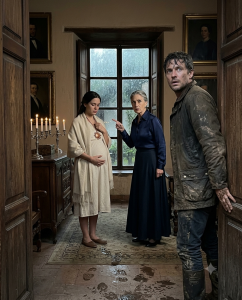
Inside the salon stood his wife, Crisanta, one hand protectively curved over her pregnant belly, the other gripping the copper medallion she wore every day. Across from her stood Saturnina, elegant even in anger, her dark dress severe, her posture rigid, her face sharpened by disdain.
“I will not allow some bean seller to stain what my husband built with twenty years of sacrifice,” Saturnina said.
Crisanta did not step back.
“That child is Severo’s son.”
Her voice was calm, almost calm enough to sound detached, but Severo knew her well enough to hear the strain buried under it.
“That child,” Saturnina replied, “belongs to a girl who arrived with no family, no land, and no history. In this house, giving birth is not enough. A surname has to be deserved.”
Severo felt heat climb his spine.
In that instant, a string of overlooked moments snapped tight in his mind.
The missing wedding portrait.
The odd silences when he mentioned his wife at the dinner table.
The way some of the household staff lowered their eyes around Crisanta.
The fact that when he returned from travel, she sometimes seemed relieved in ways that had nothing to do with affection and everything to do with survival.
He had mistaken all of it for adjustment.
He had told himself that two strong women under one roof would naturally clash. He had said, more than once, that his mother needed time. That old families held old habits. That marriage itself would settle things.
Standing there, hearing Saturnina threaten his pregnant wife, he understood the cruelty of every excuse he had made.
“Leave before winter,” Saturnina said softly. “Leave before that creature is born. If you stay, I will not be responsible for what happens.”
Severo pushed the door open.
The sound cracked through the room like judgment.
Both women turned. Crisanta’s face changed, though only slightly. Relief flickered there and vanished beneath control. Saturnina’s expression emptied for a fraction of a second, and that alone was shocking. She was a woman who always had a response. Always had a weapon ready.
“How long has this been going on?” Severo asked.
No one answered.
He looked from his mother to his wife and suddenly hated the question, because the truth was already written everywhere—in the way Crisanta held herself, in the caution in her breathing, in the stubborn dryness of her eyes.
Long enough.
Long enough for tears to have been replaced by endurance.
Long enough for humiliation to become routine.
He took one step toward Crisanta. “Why didn’t you tell me?”
She gave him a look so raw it almost drove the breath from him.
Because you did not see, that look said.
Because I did not want to become the reason you chose between your mother and your home, another part of it seemed to say.
Because some women know that telling the truth only matters if the person hearing it is ready to believe it.
A late shaft of sunlight slipped between the storm clouds and struck the medallion at her throat.
Copper flashed red-gold.
Saturnina stared at it, and the color drained from her face.
“Where did you get that?” she asked.
Crisanta touched it reflexively. “It was my mother’s.”
Saturnina’s eyes narrowed. “Your mother’s name.”
The demand was too immediate, too sharp.
Crisanta hesitated. “Remedios Ureña.”
The name changed everything.
Severo had spent his life watching his mother handle bad news, scandal, debt, death, insult, and gossip with almost chilling control. But at the sound of that name, Saturnina looked afraid.
Not offended.
Afraid.
“Mother,” Severo said, quiet now, “what do you know about Remedios Ureña?”
She did not answer. She turned and left the room with rigid dignity, but her steps were too quick. Severo watched her go and understood, with a clarity that made his stomach tighten, that the cruelty toward Crisanta was not born from simple class contempt.
It was personal.
He turned back to his wife.
Rain tapped softly at the windows. The room smelled of wax, damp earth, and roses beginning to wilt in a vase by the mantel. Crisanta looked exhausted. There was a faint mark at her wrist, as if someone had grabbed her too hard.
Severo noticed it and went still.
“Did she touch you?”
Crisanta lowered her hand over the mark. “It’s nothing.”
His voice hardened. “Did she touch you?”
“She grabbed me when I tried to leave.”
The admission was simple, but it lit something dangerous in him. He had seen men lose themselves in anger before. Had judged them for it. Had prided himself on being made of steadier material.
In that moment he understood how thin steadiness could become.
Instead of storming after his mother, he forced himself to remain where he was. “Sit down,” he told Crisanta.
“I’m fine.”
“That was not a request.”
She sat.
He knelt in front of her despite the mud on his clothes and the ache in his back. Up close, he saw what the house had been doing to her. Not bruises, not obvious damage. Something worse. The drawn exhaustion of someone made to justify her existence daily. The caution of someone never allowed to forget she was unwelcome.
“I should have seen it,” he said.
Crisanta looked away.
“I should have asked. I should have listened to the things you didn’t know how to say.”
After a moment she answered quietly, “I tried to believe it would get better. And every time you came home, it did. For a day. Sometimes two.”
Shame settled heavily in him.
“Tell me about Remedios Ureña.”
Crisanta’s fingers tightened around the medallion. “My mother worked here once. She never told me much. Only that she had left this place with nothing but me and this medallion. When I was little, if I asked about my father, she would go silent. If I asked about Las Golondrinas, she would tell me to forget the name.”
Severo sat back on his heels.
“She knew this house?”
“She feared it.”
Before he could ask more, a shadow appeared in the doorway.
Hermenegilda, the oldest servant in the house, stood there breathing hard, one hand pressed to her chest. She had served the family longer than Severo had been alive. She had bathed him as an infant, covered for his mistakes as a boy, and once bandaged his arm after a fall from a colt without telling Saturnina how reckless he had been.
“What is it?” Severo asked.
The old woman looked at Crisanta, then at the medallion, and whatever she saw there seemed to make up her mind.
“You need to go to your father’s study,” she whispered. “Before Doña Saturnina gets there first.”
Severo rose. “Why?”
Hermenegilda swallowed. “Because the last time I heard the name Remedios Ureña in this house, your father locked a bundle of letters in the black cabinet and said if the truth ever came out, your mother would lose more than her standing.”
A strange stillness followed.
Severo turned to Crisanta. “Can you walk?”
She nodded.
“No,” Hermenegilda said quickly. “She shouldn’t go there. Not yet.”
“Why not?”
The old woman hesitated. “Because what’s in that room may wound her before it helps her.”
Crisanta stood anyway. “I’ve been wounded enough by half-truths.”
Something in her tone silenced them both.
The three of them crossed the corridor together. The house felt different now, stripped of appearances. Every framed portrait, every polished side table, every embroidered curtain seemed part of a performance whose script Severo had finally stopped believing.
His father’s study was at the end of the west hall. Saturnina was already there, standing before the black cabinet with a key in her hand.
“Step away from it,” Severo said.
She turned slowly. Her fear had reshaped itself into fury.
“You have no idea what you are doing.”
“Then explain it.”
“This is not your wife’s concern.”
“It became her concern the moment you threatened her child.”
Saturnina’s gaze flicked to Crisanta, and the contempt returned, though thinner now, less certain. “Some truths are filth. Digging them up only stains everyone.”
“Open it,” Severo said.
“No.”
He crossed the room in three strides and took the key from her hand.
She slapped him.
The sound echoed.
No one moved.
Severo looked at her—not as a son now, but as a man seeing another adult stripped of title, ritual, and inherited power. “You have exactly one chance to speak before I learn this without you.”
Something flickered in Saturnina’s face then. Pride battled panic. Panic lost.
“Your father was weak,” she said. “That is what you need to know.”
He opened the cabinet.
Inside, beneath account books and wrapped documents, lay a tied bundle of letters, a folded baptismal record, and a faded photograph.
Crisanta saw the photograph first.
It showed a younger Saturnina standing stiffly beside Severo’s father on the hacienda steps. Off to one side, half in frame, was another woman—beautiful, dark-haired, wearing the same copper medallion now hanging from Crisanta’s neck.
Remedios.
Crisanta’s breath caught.
Severo picked up the baptismal record. The paper crackled in his hands. He scanned the names once, then again, because the first reading made no sense.
Child: female.
Mother: Remedios Ureña.
Father: Ignacio Elisalde.
Ignacio.
His father.
The room seemed to tilt.
Crisanta stared at him, then at the paper. “What is it?”
He couldn’t answer at first.
Hermenegilda took the document from his shaking hand and closed her eyes as if bracing against an old pain. “I always prayed this day would never come like this.”
Crisanta stepped forward. “Tell me.”
Severo forced the words out.
“According to this… Remedios had a daughter with my father.”
Silence.
Then Saturnina laughed once, a brittle, hateful sound. “There. Now it’s said.”
Crisanta didn’t seem to understand. Not immediately. Her mind moved over the fact carefully, rejecting it, returning to it, trying to place herself inside the geometry of it.
“My mother…” she whispered. “No.”
Severo opened one of the letters. It was in his father’s hand. He knew the script instantly.
Saturnina found out. She says the child will never be acknowledged. I have failed you both. I can send money, but I cannot undo what has already been done.
Another letter.
I begged her not to turn you out. She said one bastard under this sky is already too many.
Another.
Keep the medallion. One day it may be the only proof that your daughter belonged to me, even if I lacked the courage to claim her.
Crisanta’s face went white.
She swayed, and Severo caught her before she fell.
The truth landed in pieces, each one more devastating than the last. His father had had an affair with Remedios Ureña. Saturnina had discovered it. Remedios had been driven from Las Golondrinas. The daughter from that affair—
Crisanta.
His wife.
No.
The thought came like a blade and then stopped short, because the dates did not fit. Severo lunged for the next document, his heartbeat pounding in his ears. Another certificate. Another date. Another child.
Not Crisanta.
A stillborn daughter.
He exhaled so hard it hurt.
“What is it?” Crisanta asked weakly.
Hermenegilda answered this time. “Your mother’s first child with Don Ignacio died at birth.”
Crisanta stared at her. “Then why—”
The old woman looked at the medallion. “Because after that, Remedios later had you. Everyone assumed you were also his. Saturnina believed it. Remedios let her believe it, perhaps because hatred was easier than begging. Perhaps because the truth would not have saved her.”
Severo turned to the final letter, the one hidden deepest in the bundle.
It was from Remedios.
You can bury me in gossip if you wish, Doña Saturnina, but the child I carry now is not your husband’s. He was kind to me once and cruel to me later because he was afraid of you. That is his shame. But this child is mine alone to protect. I would rather starve than let her be raised under your roof.
Crisanta covered her mouth.
Saturnina looked suddenly older. Not softer. Never that. But diminished, as though the force she had used to preserve one lie for decades had finally begun to drain out of her.
“You knew?” Severo asked her.
“She wrote the letter after she left,” Saturnina said. “I didn’t believe her.”
“You spent years punishing a woman and then her daughter because you didn’t believe her?”
Saturnina’s chin lifted. “Your father betrayed me. She was part of the ruin.”
“No,” Hermenegilda said quietly, with more courage than Severo had ever heard from her. “Your pride was.”
Saturnina turned sharply. “Mind your place.”
“My place?” the old woman replied. “I stood in this house while you starved a frightened girl of dignity because she reminded you that you could not control everything. I watched you force the mistress of this home to eat in the kitchen. I watched you erase her portrait. I watched you try to deny an innocent child his father’s name. My place was silence for too many years.”
The words struck harder than shouting.
Crisanta had begun to cry at last, but quietly, almost angrily, as if she resented giving anyone the sight of it. Severo drew her close.
“I am sorry,” he said into her hair. “For all of it. For bringing you here without knowing what waited. For every day I left you alone with this.”
She clutched the front of his muddy coat. “I thought she hated me because I was poor.”
“She hated what she feared,” he said.
Saturnina looked at them both and saw, perhaps for the first time, that whatever authority she once possessed over the moral order of this house had cracked beyond repair.
“What do you intend to do?” she asked.
Severo turned to her slowly.
For a moment he saw not only his mother, but the woman she had chosen to become: one who valued bloodlines over decency, appearances over truth, revenge over innocence. He had spent his life excusing her severity as strength. Now he understood how often cruelty masqueraded as principle.
“You will leave the main house by sunset tomorrow,” he said. “The smaller residence near the east orchards will be prepared for you. You will be provided for materially, as is proper. But you will not decide who belongs under my roof. Not ever again.”
Saturnina stared at him in disbelief. “You would exile your own mother for her?”
“For what you did,” he said. “And for what you would have done if I had arrived one hour later.”
For the first time, Saturnina had no answer that could save her.
She left without another word.
No one tried to stop her.
That night, Severo ordered the wedding portrait returned to the hall. He had the dining room set for three and personally brought Crisanta to the table. He dismissed every servant who had obeyed Saturnina’s cruelty too eagerly and kept those who had remained kind in whatever small ways they could. He sat with Hermenegilda until past midnight and listened to everything she had been too afraid to say before.
Some truths were uglier in their details than in their outline.
Saturnina had forbidden Crisanta from using the family chapel alone.
She had called her child “that thing” more than once.
She had spread quiet suggestions among neighboring women that the pregnancy had been rushed to cover shame.
Each revelation felt like another debt falling into Severo’s hands—one he could never fully repay, only answer for.
The next morning, he found Crisanta in the courtyard under the jacaranda tree, one hand on her belly, the copper medallion glowing softly in the dawn light.
“Are you angry?” she asked without looking at him.
“At you?” He moved beside her. “Never.”
“At what my mother’s life touched. At what it brought into yours.”
He considered the question carefully. “I’m angry at the years stolen from both of you. At cowardice. At silence. At the way powerful people can turn their shame into punishment for someone weaker. But not at you.”
She looked up. “And if I had been his daughter?”
He did not answer immediately.
“Then none of this would have been your fault either.”
Her eyes filled again, but this time the tears seemed to release something rather than merely wound. She leaned into him, and he rested his hand over hers on the child she carried.
Their son was born in late autumn.
Severo named him Ignacio, not to honor the grandfather who had failed so badly, but to reclaim the name from secrecy and cowardice. Crisanta objected at first, then understood. The child would not inherit silence. He would not inherit hidden shame dressed as family dignity. He would know his history plainly, and he would be taught that a name meant nothing if it was not carried with decency.
Saturnina saw the child only once that first year.
She came to the orchard house dressed in mourning colors despite no recent death, as though grief itself could still be used as a form of control. She asked to hold him. Crisanta looked to Severo, and Severo let the decision rest where it belonged.
Crisanta said no.
Saturnina’s face hardened. “You would deny a grandmother—”
“A grandmother protects,” Crisanta replied. “You threatened.”
The older woman stood there for a long moment, then nodded once. It was not humility. Not apology. But it was the first boundary she had ever been forced to accept without winning.
As she turned away, her gaze fell one last time on the copper medallion at Crisanta’s throat.
“You still wear it,” she said.
“Yes,” Crisanta answered.
Saturnina gave a faint, unreadable smile. “Then perhaps Remedios won more than I ever understood.”
After she left, Crisanta stood in silence for a long while.
“What are you thinking?” Severo asked.
She watched the road beyond the orchard. “That some people destroy half their lives trying not to be humiliated… and end up revealing themselves instead.”
Years later, people in town still told the story wrong. Some said the young wife had exposed an old affair. Some said the mother was mad with jealousy. Some insisted wealth had merely done what wealth always did when threatened—it struck downward.
But inside Las Golondrinas, the truth settled differently.
A man had come home early and discovered that evil does not always shout.
Sometimes it arranges silverware.
Sometimes it speaks in measured tones.
Sometimes it calls cruelty tradition and asks everyone else to mistake endurance for peace.
Severo never again left his house blind to what silence could hide. Crisanta never again lowered her eyes at her own table. And the child Saturnina had once tried to deny grew up running through the courtyards of Las Golondrinas with the full weight of his name behind him—not because it made him better than anyone else, but because his parents finally understood that a name is worth defending only when it no longer serves as a weapon.
Still, there was one question that lingered long after the storm, the letters, and the exile had passed.
What was the greater betrayal—Ignacio’s weakness, Saturnina’s cruelty, or every silent witness who let a young woman suffer because challenging power felt too dangerous?
No one in that family answered it the same way.
And perhaps that was the final wound that never healed completely.