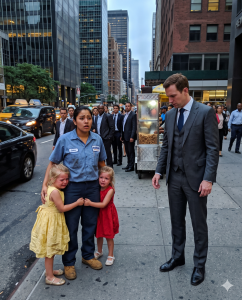
The cleaning lady found twin girls crying alone in the middle of Wall Street, and when she tried to return them to their father, they wrapped themselves around her legs and screamed the one word he had forbidden for five years.
“Mommy!”
For a split second, Manhattan seemed to lose its voice.
Valerie would remember that moment later in sharp, impossible fragments: the heat wavering above the pavement, the smell of roasted peanuts and taxi exhaust, the stunned look on a stranger’s face, the violent way Franklin Buchanan went pale, as though two tiny voices had just ripped open a grave he had spent years sealing shut.
But before that moment, before the mansion and the offer and the woman in silk heels, there was only another exhausting day and a bus she nearly made.
Valerie Santos left the glass tower on Broad Street with a pain running from her lower back to the soles of her feet. She had spent the day emptying bins overflowing with takeout boxes, scrubbing bathrooms no executive would ever imagine cleaning himself, polishing conference room tables until they reflected ceiling lights like still water. By the end of the shift, the sharp smell of chemicals clung to her hands no matter how much she rinsed them.
At twenty-eight, she had mastered the art of being invisible.
In Midtown and Lower Manhattan, invisibility was useful. Wealthy people didn’t want to think about the women who wiped fingerprints off their marble counters or scrubbed coffee stains from the carpets under their imported shoes. They preferred everything spotless and effortless. Valerie had learned to move quietly, keep her head down, and save her energy for the life that actually mattered—her mother Alice waiting at home, rent due in four days, and a pharmacy bill folded in her pocket like a threat.
That evening the heat felt wrong, too thick for late spring, pressing down on the city until even the air seemed tired. Valerie adjusted the strap of her bag and headed toward the bus stop, counting the dollars she had left in her head.
Then she heard crying.
At first she thought it was far away. The city was full of noise. Sirens bled into horns, snippets of conversation collided with construction drills, heels struck pavement in a thousand impatient rhythms. But this sound pushed through all of it. Thin, frightened, persistent.
She turned.
Two little girls stood near the curb, hand in hand, crying so hard they could barely breathe. They were identical down to the shape of their pale eyebrows and the delicate tilt of their chins. One wore yellow, the other red. White bows sat in their blonde hair. Their shoes were polished, their dresses expensive, and their faces were drenched in tears.
Everything about them screamed protected, precious, watched over.
Except they weren’t.
They were alone.
Valerie didn’t think. She moved.
A delivery bike flew past and missed her by inches as she crossed the street. She reached the girls just as the one in yellow took a dangerous half-step toward the curb, peering into a crowd as if expecting someone to emerge instantly and fix everything.
Valerie crouched in front of them.
“Hey, little ones. Slow down. Breathe. Where’s your grown-up?”
The girl in yellow gulped air. “We lost Daddy.”
The other one was trying hard not to cry any harder than she already was. “He said stay there,” she whispered, pointing vaguely behind her. “But there was a pigeon.”
Valerie almost laughed despite the worry. “A very suspicious pigeon, I’m guessing.”
The girl in red blinked at her.
Vanessa, Valerie would learn a minute later, was the softer of the two. Ashley, red dress, had the brave face and trembling chin of a child trying to hold the whole world together with sheer willpower.
“We’re not supposed to talk to strangers,” Ashley informed her.
“That’s a good rule,” Valerie said. “So we won’t do anything secret. We stay right here where everyone can see us, and we find your dad.”
That seemed to matter. Ashley relaxed enough to let Valerie guide them toward the wide marble steps outside a bank. Their fingers never untangled from each other. Valerie bought them peanuts from an old street vendor with the money she had planned to use for dinner. Ashley looked suspiciously at the paper bag.
“My daddy says street food has germs.”
Valerie smiled. “Then tonight we survive germs together.”
Vanessa giggled through tears, and in another minute she leaned against Valerie’s shoulder with complete trust.
That small weight nearly broke Valerie’s heart.
There had been a time in her life when she thought she might have children. A different future. A husband. A tiny apartment crowded with noise and cheap toys and laundry and love. But dreams had a way of changing shape when bills arrived faster than miracles. Her father had disappeared when she was twelve. Her mother had worked double shifts until diabetes and bad knees made standing painful. Valerie had become the practical one. The reliable one. The one who gave up things before they could disappoint her.
Yet here was this child, warm and sleepy against her, as if Valerie’s shoulder had always been where she was meant to rest.
Then a man shouted their names.
The panic in his voice was so raw that people turned.
He came running through traffic, ignoring horns, jacket open, tie half-pulled loose, the kind of man who looked as though he never ran for anything. Franklin Buchanan was known in business magazines, in financial columns, on charity boards. Valerie had seen his photo once in the glossy section someone left behind in a lobby—young widower billionaire, brilliant investor, devoted father, private to the point of obsession.
In person, he did not look brilliant or powerful.
He looked terrified.
That terror lasted only until he saw his daughters with Valerie.
Then it hardened.
He reached them, grabbed Ashley’s arm, and snapped, “Get away from my daughters.”
Valerie rose immediately, every nerve alive.
“Lower your voice. You’re frightening them.”
He didn’t even glance at her. “I said step away.”
Ashley cried out. “Daddy, you’re hurting me!”
The sound changed him at once. He looked down, saw the red mark his fingers had left on his daughter’s skin, and recoiled. His face crumpled under the weight of what fear had made him do.
“Sweetheart… no, I’m sorry…”
“You weren’t there,” Ashley sobbed. “We looked and looked and you weren’t there.”
He sank to his knees right there on the sidewalk.
Valerie had never seen a rich man fall apart in public. It was strangely humanizing. The expensive suit didn’t protect him from guilt any more than her faded uniform protected her from exhaustion.
“I was scared,” he told them. “I should never have shouted. I’m sorry.”
The girls stared at him, still trembling. Their trust was hurt, not broken. Valerie could see that. He loved them. He simply loved them badly under pressure.
When the worst of the tears had passed, Franklin stood and tried to gather whatever dignity remained.
“Thank you,” he told Valerie. “I’ll take them now.”
She bent to reassure the girls. “Go on. Your daddy’s here.”
Vanessa clung harder. “You come too.”
Valerie shook her head gently. “I can’t.”
And then the world stopped.
Both girls wrapped themselves around her legs and cried out together, “Mommy! Don’t leave us!”
Shock rippled through the street. Valerie could barely breathe. Franklin looked as if someone had punched the air from his chest.
Later she would learn that their mother, Jessica Buchanan, had died during childbirth after doctors managed to save the twins. Franklin never recovered from the split-second exchange the universe had forced on him: two lives for one. The girls had grown up in a house where every material need was met and one emotional wound was sealed shut so tightly that speaking the word “Mommy” felt like betrayal.
No photos in common spaces. No bedtime stories about her. No questions answered fully. Even the staff learned quickly that the word itself caused something dark to pass over Franklin’s face.
The girls knew their mother existed in the abstract, the way children know heaven exists because adults point upward and say so. But they had no shape for her. No memory. No voice. No body to attach to the ache.
Until Valerie.
It was not logic. It was not truth. It was instinct. Warmth. Safety. A woman who knelt on dirty concrete for them and spent her dinner money to stop their tears.
Franklin’s voice came out rough. “If you walk away now, will they follow you?”
Valerie looked down at the girls and answered honestly. “Yes.”
He closed his eyes for one beat, like a man surrendering to necessity.
“Then please. Come with us. Just until they calm down.”
She should have refused. Sensible women didn’t get into black SUVs with billionaires and strange children because a terrible coincidence had taken hold of the evening. But Valerie thought of her mother, of the missed bus, of the girls’ shaking hands. She called Alice from the curb, explaining in the safest version possible that a family emergency had delayed her. Alice, used to life’s odd turns, told her to be careful and call later.
The ride uptown was quiet.
The girls fell asleep draped over Valerie almost immediately, one against each shoulder as if they’d done it forever. Franklin sat in the front seat beside the driver, Oliver, staring at passing lights. In the reflected window Valerie saw him discreetly wipe his eyes.
The Buchanan mansion stood behind wrought iron gates and old trees on a street so polished it made Valerie feel underdressed just breathing on it. The house itself was enormous, elegant, and lifeless. Beautiful in the way a museum was beautiful—everything curated, nothing warm.
An older housekeeper rushed to the entryway.
“Mr. Buchanan, I was about to call the police.”
“This is Valerie,” Franklin said. “She helped the girls.”
Eleanor’s face softened at once. “Then thank God for you.”
The twins were carried upstairs. Valerie followed long enough to see a nursery transformed into a five-year-old fantasy of pink walls, miniature tea sets, stuffed animals arranged too precisely, and shelves of books whose spines looked barely cracked. It was the room of children cared for efficiently, not lived with deeply.
Back downstairs, Franklin invited Valerie into a sitting room larger than her apartment building’s first floor. The silence between them was strange. They were from different planets and somehow bound by those two children already asleep above them.
“I need help,” he said at last. “Not temporary help. Permanent. The girls… they’ve never responded to anyone like that. Their nannies leave. Tutors fail. They don’t trust easily. But they trusted you instantly.”
Valerie folded her arms, not to be defensive, but to stop her hands from betraying how overwhelmed she felt.
“I’m a cleaner, not a governess.”
“I’ll hire teachers,” he said. “I can teach routines. I can’t buy what happened on that sidewalk.”
He named a salary so high Valerie thought she had misheard him. Three times what she currently made, housing included, food included, Sundays off. She thought of Alice’s medication, the landlord’s expression, the old refrigerator that groaned every time the door opened. The offer felt less like temptation than rescue.
Still, she lifted her chin. “I have one condition.”
He waited.
“You don’t shout at those girls like that again. Not in fear, not in anger, not because you had a bad day. And if I come here, I’m not helping raise dolls in designer dresses. They’re children. They need grass stains and laughter and scraped knees and stories and mud and birthday cake on their faces.”
For a long moment Franklin said nothing. Then, quietly, “Agreed.”
She should have felt the room change in her favor.
Instead, Eleanor appeared in the doorway with a tea tray and set it down with unusual care. Her eyes flicked to Valerie, then to the hallway beyond.
“If he asked you to stay,” Eleanor said softly, “then the children chose you.”
Valerie frowned. “What does that mean?”
Eleanor hesitated. “It means she won’t like you.”
Before Valerie could ask who “she” was, heels clicked across marble.
The woman who entered belonged to the house the way thorns belonged to a rosebush—decorative until they drew blood. She was in her thirties, elegant, composed, and devastatingly polished. Her perfume reached the room before her smile did.
“Franklin,” she said, leaning in to kiss his cheek.
He went stiff.
Then she noticed Valerie.
The smile remained, but the temperature in it changed. It became assessing, cruel around the edges.
“So this is her,” the woman said.
Franklin’s jaw tightened. “Celeste, this is not the time.”
“On the contrary,” Celeste replied. “Timing seems to be everything tonight.”
Valerie stood because sitting suddenly felt foolish. Up close, Celeste was breathtaking in the way expensive things often were—beautiful enough to make people assume goodness. But Valerie had spent her life reading rooms. There was hostility behind the woman’s perfect poise.
“I’m Valerie,” she said.
Celeste’s eyes swept over her cleaning uniform with surgical precision. “Yes,” she said. “I can see that.”
The insult was light enough to deny and sharp enough to wound.
Franklin stepped in. “Valerie helped find the girls.”
Celeste’s gaze snapped back. “Find them?”
“They wandered off downtown.”
“And she was there.” Celeste smiled again. “How fortunate.”
Valerie disliked her instantly.
Then Celeste asked, almost casually, “Is it true they called you Mommy?”
No one in the room moved.
Valerie answered carefully. “They were frightened.”
“Children say very revealing things when frightened.”
Upstairs, one of the twins called out in her sleep.
Without thinking, Valerie turned toward the sound.
The shift in Celeste’s face lasted less than a second, but Valerie saw it clearly.
Not annoyance.
Fear.
Real fear.
It vanished beneath silk and poise before anyone else reacted. Celeste smoothed a hand over her hair and laughed softly, as if she had merely remembered something amusing.
“I’m sure this is all very emotional,” she said. “Still, boundaries matter.”
“Enough,” Franklin said.
Celeste’s eyes slid to him. “You invited a stranger into the house because the girls were upset. I think I’m entitled to ask questions.”
“She’s staying,” he said.
That landed.
For the first time, Celeste’s composure cracked openly. “Staying?”
“As governess.”
Silence. Then: “You hired her tonight?”
“I made a decision for my children.”
“Of course you did.” Celeste looked back at Valerie, and the sweetness in her expression became almost frightening. “Then let me be the first to welcome you.”
Valerie didn’t believe a word of it.
Celeste stepped closer. Her voice dropped low enough that Franklin, pouring himself a drink he probably didn’t need but desperately wanted, could not hear the first sentence.
“Be careful,” Celeste murmured. “This house has a way of burying women who get too attached.”
Valerie met her eyes. “Is that a warning?”
Celeste smiled. “A kindness.”
Then she turned and crossed the room like she had left perfume and poison in equal measure.
That night Valerie was shown a small but lovely room on the second floor. She stood alone in the doorway after Eleanor left, looking at the neatly folded robe on the bed, the private bathroom, the window overlooking a garden she had only seen in movies. It should have felt like stepping into luck.
Instead, she felt watched.
She sat on the edge of the bed and called her mother.
Alice listened quietly as Valerie told her everything except how shaken she really was. Mothers heard the missing parts anyway.
“Do you trust that man?” Alice asked.
Valerie thought of Franklin on his knees on the sidewalk, of the tear he had hidden in the car, of the exhausted loneliness inside his giant house.
“I think he loves his daughters,” she said.
“That’s not the same thing.”
“No,” Valerie admitted. “It’s not.”
“And the other woman?”
Valerie stared at the dark hallway beyond her door. “She’s dangerous.”
Alice was quiet for a moment. “Then remember who you are. Rich people think poor girls can be rearranged to fit whatever story they need. Don’t let them rename you.”
Valerie promised she wouldn’t.
The promise became harder to keep the next morning.
She woke to small feet pounding down the hallway and opened her door just in time for Vanessa and Ashley to launch themselves into her arms. Eleanor looked shocked. Franklin, standing farther back with a coffee cup in hand, looked stunned and hopeful and terrified all at once.
“See?” Vanessa said to her sister triumphantly. “She didn’t disappear.”
Valerie laughed despite herself. “No, I did not.”
Breakfast changed the rhythm of the house. The girls wanted Valerie next to them, Valerie cutting their pancakes, Valerie listening to a detailed argument about whether yellow crayons smelled happier than red ones. Franklin kept watching, as though each easy interaction rewrote something he had believed was permanent.
By afternoon, Valerie had learned more than anyone intended to tell her. The girls’ schedule had been military-level rigid under previous staff. Piano, French, early reading, etiquette, supervised outdoor time, bed by seven-thirty. They owned a playroom bigger than Alice’s apartment and rarely got paint on their fingers. They had no real friends. Franklin traveled less than before but was emotionally absent even when home. Celeste was his fiancée—at least publicly. Wedding plans had been whispered about for months, though the girls disliked her enough to become silent whenever she entered a room.
And Jessica, the dead wife, existed only in sealed corners. A locked studio upstairs. A few photos hidden in drawers. A staff culture of silence.
Children notice silence more than speech.
That evening Valerie found Vanessa in tears because Ashley had discovered an old music box under a cabinet in the nursery. Inside the lid was a faded photograph of a smiling pregnant woman with the twins’ eyes.
“Is that the angel lady?” Vanessa asked.
Valerie crouched down and looked at the photo.
Jessica.
Young, luminous, warm. Very much alive in a way the house had never allowed.
Before Valerie could answer, Franklin entered, saw the photograph, and stopped dead.
The room changed.
Ashley held up the box. “Was she our mommy?”
The question hung there, simple and devastating.
Franklin crossed the room slowly, as if approaching a fire. He took the music box from Ashley with shaking fingers and stared at the photograph for a long moment.
Valerie expected him to deflect. To close down. To end the moment the way wounded adults always did when truth threatened to arrive uninvited.
Instead, something in his face gave way.
“Yes,” he said.
The girls blinked.
“That was your mommy.”
Vanessa’s voice was small. “Why didn’t you tell us more?”
Franklin sat on the rug. On the rug, in his tailored trousers, with the music box in his lap and grief all over his face. “Because every time I tried, I felt like I was losing her all over again.”
Ashley climbed into his lap first. Vanessa followed. Valerie watched from the doorway, feeling like an intruder and a witness to something sacred.
“She loved music,” Franklin told them. “And flowers. And terrible jokes. She laughed loudly in fancy restaurants and never cared who stared. She painted in the room upstairs. She wanted both of you so badly that she talked to you before you were born.”
The girls listened in complete silence.
It was the first true story their father had ever given them about their mother.
Valerie saw then what Celeste feared. Not a servant. Not a nanny.
A crack in the carefully managed silence.
That fear turned out to be justified.
Two nights later, Valerie woke to hushed voices in the hall. Celeste and Franklin were arguing. Valerie should have stayed out of it, but Celeste’s tone sliced through the dark.
“You’re letting that woman rewrite this house.”
“She is helping my daughters.”
“She is replacing me.”
“There was never anything for her to replace.”
The quiet that followed was colder than shouting.
Then Celeste said, “If they start asking questions about Jessica, everything changes.”
Valerie stood frozen behind her door.
Franklin answered, low and dangerous, “Maybe it should have changed years ago.”
The next morning Celeste was sweetness itself at breakfast. By noon Eleanor found a stack of papers slipped under Franklin’s study door: anonymous photographs of Valerie in her cleaning uniform outside office buildings, grainy shots of East New York streets, and one humiliating image of Alice carrying groceries with a cane. On top was a typed note:
Women like her always want more.
Franklin’s rage shook the room when Eleanor brought it to him. Valerie felt something else.
Clarity.
Celeste was not merely jealous. She was threatened enough to investigate Valerie’s life and weaponize poverty against her.
Franklin apologized, but Valerie stopped him. “Don’t apologize for her. Decide what you’re going to do.”
He looked at her for a long time and finally seemed to understand that passivity was its own cruelty.
That evening he called Celeste into the blue sitting room. Valerie wasn’t meant to hear, but the twins were in the nursery beside the hall, and she stayed near their door.
“You had someone follow Valerie and her mother.”
Celeste didn’t deny it. “I protected this family.”
“You targeted a woman who saved my daughters.”
“A woman my daughters call Mommy.”
The word came out like acid.
Franklin’s voice hardened. “They called her that because she made them feel safe.”
“And what does that make me?”
He answered without hesitation. “A mistake.”
The silence after that was enormous.
Then Celeste laughed once, brittle and disbelieving. “You would end an engagement over a maid?”
“No,” he said. “Over the truth.”
Valerie heard movement, a glass shatter, then Celeste’s final shot as she stormed toward the door.
“Fine. Tell your daughters why their real mother died. Tell them whose fault it was.”
The house went still.
Valerie stopped breathing.
Franklin did not answer.
That silence told her more than any confession could have.
Later, when the twins were asleep and the broken glass had been cleared, Franklin came to find Valerie in the garden. The night air smelled of wet leaves and distant rain. He looked like a man who had been dragged backward through years he had refused to revisit.
“She hemorrhaged,” he said quietly. “The doctors told me there was a choice. Very little time. They could try to save her, or they could save the babies. Jessica was conscious long enough to understand. She chose them.”
Valerie closed her eyes.
“I told myself I honored her by keeping the girls alive and protected. But really…” He swallowed hard. “Really, I blamed them for surviving. Not openly. Never consciously. But in every silence. Every distance. Every time I could not bear to hear them ask for her. They were living proof of the worst day of my life, and I made them carry that weight without knowing why.”
It was the ugliest truth a parent could admit.
It was also the first honest thing he had said to himself in years.
“What will you do now?” Valerie asked.
He looked up toward the lit nursery windows.
“I tell them the truth in a way children can carry. I stop punishing them for being born. And I ask whether you’ll help me learn how to be their father without hiding behind money and rules.”
Valerie did not answer right away.
She thought of Alice’s warning. Don’t let them rename you.
“I’ll help the girls,” she said. “I won’t become another ghost in this house. And I won’t let you hide again.”
A faint, broken smile touched his mouth. “That seems fair.”
The truth came out slowly over the following weeks, in child-sized pieces. Mommy had loved them before she saw them. Mommy had been very sick when they were born. Mommy had died, but not because they were bad, and not because anyone was supposed to be punished forever. There were tears. Tantrums. Questions repeated twelve different ways because children circle pain until it begins to look survivable.
Valerie stayed.
Not because of Franklin. Not because of the room or the pay or the polished world she still did not belong to.
She stayed because Ashley stopped having nightmares when Valerie read to her. Because Vanessa learned to laugh with her whole body once someone let her jump in puddles. Because Eleanor cried in the pantry after hearing the girls say “Mommy Jessica” without fear for the first time.
Months later, the locked upstairs studio was opened.
The twins stood in the doorway holding Valerie’s hands. Canvases leaned against walls, unfinished flowers bloomed under dust, sunlight spilled over paint jars dried into color fossils. Franklin stood behind them, eyes wet, but he did not turn away.
“This was her room,” he told the girls.
Vanessa looked up at Valerie. “Can we come here again?”
“Yes,” Franklin said before Valerie could answer. “As often as you want.”
Ashley walked to a canvas and touched the air just above it, careful not to damage anything. “I think she liked bright colors.”
“She did,” Franklin said.
The twins spent that afternoon finger-painting at a table Eleanor covered with old sheets. Paint got on their dresses, their elbows, the tip of Franklin’s nose when Vanessa reached up laughing. For the first time, he laughed too.
A real laugh. Not polished. Not controlled.
Alive.
Celeste was gone. The engagement ended quietly in public and violently in gossip circles. Valerie’s mother moved into better care. Bills were paid. The house began to look less like a mausoleum and more like a place where children actually lived.
People, of course, talked. They always did. About the billionaire widower and the governess from Brooklyn. About class and grief and appearances and impropriety. Valerie ignored most of it. She knew what she was inside that house.
Necessary.
Not because she replaced Jessica. No one could.
She had done something harder.
She had made the dead speak again without saying a word at first. She had forced a grieving father to hear what his daughters had been crying out all along: they did not need perfection, and they did not need silence.
They needed truth wrapped in love.
One evening, long after the worst had passed, Valerie tucked the twins into bed. Ashley yawned and asked, “Do you think Mommy Jessica can see us?”
Valerie pulled the blanket up under her chin. “I think love leaves marks. So yes. In all the ways that matter.”
Vanessa’s sleepy voice drifted through the dim room. “And you’re still Valerie, right?”
Valerie smiled. “Very much.”
“Good,” Vanessa murmured. “Because we already have one mommy in heaven. And one Valerie here.”
Valerie had to blink away tears before turning off the lamp.
Downstairs, Franklin stood in the hall as she came out. He had heard. She could tell.
For a moment neither of them spoke.
Then he said quietly, “You gave them back something I took away.”
Valerie shook her head. “No. They found it on a sidewalk before either of us was ready.”
That was the truth of it.
Two lost little girls had mistaken safety for motherhood, and in doing so exposed every lie in the house they were born into.
Maybe that was the biggest red flag all along—not the dead wife, not the jealous fiancée, not even the silence itself, but the fact that two children recognized maternal love faster in a stranger’s tired embrace than in the palace they called home.
And once that happened, nothing inside those walls could stay hidden for long.