She almost didn’t open the porch door.
It was past nine on a Tuesday in October, and the rain was coming sideways across the Bitterroot Valley the way it does when the mountains decide they’ve had enough of summer. Norma Jean Calloway, sixty-seven years old, retired school librarian, owner of one arthritic beagle and a porch light she kept on out of habit — she heard the sound from her recliner and told herself it was just the wind.
But she opened the door anyway.
He was maybe twenty-two. Soaking wet, backpack held over his head like it could still do any good. Dark circles under his eyes that had nothing to do with the rain. He didn’t ask to come in. He didn’t say anything at all, really. Just stood there on the steps like a boy who had forgotten the word for help.
Norma Jean had spent thirty-one years reading faces across a library counter. She knew tired. She knew scared. She knew the kind of young man who was one warm meal away from being okay.
“The porch is dry,” she said. “There’s a rocker and a wool blanket on the hook. I’ll leave it at that.”
She did not ask his name.
She went to the kitchen and heated up the last of her chicken and biscuit soup — Harold’s recipe, the one she still made every Sunday out of some loyalty she couldn’t fully explain. She ladled it into the big blue bowl. Covered it with a dish towel to keep it warm.
And then she did something she hadn’t planned to do.
She opened the kitchen junk drawer and stood there for a moment, looking down at it. Harold’s library card. From 1987. His handwriting on the back — careful and unhurried, the way he did everything — where he’d written his name in blue ink that had barely faded.
Harold E. Calloway.
She had no idea why she picked it up. She couldn’t have explained it to a single soul. She just tucked it under the edge of the bowl, carried everything to the porch step, knocked twice on the door frame, and went back inside.
She didn’t watch through the window. That felt like a violation of something unspoken between them.
By morning, he was gone.
The bowl was on the step, rinsed clean. The dish towel folded beside it. And the library card — Harold’s card, his careful signature, his 1987 handwriting — was gone.
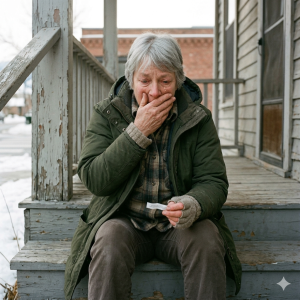
In its place was something so small she almost missed it. A tiny square of paper, folded twice. The size of a fortune from a cookie.
Norma Jean picked it up. Turned it over. Set it on the kitchen counter while she made her coffee because she thought — she genuinely thought — it was probably just a thank-you note, and she didn’t want to be sentimental about a thank-you note before she’d had her first cup.
Three weeks passed.
She was at the Bitterroot County Library — her old library, habit still pulling her in on Thursday mornings — when she saw the magazine rack by the front door. A glossy cover. One of those literary journals that had started covering rural stories, human interest, the kind of America people in cities sometimes forgot existed.
And there was his face.
She knew it immediately. The dark circles were gone, but the eyes were the same — that particular look of someone who had been very lost and was now, somehow, found. The headline curved above his photograph in clean black type.
She bought the magazine. Sat in her car in the parking lot and read the whole article right there, hands trembling slightly, the heat running because October in the Bitterroot doesn’t forgive you for sitting still.
By the time she finished, she understood that this young man’s story was not what she would have guessed. Not even close. It was bigger than that. Stranger than that. The kind of thing that makes you wonder whether certain nights in certain rainstorms are actually accidents at all.
She drove home.
She made coffee she didn’t drink.
And then she remembered the folded paper. The tiny square still sitting on her counter, right where she’d left it, because somehow in three weeks she had never once felt ready to open it.
She picked it up now.
Turned it over in her fingers the way she had that first morning.
Unfolded it slowly.
And there — in handwriting that was absolutely, certainly not Harold’s — was her husband’s name.
Harold E. Calloway.
And beneath it, four words.
Four words that made her sit down on the cold porch steps and press her hand hard against her mouth.
He saved my life.
She sat there for a long time. Long enough for Chester, the arthritic beagle, to push through the screen door and settle his warm weight against her hip. Long enough for the sun to tip past the ridge and turn everything that particular amber that the Bitterroot does in late October, the light that always made Harold stop whatever he was doing just to look at it.
She read it again. Three times. Four.
He saved my life.
Not she. Not you. He.
She went back inside and got the magazine.
His name was Eli Marsh. Twenty-three years old, from a small town in eastern Oregon she’d never heard of. The article was long — seven or eight pages — and it had been written by a journalist who’d spent two months piecing together a story that had apparently moved through certain circles like something between a mystery and a miracle.
Eli Marsh had spent four years working at a veterans’ archive in Portland, digitizing old records, military documents, the kind of paperwork that bureaucracies generate and then forget. He was the kind of young man, the article said, who paid attention to details that most people skimmed past.
Eighteen months ago he’d come across a casualty report from 1968. A name on the wrong list. A clerical error, the kind that happened in wartime, the kind that happened when nineteen-year-olds were filling out forms in the dark. The name on the wrong list belonged to a Marine from Stevensville, Montana. The error had rippled forward through decades of records, through a pension file, through a memorial wall inscription, through everything.
The Marine’s name was Harold Eugene Calloway.
Norma Jean had to set the magazine down.
She pressed both palms flat on the kitchen table. Breathed. Picked it up again.
Harold had come home from Vietnam. She knew that. She had watched him come home, thinner and quieter than he’d left, and she had loved him back toward himself over the better part of a year. They had thirty-four years together. He had died of a heart attack in his vegetable garden in 2009, pulling up the last of the tomatoes. She had found him there, and that was that, and she had gone on in the way that you do.
But somewhere in a records office in Portland, Harold Eugene Calloway of Stevensville, Montana, had been incorrectly flagged as killed in action — a duplicate file, a transcription error, a ghost that had taken on small bureaucratic life. It had never affected his actual pension. Had never touched his real life in any way she’d known of. But it had attached itself to his name in a national archive database. And when veterans’ families searched those archives — when they looked for the names of fathers or grandfathers or uncles — they sometimes found Harold’s name on a list it had no business being on.
One family had. A woman in Missoula, the article explained, who had spent thirty years believing her father had been killed next to a man named Calloway, believing that because of what was written on a mistyped form. She’d built part of her understanding of her father’s death around that name. And then Eli Marsh had found the error and corrected it and reached out to her, and what followed had been both a grief reopened and a grief, at last, more accurately held.
But that wasn’t the part that had sent Eli Marsh walking in the rain down a highway in the Bitterroot Valley on a Tuesday night in October.
That came later, on the last page of the article.
In the course of his research, Eli had tracked down every living relative of Harold E. Calloway that he could find, to document the correction and close the record properly. He’d found Norma Jean’s address. Had driven out from Portland in a car that died outside of Hamilton in a rainstorm that came out of nowhere, soaking him through before he could get his bag out of the back seat.
He’d been walking toward the nearest lights when he saw hers.
He hadn’t knocked because he hadn’t known what to say. He hadn’t known how to explain, standing on a stranger’s porch steps, that he’d been looking for her. That he had something to tell her. That a man she had loved had been written down wrong for fifty years, and he’d spent the better part of a year setting it right, and he thought she might want to know.
He’d been, the article said, on the verge of just walking on.
And then she’d opened the door.
He’d eaten the soup in the dark on her porch, in the rocking chair with the wool blanket pulled up to his chest, and he’d thought about knocking again. About saying: I know your husband’s name. About explaining everything right there in the October rain.
But he hadn’t. Because she’d given him the porch and the soup and the blanket and then left him completely alone with it, which was exactly what he’d needed without knowing he’d needed it, and disturbing that felt wrong.
And then he’d found the library card under the bowl.
Harold E. Calloway, in careful blue ink.
He’d sat with it in his hands for a long time. And then he’d taken the only piece of paper he had — a receipt from his jacket pocket, blank on the back — and he’d torn off a small square and written the only true thing he knew how to say.
He’d driven back to Portland with a borrowed jump cable and a stranger’s AAA number and spent three weeks writing the article, which was not just about the archive error. It was about what it meant to be the person who found the mistake. About carrying a name around with you until you could give it back to the right people. About what it felt like to eat soup on a stranger’s porch in a rainstorm and feel, for the first time in a long time, like what he was doing mattered.
He hadn’t used her name in the article. He’d called her only “the woman in the valley.” He’d described the bowl, the blanket, the folded dish towel. He’d written about finding the library card and said that he thought, in that moment, that Harold Calloway must have been exactly the kind of man you’d want setting the record straight on your behalf.
Norma Jean sat at her kitchen table for a very long time.
Chester put his head in her lap.
Outside, the afternoon light was doing that thing Harold used to stop for.
She thought about Harold pulling up tomatoes. She thought about a records office in Portland and a young man who paid attention. She thought about how a clerical error and a broken-down car and a sideways rain had conspired to put Eli Marsh on her porch steps with her husband’s name in his backpack, and how she had fed him soup without either of them knowing any of it.
She thought about the library card, Harold’s careful handwriting, gone now into a stranger’s pocket and maybe a desk drawer in Portland, and she found she didn’t mind. It felt like the right place for it to have gone.
She went to the junk drawer. Pulled out a notepad and a pen.
She was not a woman who wrote letters typically, but she’d spent thirty-one years writing the call numbers on catalog cards, and she knew her way around deliberate words on paper.
She found the email address for the literary journal at the front of the magazine and she wrote them a letter, formal and brief, asking if they’d be willing to forward her contact information to the young man they’d profiled, Eli Marsh of Portland, Oregon.
The journal wrote back in four days. They said they’d pass it along. They said, in a slightly unprofessional postscript that made her smile, that hers was not the first letter they’d forwarded to him.
Eli called on a Thursday morning in November, when the first real snow was coming down soft over the Bitterroot and Norma Jean was on her second cup of coffee.
He said, “Mrs. Calloway, I didn’t know how to tell you on the porch. I didn’t know where to start.”
She said, “You started in the right place. You came to the door.”
There was a silence that wasn’t uncomfortable.
Then she said, “Tell me what you found. Tell me all of it. I want to hear the whole thing from you, not from a magazine.”
And he did.
He talked for a long time. He told her about the archive and the record and the name on the wrong list. He told her what he’d found and how he’d found it and what it had taken to correct it, the phone calls and the forms and the months of patient, careful work. He told her about the woman in Missoula and what the correction had meant to her family.
And Norma Jean listened the way she had always listened, the way thirty-one years behind a library counter had taught her — fully, without interrupting, in a way that made people feel their words were going somewhere they would be kept safe.
When he finished she said, “Harold would have liked you.”
Eli said, “The soup tasted like something a good man would have come up with.”
She laughed at that. A real laugh, the kind she hadn’t expected.
She told him the recipe. All of it, including the part about the bay leaf that Harold always said was optional and never actually was. Eli wrote it down.
They have talked on the phone six times since then. He is coming through the valley in April, on his way to a conference in Missoula, and she has already told him the porch is dry and the rocker is there and she will have soup on the stove, same as before, except this time she’ll have put the good bowl out.
Norma Jean did not believe — she was careful to say this, on the phone, when he tried to thank her again — she did not believe in coincidence exactly. But she did believe in paying attention. She believed that most nights had more in them than you could see from a recliner, and that porch lights mattered, and that the difference between a small moment and a large one was usually just whether you opened the door.
Harold had known that too. He had written his name in ink that barely faded. He had made a soup that was worth heating up.
She keeps the little square of paper in the junk drawer now, tucked in behind the notepad and the rubber bands and the other small things she’s not ready to throw away.
He saved my life.
She doesn’t think about whether it was Harold who sent the boy or just the rain. She’s sixty-seven years old and she’s made her peace with not knowing the whole story. Some things you receive and don’t explain.
You just make sure the porch light is on.