“You will not sleep in the cold.”
Whit Boyd said it as plainly as if he were commenting on the weather, but for Verena Ashford, those six words landed with more force than anything she had heard in months.
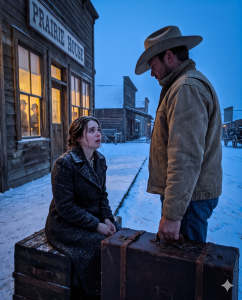
She was sitting on her trunk outside the Cordell Hotel, snow gathering on the lid, her gloved hands so numb they barely felt like part of her body. Two hours earlier, she had still been telling herself this was a temporary humiliation. A misunderstanding. A delay. By dusk, the truth was much uglier than that.
She had nowhere to go.
Only three weeks before, she had been in St. Louis, folding and unfolding a letter until the edges went soft. It had come from a family in Cordell, asking whether she would consider traveling west to become a music teacher and companion to an elderly mother whose health was declining. The letter was formal but kind. It promised room, board, wages, and a household where refinement still mattered.
Refinement. Verena had almost laughed when she first read that word.
Her husband, Thomas, had been a church organist with gentle hands and too much patience for suffering. During the last year of his life, every coin they owned had gone to doctors, broth, coal, medicines that did nothing, and prayers that changed nothing. By the time he died, Verena was left with a trunk, black mourning dresses gone shiny at the seams, and the sort of careful manners that made people assume she had options when she no longer had any.
So she had come to Cordell.
She arrived exhausted, chilled to the bone, and clutching hope so tightly it almost embarrassed her. Then the family who had written the letter received her with stricken faces and an apology she knew, before they even finished speaking, was going to ruin her.
The elderly mother had died three weeks earlier.
In their grief, they had forgotten to send word.
There was no position. No room. No wages.
They were sorry.
Verena accepted the apology because there was nothing else to do. One could hardly demand employment from the dead.
The hotel took her in for two nights. On the third day, when her last coin was gone, the proprietor stood shifting his weight with visible discomfort and said he could not let a room remain unpaid. He was not cruel. In some ways, that made it worse. Cruelty could be hated. Indifference wrapped in regret had nowhere to strike back.
So her trunk was placed on the curb.
Then she was placed beside it.
She sat there through the fading light, watching people choose not to see her. That was the first thing Cordell taught her: entire towns could look straight at despair and still call themselves decent.
Then Whit Boyd stopped.
He was not handsome in the polished way some men were. His coat was work-worn, his boots caked with mud and old snow, his face broad and ordinary. But he had clear gray eyes and the manner of someone who did not waste words or ask questions he did not mean to hear answered.
“Are you waiting for someone, ma’am?”
“I was,” Verena said. “But I seem to have run out of people.”
It should have been humiliating to say. Instead, exhaustion stripped the pride from it.
She told him enough for him to understand. Not everything. Just enough.
He listened, looked up at the thickening snow, and said, “You will not sleep in the cold.”
When she protested that she did not know him, his answer came at once.
“That is why it must be done carefully.”
Then he explained. She could stay at his ranch house. Not with him there. He would move into the bunkhouse with the ranch hands. She would lock the doors from the inside and keep the only key. No one would enter. Not even him.
Verena had never heard such a proposal and did not know whether it was madness or decency so complete it looked strange.
“I cannot put you out of your own home,” she said.
He lifted her trunk. “The weather already has. I’m merely deciding which one of us it won’t kill tonight.”
That was how she came to Whit Boyd’s ranch.
The house stood plain and sturdy against the dark, with lamplight in the windows and a porch wind-scoured by years of winter. Inside, the kitchen was warm, the stove alive, the bed turned down, a folded blanket left on a chair with such awkward earnestness that Verena knew at once he had prepared the room himself.
She locked the door after him and stood in the silence of a stranger’s kindness until she began to cry.
The first morning felt unreal. The second felt dangerous, because it suggested this arrangement might actually work.
Whit kept his word with a precision that humbled her. He left supplies on the porch. He called before approaching the house. He never crossed the threshold. If they needed to speak, they did it with the open door between them, distance carefully preserved, as though her safety and reputation were not just considerations to him but duties.
On the second day, she found the organ.
It stood in the parlor under a dust cloth. When she drew the cloth away, she discovered a handsome old instrument with carved wood darkened by age and neglect. She touched a key. The thin note that answered nearly buckled her knees.
After Thomas died, she had refused to touch a keyboard. Music had become too bound up with hospice whispers, unpaid bills, and the expression her husband wore when pain made him unable to finish a hymn. She had told herself she was done with that part of life.
Now, in a quiet ranch house in Oklahoma, one trembling note broke the lie.
That evening she asked Whit about the organ.
“It was my mother’s,” he said. “Ada Boyd. She played every day.”
“And when she died?”
“I covered it.” He shifted, as if the words had weight. “Couldn’t stand looking at it. Couldn’t stand selling it either.”
“Would you rather I leave it alone?”
He shook his head. “Play it if you want. Better that than letting it die under a sheet.”
So she played.
The music she chose was simple at first, hymns and old arrangements her fingers remembered before her mind did. The sound changed the house instantly. It moved through the rooms as if waking them. Outside, Whit sat on the bunkhouse steps in the cold and listened.
He never told her that directly. She discovered it on her own when she glanced through the parlor window after finishing one evening piece and saw his silhouette in the yard, still as a fence post, head slightly bowed toward the sound.
Their life settled into a pattern that was odd enough to scandalize town and gentle enough to save them both.
Verena cleaned and aired the house. She found mending baskets, old china wrapped in newspaper, books with Ada Boyd’s name inside. She baked when there was flour enough and left portions for Whit. He repaired hinges, stacked wood, and brought her thread, lamp oil, and once a set of fresh music paper without comment.
Cordell noticed.
Towns like Cordell always noticed when kindness crossed the lines they understood. Some people approved of Whit in a distant, admiring way that required nothing of themselves. Others smirked. More whispered. A widow living alone in a rancher’s house while he slept in the bunkhouse was too unusual to be left alone by shallow minds.
Verena bore the gossip with composure until she met Gideon Pike.
Gideon owned the general store, several notes on neighboring farms, and, if rumor could be trusted, half the grudges in three counties. He was a man with careful hair, expensive gloves, and a smile that never seemed to touch the rest of him.
He greeted Verena warmly the first time they met, then studied her as if calculating value.
“So this is the lady who brought music back to Boyd’s place,” he said.
“I don’t know that I brought anything,” Verena answered.
“No?” His gaze sharpened. “Perhaps you brought more than you realize.”
She disliked him at once.
Whit’s dislike was quieter. That was how she learned it was serious. He became shorter in Gideon’s presence, his politeness turning hard-edged. Once, outside the store, Verena heard Gideon say, “You’ve always been too sentimental where your mother is concerned,” and saw Whit’s shoulders lock as if against a blow.
She asked no questions then. She was still a guest. Still grateful. Still afraid of spoiling the fragile peace she had been given.
But peace rarely survives being observed by envious people.
One afternoon, Whit was out checking fencing on the south pasture when Gideon arrived at the house with a sack of flour and a confidence that told Verena he expected to be admitted.
She kept the door mostly closed.
“You may leave it on the porch,” she said.
“I hoped for a word.”
“You have one.”
He smiled faintly. “You are sharper than most women who end up dependent on men’s generosity.”
The insult was smooth enough to hide from anyone not listening closely. Verena heard it clearly.
“Then you should know better than to offer one.”
Instead of retreating, he let his eyes move past her into the house, toward the parlor.
“Do you know what keeps Whit Boyd tied to this place?” he asked softly. “Not profit. Certainly not good sense. Sentiment. Old promises. Dead people’s wishes.” He lowered his voice. “His mother left complications behind. Complications that would interest anyone living under his roof.”
Verena’s hand tightened on the doorknob.
“You should leave before Mr. Boyd returns.”
His expression changed almost imperceptibly. Satisfaction flickered there. “Ah. So he hasn’t told you.”
“Told me what?”
“That depends which secret he was trying hardest to keep.”
Before he could say more, hoofbeats sounded in the yard. Whit dismounted before the horse had fully stopped.
He did not shout. He did not threaten. But whatever passed between the two men made Gideon’s amusement sharpen into something close to triumph. He left with a parting glance toward Verena that made her skin crawl.
That evening she asked Whit directly.
“What did he mean? About your mother?”
Whit stood outside the kitchen door, hat in his hands.
“Nothing that concerns you.”
She had known him long enough by then to hear the lie.
It disturbed her more than if he had admitted some shameful thing. Whit was not a liar by nature. If he lied, it was to protect someone—or because the truth had become dangerous.
The next morning, while dusting the parlor, she noticed the cloth over the organ had shifted. She was sure she had left it neatly folded across the bench. Now one edge trailed the floor. More troubling, the panel at the back of the instrument stood slightly open.
Verena knelt and peered inside.
There, hidden deep in the cavity behind the pipes, was a packet of papers tied with black ribbon.
Her heart began to hammer.
She drew them out carefully. The top page bore Ada Boyd’s name. Another looked like a land record. Another, half-unfolded, revealed legal wording and a signature cramped by age.
Then boots sounded on the porch.
Not Whit’s.
“Mrs. Ashford,” Gideon called through the door. “I believe you have found something that belongs to me.”
Cold flashed through her so violently she almost dropped the packet.
“It belongs to the Boyd family,” she said.
A quiet laugh came through the wood. “That depends on how fond one is of fraud.”
She backed away. The door was locked, but she suddenly remembered the windows, the isolation, the fact that the nearest ranch hand was out by the far corral. Gideon continued in that same maddeningly calm tone.
“Whit never explained, did he? Ada Boyd filed a claim years ago over the north pasture acreage. Valuable acreage. Water under it. Access road beside it. But the claim was disputed. There were irregularities. Witnesses missing. Dates altered. The kind of thing that becomes very expensive when reopened.”
Verena looked down at the papers. One was a sworn statement. Another was a copy of a letter in a woman’s neat, forceful hand.
“My mother was not dishonest,” Whit said from the porch steps.
His voice had arrived so suddenly that Verena gasped.
A heavy silence followed.
Then Gideon said, “No. Just inconvenient.”
Whit had ridden hard; she could hear it in his breathing when he came to the door on the other side. “Verena, open for me.”
She hesitated only a second before doing it.
Whit entered for the first time since she had come to the ranch, not because the arrangement had changed, but because danger had. Snow clung to his coat. His face was grim in a way she had never seen.
Gideon remained outside, watching through the half-open door as if the house were already half his.
Whit looked at the packet in Verena’s hands and closed his eyes briefly.
“I was going to burn those,” he said.
Gideon laughed aloud. “And there, finally, is the honest part.”
Verena stepped back. “Tell me what they are.”
Whit met her gaze. “Proof my mother was cheated. And proof Pike’s father helped do it.”
The air in the room changed.
Gideon’s smile vanished.
Slowly, carefully, Whit explained. Years earlier, Ada Boyd had secured a legal claim to the north pasture after her husband’s death. The land was rough but strategic—water nearby, access to the road, enough grazing to change a family’s future. Ezra Pike, Gideon’s father, had wanted it. He had used his influence with a county clerk and a witness whose debts he controlled to challenge Ada’s filing. Documents disappeared. Dates were altered. Ada fought back quietly, gathering statements and letters, hiding copies where she thought no one would find them until the right moment.
Then she died before she could press the case.
Whit found the papers afterward. By then Ezra Pike was dead, Gideon had inherited both the store and the old man’s habits, and Whit wanted no more war in his mother’s name. So he hid the packet inside the organ and told himself the dead should be allowed to rest.
“Then why is Gideon after them now?” Verena asked.
Whit’s expression hardened. “Because the railroad survey changed last month. If the county approves the new spur road, the north pasture triples in value.”
Gideon’s reply came instantly. “And if those forged records come to light, every title around them gets questioned. Including Boyd’s. You won’t just lose land, Whit. You’ll lose standing. Credit. Your ranch could be tied up in court until it collapses.”
“So that is your plan,” Verena said, looking at him. “To scare him into surrendering what your family stole.”
Gideon’s eyes shifted to her, and the politeness finally fell away.
“My plan was to settle matters quietly. But now a grieving widow with a talent for melodrama has put her hands where they don’t belong.”
Whit took one step forward. “Leave.”
For the first time, Gideon seemed uncertain. Not afraid, exactly. More like a man realizing a situation was no longer following the lines he had drawn for it.
“You think sentiment will save you,” he said. “It never does.”
He turned and walked back to his wagon.
By morning, half the town had heard some version of the story. By afternoon, the county recorder had one too—because Verena insisted the papers be copied and filed properly before they could disappear again.
Whit resisted at first.
“Bringing this up will drag my mother’s name through every filthy mouth in Cordell.”
“She already fought this once,” Verena said. “You are not protecting her by letting the lie stand. You are only protecting the people who wronged her.”
He looked at her for a long moment, then nodded once.
The hearing took place in the back room of the mercantile three days later because the courthouse roof was under repair and Cordell did everything in borrowed spaces. The county recorder came. So did a judge from the district seat, delayed but curious. So did nearly everyone in town who had enjoyed gossiping about Whit Boyd and the strange widow in his house.
Gideon arrived immaculate and confident. He had lawyers’ letters, old account books, witnesses prepared to blur the truth until it resembled smoke. For an hour Verena feared he might succeed. He had the advantage every bully cultivates: he sounded reasonable.
Then Ada Boyd began speaking from the grave.
Her letters were precise. Her copies were dated. One witness statement, hidden with the others, came from a former clerk who had died two years earlier but had signed an affidavit before a notary, confessing that Ezra Pike pressured him to alter a filing. Another was a note in Ezra Pike’s own hand referencing “the Boyd widow’s acreage” and the “adjustment” needed to secure it.
The room changed as the papers were read aloud.
Gideon’s face did not crack all at once. It went in stages—the polished ease, then annoyance, then disbelief, then a fury he could not safely display.
When the judge asked whether he wished to challenge the handwriting, Gideon understood before anyone else did that he had lost.
The finding did not grant Whit instant wealth. Real life rarely arranges itself so neatly. But it restored Ada Boyd’s claim, voided the fraudulent challenge, and exposed the Pike deception publicly enough that no bank or board in the county wanted to be seen supporting him. Within weeks, Gideon’s influence shrank. Quietly at first. Then very visibly.
As for Cordell, towns are capable of astonishing moral flexibility when shame becomes inconvenient. The same people who had whispered about Verena’s presence on the Boyd ranch now praised her courage, Whit’s honor, and Ada Boyd’s determination as though they had always admired all three.
Verena accepted none of it too easily.
Winter began to break. The snow retreated from fence lines. Water ran under the ice. Life at the ranch changed too, though more gently.
Whit started taking coffee in the kitchen doorway, then at the table when invited, then without needing to be invited at all. The first evening he crossed the threshold simply to listen while Verena played, he looked almost apologetic for the sound of his own boots on the floorboards.
“You kept your word long enough,” she told him.
“That depends what the word became,” he said.
She smiled at that.
By spring, it was impossible to pretend the house no longer belonged to both of them in some quiet, unnamed way. Not ownership. Not yet. But presence. Habit. Care.
One evening, after she finished playing Ada’s old organ, Whit remained standing beside it, one hand resting on the polished wood.
“My mother would have liked you,” he said.
Verena looked up. “I think I would have liked her.”
He nodded once. “She was fierce under the gentleness.”
“I suspected as much.”
He was silent a moment longer. Then, with the same plainness he had used outside the hotel on that first night, he said, “I don’t want you to leave.”
The words should have startled her. Instead, they felt like something she had been hearing from a distance for weeks, finally spoken where both of them could reach it.
“I was wondering when you might say that,” she replied.
He gave a small, almost disbelieving laugh. “I’ve been wondering how.”
“That was enough.”
Their courtship, if it could be called that, was built more from truth than flourish. There were no grand speeches. Just honesty, shared labor, respect hard-won and carefully kept. Whit asked if she would stay not as a guest rescued from snow, but as a woman he loved. Verena answered not from desperation or gratitude, but from a steadier thing: she loved him too.
When they married in early autumn, the whole town came because towns love redemption stories when they can attend them in proper clothes. Verena walked into the parlor afterward and played the organ while the windows stood open to the cooling fields. Whit listened from beside her this time, not from the yard.
The north pasture was finally fenced under the Boyd name. The new road brought business. The ranch grew stronger. Life did not turn perfect—no honest life does—but it turned solid, which can be better.
Years later, Verena would still sometimes remember the hotel curb, the trunk beside her, the snow beginning to fall, and the terrible silence of people choosing not to interfere.
Then she would look at the house around her, at the organ no longer hidden, at the man who had once given it all up so a stranger would not freeze, and think how close a life can come to ending before it begins again.
And how strange it was that the biggest red flag in Cordell had not been the widow in the rancher’s house at all.
It had been every person who saw a woman in danger and did nothing—while the one man they found easiest to gossip about was the one who had saved her.