For three weeks, she watched him walk past.
Every single afternoon. Same gravel road. Same heavy backpack that made his small shoulders slope forward like he was carrying something much bigger than books.
And in his right hand — always — a single crumpled dollar bill.
—
Ruthie Callahan spent 31 years delivering mail on Rural Route 7 outside Denton, Montana. She knew every mailbox, every driveway, every dog that would chase her truck and every one that wouldn’t.
She retired two springs ago. Planted tomatoes. Started watching the birds.
And then one Tuesday in September, she noticed the boy.
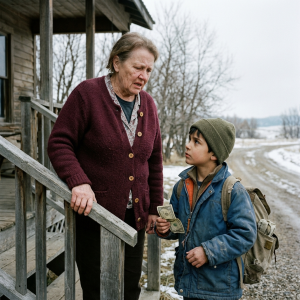
He couldn’t have been more than eight years old. Worn sneakers. A blue jacket with a broken zipper that flapped open in the October wind. He walked with his head down, one hand gripping the strap of that overstuffed backpack, the other hand clutching that dollar bill like it was something precious.
Ruthie almost called out to him.
But something stopped her.
Because every time he passed the big cottonwood at the edge of her property — right at the corner of her porch railing — he would slow down just a little. And he would reach up with his free hand and touch the front zipper pocket of his backpack.
Just touch it.
Then keep walking.
She noticed it the first day. Didn’t think much of it.
She noticed it the second day. Started wondering.
By the third day, she was standing at her kitchen window with her coffee going cold, watching for him.
*What’s in that pocket?*
—
On day four, Ruthie set a small paper bag on her porch railing.
Inside: a peanut butter sandwich, a clementine, and a handful of those little peanut butter crackers in the orange package that kids always seem to love.
She went back inside. Watched from the window.
He almost walked past it.
Then he stopped.
He looked at the bag. Looked at the house. Looked at the bag again.
He set down his dollar bill — right there on the railing, so careful, like he was paying for it — and he took the bag.
Ruthie pressed her hand over her mouth.
—
She never went out. Never made him feel watched. That felt important, though she couldn’t have explained why.
Every afternoon she left something different.
A sandwich. A juice box. Once, a pair of warm socks folded into a little bundle because she’d seen his ankles turning red in the cold.
And every single afternoon, he left his crumpled dollar on the railing.
She started leaving it there until the next day. Then quietly tucking it into a mason jar on her windowsill.
She had eleven of them now.
Eleven single dollar bills, each one soft and worn like it had been held a long time before it was spent.
—
And every single day, without fail, he would reach up and touch that front zipper pocket.
Never opened it.
Just touched it.
Ruthie started dreaming about what was inside. A note from a teacher? A photograph? Some little-boy treasure — a lucky stone, a folded-up drawing?
Whatever it was, it clearly mattered to him.
It clearly *steadied* him.
—
Three weeks in, on a Wednesday afternoon when the sky had gone that particular shade of gray that means winter is serious now, Ruthie made a decision.
She put on her good cardigan — the burgundy one with the wooden buttons — and she walked out onto the porch.
She wasn’t going to ask about the pocket. Wasn’t going to make anything strange. She just wanted to say hello. Properly. Maybe learn his name.
She heard the crunch of gravel and there he was, coming around the cottonwood, backpack listing to one side, dollar bill in his fist.
He saw her and stopped.
For a moment, neither of them moved.
Then he looked up at her — really looked at her — with these dark, serious eyes that hit Ruthie somewhere deep in her chest like a key turning in a lock she’d forgotten she had.
She knew those eyes.
She had *known* those eyes.
The boy took one small step forward.
And in a voice far too old for his little face, he said —
*”You knew my mom, didn’t you.”*
It wasn’t a question.
Ruthie’s hand found the porch railing. The cold wood was the only thing that felt real.
“Baby,” she whispered. “What’s your name?”
He reached up — one more time — and touched that front zipper pocket.
—
“Cody,” he said. “Cody Dillard.”
Ruthie said the name quietly, the way you do when you’re testing whether something is true.
Dillard.
Lacey Dillard had been twenty-six years old when Ruthie used to deliver mail to her grandmother’s house on Route 7. Just a girl then, really. Skinny and serious and always reading something on the front steps, one leg folded under her, not even looking up until Ruthie called out a hello. Then that slow smile. Those dark eyes.
Those eyes.
“Your mama was Lacey,” Ruthie said. It wasn’t a question either.
Cody nodded once. Careful. Like he was deciding whether Ruthie could be trusted with it.
“She passed,” he said. “In the spring.”
Ruthie had not known that. After retirement, the news of the county stopped flowing to her the way it used to. She stood very still on her porch and felt the cold air move through her and thought about a twenty-six-year-old girl reading on front steps, and then she thought about how that girl had become someone’s mother, and then she stopped thinking about it because she couldn’t.
“I’m so sorry, Cody.”
He looked at his sneakers. Nodded again.
“I live with my grandpa now. Down past the Sulley road.” He gestured vaguely down the route. “He works till six.”
So that was the shape of it. A boy walking home alone to an empty house for two hours every afternoon. A grandfather doing the best he could. A long gravel road that must have felt even longer some days.
“You want to come sit on the porch a minute?” Ruthie asked. “I think there might be some hot chocolate that needs drinking.”
He considered this with the gravity of a much older person. Then he climbed the two porch steps and sat in the old ladderback chair beside the door, backpack still on, and waited.
—
Ruthie made the hot chocolate on the stove, not from a packet. Whole milk, cocoa powder, a little sugar. The way her mother had made it. She could hear the creak of the ladderback through the kitchen window as he shifted his weight, and for some reason that small sound undid her a little. She stood at the stove and breathed until it passed.
She brought two mugs out and sat in the other chair.
They drank in silence for a while. The gray sky pressed down over the cottonwood. Somewhere up the road a crow made its announcement and then went quiet.
“She talked about you,” Cody said finally.
Ruthie looked at him.
“She told me there was a mail lady on this road who used to wave at her when nobody else did.” He turned the mug in his small hands. “When she was a kid. She said the lady had red hair and drove too fast but always stopped for the dogs.”
Ruthie laughed, just a short surprised sound. “I did drive too fast.”
“She said you once left a birthday card in their mailbox that wasn’t addressed to anybody. It just said ‘for whoever needs one today.'”
Ruthie had forgotten that entirely. She used to buy a box of birthday cards at the start of every year and leave one somewhere on the route whenever the mood struck her. She’d never thought much of it.
“She kept it,” Cody said. “She kept it for a long time.”
Ruthie set her mug down on the porch rail and pressed her hands together in her lap.
“She sounds like she was a wonderful person.”
“She was the best person,” he said, with a simplicity and a certainty that made the words final, like something carved.
—
They sat a while longer. The crow came back and made its announcement again, as though the first one hadn’t taken.
Ruthie knew she couldn’t ask about the pocket. She had decided that before she ever walked outside. Whatever was in there was his, and it was private, and it was keeping him going, and that was enough.
But then Cody set down his mug and put both hands in his lap and looked out at the cottonwood.
“You want to know what’s in my pocket,” he said.
“You don’t have to tell me.”
“I know.” He was quiet a moment. “But I think I want to.”
He unzipped the front pocket of his backpack. Slowly, like the zipper required care. And he reached in and drew out a folded piece of paper, creased and soft at the edges from being handled so many times.
He held it out to Ruthie.
She took it gently. Unfolded it.
It was a handwritten note on the kind of paper that comes from a yellow legal pad. The handwriting was round and looping, a woman’s handwriting, though it had clearly been written in some haste — the lines angled slightly upward, pressing toward the top of the page the way urgent things do.
It said:
*Cody —*
*I know the walk home feels long sometimes. I know some days you don’t feel like walking it.*
*But I need you to know that every single step of that road is a step I am taking with you. I am right there. I am always right there, even when it doesn’t feel like it.*
*There is going to be a woman on that route with a porch and a cottonwood tree. Her name is Ruthie. She was kind to me when I was little, before you were born, before I knew you were coming. If you ever need anything — anything at all — you stop at her porch.*
*She won’t mind. I promise she won’t mind.*
*I love you bigger than Montana.*
*— Mom*
—
Ruthie read it twice.
Then she folded it back along its creases, very carefully, and handed it back to Cody.
He tucked it into the pocket and zipped it shut and touched the outside of it once, the way he always did, and then let his hand fall to his knee.
“She wrote it before,” he said. “When she got sick. She told me not to read it until I needed it.” He paused. “I read it on the first day of school. When I was scared.”
Ruthie nodded.
“She knew this road,” Cody said. “She knew you’d still be here.”
“She did,” Ruthie said. “She knew this road.”
The sky had gone a shade grayer. Ruthie thought about a woman sitting up in a bed somewhere with a yellow legal pad, writing a letter to her son about a gravel road and a cottonwood tree and a retired mail carrier she hadn’t seen in years, trusting that it would all still be there. Trusting that the world would hold a small space open for her boy.
She thought about that for a long time.
—
That was almost two months ago now.
Cody stops at the porch every afternoon. Not because he has to. Because Ruthie leaves the ladderback chair pulled out just a little, just enough, and he knows what it means.
He stopped leaving the dollar bills after the first week, once Ruthie told him she’d been saving them all. She brought out the mason jar and set it on the porch between them without a word.
He laughed — really laughed, surprised and a little embarrassed — for what Ruthie suspects was the first time in a while.
She gave him the jar to keep.
His grandfather, Roy, came by the following Saturday with a coffee cake and stayed for two hours. He is a quiet man with the same dark eyes, and he shook Ruthie’s hand at the end and didn’t say much except thank you, and held on a beat longer than a regular handshake goes.
Ruthie understood.
—
Last week, the first real snow came down on Denton, Montana. The gravel road went white. The cottonwood held about six inches along every branch and looked like something from a Christmas card.
Cody came up the road in his blue jacket, the zipper still broken, a hat pulled down over his ears that was two sizes too big. He stomped up the porch steps and sat in his chair and Ruthie brought out the hot chocolate.
They watched the snow come down on the field.
After a while, he reached up and touched the pocket. Not anxiously. Not the way he used to, like he was checking that something hadn’t been lost. Just the way you touch something you love. The way you remind yourself it’s real.
Then he picked up his mug.
“Ruthie,” he said.
“Mm.”
“She was right about you.”
Ruthie looked out at the snow and at the cottonwood and at the road going white and quiet in both directions, and she thought about thirty-one years of that road and all the things she’d left in mailboxes and all the things she’d never known she was leaving behind.
“She was a smart woman,” Ruthie said.
Cody nodded, satisfied, the way children are when something confirms what they already knew.
They finished their hot chocolate.
The snow kept coming down.