For 38 years, Donna Keller delivered mail to every house on Route 9 outside of Billings.
She knew which families got the Christmas cards late. Which old ranchers never got mail at all. Which doors had wreaths in December and nothing in January.
She retired on a Tuesday in March, and by Thursday, she didn’t know what to do with her hands.
—
Her neighbor Patty mentioned her in passing. A young woman named Sara — maybe thirty, maybe less — who’d moved into the Hendricks place out on County Road 14 after losing her husband to a farming accident last spring.
“Nobody checks on her,” Patty said. “She’s got a little boy, maybe four years old. I don’t think she has family close.”
Donna didn’t say anything.
But the next morning, she was up at five like always.
—
The first package was small. A loaf of banana bread, still warm. A bar of good soap. A note that said absolutely nothing — just a worn index card with seven words written in plain blue ink:
*”What do you need today?”*
She left it on Sara’s porch before sunrise and drove away without stopping.
She told herself that was enough.
—
It wasn’t enough.
The following week she left a package with a children’s book, a bag of coffee, and a $20 grocery store gift card.
The index card again. Same question.
*”What do you need today?”*
She found the cards in a box her late husband Earl had kept in his workshop — a whole stack of them, crisp and yellowed at the edges. He used to write shopping lists on them. Phone numbers. Little notes to himself.
Donna had kept the box for eleven years without opening it.
She opened it now, and she took the cards, and she told herself Earl would have liked this.
—
It went on for six weeks.
Donna never knocked. Never introduced herself. Left the packages before dawn and watched from her truck at the end of the long gravel drive, just long enough to see the porch light click on.
Once she saw Sara come outside in her bathrobe and stand very still, holding the package against her chest like it was something fragile.
Donna drove home and cried the whole way, though she couldn’t have told you exactly why.
—
The index cards kept appearing.
One slipped out of the box and landed face-down behind the toaster. Donna found it while cleaning and stood in her kitchen holding it for a long time.
*”What do you need today?”*
She’d written it herself. She knew that.
But something about the handwriting — the slight curl on the *W*, the way the *y* dropped down long — made her stomach go quiet in a way she hadn’t felt since Earl died.
She put the card in her cardigan pocket and didn’t throw it away.
—
The morning everything changed was a Wednesday in early May.
Donna pulled on her coat at 5 a.m. like always, picked up the week’s package — good hand lotion, a puzzle for a small child, a bag of pinto beans — and opened her front door.
And stopped.
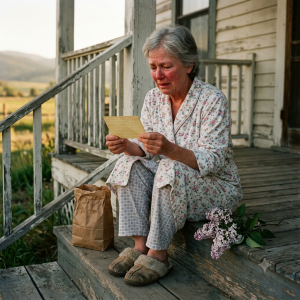
There was a package on *her* porch.
Small. Brown paper bag, folded neatly at the top. A stem of lilac from someone’s yard tucked under the twine.
And on top, held flat by a smooth river stone:
An index card.
Donna’s hand was shaking before she even reached for it.
She recognized the card stock. Same yellowed edges. Same faint blue lines.
She turned it over.
*”What do you need today?”*
Her own words. Her own handwriting — or something so close to it she felt the ground tilt slightly under her slippers.
She sat down on the porch step because her legs had made that decision for her.
Inside the bag: a small jar of honey. A packet of Earl Grey. A photograph, face-down.
She picked up the photograph last.
It was Earl.
Young Earl, maybe thirty-five, standing in front of a fence she recognized as the old Hendricks property — the same farm Sara lived on now. He was laughing at something off-camera. His hands were in his pockets. His eyes were full of light.
She had never seen this photograph before in her life.
Donna turned the index card over, the one she’d assumed she had written herself.
On the back, in handwriting she had not seen in eleven years — the slight curl on the *W*, the long drop of the *y* — were two words.
Just two.
She read them once.
Then she read them again.
—
*Keep going.*
That was all.
*Keep going.*
She sat on that porch step for a long time after that. The sun was just starting to come up over the ridge to the east, turning the frost on the grass a pale gold color. A meadowlark was doing its business somewhere in the sagebrush. The world was carrying on the way it always did, indifferent and beautiful, and Donna Keller was sitting in the middle of it holding a photograph of her dead husband and trying to remember how to breathe.
She put the honey and the Earl Grey inside. She put the photograph on the kitchen table where she could see it. She set the river stone on the windowsill above the sink because it was smooth and gray and she liked the weight of it in her hand.
Then she drove out to County Road 14.
—
It was just past six when she pulled onto the long gravel drive. She sat in her truck for a moment with the engine idling, the same spot she’d watched from all those other mornings. The porch light was already on.
She turned off the engine.
She picked up the week’s package — the lotion and the puzzle and the pinto beans — and she walked to the door and she knocked.
She heard small feet running. A child’s voice, high and clear, saying something she couldn’t make out. Then quiet. Then the door opened.
Sara was younger than Donna had expected, even knowing she was young. Dark circles under her eyes. Hair pulled back. She was wearing a flannel shirt two sizes too big and holding a little boy on her hip who was staring at Donna with the frank, unguarded curiosity that only children and animals can get away with.
Neither of them said anything for a moment.
Then Sara said, “I know who you are.”
“I figured you might,” Donna said.
“I’ve been watching from the window.” She wasn’t accusatory about it. Just stating a fact. “Every time. I’d hear the truck.”
Donna nodded.
Sara looked down at the package in Donna’s hands, then back up. Her eyes were very dark and very steady. “You want to come in?”
“I’d like that,” Donna said. “If that’s all right.”
—
The kitchen was small and clean. There were crayon drawings taped to the refrigerator. A cast iron skillet on the stove. A half-finished cup of coffee on the counter that Sara moved out of the way without thinking about it. The little boy — his name was Marcus, and he warmed up to Donna in approximately four minutes, which was a personal record for Donna even at the height of her social powers — climbed up onto a chair and started telling her about a tractor he’d seen.
Sara put on fresh coffee. She didn’t make a production of it. She just made coffee.
They sat across from each other at the kitchen table.
“How did you know Earl?” Donna asked. She’d already decided she was going to ask it straight out. She was sixty-three years old and she had delivered mail to eight hundred houses in wind and ice and one memorable tornado warning, and she was done going around things.
Sara wrapped both hands around her mug. “He was a neighbor to my dad, years back. Before my dad sold that land and moved to Missoula. Earl used to come by and help with the irrigation ditches in late summer.” She paused. “I was maybe eight or nine the first time I met him. I thought he was the funniest person I’d ever seen because he talked to the horses like they were people.”
Donna felt her throat tighten. “He did that,” she said.
“My dad took that picture. I found it in a box when he died — my dad, I mean, two years ago now. I’d been carrying it around not knowing what to do with it.” Sara looked at the table. “When I moved out here, I asked around about who owned this place before. They told me the Hendricks family. Then somebody mentioned a mail carrier named Keller whose husband had done work all over this county before he passed.” She looked up. “I asked Patty. Patty told me everything.”
Donna thought about Patty for a moment with a complex mix of affection and exasperation that she suspected was the normal condition of anyone who’d known Patty for more than a decade.
“The index cards,” Donna said.
Sara almost smiled. “Patty mentioned those too. That you’d been using cards from Earl’s old box.” She looked at Marcus, who was drawing something on a paper towel with a crayon stub. “I wanted to write back to you. But I didn’t know what to say. So I waited until I found one of his.” She hesitated. “The card was tucked inside the photo. On the back of the photo, actually, like he’d used it as a backing. Same box, same stock. I don’t know when he wrote it. I don’t know who he wrote it for.”
*Keep going.*
Donna looked at the window above the sink where the gray river stone was sitting, thirty miles away on her own kitchen sill.
“I know who he wrote it for,” she said quietly.
She didn’t explain that. She didn’t need to. Some things are just true and the explaining of them would only get in the way.
—
Marcus fell asleep on the couch around eight with his cheek mashed into a throw pillow and his arms around a stuffed horse with one eye missing.
Sara and Donna sat at the kitchen table for another hour, just talking. About the farm, and what Sara was trying to figure out about the lower fields. About Earl’s habit of leaving his coffee cup in inconvenient places. About the farming accident last spring — a moment Sara spoke about plainly and briefly, the way people do when they’ve practiced being okay with something that will never fully be okay. About Marcus and what he liked and didn’t like and how much he looked like his father, which made Sara smile in a way that went in two directions at once.
About how a house could feel like it was holding its breath.
Donna told her about the route. The eight hundred houses, the Christmas cards, the ranchers who never got mail. She told her about the morning she drove her last box of letters into Billings and dropped her truck keys on her supervisor’s desk and cried in the parking lot for seven minutes before she could make herself drive home.
“I didn’t know what to do with a day that didn’t have a shape to it,” Donna said.
Sara nodded slowly. “Yeah,” she said. “I know that.”
—
Donna drove home around nine-thirty. The highway was empty. The sky over the Beartooths had gone that deep blue-black that you only get in Montana on a clear spring morning before the sun fully commits, and the stars were still doing their thing on the western edge.
She put the photograph on the mantle when she got inside. Earl at thirty-five, laughing at something off-camera. His hands in his pockets. His eyes full of light.
She picked up the index card. Held it for a moment.
Then she set it beside the photograph, back side up.
*Keep going.*
She made herself a cup of Earl Grey with the packet from Sara’s bag. She sat in her chair by the window with the river stone on the armrest and drank it while the sun came up all the way.
She wasn’t entirely sure what Earl had meant when he wrote those words, or when, or for whom. She suspected that was the point. That some instructions are not specific to one person or one moment but are the kind of thing that just stay true, waiting to be found by whoever needs them next.
She thought about Sara’s kitchen with the crayon drawings on the refrigerator.
She thought about Marcus and his one-eyed stuffed horse.
She thought about six weeks of packages left before sunrise, and how the thing she’d told herself was enough never quite was, and how that was not a bad thing but in fact the whole point.
She finished her tea.
She got out a fresh index card.
She thought about what to write, and then she thought that she’d already written everything she needed to write on those cards. What mattered now was the other part. The showing up. The staying.
She tucked the card in her cardigan pocket anyway, the way she had a habit of doing.
Then she made a grocery list for the week — enough for two households, a small boy’s snacks, the particular brand of coffee she’d noticed on Sara’s counter — and she put on her coat, and she went out into the morning like she’d done for thirty-eight years.
Like she intended to do for a good while more.