She found a letter addressed to herself — postmarked the day her daughter was told she had died.
Twenty years. That’s how long the cardboard box had sat in the corner of Marlene Kowalski’s spare bedroom, beneath a crocheted blanket her mother made in 1987 and two broken humidifiers she kept meaning to throw out.
She was seventy-one years old. Retired. A thirty-year carrier for the U.S. Postal Service, rural route 9 out of Billings, Montana. She knew every gravel road, every leaning mailbox, every dog that would chase her truck and every one that was just pretending.
When she retired, she brought home one box.
Undeliverables. Letters that had nowhere to go.
She told herself she’d figure out what to do with them someday. Find forwarding addresses. Make calls. Do the right thing. That’s what she told herself for twenty years while the box collected dust and she collected grandchildren and then, eventually, silence.
Her husband Gary passed in March. Her youngest moved to Boise. The house got very quiet.
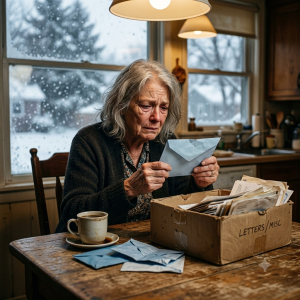
So on a Tuesday in November, with snow coming sideways off the Beartooths and nothing on television worth watching, Marlene pulled the box out and sat down at the kitchen table with a cup of Folgers and started sorting.
Most of it was ordinary sadness. Birthday cards that arrived a week late to an empty house. A final notice from a power company. A child’s drawing, rolled and rubber-banded, addressed to a grandmother in Roundup.
She set those aside gently.
And then her hand found a pale blue envelope.
The color of a robin’s egg. The kind of blue that seems to glow a little, even under bad kitchen lighting. She turned it over, and the return address stopped her cold.
Sinclair Valley Medical Center. Reno, Nevada.
She had never heard of that hospital. She had never been to Reno in her life.
But the letter was addressed to her. Her name — Marlene J. Kowalski — in handwriting she almost didn’t recognize. Almost.
She checked the postmark. She had to hold it close; her reading glasses were in the bedroom.
The date hit her like a step missed in the dark.
It was the same day.
The same exact day her daughter Debra had driven four hours to the house right here, sat down at this same kitchen table, and told Marlene that her biological mother had died. That the search was over. That there was no one left to find.
Debra had cried. Marlene had held her and said she was sorry, and she had meant it, and she had also felt — God forgive her — just the smallest, most shameful exhale of relief.
Because Marlene had given a baby girl up for adoption in the spring of 1974. And for years, she had been terrified of what would happen if that girl ever found her.
She set the blue envelope down.
Picked up her coffee.
Put it back down without drinking.
It took her a full ten minutes to keep sorting, telling herself it was a coincidence. A mistake. A letter for someone else with her name. Montana was a big state and Kowalski was not an uncommon name.
Then she found the second one.
Same pale blue. Same hospital return address. Sinclair Valley Medical Center, Reno, Nevada.
This one was postmarked seven years later. Addressed again to Marlene J. Kowalski, rural route 9.
And this time — her hands had started to shake — the handwriting on the front was hers.
Her own handwriting. Her own return address in the upper left corner.
A letter she had written. To herself. From a hospital in Nevada she had never visited.
She didn’t open it.
She couldn’t explain why. Some old and nameless instinct told her to put it face-down on the table and breathe and not open it yet.
She kept sorting.
The blue envelopes had a way of appearing.
The third one was near the bottom of the box. Same color. Same hospital. This postmark was only four years old, which meant someone had put it in this box — her box, in her spare bedroom — after she had already retired.
After Gary was already sick.
After the house was already quiet.
She picked it up. She turned it over.
And on the back flap, in faded pencil, pressed hard enough to ghost through the envelope, someone had written eight words that made the kitchen go cold and the snow outside go silent and Marlene Kowalski, who had delivered mail in blizzards, in drought, in grief, who had never once in thirty years failed to finish her route —
felt, for the first time in her life, genuinely afraid to open something.
She’s been looking for you. Don’t let her find you first.
She sat with those eight words for a long time.
The furnace kicked on. The snow ticked against the window glass. Her coffee went cold.
She’s been looking for you.
Marlene had spent a considerable portion of her adult life not thinking about 1974. She had gotten very good at it. You could get good at almost anything if you practiced long enough and the alternative was unbearable.
She was nineteen years old when she had the baby. She was alone in a way that people are rarely allowed to be alone anymore — no internet, no support groups, no language yet for what she was, which was a girl from a small town in eastern Montana who had gotten pregnant by a man ten years older than her who was already married and who had made very clear, in terms she understood completely, that she would handle this herself.
She had gone to her aunt in Butte. She had the baby in the spring. She had signed the papers and come home and never spoken of it again to anyone, including, eventually, herself.
She had married Gary six years later. She had Debra. She had a life that was good and full and real, and the girl born in Butte in the spring of 1974 became, in Marlene’s private accounting, something that had happened to someone younger, someone she no longer was.
But someone had written eight words in pencil on the back of an envelope.
She looked at the three letters on her kitchen table.
Then she got up, walked to the bedroom, got her reading glasses, came back, sat down, and opened the first one.
—
The paper inside was hospital stationery. Sinclair Valley Medical Center, the letterhead said, and below that a date, and below that, in careful, even handwriting that was not Marlene’s and not anyone she knew:
Dear Mrs. Kowalski,
My name is Ruth Pinsky. I am a social worker in the oncology unit here at Sinclair Valley. I am writing on behalf of a patient who has asked me to reach out to you. She does not have a great deal of time, and she wanted very much for you to know that she does not blame you, and that she has had a good life, and that her name is Carol.
That was how the letter ended. Her name is Carol.
No last name. No return address beyond the hospital’s. No request, no demand, no accusation.
Just: her name is Carol. And she does not blame you.
Marlene read it three times. Then she folded it along its original crease and set it face-up on the table and sat with what she was feeling, which was not what she would have predicted.
She had expected to feel guilt. Or fear. Or the urge to put the letter back in the envelope and the envelope back in the box and the box back under the blanket.
What she actually felt was something closer to grief. For the social worker who had taken the time to write this on a dying woman’s behalf. For the careful handwriting. For the phrase good life, which was doing so much work in two small words. For Carol, who had asked only that her mother know she did not blame her.
For herself, at nineteen, signing papers she didn’t understand in a room that smelled like industrial cleaner, and not knowing — not being able to know — that the baby she was leaving had grown up to be someone who, at the end of her life, had wanted her mother to know she was okay.
She opened the second letter.
This one was in her own handwriting. She had known it was, and still seeing it was a shock, the way your own voice sounds wrong on a recording.
She had no memory of writing it. None.
But as she read, it came back in pieces, the way old things do. Not a flood. More like fog lifting in patches.
It had been seven years after the first letter. Marlene had been fifty-one. Gary had been talking about early retirement. Debra was pregnant with her first. It had been, by any ordinary measure, a good season.
And Marlene had apparently — she could see it now, she could almost see herself at the kitchen table with the good stationery she kept in the secretary desk — written a letter back to the hospital. To the social worker. Asking about Carol. Asking if she was still alive. Asking if there was any way.
She had written it and, apparently, addressed it to herself. Rural route 9.
Which made no sense. Until she read the last paragraph of her own letter, and it made a terrible kind of sense.
She had written: I don’t know if I should send this. I don’t know if it’s my right. I’m going to address it to myself and keep it for a little while and decide. If you’re reading this, Marlene, you decided.
She had never decided. She had put it in the outgoing pile, or thought she had, and it had gone somewhere into the postal system’s gap and ended up in her own undeliverables box and she had brought it home without knowing what was in it and let it sit for twenty years.
She pressed both hands flat on the table. Just held them there.
Then she opened the third letter.
—
This one was not on hospital stationery.
It was written on plain white paper in handwriting she didn’t recognize, slightly cramped, a left-hander’s slant.
Dear Marlene,
I expect this is strange to receive. My name is Danny Reese. Carol was my mother. She passed away three years ago, in October. I hope it’s all right that I found you.
I’ve known about you my whole life. Mom wasn’t secretive about being adopted. She said she came from Montana and she always thought well of you. She didn’t say that to be polite — she wasn’t the type. She just actually thought well of you. That was her way.
I’m thirty-eight years old. I have two daughters of my own. I work in irrigation systems out here in Nevada. I am not writing to make anything complicated for you. I thought for a long time about whether to write at all.
Mom asked me to, though. Before she passed. She said, write to her when you’re ready, and if she writes back, wonderful, and if she doesn’t, that’s all right too. She said, either way, she should know you exist.
I was going to mail this to the postal service in Billings. I came to Montana instead. I drove up from Reno and I found your house — your address was in some paperwork Mom kept — and I was going to knock on the door, but there was a man outside who looked sick and I didn’t want to make trouble for your family.
So I put it in the box. The one that was sitting open in the spare bedroom window. The screen was up, and I know that was a strange thing to do, and I’m sorry for the intrusion.
I just didn’t want to wait for the mail.
If you want to write back, my address is below. If you don’t, I understand. Mom would understand too.
Thank you for having her. I know that sounds like a strange thing to say. But I mean it plainly.
Danny Reese
There was an address in Reno. And below it, in smaller letters:
P.S. Mom’s name was Carol Reese. She was a kindergarten teacher for twenty-two years. She loved the mountains — I think she got that from you.
—
The penciled words on the back of the envelope. She’s been looking for you. Don’t let her find you first.
Marlene understood now. Danny had written those words himself. Not as a warning. As a half-joke, maybe, or as something he’d thought better of immediately after pressing them into the paper. A thirty-eight-year-old man who’d driven from Nevada to Montana and lost his nerve on her front step and slipped a letter through a window screen and was probably embarrassed about all of it.
She’s been looking for you.
Carol. Who was a kindergarten teacher for twenty-two years and loved the mountains and did not blame her.
Don’t let her find you first.
As if finding would be the bad thing. As if being found would be the trouble.
Marlene sat at the kitchen table for a long time. The snow outside had gone from sideways to gentle. The light through the window had shifted the way it does in late afternoon in November, going gray-gold, the kind of light that makes everything look like a photograph of itself.
She thought about Debra, who had cried at this same table, telling her that the search was over, that there was no one left to find.
She thought about Carol in a hospital in Reno, asking a social worker to write a letter for her. Asking for nothing except for her mother to know she was okay. Asking for nothing and not getting even that, because the letter had gone undelivered, because Marlene had unknowingly carried it home in a box.
She thought about Danny Reese. Thirty-eight years old. Two daughters. Irrigation systems in Nevada. Driving all the way to Montana and losing his nerve and slipping a letter through a window.
She thought about Gary, who had been the kind of man who would have known exactly what to say right now. He always had. It had been one of his best qualities and one of the things she missed most — not the big comfort but the small, accurate thing he’d say that made the path visible.
She got up. She got the good stationery from the secretary desk. She found a pen that worked.
She sat back down.
She didn’t write anything for a while. She just held the pen and looked at the three letters laid out in front of her — the social worker’s, her own, Danny’s — and she thought about the forty-plus years those letters had traveled, the strange looping route they’d taken, the mailbox and the box and the spare bedroom and the blanket and the twenty years of quiet, and how they had arrived at this table on a snowy Tuesday in November, all three of them together, because she had finally run out of ways to be busy.
Then she wrote:
Dear Danny,
My name is Marlene. I am seventy-one years old and I was a mail carrier for thirty years and I am only just now reading your letter.
There is a great deal I want to tell you and some of it I don’t know how to say yet. But I want to say first that your mother sounds like she was a remarkable woman. I think she was. I knew it even then, in whatever way you can know something about someone you’ve only just met and are already letting go.
I would like to talk if you’re willing. I have grandchildren I would like you to know about. I think your daughters and my grandchildren might get a kick out of each other, if they ever get the chance.
I live alone now. My husband Gary passed in March. The house is very quiet, and I find myself with more time than I know what to do with, and I think maybe that is not entirely a coincidence.
Please write back. Or call — I’ve written my number below. Or, if you ever find yourself in Montana again and you lose your nerve at the end of the drive, knock on the door this time. I make a decent pot of coffee and I am not easy to frighten.
I have been delivering things to people my whole life. It turns out some things were always meant to arrive here.
Yours,
Marlene Kowalski
—
She sealed the envelope. She stamped it. She put on her coat and her good boots and walked it out to the mailbox herself, the way she always had, even when Gary told her she could just leave it on the counter for the regular carrier.
Some things you wanted to send yourself.
She stood at the box for a moment with her hand on the flag. The snow had stopped. The mountains were clear and close the way they only get after a good snowfall, every ridge cut sharp against the dark blue. She could see the Beartooths all the way to the top.
Somewhere out there, Danny Reese had a mailbox too.
She raised the flag.
She went inside and heated up her coffee and waited for whatever came next, which she had decided, somewhere between the first letter and the last, she was no longer afraid of.