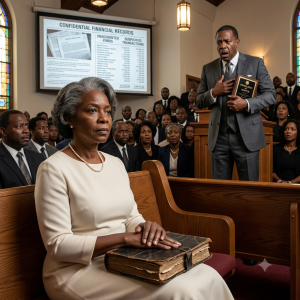
Every soul in Calvary Baptist was on their feet clapping — except Loretta Mae Briggs.
She just sat in the front pew, hands folded over that old leather journal of hers, and smiled the quietest smile you’ve ever seen on a woman.
She’d been waiting eighteen months for this exact moment.
—
Let me back up.
Loretta Mae had given thirty-one years to the IRS before she ever set foot behind a pulpit. She knew numbers the way some women know Scripture — chapter and verse, every line, every discrepancy.
When she married Gerald Briggs, she married a preacher’s voice and a preacher’s smile. The kind of man who could make a whole room feel like sunshine had walked in.
Calvary Baptist loved Gerald.
And for a long while, so did Loretta.
—
The church building fund started in 2019. Bake sales. Pledge cards. Widows putting in their grocery money. Retired schoolteachers writing checks they didn’t have to write.
Four years of sacrifice. A hundred and fourteen thousand dollars.
Gone.
And somehow — *somehow* — the paper trail led straight back to a joint account with Loretta Mae’s name on it.
She found out on a Tuesday.
Gerald found out she found out on a Wednesday.
By Sunday, he’d already spoken to the deacons.
*”Loretta’s been under a lot of stress. I hate to say it, but the finances — I’ve had to take them over completely. She’s not herself.”*
—
Most women would’ve screamed.
Loretta Mae Briggs — former GS-13 federal auditor, thirty-one years of following money through lies the way a hound dog follows a scent — Loretta did something else entirely.
She went home, pulled a worn leather journal from the bottom of her cedar chest, and started writing.
She brought it to church the very next Sunday.
Set it right in her lap, front pew, center.
People noticed. Of course they did.
“Is that your prayer journal, Sister Loretta?”
“It is,” she’d say, and smile, and never open it. Not once. Not where anyone could see.
—
Week after week, month after month, she sat in that front pew.
Smiling. Praying. That leather journal always in her hands.
Gerald preached on forgiveness. On trust. On the sin of bearing false witness.
Loretta said *Amen* with the rest of them.
She was building something, you see.
Receipts. Bank statements printed from libraries two counties over. Screenshots from a financial advisor in Memphis who owed her a favor. An email chain — oh, that email chain — that Gerald had sent from a church laptop he’d forgotten she had the password to.
Page by page, that journal filled up.
Not with prayers.
With proof.
—
The Bishop’s Award for Financial Integrity had been Gerald’s idea.
He’d submitted his own name. Wrote his own letter of recommendation, using the church secretary’s email, which everyone assumed came from the deacon board.
Loretta knew. She’d seen the metadata.
She said nothing.
She just started attending the tech committee meetings.
Volunteered to help when they installed the new projection system — the big screen Gerald had lobbied so hard for, said the congregation needed it for modern worship. She made sure she understood exactly how it worked.
Every last button.
—
The night before the ceremony, Loretta sat at her kitchen table in her housecoat and her reading glasses.
She made one phone call.
To the Bishop’s office.
Not to accuse. Not to demand.
Just to ask, *real gentle*, whether the Bishop might like to see some background documents before the service tomorrow. Something that had come to her attention. Something she’d been *praying over* for quite some time.
“Of course, Sister Briggs,” the Bishop’s assistant said. “We can look at anything you’d like to share.”
“I’ll have it ready,” Loretta said. “The Lord’s timing is always right.”
—
She wore ivory to the service.
Carried that old leather journal up the steps of Calvary Baptist like she had every Sunday for a year and a half.
Gerald was already up front, shaking hands, laughing that big warm laugh.
He didn’t look at her twice.
He never did anymore.
—
The sanctuary was full. Standing room.
The Bishop took the podium and spoke about integrity. About stewardship. About the rare and blessed gift of a man the whole community could trust with what was most sacred.
Loretta sat in the front pew.
Hands folded.
Journal in her lap.
Eyes forward.
Gerald walked up those three steps like a man who had already written the rest of his own story.
The Bishop pressed the plaque into his hands.
Flashbulbs from the church photographer.
Applause filling the rafters.
And that’s when the projection screen — Gerald’s screen, the one he’d fought the budget committee to approve — flickered.
The room went quiet.
One by one, heads turned.
And every single person inside Calvary Baptist Church saw the first page of what Loretta Mae Briggs had been carrying to services for eighteen months.
It was most definitely not a prayer journal.
Gerald’s hands went still on that plaque.
His mouth opened.
No sound came out.
And Loretta Mae — she didn’t move a muscle.
She just sat there in the front pew, in her ivory dress, with the most peaceful expression you have ever seen on a woman’s face.
—
What was on that screen was not dramatic in the way people expected drama to look.
There were no photographs of Gerald with another woman. No screaming accusations. No sermon written in rage.
It was a spreadsheet.
Clean. Precise. Color-coded in that particular way that only comes from someone who has spent three decades making federal documents hold up in court.
Column A: Date. Column B: Amount withdrawn. Column C: Account number. Column D: Corresponding transaction — boat slip rental, Tunica, Mississippi. Hotel receipts, four different cities. A timeshare deposit in Gulf Shores, Alabama. Eleven months of payments to a P.O. box in Hernando that traced back to a woman named Cynthia Rowe, who was, as the footnote on page two explained, Gerald’s administrative assistant at the satellite congregation he’d started in Senatobia without telling the deacon board.
Loretta had footnotes.
She had footnotes.
Thirty-one years of federal audit work does not leave a woman. It just waits, patient as a stone, for the moment it is needed.
The second slide showed the email chain. Gerald’s own words, sent from the church laptop at 11:47 on a Wednesday night, addressed to a Gmail account that was not his wife’s. The emails themselves were not shown in full — Loretta was a woman of dignity and she had extended Gerald more of it than he deserved — but the relevant financial arrangements were highlighted in yellow. Twenty-three thousand dollars, moved in increments small enough to avoid automatic reporting flags. A trick she recognized. A trick she had seen before, in her professional life, pulled by men who thought they were the first ones clever enough to think of it.
They never were.
The third slide was the simplest.
It was a single sentence, in 36-point font, centered on a white background.
*The building fund account has been restored in full as of Thursday, October 3rd, 2024, via certified bank transfer. Documentation available upon request. — L.M. Briggs*
—
The room did not explode the way you might think.
There was no shouting. No one fainted. Sister Paulette Washington, who was sitting three rows back and had written a check for four hundred dollars out of her teacher’s pension, let out one long breath that seemed to speak for everybody.
Gerald was still holding the plaque.
He looked at it. Then he looked at the screen. Then he looked at his wife, sitting five feet away from him in her ivory dress with her hands folded in her lap.
And Loretta Mae looked back at him with an expression that was not hatred and was not triumph and was not even satisfaction, exactly.
It was the face of a woman who had finished a very long piece of work.
The Bishop stepped away from Gerald as quietly as a man can step, which is its own kind of statement.
One of the deacons — Brother Eugene Tate, who had known Loretta for twenty years — walked to the front of the sanctuary, gently took the plaque from Gerald’s unresisting hands, and set it face-down on the communion table.
Gerald did not fight him.
He just walked down those three steps, up the center aisle, and out the double doors of Calvary Baptist into the October morning.
No one stopped him.
No one said a word to him.
Some silences are louder than anything.
—
After he was gone, the Bishop stood at the podium for a long moment.
Then he said, “I believe we owe Sister Loretta an apology and a conversation. And I believe we owe this congregation some prayer.”
And then, because the Lord works in ways that would embarrass a novelist, he asked Loretta Mae Briggs to come up and lead them in it.
She stood. She smoothed the front of her ivory dress. She carried that leather journal to the front of the church and set it on the podium, and she opened it, and for the first time in eighteen months she let people see what was inside.
The front half, the half people had assumed was all of it, was the documentation. Every receipt, every printout, every exhibit organized with the tabs and the color-coded flags of a woman who had been an expert witness in four federal proceedings and knew exactly what made evidence hold.
The back half was different.
The back half was, in fact, a prayer journal.
Because Loretta Mae Briggs had kept both things inside the same cover for a year and a half. The evidence and the prayer. The proof and the petition. Every Sunday she had sat in that front pew and she had written down what she needed God to know and she had written down what she needed the world to eventually see, and she had kept them together because, as she told the congregation that morning in a voice that did not shake even slightly, she had never once believed they were separate things.
“I did not carry this here for revenge,” she said. “I carried it because those widows wrote checks. Because Sister Paulette and Brother Eugene and every person in this room gave something real to something they believed in. And I was not willing to be the woman who let that stand unchallenged just because challenging it was going to be uncomfortable for me.”
She paused.
“The money is back. Every dollar. Gerald will face what he faces. I have given what I found to the appropriate authorities and I will cooperate fully, and then I will be done with my part of it. What I am not done with is this church. This is my church. It was my church before I ever met Gerald Briggs and it will be my church long after.”
Sister Paulette started clapping first.
Then Eugene Tate.
Then the whole room, all at once, rising to their feet the way congregations do when something true has been said out loud in a holy place.
—
Gerald Briggs was formally charged eleven weeks later. He did not contest the civil judgment. The criminal matter took longer, the way those things do, but it resolved the way that evidence like Loretta’s tends to resolve things.
Cynthia Rowe in Hernando cooperated with investigators and was not charged.
The timeshare in Gulf Shores was liquidated as part of the restitution.
Loretta filed for divorce on a Wednesday — she always did prefer Wednesdays for the difficult paperwork — and it was finalized the following spring.
—
What people talk about, when they talk about that Sunday, is not the spreadsheet or the email chain or even Gerald’s face when the screen came on.
What they talk about is the journal.
That worn leather journal that sat in Loretta Mae’s lap every Sunday for a year and a half while Gerald preached about trust and the whole congregation wondered what was written inside.
Somebody — Sister Paulette, most likely — eventually said the thing everyone was thinking.
“Loretta, weren’t you scared? All those months, sitting right there in the front row, knowing what you knew?”
Loretta Mae thought about that for a moment.
“No,” she said. “I had done the work. The work was solid. I have been doing solid work my whole life and I know what it feels like when it’s right.”
She picked up her coffee cup, the one that said WORLD’S OKAYEST AUDITOR that her granddaughter had given her as a joke.
“Besides,” she said, “I was sitting in the front pew of the Lord’s house with the truth in my lap. What exactly was there to be scared of?”
Nobody had an answer for that.
Which was, of course, the right response to a question like that from a woman like Loretta Mae Briggs.