She didn’t come back to Beaumont to get even.
She came back because her name was on the deed — and somebody had to sign the papers.
—
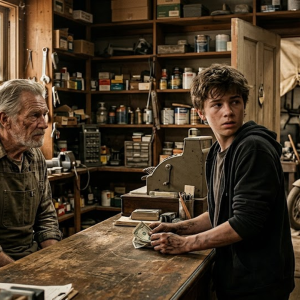
Eleven years ago, Darlene Kowalski walked out of Beaumont Hardware on a Tuesday morning in November, still wearing her orange apron, while sixteen coworkers stood frozen in the seasonal aisle watching Gerald Fitch point his finger at her face and call her a thief.
Over a four-dollar box of nails.
She had paid for them.
She had the receipt.
It was right there in her wallet — a little slip of thermal paper, creased down the middle, stained at the corner from where her travel mug had leaked on the ride in that morning. She’d bought the nails on her lunch break for a birdhouse she was building her mother for Christmas.
But Gerald didn’t want to hear that.
Gerald never wanted to hear anything from Darlene.
She was, after all, the woman his son had left at the altar six months prior. And Gerald Fitch was not a man who separated business from personal. Not ever.
So he fired her in front of everyone, said the word stealing loud enough that Patty Simmons in plumbing dropped a pipe fitting, and told her to leave her apron at the register.
Darlene folded that apron. Set it on the counter. Picked up her purse.
And she never said one single word.
—
People in Beaumont talked about that silence for years.
Some thought she was in shock. Some thought she was ashamed, even though she had nothing to be ashamed of. Patty Simmons — who felt guilty about that pipe fitting for a decade — always said Darlene’s face wasn’t the face of a woman who was broken.
It was the face of a woman who had already decided something.
Nobody knew where she went. Somewhere out west, somebody said. Her mother passed in 2019 and Darlene didn’t come back for the service, which hurt people’s feelings until they found out Gerald Fitch had sent flowers to the funeral home with his name on the card, which was the kind of thing Gerald did to remind people he was still the biggest man in the room even when it wasn’t his room.
The receipt stayed in her wallet the whole time.
Creased. Coffee-stained. Getting softer at the fold every year, the way paper does when it’s been handled enough.
She never threw it away.
She never talked about why.
—
The Beaumont Hardware building had been Gerald’s pride since 1987. His father built it. His name was on the sign out front in letters two feet tall.
By last spring, it was forty days from foreclosure.
The pandemic had hurt him. Then the big-box store out on Route 9 finished what the pandemic started. Gerald had borrowed against the building twice, and now the bank was done being patient, and his son — the one who’d left Darlene standing at the altar in her grandmother’s dress — had moved to Phoenix and wasn’t returning calls.
Gerald Fitch, for the first time in his seventy-one years, did not know what to do.
Then his attorney called him with news that rearranged his whole understanding of the last eleven years.
A buyer had come forward. Full cash offer. Not just for the business — for the building itself. For the land. For the sign out front with the letters two feet tall.
The buyer wanted a meeting.
The buyer’s name was Darlene Kowalski.
—
She walked into that conference room at First Federal on a Wednesday morning looking like somebody who had spent eleven years becoming exactly who she intended to be.
Good coat. Quiet confidence. The kind of posture that doesn’t announce itself.
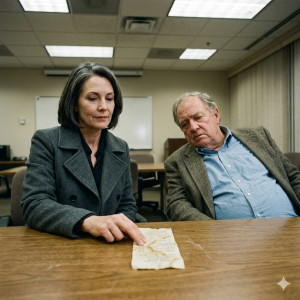
Gerald was already seated. His attorney was there. Her attorney was there. There were papers on the table and coffee going cold in paper cups and the kind of fluorescent silence that fills a room when everyone knows something enormous is about to happen.
Darlene set her handbag on the chair beside her.
She sat down.
She reached into her wallet.
And she placed that receipt on the table between them — still creased, still stained, thermal ink faded but legible after eleven years — and she laid it down flat with two fingers, the way you’d set down a card you’d been holding since the very first hand.
She didn’t say a word.
Gerald looked at it.
He looked at the date. The amount. The four-dollar line item for a single box of wire nails.
Then he looked up at her face.
And whatever was written there — whatever eleven years of silence had built up behind her eyes — made Gerald Fitch do something nobody in Beaumont had ever seen him do.
He took one slow step backward.
—
Not out of fear, exactly. His attorney would say later that it was more like a man who had walked into a room expecting a wall and found a window instead.
Gerald Fitch sat back down in his chair. He straightened his pen on the table in front of him. He did that thing men of a certain age do when they’re trying to hold themselves together in front of witnesses — he cleared his throat, and looked at the ceiling for a moment, and then looked back at Darlene.
She still hadn’t spoken.
Her attorney — a woman named Rosamund Park who had driven up from Portland specifically for this — had advised her client on this point. You don’t owe him a speech, Rosamund had said the night before over the phone. The documents say everything. Just show up.
Darlene had listened. She was good at that.
Gerald’s attorney, a local man named Hewitt who had handled Gerald’s affairs for twenty years and knew exactly what had happened in that hardware store, cleared his throat too and tapped the top page of the closing documents. He said something about proceeding when both parties were ready.
Darlene pulled the papers toward her and uncapped a pen.
Gerald watched her sign her name on three pages without a tremor, the way someone signs their name when they have been practicing it in their imagination for a very long time. Not out of hatred. Just out of certainty.
She capped the pen. Set it on the table. Aligned it parallel to the receipt, which was still sitting there between them like a small, patient witness.
And then she spoke.
For the first time in eleven years, in the context of Gerald Fitch, Darlene Kowalski opened her mouth.
She said: “I kept it because I needed to remember I was right. Not for this. Not for you. Just for me, on the hard days.”
Then she picked up the receipt, folded it once along that old crease, and put it back in her wallet.
She stood. Lifted her handbag. Buttoned the good coat.
And she walked out of First Federal into a gray March morning in Beaumont, Maine, and she stood on the sidewalk for a moment and breathed the cold air that smelled like woodsmoke and coming rain, and she felt something she had not felt in a very long time — which was simply that she was finished.
Not triumphant. Not healed, entirely. Just finished, the way a long job is finished when the last nail is in and the work is solid and you can put the hammer down.
—
What had happened in those eleven years was not magic. It was just work.
She’d gone to Portland first, then out to her cousin’s place in Boise. She got her contractor’s license the same year her mother was diagnosed. She built things — small jobs at first, decks and mudrooms and the occasional kitchen gut. She had a good eye and she was honest about timelines and she showed up when she said she would, which turned out to be rarer in that business than anyone admits.
By the time her mother passed, she had a crew of four and a reputation that spread the way good reputations do in small markets, by word of mouth and nothing else.
She bought her first commercial property in 2021. A former auto shop in Nampa that she converted into a rental space for tradespeople — welders, a custom furniture maker, a woman who restored vintage motorcycles. She understood what a working building needed because she had spent years in one.
The Beaumont property she’d found through a broker who didn’t know the history, which was fine. The history wasn’t the point, or not the whole point.
She had looked at the numbers. She had looked at the location — a corner lot on Main Street in a town that was slowly finding its way back after a hard decade. Good bones. Good visibility. The kind of building that wanted to be useful again.
The Fitch name on the sign had not escaped her attention. But she hadn’t let it be the reason. She was careful about that. She’d made herself be careful.
She was buying a building, not a grievance.
—
The sign came down on a Thursday, two weeks after closing.
She’d hired a local crew and they were professional about it, early morning, scaffolding up before most of Beaumont was awake. But word travels, and by eight o’clock there were seven or eight people on the sidewalk watching the letters come off one by one.
Patty Simmons was there. She was sixty-three now and had left Beaumont Hardware herself, years ago, and was working at the garden center out on County Road. She stood with her coffee and watched and when the last letter came down she felt the guilt she’d been carrying since that November morning finally loosen its grip on something in her chest, just slightly, the way a knot will ease when the tension finally comes off the rope.
She sent Darlene a Facebook message that afternoon. Just said she was glad she was back, and she was sorry she’d dropped that pipe fitting and walked away.
Darlene replied within the hour. She said Patty had nothing to be sorry for. She said it was a long time ago and she meant it.
—
The building reopened fourteen months later.
Not as a hardware store. As a mixed-use space — contractor supply on the ground floor, scaled back and curated and run by a guy named Marcus who had been trying to open exactly that kind of shop in that zip code for three years. Above it, two floors of affordable commercial rental units, the sort of thing that independent tradespeople and small creative businesses need and almost never find on Main Street.
There is a birdhouse above the front door.
It is well-made and slightly weathered, painted the particular dark green of old milk paint, with a small brass number four on the front panel.
Most people assume it is decorative.
It is.
But the four is not random, and Darlene knows it, and that is enough.
—
Gerald Fitch still lives in Beaumont. He is seventy-one years old and in reasonable health and he attends the eight o’clock service at St. Michael’s when the weather is good. He does not go past the building on Main Street very often, and when he does he doesn’t stop.
His son eventually returned a call, after the foreclosure was final and there was nothing left to argue about. They speak occasionally. It’s not warm but it’s something.
Gerald has never said he was wrong about Darlene Kowalski, not in any word anyone has heard. But he tells the story differently now when it comes up, which it does sometimes, the way old stories do in small towns. He says she was a good worker. He says things got complicated. He says it was a long time ago.
For Gerald, that is as close as it gets.
Some people only ever make it to the edge of the thing they owe.
—
Darlene drives up from Portland on the first Monday of every month to check on the building and meet with Marcus and walk the floors and make sure everything is sound.
She brings coffee from the place on Congress Street that she likes, in a good travel mug that doesn’t leak.
She parks in the lot in back and comes in through the side door and sometimes she will stand in the middle of the ground floor for a minute, in the smell of clean lumber and concrete sealer, and just listen to the building settle around her.
She is forty-four years old. She is not particularly interested in being an example or a lesson or a story someone tells on the internet.
But she kept the receipt.
She kept it because on the hard days, when doubt is a cold thing and the light is bad and the world is trying to convince you that you remembered wrong, it matters to be able to reach into your wallet and touch the truth.
Four dollars and seventeen cents, including tax.
Wire nails, common, one-pound box.
Paid in full.