They threw Loretta Faye Cobb out of the family catfish business the morning after she buried her husband, and for fifteen years, nobody in the Mississippi Delta expected to hear from her again.
That was the first mistake.
The second was assuming she had left empty-handed.
The day Ray Cobb was laid to rest, the sun came down hard over the churchyard, flattening every color into heat and dust. Men in white shirts stood in clumps under pecan trees, talking in low voices about pond levels, diesel prices, and who was bringing food by the house later. Women passed paper fans back and forth and pressed Loretta’s hand as if grief could be managed through touch. She heard almost none of it. Her mind kept returning to the same useless details: the way Ray’s wedding ring had left a pale band on his hand, the split in the heel of his favorite boot, the fact that she had washed his coffee cup and set it back in the cabinet out of habit the day before he died.
Ray had been gone six days.
Six impossible, unreal days.
His heart had given out in the early dark before dawn, right after he’d pulled on his work jeans and stepped onto the porch to check on a delivery. One moment he was there, broad-shouldered and alive and muttering about a lazy supplier. The next he was on the floorboards, one hand clawed around empty air while Loretta screamed his name into a morning that did not care.
Since then, everything had been noise. Casseroles. Prayers. Handshakes. Paperwork she had not been allowed to see. Brothers who suddenly acted as if being related by blood gave them a claim over every decision, every account, every acre, every memory.
Gerald Cobb had taken over the minute Ray’s body left the house.
He was the oldest, which in his mind made him right about everything. He had a way of speaking in statements so firm people forgot to ask whether any of them were true. Junior, two years younger and twice as weak in the spine, followed him the way some men follow weather: resentful, dependent, certain resistance would cost more than surrender.
Through the funeral, they had been attentive in public and efficient in private. Gerald spoke to the bank. Gerald met with the insurance man. Gerald assured everyone that family matters were under control. Junior nodded along and kept coffee in people’s hands.
Loretta, too numb to suspect how quickly control was turning into theft, let the first few hours pass without a fight.
Then came the next morning.
The farm office sat near the main ponds, a low building with sun-faded siding and a porch that always smelled like fish feed and paper. Loretta had spent half her marriage walking in and out of that office with invoices in one hand and a biscuit in the other. She knew which drawer stuck in humid weather, which light switch sparked if you slapped it too hard, and exactly where Ray hid petty cash when he didn’t want Gerald borrowing from the till. It was not her name on the deed. It was not her name on all the signatures. But it was her labor in the walls.
Gerald waited on the porch when she arrived. Junior stood just behind him, already looking guilty.
Gerald held a cardboard box.
For one disoriented second, Loretta thought someone had packed up sympathy cards from the house. Then she saw the frame edge of their wedding photograph and felt something cold settle in her stomach.
“What is this?” she asked.
“Your things,” Gerald said.
There was no invitation to sit, no effort at softness. He wore a clean button-down shirt and the look of a man handling business. Junior shifted his weight from one foot to the other but said nothing.
Loretta looked past them into the office. Her ledger book was gone from the desk. The side cabinet where invoices were kept stood half open. Somebody had already been through the place.
“Ray told me we’d sit down together,” she said slowly. “He said if anything happened, I’d be taken care of.”
Gerald’s expression barely changed. “Ray said a lot of things.”
The sentence landed like a slap.
Loretta stared at him. “What’s that supposed to mean?”
“It means,” Gerald said, “the farm stays with blood. You were Ray’s wife, and we respected that. But now that he’s gone, we need to be clear. You never really belonged in the business.”
Junior inhaled sharply as if even he heard how ugly it sounded, but he did not correct it.
Loretta felt the grief in her chest change shape. Still heavy, still suffocating, but edged now with something hot enough to keep her standing.
“Didn’t belong?” she repeated. “I balanced your feed invoices when your daddy was in the hospital. I handled restaurant orders when Ray was hauling stock. I was in the ponds with y’all after that levee break in ’97. I sat up all night for three winters figuring out which buyers were paying late. But I didn’t belong?”
Gerald’s jaw tightened. “Helping your husband isn’t ownership.”
“Neither is being born entitled,” she shot back.
His face changed then, the polite mask slipping.
“Listen to me,” he said, voice dropping low. “The land is Cobb land. The company is Cobb business. We are not about to hand control over to someone who married in.”
Someone who married in.
As if thirteen years of partnership could be erased by one funeral and a signature.
Junior finally spoke. “Best for everybody if this stays peaceful.”
Loretta looked at him with disbelief. “Peaceful?”
But the truth was already arranging itself in front of her. The brothers had talked to the bank first. They had secured the records first. They knew which accounts sat where and which documents had names she had never been permitted to read. Every time she had asked over the years to see long-term financing papers or ownership structure, Gerald had waved her off with a laugh and Ray, tired from work and conflict-averse in family matters, had told her they’d go through it later.
Later had died with him.
She could have screamed. She could have thrown the box at Gerald’s chest. She could have made a scene ugly enough to satisfy the women watching from church windows for the next decade.
Instead, Loretta did something that unsettled Gerald far more.
She went very still.
“All right,” she said.
He blinked. “All right?”
She took the box from his hands and carried it to the passenger seat of Ray’s old pickup without another word. Then she walked into the house and returned with two things: her grandmother’s cast-iron skillet and the brass key she always wore on a leather cord tucked beneath her blouse.
Gerald noticed it as she came down the porch steps.
“You still wearing that ugly little thing?” he asked.
Loretta touched the key. “Just a keepsake.”
He laughed. Junior half smiled. Neither man asked another question.
That was their third mistake.
The key had come from Ray’s father, Amos Cobb, three months before the old man died. Amos had been difficult, proud, and stingy with affection, but he had not been blind. One afternoon, after Gerald stormed off over a disagreement about expansion debt and Junior followed him like a shadow, Amos called Loretta into the smokehouse out back.
He was sitting on an overturned feed bucket, chewing slowly and breathing harder than usual.
“Come here,” he told her.
When she did, he pressed the little brass key into her palm.
“What’s this for?” she asked.
He looked toward the house to make sure nobody else had followed. “Insurance.”
She tried to hand it back. “I don’t need your insurance.”
“You don’t know what you need yet,” he said.
Then he pointed to a cedar cabinet built high in the smokehouse wall, so ordinary it blended into the boards around it. Loretta had seen it for years and never thought twice about it.
“One day paper’s gonna matter more than promises,” Amos said. “On that day, open that cabinet before you trust either of my sons.”
She almost laughed. “Ray too?”
Amos’s eyes softened a fraction. “Ray’s got the best heart and the weakest appetite for a fight. That can ruin a man just as quick.”
He made her promise not to speak of it unless the day ever came.
Then he died, and life kept moving, and the key became one of those private objects people stop noticing after they ask once or twice. Loretta wore it because it felt tied to something unfinished, not because she expected to need it. The cabinet remained closed. Ray remained alive. The warning remained abstract.
Until the morning Gerald handed her that box.
Loretta almost turned around before she left the property. Almost walked to the smokehouse, climbed onto a crate, opened the cabinet, and demanded answers while she still had the right to stand there.
But pride had a wound of its own, and humiliation moves faster than strategy. She drove away before she could think clearly, tears blurring the road and dust rolling behind her. By the time she reached the county line, all she had with her was the skillet, the box, the key, and enough hurt to remake a life around.
The first years were ugly.
She landed in Jackson with two dresses that weren’t black, a small envelope of cash, and a phone number for a cousin who couldn’t house her long. She rented a narrow room above a beauty shop and took work in a diner off the highway where truckers wanted coffee strong enough to strip paint and breakfast before sunrise. Her feet hurt. Her shoulders ached. At night she counted bills on the bedspread and tried not to calculate how long she could survive if she got sick.
Still, she worked.
Loretta had always known how to do difficult things without making them theatrical. She learned the diner menu in two days, the regulars’ tempers in four, and the owner’s bookkeeping habits in a month. When the owner complained one evening that his numbers never matched, Loretta asked to look. He laughed, then shrugged, then pushed the receipts toward her.
She found the problem in twenty minutes.
After that, the office door stayed a little more open to her.
One of the regulars, Mr. Halpern, was a retired bookkeeper with cataracts coming on and nobody at home who cared whether he talked. He spent long afternoons at the counter with decaf coffee gone cold, muttering at newspapers and solving other people’s mistakes for free. When he learned Loretta could already track invoices and vendor terms better than half the small-business owners he knew, he began teaching her the formal language of finance.
Not because she asked.
Because he recognized hunger when he saw it.
He showed her balance sheets, debt schedules, amortization, equity dilution, collateral structures. He explained how businesses died slowly on paper long before they looked sick from the road. He taught her that prideful men often mistake ownership for control and control for intelligence.
Loretta listened. She copied terms onto index cards and studied after late shifts. The same mind that once tracked feed losses and fish mortality began understanding leverage, distressed debt, and acquisition strategy. She did not become rich overnight. She became dangerous slowly.
From the diner, she moved into purchasing for a regional food distributor. From there, into logistics. Then into processing support. Each step looked small from the outside. Each step widened her view. She learned who financed farms, who insured them, who held transport contracts, who quietly serviced equipment liens after flashy owners stopped paying attention.
She also learned something else: industries talk.
A missed payment in one county becomes gossip in another. A family business refusing to upgrade aging aeration systems shows up eventually in supplier chatter. A processor pressing for different terms usually means someone upstream is struggling. Loretta never asked about Cobb Catfish directly. She did not need to. Over time, pieces drifted toward her anyway.
Gerald had borrowed hard during a good year and called it vision.
Junior had cosigned things he barely understood.
Ray’s death had removed the one person who could persuade Gerald to slow down.
The farm still operated, but thinner every season. Equipment was patched instead of replaced. Loans were refinanced. Contracts were reworked. When cash tightened, they sold bits of flexibility for short-term relief and told themselves recovery was right around the corner.
Fifteen years is enough time for a reckless business to become a bundle of vulnerable edges.
It is also enough time for a patient woman to decide exactly where to place her hands.
Loretta’s first purchase was tiny, anonymous, and made through a holding entity no one in the Delta would connect to her. A short-term note tied to refrigerated transport servicing several farms, Cobb included. The return was modest, but the position gave visibility. Later came a minority interest in a processor account. Then a distressed vendor paper package when another company overextended and sold cheap. Then a small equipment lien folded into a broader financing restructure.
No single move looked important.
Together, they formed a map.
She never lunged. She never announced herself. She let older men talk too much at conferences and younger men brag too loud at bars. She watched where pressure accumulated. She bought what desperate people offloaded first. Sometimes she waited months for a number to soften. Sometimes years.
And every time someone noticed the brass key and asked about it, Loretta smiled and said, “Just a keepsake.”
By the time she returned to the Delta, she was not the woman who had left in Ray’s pickup with tears on her face and rage in her throat. Grief had not vanished. It had matured. The humiliation had not faded. It had acquired structure.
The town noticed her within hours.
People always notice a ghost when it walks back through familiar places wearing good shoes and no visible desperation.
She stayed at a motor lodge near the highway instead of calling old friends. She bought coffee at the feed store. She drove past the ponds once in broad daylight and once at dusk. The sign out front still read COBB CATFISH in peeling blue letters. From a distance, it might have looked unchanged. Up close, Loretta saw sagging fence lines, neglected pump housing, rust spreading in the seams of things Ray would never have let go that long.
She sat in the truck a long while and let memory do what it would.
Then she drove to First Delta Agricultural Bank for the closing.
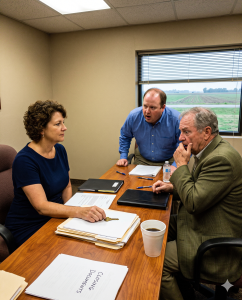
Gerald entered the conference room acting irritated, which was how he handled fear. Junior carried a folder and avoided eye contact with everyone. Their attorney had the polished detachment of a man who preferred transactions to truths. Two representatives from the acquiring group sat across from them, prepared and silent.
Loretta took the final seat.
Gerald stopped short when he saw her.
For a heartbeat, he looked almost humanly shocked. Then the old contempt returned to protect him.
“You lost, Loretta?” he said.
“No,” she replied.
Junior frowned at the bank officer. “What’s she doing here?”
The officer adjusted his glasses. “Mrs. Cobb is here in her capacity as principal.”
Gerald barked out a laugh. “Principal of what?”
Loretta said nothing. Let the folders answer.
Documents moved down the table. Pages turned. The acquiring structure revealed itself in layers. Entities Gerald had dismissed as irrelevant. Holdings he never traced because they did not bear a local name. Debt positions he had signed around in moments of stress, assuming future him would solve present him’s problems. The processor interest. The transport note. The feed contract exposure. Equipment paper. Collateral-linked options that had matured into leverage.
Junior went pale first.
Gerald read faster, then slower, then back to front as if insult alone might rearrange law.
“This is wrong,” he said.
“It is not,” the bank officer replied.
“She doesn’t have this kind of money.”
Loretta folded her hands. “Not all at once.”
He looked at her then with something close to horror.
Because the truth had become visible in the room: she had not arrived rich and conquered him in one dramatic move. She had studied him. Waited him out. Purchased the weak places his own arrogance exposed. The farm had not been stolen in a day. It had been surrendered piece by careless piece by men too proud to notice a patient buyer.
Junior licked his lips. “You bought the processor account?”
“Yes.”
“The transport note?”
“Yes.”
Gerald shoved the papers away. “This is ridiculous. A widow with a diner apron doesn’t become majority shareholder.”
“A widow who listens might,” Loretta said.
The line landed clean.
His face flushed. The attorney stared at the papers, doing private arithmetic about malpractice risk. Nobody spoke for several long seconds.
Then Gerald made the mistake that finished him.
He laughed, cruel and dismissive, reaching for the oldest version of her because it was the only one that had ever made him feel safe.
“Loretta, honey, you can’t even read a balance sheet.”
She looked at him for a moment that stretched just a little too long.
Then she reached up, unclasped the brass key from around her neck, and laid it gently across his signature line.
Junior made a strangled sound.
Gerald’s eyes locked on the key. All color drained from his face.
“You remember it,” Loretta said.
He did.
The old smokehouse.
The cedar cabinet.
The thing Amos Cobb had guarded like a second will.
“Where did you get that?” Gerald asked, but it wasn’t really a question. It was fear speaking in a familiar voice.
“Your father gave it to me,” Loretta said. “Three months before he died.”
“That cabinet burned,” Junior blurted out.
Loretta gave him a small, unreadable smile. “Did it?”
From her bag she took an oilcloth bundle darkened by age and use. She set it beside the key and untied the cord. Inside were folded original papers, some brittle, some newer, all preserved carefully. On top lay a handwritten letter from Amos Cobb, signed and witnessed. Beneath it, older ownership records, corrective filings, and a private memorandum Ray had added years later after discovering discrepancies Gerald had tried to bury.
Gerald stared as if the dead had reached through the table and put a hand around his throat.
Amos’s letter was plain, direct, and devastating. In it, he acknowledged that portions of the original farm expansion had been financed through assets brought into the marriage by Loretta and Ray jointly, including money from the sale of land inherited through Loretta’s family and reinvested into operational recovery after a flood year. He further stated his intent that if Ray predeceased Loretta, any future disposition involving key ponds, processing agreements, and the original south acreage should require review of attached equity rights that had never been fully reflected in the later corporate structuring Gerald favored.
In short, the brothers had not merely mistreated Loretta.
They had pushed out a woman whose economic stake had always been real.
Amos had known Gerald would resist. Ray had known conflict was coming. Between them, they had hidden the proof in the only place Gerald would never imagine mattered until too late.
The cedar cabinet had not burned because Loretta had opened it the night before she left the property, after all.
That was the part no one had known.
Halfway to the county line fifteen years earlier, crying so hard she could barely see, she had remembered Amos’s voice: One day paper’s gonna matter more than promises.
She turned the truck around under cover of dusk, parked beyond the barn, and crossed the back acreage on foot while the house lights glowed with company and confusion. Nobody noticed a grieving widow slipping into the smokehouse. Everyone was too busy deciding her future for her.
Inside, she climbed onto a crate, unlocked the cedar cabinet, and found the bundle.
She did not understand everything in it then.
But she understood enough to know the brothers had lied when they said she had nothing.
That discovery changed the nature of her leaving. She still left broken. Still left wounded. But she left carrying proof that the story was not finished.
Back in the bank conference room, Gerald reached toward the papers and stopped. He knew better than to touch what might damn him further.
“This doesn’t change control,” he said hoarsely, though he no longer believed himself.
The bank attorney finally spoke. “Actually, in light of these documents and the rights attached to the current acquisition structure, it changes quite a lot.”
Junior sank back in his chair as if his bones had gone loose.
Loretta looked from one brother to the other. “You told me I never belonged. Turns out I was the piece you never could get rid of.”
No one rushed to defend them. Not the bank. Not their lawyer. Not even each other.
The rest unfolded with a slow inevitability Gerald had spent a lifetime assuming would only ever happen to other men. The sale could proceed only on terms recognizing Loretta’s controlling interest and the previously concealed equity rights. The brothers were no longer negotiating from power; they were negotiating for mercy. Their personal guarantees, cross-collateralized foolishly against other holdings, left them exposed. Gerald tried bluster, then indignation, then accusation. None of it worked. Junior asked twice whether there was any way to unwind the documents. There was not.
In the end, Loretta did buy them out.
Not because she wanted the satisfaction alone, though she would have been less than honest if she denied it. She did it because the ponds still mattered. Because Ray had loved that land. Because what had been built there deserved a cleaner ending than Gerald’s vanity and Junior’s cowardice.
The terms were brutal but lawful. Gerald lost the title he had worn like a crown. Junior lost the illusion that passivity exempted him from consequence. Neither man left ruined beyond repair, but both left diminished, which was perhaps the more lasting punishment.
When the last signature dried, Gerald stood and stared at Loretta across the table.
“You planned this for fifteen years,” he said.
She considered the question. “No.”
He frowned, almost wanting the drama of being the target of some grand revenge.
“I survived for fifteen years,” she said. “Planning came after.”
That answer hit harder than anything crueler could have.
Weeks later, Loretta walked the farm at sunrise with a new manager beside her and a legal packet in her bag. The ponds caught the early light in sheets of copper. The pump houses needed work. The south levee needed reinforcing. Half the old equipment should have been retired years ago. There was debt to restructure, trust to rebuild, wages to improve, and a local reputation to scrub clean.
It was not a fairy tale ending. It was an honest one.
She kept the old sign for a while, though eventually she changed it. Not to erase history, but to correct it. The new name included Ray’s. It included hers.
The skillet still hung in her kitchen. The brass key stayed in a drawer now, its job done at last.
People in town argued for months about whether Loretta had been too harsh or not harsh enough. Some said Gerald got what he deserved. Some said family should have stayed family no matter what. A few admitted, in quieter voices, that they had believed the brothers too easily because it was simpler than looking hard at what was being done to a grieving woman in plain sight.
Maybe that was the question that lingered longest.
Not whether Loretta was right to come back.
But how many people had watched her be erased the first time and called it business.