By the time Nora Bell saw the estate sale sign nailed to a utility pole outside Tulsa, she had already spent years learning how easy it was for the world to accept a lie once enough paperwork existed to support it.
The sign was crooked, handwritten in thick black marker, with an arrow pointing down a gravel road she had known since childhood. ESTATE SALE – FRI/SAT – EVERYTHING MUST GO.
She would have kept driving if not for the photograph she had seen online twenty minutes earlier. A green cabinet in the background. Warped left door. Brass pull. A tiny white ring near the bottom where furniture polish had eaten the finish sometime in the late nineties.
It was her mother’s cabinet.
The listing gave no family name. No address she recognized at first glance. No explanation beyond “multi-family estate liquidation” and “vintage household goods.” But she knew that cabinet as surely as she knew the scar under her chin. She had knelt beside it on Christmas mornings. She had hidden school progress reports behind its serving platters when math grades came home bad. She had watched her mother stand in front of it and cry the night after the bank called about overdue taxes.
That cabinet did not belong in an anonymous sale ad.
Yet there it was.
So Nora pulled her car to the side of the road, stared at the photo again, and felt the old world start opening beneath her feet.
Seven years earlier, according to Tulsa County records, Nora Bell had died.
Not in a hospital. Not in a car wreck. Not in some flood or fire or known disaster. She had simply become, through a process so tidy it still amazed her, legally dead.
After their mother’s decline and death, Nora had been gone for years. She left Oklahoma in her late twenties with almost nothing, driven out by family pressure she could never explain in one clean sentence. The simple version was that home had become unbearable. The true version involved debt, silence, intimidation, and the kind of family loyalty that rots from the inside until nobody remembers what honesty sounds like anymore.
She drifted for a while. Amarillo. Santa Fe. Albuquerque. Waitressing, then office temp work, then billing for a medical supply company. She changed apartments often. Kept her head down. Called almost no one.
She knew disappearing came with consequences. Missed funerals. Lost connections. Unclaimed memories. But she never imagined her own sister would turn absence into death.
The truth came out at a community clinic in Albuquerque when a receptionist scanned Nora’s identification and politely asked her to sit down. Then a security guard appeared. Then a supervisor. There had been an error in the system, they said. Her social security record showed a death report. Her insurance file would not process. Her state-issued documents were in conflict with federal databases.
Nora thought it had to be a clerical mix-up.
It wasn’t.
Over the next six months, she pulled documents that made her physically shake. A petition in Tulsa County declaring her presumed deceased after prolonged absence. Supporting affidavits. Notification notices. Inventory transfers. An estate administrator’s summary. Her share of the family inheritance redirected through legal channels after “due diligence” failed to locate her.
And everywhere, directly or indirectly, Evelyn Bell.
Older by six years, Evelyn had always been the organized one, the persuasive one, the one who knew how to speak to bankers, church women, and county clerks in the exact tone that invited sympathy and lowered suspicion. As children, she corrected teachers before teachers corrected her. As an adult, she could smile at a person while taking inventory of everything useful about them.
When Nora found the filings, she first hoped Evelyn had made some desperate but honest mistake.
That hope lasted until she saw the dates.
The death declaration had come suspiciously fast after their mother’s estate opened. A dormant account their father left behind had required both daughters, or proof that only one remained. The family house had passed through probate. Some antique contents had been appraised. Small insurance proceeds were released. Acreage on the county edge sold at a price far below later market value. Within a year, Evelyn had control of everything that once required two signatures.
Nora hired a lawyer. Then another. The problem with proving you’re alive, she discovered, is that the correction itself does not automatically restore what the lie already moved. Identity could be reinstated. Records could be amended. But property, assets, transfers, and intent were a different war.
Evelyn’s attorney responded exactly as Nora feared he would: there had been no malicious fraud, only good-faith administration based on prolonged disappearance and inability to locate the missing heir.
Good faith.
Nora nearly threw the letter away in disgust.
Because Evelyn knew exactly why Nora had stayed gone. She knew the phone number Nora once used. She knew at least two places Nora had worked. She knew, more importantly, that Nora was the one person alive who could still challenge the version of family history Evelyn had spent decades controlling.
The dispute crawled through hearings and delays. Reinstatement of identity came first. Then objections. Then quiet settlement feelers from the other side. Nora refused. She did not yet know what evidence Evelyn feared most, but she knew fear when she saw it. Every time a filing got too close to discovery, another procedural stall appeared.
Then one Friday morning, while drinking burnt gas-station coffee before work, Nora saw the estate sale listing.
And drove to Tulsa.
The Bell house stood farther back from the road than she remembered, maybe because age had drawn everything inward. The sycamore by the mailbox was larger. The porch sagged more. The paint had long since surrendered. But the bones of the place were the same. The same side drive. The same cracked front walk. The same garage where their father once lined up paint cans like soldiers and cursed if anyone touched them.
Only now the yard was filled with folding tables.
People moved through her history carrying armloads of dishes and lamps. A young couple tested the drawers of an oak dresser that had belonged to her grandmother. Two teenagers laughed over a box of costume jewelry. Someone had set the family Bible near a stack of gardening magazines and priced it at four dollars.
Nora walked through it in a state that felt almost outside the body.
There was her mother’s pie safe.
There were her father’s radio repair tools.
There were embroidered pillowcases she had stitched at fourteen while her mother complained every flower leaned left.
There was the enamel basin from peach season.
The humiliation of it landed in layers. Evelyn had not only taken the inheritance. She had turned memory itself into inventory. Every object held a reduced value determined by a sticker gun and a stranger’s willingness to haggle.
Then Nora saw the ceramic rooster.
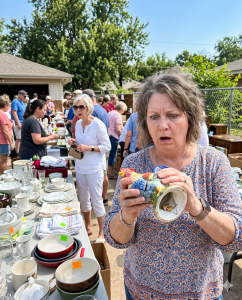
It sat on a table of kitchen odds and ends, ridiculous and unmistakable: white glaze, red comb, yellow feet, blue flowers hand-painted along the side. A crack ran down its beak. One wing had been repaired badly years earlier. Anyone else would have thought it worthless.
But Nora’s pulse stumbled the moment she saw it.
The rooster had belonged to her grandmother, who took a ceramics course in the sixties and brought home several pieces the family teased forever. After Grandma died, Nora’s mother kept the rooster on top of the refrigerator. People stuffed receipts beneath it, tucked coupons under the base, joked about throwing it out every spring and never did.
When Nora was nineteen, she took it down late one night and hid a note inside.
The memory returned with almost painful clarity. Her father had recently sold a narrow strip of inherited land. The family was drowning in debts no one discussed openly. Her mother cried in secret. Evelyn and their father whispered behind closed doors, stopping whenever Nora entered. One evening Nora overheard enough to piece together something ugly: part of the deed money had not gone where it was supposed to go, and Evelyn knew. More than that, she had helped reshape the story being told to their mother.
Then came the sentence Nora heard in the kitchen doorway that changed how she saw the entire house.
“If she repeats any of it,” Evelyn said, calm as weather, “nobody will believe her before they believe us.”
Nora had gone to her room, shaking so hard she could barely hold a pen. She wrote names. Dates. Amounts. What she heard. What her mother later admitted through tears and denial. She folded the paper into a tiny square and hid it inside the ceramic rooster because she did not know what else to do with knowledge that dangerous.
Years passed. Fights shifted. Her father died. Her mother hardened. Nora left. The note became one more buried thing.
Until now.
She picked up the rooster and turned it over. The felt circle once covering the base opening was gone. She slipped her thumb inside and felt it immediately.
Paper.
Still there.
A brittle folded scrap, tucked exactly where her younger self had hidden it thirty years earlier.
Everything around her blurred.
If the note remained legible, it would not single-handedly win every legal dispute. But it would do something even more important: establish a pattern. It would show Evelyn’s manipulation did not begin with the death declaration. It would connect the inheritance fraud to older acts of concealment, family coercion, and financial deceit. It might force discovery where denial had always been enough.
Nora set the rooster carefully into a shopping basket and covered it with recipe cards.
Then she heard the gate open.
“I’ll take whatever’s left,” a woman’s voice called from the front. “I’m the one who donated it all.”
Nora froze.
Evelyn.
She hadn’t seen her sister in over a decade, but the voice was untouched—warm, measured, gracious at a distance and ice-cold up close. Nora moved behind a table of hardbacks and looked toward the porch.
Evelyn stood by the cashier in white capris, large sunglasses, and a pale blouse that probably cost more than Nora’s weekly groceries. She wore the expression of a woman performing burden nobly. Someone said, “It must be hard letting family things go.”
Evelyn gave a soft laugh. “At some point you just have to accept no one’s coming back for them.”
Then her gaze drifted over the yard and landed on Nora.
For one pure second, the mask slipped.
Evelyn did not look confused. She did not look uncertain. She looked as if she had seen a body sit up in a coffin.
The cashier kept talking, but Evelyn didn’t answer. Color drained from her face before she recovered and leaned closer to the register, speaking low. The cashier looked toward two men near the garage. They straightened.
Nora understood immediately: Evelyn wanted her watched, delayed, perhaps cornered until she could decide what story to tell.
But Nora had not spent seven years clawing her way back into legal existence just to panic now.
She left the basket on the table, pulled the rooster under her arm inside an old cardigan she’d tied around her waist, and moved through the shoppers toward the far side yard. One of the men started after her. Nora ducked behind a card table, passed a woman carrying lampshades, and slipped through the narrow gap between the garage and fence.
The side door of the house stood open.
Without thinking, she went inside.
The kitchen was smaller than memory and sadder than she expected. Wallpaper peeled at the seams. The old phone nook was gone. But the room still held traces of every fight, every holiday, every silence stretched too long across chipped plates.
Footsteps sounded behind her in the side hall.
“Nora.”
Evelyn stood in the doorway.
Up close, the years showed. Fine lines around the mouth. Tightness in the jaw. But the essential force of her remained untouched—the same stare that used to make school secretaries apologize when Evelyn was the one at fault.
“You need to leave,” Evelyn said softly.
Nora almost laughed. “I was dead, remember?”
Evelyn’s throat moved. “You don’t understand what this looks like.”
“I understand exactly what it looks like. You sold my death before you sold the furniture.”
“That is not what happened.”
“Then why are you pale?”
For a beat, neither woman moved. Then Evelyn’s eyes dropped to the bundle under Nora’s arm.
“What did you take?”
Nora pulled out the rooster.
Something shocking happened then: genuine fear broke across Evelyn’s face.
Not annoyance. Not anger. Fear.
Nora saw it and knew she’d been right all along.
“You remember this,” Nora said.
Evelyn recovered quickly. “It’s junk.”
“Then why do you care?”
“You’ve been gone for years. You abandoned this family. Mother died thinking—”
“Don’t.” Nora’s voice cracked sharp enough to stop the room. “Do not use her now.”
Evelyn stepped closer. “Give me the rooster.”
The directness of it was almost a confession.
“No.”
“It belongs to the estate.”
“I’m the estate,” Nora said.
That landed.
Evelyn’s expression hardened in a way Nora remembered from childhood, the final form beneath all the polite surfaces. “You have no idea what you’re doing.”
At that, Nora smiled for the first time all day. “I think I finally do.”
She backed toward the mudroom door, one hand already in her bag for her phone. “I came here wondering whether you really believed your own lies. Now I know you don’t.”
“You can’t prove anything from an old trinket.”
“Maybe not,” Nora said. “But you looked scared before you even knew whether it was empty.”
And that was the mistake.
Evelyn lunged—not violently, not wildly, but with the swift desperate reach of someone trying to intercept disaster. Nora stepped back. The rooster slipped in her hands, hit the edge of the washing machine in the mudroom, and cracked wide open against the floor.
Both women stared.
Inside the shattered ceramic body lay a tight, yellowed fold of paper.
For a moment neither moved.
Then Nora bent first, snatched it up, and unfolded it with shaking fingers.
The writing was faded but readable. Her own. Younger, angrier, cramped. Names. Dates. References to the land sale. The amount missing. A line about the account. A line about hearing Evelyn tell their father they could “fix the story before Mother asks more questions.” And at the bottom, a sentence she had completely forgotten writing:
If anything happens and I disappear, start with Evelyn. She knows where the money went.
The room went silent except for both of them breathing.
Nora looked up.
Evelyn stood frozen, her face so stripped of performance it seemed almost unfamiliar.
“That note proves nothing,” she said, but the force had gone out of her voice.
“It proves you were lying long before I left.”
“It proves you were dramatic at nineteen.”
“It proves why you needed me dead.”
That one hit cleanly.
Evelyn looked away first.
The sound of voices from the yard drifted in through the screen door. Somewhere outside, someone laughed over the price of a lamp. The ordinary world continued as if this kitchen were not finally cracking open around its oldest secret.
Nora lifted her phone and photographed the note front and back. Then the broken rooster. Then Evelyn standing in the kitchen with the panic she could no longer hide.
“You think anybody will care?” Evelyn whispered.
Nora met her eyes. “A court will.”
For the first time in her life, Evelyn looked small.
Not harmless. Never that. But small in the way powerful people do when the story they control slips out of their hands. She sat heavily in one of the kitchen chairs as though her knees had failed.
“I did what I had to do,” she said after a long moment.
Nora let that hang in the air between them.
Had to.
Not grieved. Not misunderstood. Not accidentally believed.
Had to.
There it was—the closest thing to truth Evelyn had ever offered.
Nora called her lawyer from the mudroom before she even reached the car. Then she called the county sheriff’s office and requested an officer to take a statement regarding ongoing estate fraud and unlawful transfer of assets connected to a prior false death declaration. By sunset, copies of the note were in three inboxes and one evidence envelope.
The legal fight that followed was every bit as ugly as promised.
But this time Evelyn was the one on defense.
The note did not solve everything on its own. Real life never works that neatly. Yet it opened doors that had stayed shut for years. Subpoenas followed. Banking records surfaced. Probate communications were reexamined. Prior financial discrepancies involving the land sale were connected to later misrepresentations in the estate filings. Witnesses who once brushed things aside became less comfortable under oath.
And eventually, the shape of what Evelyn had done became too visible to hide under “good faith.”
Civil judgments came first. Assets were frozen. Property transfers challenged. Portions of the estate were clawed back. The county referred parts of the matter for criminal review related to false statements and fraudulent filings. Even before the cases fully resolved, Evelyn’s carefully curated standing in town began to collapse under the weight of details she had once counted on nobody pursuing.
As for the Bell house, it was sold properly months later under court supervision. Not in secret. Not through a fake tidy ending. Nora walked through it one final time before closing. The rooms felt smaller, but not haunted in the same way. She took only a few things: the green cabinet, the embroidered pillowcases, the enamel peach basin, and the cracked remains of the ceramic rooster in a padded box.
The note stayed in protected storage after that, but the rooster pieces remained with her.
Sometimes what saves you is not something grand. Not a witness arriving at the perfect moment. Not a dramatic confession. Sometimes it is a foolish old object nobody values enough to destroy. A cracked beak. A hollow center. A younger self who, in the middle of fear, decides to leave evidence behind just in case the future ever comes looking.
Years later, when people asked Nora what the biggest red flag had been, she never said the probate filings or the money trail or the polished lies.
She said this:
The most dangerous person in a family is often the one who sounds the calmest while erasing you.
And the hardest question was never whether Evelyn deserved forgiveness.
It was whether the rest of them had seen enough to stop her sooner—and simply chose not to.