The front office had changed since the last time Marisol Vega had crossed those doors. The paint was softer, the furniture more expensive, the walls lined with framed student artwork chosen carefully enough to look spontaneous. The school had always been good at appearances. Warmth curated into prestige. Kindness polished until it gleamed.
But buildings have memories even when people pretend not to.
As she entered the administrative wing, her attorney kept pace beside her, one hand on a folder thick with documents. Marisol held something much smaller in her left hand — a faded prayer card laminated in cloudy plastic, the saint’s face almost worn away from years of handling. The edges had softened with time. It looked ordinary. Fragile, even.
It was neither.
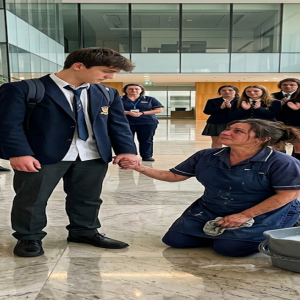
Fifteen years earlier, she had clutched that same card while two security guards escorted her across campus and out to the parking lot after she was accused of stealing from the cafeteria fund. She still remembered the shame of that walk more vividly than she remembered her own wedding day, more sharply than the births of either of her sons, more clearly than some of her greatest triumphs.
Humiliation brands itself into the body.
She remembered the smell of asphalt warming in the sun. The pressure of her apron knot still tied around her waist because no one had given her a chance to remove it. The line of idling SUVs in the carpool lane. Parents trying not to stare and staring anyway. A little girl from second grade crying because she thought someone was taking Miss Marisol to jail.
No one had defended her loudly enough to matter.
By the end of that day, she was jobless, disgraced, and too broke to hire the kind of lawyer that could force a private school to admit it had made a very public mistake.
She had gone home with a cardboard box of belongings, swollen eyes, and the prayer card her abuela had once placed in her palm.
Hold this when people try to make you doubt what God already knows.
At the time, those words had felt like comfort. Later, they became a challenge.
Before that day, Marisol had spent eleven years working in the cafeteria at Saguaro Ridge. She was more than a lunch lady and everyone knew it, especially the children. She remembered which students had severe allergies and which ones just claimed to. She knew who hated milk cartons, who broke into hives if the cookies were near walnuts, who pretended to be brave after their parents’ divorce and fell apart if someone handed them extra fruit with a smile.
She made fresh rice every morning because she refused to serve instant rice. “That isn’t food,” she used to tell the kids. “That’s beige.”
The students loved her. Former students came back to visit her after graduating, and not out of obligation. They came back because she had seen them. Because she had noticed when they were lonely, celebrated when they won things nobody else thought were important, and fed them with the kind of care children never forget.
Most adults at the school respected her.
One did not.
Pamela Hartwell was Saguaro Ridge royalty. Head of the booster club. Major donor. Frequent chair of committees that somehow always seemed to matter more than other committees. She had money, family connections, social control, and the kind of confidence that comes from moving through life with very little resistance. She spoke in a polished, patient tone that made cruelty sound administrative.
Pamela never liked Marisol. Nobody could fully explain why at first, though several teachers suspected Pamela resented how naturally beloved Marisol was. Admiration that can’t be bought often irritates people who are used to purchasing the room.
Pamela hosted galas. Marisol comforted children. Only one of those women was unforgettable.
The accusation began with numbers.
Pamela claimed there were small but repeated discrepancies in cafeteria funds. Tiny amounts, easy to miss individually but suspicious in total. She came to the headmaster with printed records, highlighted entries, and a grave expression that signaled disappointment more than outrage. That was part of what made her so effective. She didn’t seem emotional. She seemed responsible.
The documentation looked neat.
Too neat, as Marisol would later realize.
Dates didn’t line up. Certain initials were copied in a different pen than the originals. One signature was meant to be hers but used a surname she had not legally had at the time. Anyone patient enough to scrutinize the records could have picked them apart.
But institutions under pressure rarely choose patience when hierarchy offers them a simpler story.
Pamela was credible. Marisol was not considered the sort of employee whose word required deeper investigation. There was a meeting. There were tight faces, vague references to fiduciary trust, and a request that Marisol turn in her keys immediately.
She denied everything.
The headmaster looked pained. The business manager avoided her eyes. Pamela sat with folded hands and that expression women like her wear when they have already decided the moral burden of what comes next belongs to everyone except them.
Then security was called.
Marisol had not stolen one cent.
What she had done, though she hadn’t understood the danger of it yet, was notice.
For weeks before her firing, she had been tracking irregularities in the fundraiser cash process. Not formally, not as an investigator, just as someone who had spent years around family businesses and knew when money moved in ways it shouldn’t. Envelopes were arriving light. Lockboxes were opened when they shouldn’t have been. Once, while carrying trays past the office after a spring fundraiser, she had glimpsed Pamela taking an envelope from the cash box and slipping it into her tote before anyone else entered the room.
Marisol had written down dates and amounts on the back pages of an old carbon-copy receipt book she kept in her bag. It wasn’t much, but it was enough to tell her she wasn’t imagining things.
The morning she was fired, her tote bag disappeared into the office for several minutes before being returned.
Later, when she unpacked at home, the prayer card was inside.
One page of notes was not.
At first she thought the loss was just one more indignity in a day full of them. Only later did she understand the theft had been targeted.
Pamela hadn’t just framed her.
Pamela had removed the only written record suggesting someone else had been siphoning money long before Marisol was blamed for it.
That realization might have broken a weaker person.
Instead, it redirected her.
Marisol was the youngest daughter of a restaurant owner in Chandler who had built three successful businesses from almost nothing. She grew up hearing inventory discussions over dinner and vendor arguments before dawn. Her father believed ledger books told the truth people were afraid to say aloud. He taught her that margins mattered, receipts mattered, and pride was useless unless you could back it up with numbers.
After losing the school job, Marisol went home, cried for one weekend, and then started cooking.
At first it was just catering trays from her kitchen — arroz rojo, roasted chicken, tamales at Christmas, giant pans of enchiladas for christenings and funeral receptions. People remembered her food. They remembered her warmth. They told their cousins. Then their churches. Then their offices. Her little operation grew too large for her house, so she rented commercial kitchen hours. After that came a food truck. After that, a restaurant.
She worked like someone who had been publicly humiliated and intended never to be cornered again.
The first restaurant succeeded. The second did better.
At a charity dinner years later, a developer named Ezra Cole watched her manage donors, staff, and a kitchen delay without dropping her smile once. When the event was over, he found her near the loading dock and said, “You know the people making money off these buildings aren’t the ones inside them. You should be on the other side of the table.”
Most people would have taken that as a compliment and moved on.
Marisol took it as homework.
She began asking questions about leases, parcels, financing, zoning, and redevelopment. She embarrassed herself often at first. She trusted the wrong person once and lost money on a small deal. She learned from it. Then she made money. Then more. She partnered carefully, read obsessively, and discovered she had an excellent instinct for underpriced properties and overconfident men.
She kept her restaurant businesses. She expanded her holdings. She became, quietly, someone very difficult to dismiss.
And all the while, she kept one ear open for Saguaro Ridge.
Not because she spent her life plotting revenge. That would have consumed too much oxygen. She built too much, loved too many people, and came too far for revenge to be her only fuel.
But she did believe in unfinished accounts.
So when word circulated in discreet channels that the family trust behind Saguaro Ridge was preparing to sell the real estate parcel beneath the campus through a private, invitation-only process, Marisol paid attention. The school itself would continue to operate under a leaseback arrangement, but ownership of the land would transfer. It was the kind of transaction that rarely reached public discussion. The people involved preferred it that way.
Marisol had been waiting for a door like that.
She assembled financing. She structured partnerships. She prepared for four years, long enough that by the time the auction committee invited bids, she was not reaching. She belonged there as much as anyone else in the room.
On the day of the meeting, she chose a charcoal blazer and low heels she could stand in comfortably. Her attorney, Daniel Price, met her at the entrance with the documents. She carried the prayer card herself.
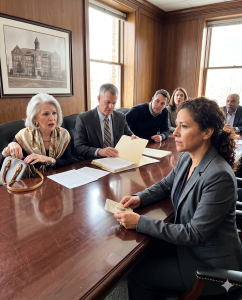
The conference room was cool and overlit. Developers in tailored sport coats glanced at their phones while pretending not to assess one another. Water pitchers sat on a sideboard. Committee members arranged papers in front of them with elaborate calm.
And there, seated at the head of the committee table, was Pamela Hartwell.
Older now. Silver-haired, perfectly dressed, posture still regal. Time had refined her but not softened her. She still looked like someone who expected every room to adapt itself around her.
For one brief second, Marisol wondered whether Pamela would recognize her.
Then Pamela looked up.
Recognition struck instantly.
Marisol saw the whole progression in her face — dismissal, confusion, certainty, then something that looked dangerously close to fear.
Marisol took her seat and set the prayer card on the table.
She didn’t explain it. Didn’t perform for the room. She just placed it in front of her and folded her hands.
Most of the men in the room never noticed.
Pamela did.
Her gaze dropped to the card and stayed there.
Color drained from her face so fast the committee member beside her leaned over and murmured, “Pamela, are you alright?”
Pamela didn’t answer.
Because that card should not have been meaningful to anyone but Marisol — unless someone remembered exactly what had gone missing from Marisol’s bag the day she was fired.
Marisol waited.
She had become extraordinarily good at waiting. Waiting had built businesses. Waiting had helped her outgrow anger and sharpen it into judgment. Waiting had taught her when silence was more dangerous than accusation.
Finally she leaned forward and said, softly enough that only Pamela could hear, “I believe you still have something that belongs to me.”
Pamela’s hand moved before her expression could stop it.
Straight to her handbag.
Daniel saw it. So did a board member across the table.
The room changed.
Marisol nodded once to Daniel, and he opened the thick folder.
He began sliding documents onto the table one by one.
A scanned copy of the original cafeteria ledgers. An independent forensic review identifying altered entries. Archived email printouts showing Pamela had accessed and reprinted financial logs before presenting her “evidence.” Bank records tied to deposits that never matched official fundraiser totals. And then, perhaps most devastating of all, a notarized statement from Edith Larkin, the former administrative assistant who had processed staff terminations the year Marisol was fired.
Edith was retired now. She had cancer. And according to her statement, she had remained silent for fifteen years because she feared losing the job that paid for her husband’s treatment. But silence had become unbearable. In the statement, she swore that the morning Marisol was fired, Pamela had entered the office alone, removed papers from Marisol’s tote bag, and instructed Edith to “make sure nothing unnecessary is returned.”
There was more.
Months before the meeting, Marisol’s team had tracked down an estate liquidator handling the contents of a storage unit once rented by Pamela’s late brother-in-law. Inside a filing box of old family papers, forgotten and unsorted, was a school fundraiser packet from that same year. Tucked inside it had been a folded carbon-copy page from a receipt book.
Marisol’s notes.
Dates. Missing amounts. And one circled line: Saw P.H. remove envelope from spring auction lockbox at 2:17 p.m. Blue tote. No witness.
Pamela must have hidden the page, then lost control of where it ended up during some later household shuffle. Fate, age, carelessness — whatever the cause, it had surfaced at last.
Daniel placed the recovered page on the table.
The room went dead silent.
Pamela’s fingers tightened around her bag so hard her knuckles whitened.
“You have no idea what you’re doing,” she said.
But the old certainty was gone. Her voice thinned at the edges.
“I think we do,” Daniel replied.
A committee member asked Pamela, carefully, what was in her bag.
She laughed once. It sounded brittle. “This is absurd.”
Another committee member — the sort of man who had spent years nodding along to Pamela’s leadership — said, “Then open it.”
For a second Marisol thought Pamela might bolt. Not literally, not in a dramatic movie way, but she could see the animal panic flickering behind the woman’s eyes, the instant calculation of whether power could still talk its way out of evidence.
Slowly, Pamela unzipped the bag.
Inside was a narrow leather document sleeve.
She hesitated.
“Please,” said the current headmaster, who looked as though he had aged a decade in five minutes.
Pamela drew the sleeve out and set it on the table.
Daniel opened it.
Inside was the original missing receipt-book page’s top carbon sheet — the cleaner copy, the one Marisol had written on first — along with several old fundraiser envelopes and a memo draft never sent. The memo was the final blow. It had been typed by Pamela and saved for reasons no one in the room could explain except arrogance. In it, she outlined “concerns” about Marisol and suggested that “isolated cash discrepancies may offer a necessary path to resolution” before the spring audit “draws attention elsewhere.”
Elsewhere.
Meaning Pamela.
Meaning the accusation had not just been false. It had been strategic.
The headmaster sat back slowly as if someone had struck him.
One of the developers muttered, “My God.”
Pamela tried to speak, then tried again. “I was protecting the school.”
Marisol stared at her.
From what? she wanted to ask. From embarrassment? From scrutiny? From a donor scandal? From the inconvenience of being caught?
But she didn’t ask, because Pamela was not a woman who confessed for truth. She confessed only when every exit sealed shut.
“You were protecting yourself,” Marisol said.
The words landed with more force because they were quiet.
Pamela’s eyes flashed. For the first time in all the years Marisol had known of her, the woman looked small.
Committee counsel was called into the room. The bidding process was suspended. Phones came out. Doors closed. Voices dropped into urgent legal tones. Someone asked Pamela to remain seated. Someone else asked Daniel for copies of everything. The current headmaster approached Marisol and began apologizing before he even reached her, but she lifted a hand.
Not yet.
She did not want a trembling institutional apology delivered in panic. She had waited fifteen years. She could wait ten more minutes for the truth to finish arriving properly.
Within the hour, Pamela was removed from the committee and asked to leave the premises under supervision so no records could disappear. It was not the same as the walk Marisol had endured, and perhaps that was good. Marisol did not need symmetry. She needed truth visible enough that nobody could polish it back into something more comfortable.
The school board initiated an emergency review. Their outside counsel recommended immediate contact with law enforcement and financial investigators. Former employees were called. Archived files were pulled. Within days, more irregularities surfaced in old fundraising accounts, none large enough individually to attract serious scrutiny, all of them ugly in aggregate.
The official statement came two weeks later.
Saguaro Ridge Academy publicly acknowledged that Marisol Vega had been wrongfully terminated based on falsified evidence. They apologized unreservedly. They announced a full independent review of past financial practices. Pamela Hartwell resigned from every affiliated role before formal removal procedures could conclude.
The statement was formal.
The fallout was not.
Parents were furious. Alumni flooded social media with memories of Marisol’s kindness and disbelief at what had been done to her. Former staff members came forward with stories about Pamela’s manipulation, intimidation, and carefully managed influence. The old power structure at the school cracked open in the bright light of collective hindsight.
The board offered Marisol a private meeting, a public apology event, and a financial settlement.
She accepted the settlement after Daniel made sure it included language she wanted. Not just compensation. Corrective action. Scholarship funding for cafeteria workers’ children. Protections for non-administrative staff facing internal accusations. Independent review procedures that could not be bypassed because a donor was “trusted.”
She accepted the apology event, too, though she insisted it be held in the cafeteria.
That was where the wound had started.
When she walked back into that room a month later, dozens of former students had returned. Some were adults with children of their own. Some cried before she even spoke. The school had arranged flowers and a podium. Marisol ignored both.
She stood near the old serving line and told the truth.
She said humiliation can make people disappear if they let it. She said people in power often gamble that working women, immigrant women, women without immediate resources, will be too tired or too ashamed to ever come back. She said they count on time to help bury what they did.
Then she looked at the students, the staff, the parents, the board.
“And sometimes,” she said, “time does something else.”
After the event, one of the younger kitchen employees approached her quietly and said, “I thought people like us never win.”
Marisol held her gaze. “Sometimes we don’t,” she said honestly. “But sometimes we keep going long enough to become something they never planned for.”
As for the land parcel, the school’s sale was delayed during the investigation. Months later, after the board restructured and the legal dust began to settle, Marisol’s group acquired it anyway under revised terms. She did not evict the school. She offered them a stable long-term lease at fair market rates with certain accountability conditions built in.
That choice confused some people.
Why help them stay?
Because ownership, she had learned, was not just about revenge. It was about deciding what kind of person power turns you into.
Pamela disappeared from public school life almost overnight. Rumors swirled, as they always do. Some said she had legal exposure. Some said her family urged her to settle quietly. Some said she still insisted she had done what was necessary. Marisol didn’t chase those rumors. Pamela no longer occupied that kind of space in her mind.
What mattered was simpler.
The lie had been named.
The record had been corrected.
The woman they tried to erase now owned the ground beneath their feet.
At home that evening, after the final paperwork was signed, Marisol sat alone at her kitchen table with a cup of tea gone lukewarm. She placed the prayer card in front of her and ran her thumb along its worn edge.
She thought about the girl in the carpool lane who had cried when security walked her out. She thought about her abuela. Her father. The receipt-book page. The years it took. The cost of patience. The strange way justice rarely arrives looking like the fantasy you imagine when you’re hurt.
It had not come with shouting.
It had come with records, survival, discipline, and the refusal to disappear.
Maybe that was the red flag all along: how easily an institution believed a powerful woman with polished lies over a working woman with no shield but her own truth. Or maybe the deeper question was harder — how many people had sensed something was wrong and told themselves silence was practicality.
Marisol turned the prayer card over in her hand and thought about forgiveness.
She wasn’t sure Pamela deserved it.
She wasn’t sure forgiveness and release were even the same thing.
What she knew was this: some people mistake kindness for weakness because they have never met a kind person who can also wait them out.
Pamela Hartwell had.
And by the time she understood that, it was far too late.