Every morning for three weeks, Margaret left the biscuits without saying a word.
She never told anyone she was doing it. She did not mention it to the circulation staff, did not write it down in the little notebook where she tracked building issues, and certainly did not tell the board members who liked to speak grandly about community outreach while rarely setting foot in the building before noon. It was a private thing, a small act done on instinct, and after thirty-four years as head librarian at the Savannah Public Library on Bull Street, Margaret trusted her instincts more than most official policies.
The first morning she saw the boy, she thought perhaps she had made a mistake.
It was just after 7:15, and the library was still in that tender state between darkness and duty. The automatic lights had come on in sections. The air-conditioning hummed with sleepy inconsistency. Outside, Savannah was only beginning to stir. Inside, the periodicals room carried the clean-paper smell Margaret had loved for decades.
That was where she found him.
He was asleep in the corner chair behind the atlas stand, partially hidden from the main aisle. One arm was wrapped around a black backpack. His shoes were planted awkwardly on the carpet as if he had sat down intending to stay awake and simply failed. The morning light came through the windows in a low gold band that touched one side of his face.
Margaret did not wake him at once.
She stood at a distance and observed, the way librarians learn to do after a lifetime of understanding that information usually reveals itself if you are patient enough. The boy looked young—sixteen, maybe seventeen. There was nothing openly alarming about him. No signs of intoxication, no disorderly mess, no obvious trouble. But there was something in the way he slept that reached her immediately.
He was not resting.
He was collapsed.
When she finally made enough noise shelving newspapers to stir him, he woke with the kind of start that spoke of someone who was used to sleeping lightly and still never getting enough of it. He looked around with instant alarm, then tightened his grip on the backpack.
Margaret said only, “We open at eight.”
He nodded once. No excuse. No attitude. Just a guarded glance and a silence that hung around him like a coat.
The next morning he was there again.
Same chair. Same backpack. Same exhaustion.
By the third morning, Margaret had already made a decision.
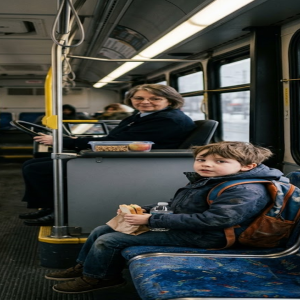
She stopped at Clary’s Café on her way in and bought a biscuit. Ham and egg. Warm enough to fog the paper bag. She placed it on the chair beside him and went about unlocking the returns desk without a word.
He did not acknowledge it while she was nearby. But by 8:30, the bag was empty.
The next day she brought two biscuits.
The day after that, she added a small carton of orange juice.
Margaret understood pride. She also understood hunger. There were ways to help that cornered people, and ways to help that left their dignity intact. She chose the second.
Over the next week, she learned the outline of him without asking for the details. He came early and left late. He rarely spoke. He kept himself clean as best he could, though his jacket cuffs were frayed and his shoelaces had been tied in tiny knots where the ends had split. He read like a person searching for something specific, not like a student killing time. Some days it was newspapers, especially local sections from years back. Other days it was old city directories, architectural books, microfilm records, and library planning binders no teenager would ordinarily touch.
Margaret took note.
She noticed him pausing near the east corridor more than once. She noticed him studying the old framed building maps near the history room. Once she caught him counting doors under his breath.
On a Tuesday morning, as he slept, a student ID slipped halfway out of his backpack pocket.
Marcus J.
Margaret didn’t move closer. She didn’t need to. The name was enough.
That afternoon, she filled out a library card and left it tucked beneath the biscuit bag the next morning.
By lunchtime it was gone.
The first time Marcus actually spoke to her, it was only one word.
“Thanks.”
He said it without looking directly at her.
Margaret answered the same way she answered anyone asking for a pencil sharpener or a newspaper archive reel. “You’re welcome.”
No soft tone. No pity. No questions.
After that, the silence between them became less defensive. He still kept most of himself protected, but he no longer looked ready to bolt every time she crossed his path. Sometimes she saw him writing in a spiral notebook. Sometimes he copied floor plans from old renovation documents with such concentration that he seemed to forget the world around him.
Then came the map.
Margaret found it folded near his chair, so precisely creased that she knew at once it was no accident. Inside was a hand-drawn layout of the entire library, rendered in blue ink with remarkable accuracy. It included corners most visitors never noticed and utility hallways most staff forgot existed.
One room was circled in red.
The archive room off the east corridor.
Margaret stared at it long enough to feel the first real unease move through her.
The archive room had been closed since the 2022 renovation. That was the official explanation. HVAC complications. Incomplete environmental controls. Liability issues. Facilities delays. It was the sort of bureaucratic fog old institutions produced whenever no one wanted to answer a simple question directly.
Margaret had accepted it because she had other things to run, budgets to defend, books to save from being discarded by cheerful consultants with no understanding of what communities actually kept alive.
Still, she folded the map and kept it.
Something in her told her Marcus had meant for her to see it.
Days passed. She continued bringing breakfast. Marcus continued arriving before opening. Yet there was a new alertness in him now. Twice she saw him glance over his shoulder. Once he closed his notebook so quickly when footsteps approached that Margaret knew he was hiding more than doodles or homework.
Then, on a Thursday morning, he was gone.
The absence struck Margaret instantly.
The chair behind the atlas stand was empty. Not just temporarily abandoned, but empty in a deeper way. No backpack. No folded jacket. No signs he had been there at all. The space felt wrong, as though a sentence had been cut off in the middle.
Margaret did what sensible people do when something unsettles them: she tried to continue her day.
She answered reference questions. She approved a volunteer schedule. She corrected a mislabeled genealogy file. She listened with half an ear while a donor called to ask why her husband’s memorial plaque hadn’t been moved to a brighter wall.
But Marcus’s absence sat under everything.
By ten o’clock she found herself drawn to the old burgundy dictionary stand in the reference section. Margaret had a habit, one known only to herself, of opening the dictionary to the M’s whenever she needed to think through a problem. She could not have explained when the ritual began. Over time it had simply become part of how she steadied herself.
When she opened it that morning, a folded note slid free.
Ms. Margaret, the front read in careful handwriting.
Inside, only two lines:
Thank you. Please don’t tell anyone. Check the map.
Margaret stood very still.
Then she took the map from her cardigan pocket and went to the east corridor.
The hallway was quiet and faintly cool. Framed photographs of old library expansions lined the wall. The archive room door waited at the end, old wood painted over so many times the panels had softened. The brass handle had gone green at the edges.
Margaret expected resistance when she turned it.
Instead, the handle moved easily.
The door opened into dimness.
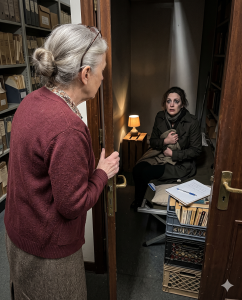
At first she could not understand what she was seeing. The room should have been stale storage, boxed records, abandoned shelves. Instead it held the unmistakable signs of habitation. A folding cot from the supply closet. A blanket tucked with military precision. Three milk crates full of donated paperbacks. A lamp plugged into an extension cord. On a crate lay toiletries, a half-empty bottle of water, and a library card under a pillow as if it mattered enough to be kept safe while sleeping.
Then someone sat up on the cot.
Margaret’s breath left her.
It was Denise Calloway, the library’s assistant director.
For twelve years Denise had been a model of polished administration. She wore tailored blazers, spoke beautifully at donor lunches, and could thank sponsors in language so smooth it made stinginess sound noble. She had built a reputation on phrases like strategic community engagement and operational sustainability. She was also the person who had signed every memo explaining why certain programs had quietly lost funding.
Margaret had never trusted her entirely, but she had never imagined this.
Denise looked exhausted. Her makeup was gone. Her hair, usually immaculate, was pulled back in a loose, hurried knot. There were shadows under her eyes deep enough to make her seem older by a decade.
“Margaret,” she whispered, as if the name hurt to say.
Margaret did not answer right away. Her attention had shifted.
On a crate beside the cot sat a spiral notebook. Marcus’s notebook. Open.
Next to it rested a ring of building keys.
Margaret recognized them at once.
“Why do you have those?” she asked, but even as the words left her mouth she was no longer sure which mystery she was speaking about—the notebook, the room, or Denise herself.
Denise looked from the notebook to Margaret and back again. “Please,” she said. “Close the door.”
Margaret did.
The click sounded far too loud.
When she turned back, Denise had pushed herself upright but remained sitting on the cot, clutching the blanket with stiff fingers. She looked like a person balanced at the edge of confession and collapse.
“Where is Marcus?” Margaret asked.
Denise’s eyes filled immediately. “I don’t know.”
It was the answer Margaret had feared most, because it came too fast and sounded too true.
She moved to the crate and looked down at the open notebook. Marcus’s handwriting covered the page in neat lines. Dates. Times. Small observations. Notes about deliveries to side entrances. Names of staff who stayed late. Snatches of overheard conversation.
Across the bottom of the page, underlined twice, were the words:
She said no one would ever think to look in here.
Margaret felt cold all over.
“She?” Margaret said quietly.
Denise closed her eyes.
For a moment Margaret thought she would refuse to answer. Instead Denise let out a long, shaking breath and looked toward the back wall.
That was when Margaret noticed the second door.
It was narrower, half hidden by an old shelving unit that had been dragged aside. She remembered it vaguely now: access to the former records annex, a windowless storage extension used years ago before digitization made half the building’s forgotten spaces seem irrelevant.
A thin line of light showed beneath it.
“Who’s in there?” Margaret asked.
Denise’s face changed. Whatever composure she had left cracked open.
“You have to leave,” she whispered. “Get someone. Not from the front desk. Not security. Call the police.”
Margaret did not move.
“Who’s in there?”
Denise swallowed. “Board President Harlan keeps another set of keys.”
For a second the sentence made no sense.
Then it did.
Harlan Pierce chaired the library board, appeared at galas twice a year, donated generously when a plaque or a photo in the paper was involved, and liked to speak of the library as if it were a gracious extension of his family’s civic legacy. Margaret had always disliked the way staff straightened when he entered, as though wealth itself demanded a posture adjustment.
The annex door handle moved.
Denise flinched so visibly that Margaret’s decision was made for her.
She took her phone from her pocket and called 911.
The dispatcher answered in a calm voice. Margaret spoke in the same clipped, level tone she used when reporting burst pipes or medical incidents, but her pulse thundered all the while. Public library. East corridor. Suspicious unauthorized occupancy. Possible danger. Send officers immediately.
The scrape behind the annex door stopped.
Silence.
Then the door opened.
Harlan Pierce stepped out carrying a banker’s box.
He wore no jacket despite the heat outside, just a rolled-sleeve dress shirt and expensive slacks. His smile appeared automatically when he saw Margaret, the kind of social reflex wealthy men learn before they understand consequence. It vanished when he registered Denise, the open notebook, and Margaret’s phone still in her hand.
No one spoke for one heartbeat.
Then Harlan said, “This is a restricted area.”
Margaret had spent decades dealing with loud donors, self-important trustees, and men who mistook confidence for authority. She had never been in the mood for any of them, and she was especially not in the mood that morning.
“This library,” she said, “is a public institution, not your attic.”
His eyes hardened.
The banker’s box in his hands was filled with folders. Old personnel records. Grant files. Donation agreements. On top lay several envelopes and a ledger book. Denise made a small sound at the sight of them.
Harlan set the box down carefully, as if still hoping to preserve the illusion of control.
“You don’t understand what you’re looking at,” he said.
“I suspect I understand more than you’d like,” Margaret replied.
The notebook told the rest in fragments that quickly assembled into a whole.
Marcus had not come to the library by accident. His mother, Lena James, had once worked there as a temporary archives assistant during the renovation period. She had died the previous year in what had been described publicly as an overdose. Marcus, sorting through the few belongings left behind, had found her notes—notes referencing missing donation funds, misfiled grants, and records removed from the archive room during the renovation. She had apparently tried to report discrepancies and had been brushed off, then quietly dismissed.
Marcus had come to the library looking for proof.
He had found more than proof.
He had also found Denise.
Under questioning—once the first police officer arrived and the space was no longer under Harlan’s control—Denise finally told the full story. Months earlier she had discovered financial irregularities tied to renovation contracts and “special donor handling fees,” money routed through shell consulting invoices linked back to Harlan’s associates. When she confronted him, he had not threatened her outright. He had done something colder. He had implied that her own approvals and signatures, obtained through selective paperwork and buried addendums, could make her appear complicit.
Then, after she tried to go to an auditor, private photographs and personal information from her email were used to pressure her into silence. Her marriage collapsed. Her access to money became unstable. Harlan offered “temporary help” while keeping her effectively hidden and dependent inside the unused archive room when things spiraled. She had been living there in secret for weeks, too ashamed and frightened to tell the truth, convinced no one would believe how thoroughly she had been cornered.
Marcus had discovered her while mapping the building.
At first he thought she was part of the cover-up.
Then she recognized his mother’s name in his notebook.
From there an uneasy alliance formed. Marcus documented movements. Denise showed him which files mattered. They planned to copy records and bring them to someone outside the board structure. But Marcus realized they were being watched. Someone had noticed questions being asked, boxes being moved, doors checked too often.
So he drew the map.
So he left it where Margaret would find it.
Because in all his days hiding in plain sight at the library, he had learned one crucial thing: the head librarian noticed everything.
Police found Marcus that afternoon at a church outreach office two blocks away. He had left the library before dawn after seeing Harlan’s car in the service alley and had gone to the only place he believed might be safe until Margaret understood what the map meant. He arrived exhausted, carrying a flash drive, his notebook duplicates, and the quiet certainty that he had run out of time.
When Margaret finally saw him again, he looked even younger standing under fluorescent lights in a borrowed folding chair, but there was relief in his face now too.
“You checked it,” he said.
Margaret looked at him for a long moment before answering. “You made sure I would.”
The investigation that followed stretched for months. Financial crimes units became involved. Local reporters started digging. Donor records were subpoenaed. Contracts from the renovation years were reopened. It turned out Lena James had indeed tried to raise alarms and had been dismissed as unstable. The “overdose” ruling around her death, while not overturned, was scrutinized in a way it had never been before, and questions that had once died in filing cabinets suddenly reached public hearings.
Harlan Pierce resigned before he could be formally removed. Then he was charged.
Several others followed.
Denise cooperated fully. The public was divided over her. Some saw only the signatures on the paperwork and judged her weak. Others understood too well what coercion can make people look like from the outside. Margaret did not excuse her choices, but she did not reduce her to them either. She had seen the cot, the blanket, the terror at the annex door. People could be compromised and still worth saving.
As for Marcus, the truth about his situation emerged more slowly. After his mother’s death, he had passed through relatives, then couches, then days where the library became the closest thing to a stable shelter. Quietly, and without turning him into a charity case, Margaret made calls. A legal aid group helped. A counselor stepped in. A housing program for students connected him with support. By the start of the next school term, he had a safe place to stay and a school advocate who knew his name.
He kept the library card.
Months later, once the dust had settled enough for ordinary life to begin pretending it had returned, Margaret found him in the local history room helping a volunteer sort photographs.
He was taller somehow. Or maybe just less folded in on himself.
“Got something for you,” he said.
He handed her a piece of paper.
It was another map.
This one showed the same library, but cleaner, calmer. No red circle. No hidden warning. In the corner, in small careful handwriting, he had written:
For the record, you were right. Quiet help works.
Margaret folded the paper with the same care he once had and placed it inside the burgundy dictionary under M.
The library stayed open through scandal, hearings, repairs, and budget meetings. The east corridor was finally restored. The archive room was cataloged properly. The annex was emptied and audited. Donor plaques were rearranged. Policies changed. Certain names stopped carrying so much unearned weight.
But the building never felt quite the same to Margaret after that.
Not in a bad way.
Just honest.
Every old institution had hidden corners. Every system had doors people stopped questioning because they had been told too many times that locked things were normal. What changed a place was often not grand courage or public speeches. Sometimes it was a tired boy who drew a map. Sometimes it was a frightened woman who finally told the truth. Sometimes it was a librarian old enough to know that the smallest acts of care could open the heaviest doors.
Margaret still arrived early most mornings.
Sometimes she passed the periodicals corner and remembered the brown paper bags, the sleeping boy, the note in the dictionary, the shock of that door swinging inward.
And every now and then she wondered what the biggest red flag had really been.
The locked room no one questioned.
The powerful man everyone accommodated.
Or the fact that a child in trouble had trusted the quiet kindness of a biscuit more than the entire system built around him.
She was never entirely sure.
But she knew which one she could still live with.