Twenty-two years ago, Patty was handed a Greyhound bus ticket at her own baby shower and told, in front of an entire room, that she would never amount to anything.
On a spring Saturday in 2003, she was twenty-six years old, seven months pregnant, newly married, and still trying with all the earnest determination she had to fit into the Cahill family of Branson, Missouri. She had spent the whole week before the shower worrying about whether the ribbon colors matched, whether the lemon bars looked homemade enough, whether Loretta Cahill would finally approve of her if she stayed sweet, stayed polished, stayed grateful.
By the time guests began arriving at the fellowship hall at First Baptist, Patty had already written half her thank-you notes.
That was the kind of woman she was then. The kind who believed effort counted. The kind who thought love, if tended carefully enough, might eventually soften people who did not naturally know how to give it.
The hall was exactly what you’d expect for a church shower in a town like Branson. Folding chairs with satin bows. Plastic tubs filled with ice and canned sodas. A long white table with sheet cake, fruit trays, and pastel mints nobody really ate. Women from church wore floral blouses and smiled too brightly. Loretta moved among them like a queen greeting her court, perfectly styled in a pale yellow blazer with pearl earrings and lipstick that never smudged.
Patty noticed everything that day because nerves sharpen memory. Loretta’s voice, low and creamy and always just polite enough. Derek’s habit of adjusting his watch when he felt trapped. The way Patty’s own mother stayed near the wall, speaking only when spoken to, as if she already sensed the afternoon was dangerous.
Patty wanted so badly for it to go well.
She opened tiny socks and swaddling blankets and bibs embroidered with ducks. She laughed when she was expected to laugh. She held each gift up for the room and thanked every person by name. When someone joked that the baby would come out spoiled already, she pressed her hand to her stomach and smiled like she could already imagine that future clearly.
At that point, she still believed Derek would grow into the husband she had married in his best moments.
In private, he had seemed gentle. Funny. Sometimes even brave. Away from his mother, he talked about getting a place of their own, raising the baby differently, making decisions together. But around Loretta, something in him always folded. He became a quieter version of himself. Evasive. Cautious. Almost boyish in the worst possible way.
Patty had told herself that marriage took time. Boundaries took time. Families adjusted slowly.
She would later understand that some people do not need time. They need courage. And if they don’t have it when it matters, time only makes the absence more obvious.
Halfway through the shower, just as dessert plates were being passed around and the room had settled into the comfortable hum of women talking over one another, Loretta rose from her chair.
She tapped her spoon against her sweet tea glass.
The ringing sound cut through the room.
Conversation faded.
Loretta smiled, one hand resting lightly on the back of her chair. “I just wanted to say a few words,” she began.
Patty’s stomach tightened immediately.
There was something about the measured sweetness in Loretta’s voice that always made the air around her feel unsafe.
Loretta talked about family first. About how the Cahills had always tried to open their doors, always tried to do the right thing, always tried to support Derek through his choices. Then she shifted, ever so slightly, into the part that made the room begin to stiffen.
“Sometimes,” Loretta said, smiling directly at Patty, “we discover that no matter how hard we try, some people simply are not built for certain lives.”
A ripple of discomfort passed through the tables.
Patty sat frozen, one hand on the edge of her paper plate.
Loretta reached across the gift table, lifted a white envelope, and slid it toward her.
“We thought this might be more appropriate than a onesie.”
Inside was a one-way Greyhound bus ticket from Branson to Tulsa.
For one long second, nobody reacted. The room seemed to lose sound. Patty heard the scrape of a fork against styrofoam somewhere in the back, the hum of an air vent, the sudden furious beat of her own heart.
Her face burned.
She looked instinctively to Derek.
He did not stand up.
He did not speak.
He did not say, Mom, enough.
He looked at the table.
That silence hurt more than the cruelty itself.
Patty had always suspected Loretta disliked her. She had not fully understood until that moment that Derek would let his mother humiliate her publicly and ask her, without words, to endure it politely.
That was the day Patty stopped mistaking endurance for love.
She lifted the ticket with both hands. Folded it once. Slid it into the pocket of her maternity dress.
Then she looked Loretta in the eye and said, with astonishing calm, “Thank you for the party, Loretta.”
Nothing in Loretta’s expression suggested she expected grace. That almost seemed to disappoint her.
Patty stood, picked up her purse, and walked out.
Only once she was inside her secondhand Honda Civic did she allow herself to break.
She sat in the church parking lot with the windows closed and both hands gripping the steering wheel. She cried until her throat hurt. Then she went home and began, quietly, to imagine a future that no longer included begging anyone to treat her like she belonged.
The divorce was final before the baby came.
Derek signed without a fight. Loretta, everyone said, had made sure of that. Patty wasn’t surprised. By then she had stopped wondering what sort of man would choose peace with his mother over loyalty to his wife. She knew exactly what sort.
She moved to Tulsa shortly after, carrying as much dignity as she could pack beside practical things. A cousin had offered her a pull-out couch and a room where no one would question her decisions. Patty accepted because sometimes survival looks a lot like accepting help without defending yourself for needing it.
Her daughter was born that summer.
Patty named her June.
June had her mother’s dark eyes and stubborn little chin. The first time Patty held her, she felt something settle inside her that had been wild and terrified for months. It wasn’t confidence. Not yet. But it was direction.
For the next several years, Patty’s life was brutally ordinary in the way only struggle can be. She worked double shifts waitressing with aching feet. She stretched every dollar. She learned the timing of overdue notices, the exact price difference between one brand of diapers and another, how to smile at customers when she had slept three hours and still had to review flashcards for class later that night.
She took real estate courses because someone told her it could become a career if she could hold on long enough. She studied after June went to sleep. She highlighted chapters at a kitchen table scarred by cigarette burns left by a previous tenant. She failed the licensing exam twice.
The third time, when the screen flashed PASS, Patty sat in her car and cried with both hands covering her mouth.
That cry was not humiliation.
It was release.
From there, the climb was slow and unspectacular to anyone who wasn’t living it. She sold starter homes. Small listings. Hard listings. Houses with cracked driveways, angry sellers, skeptical buyers. She outworked people with better connections. She learned contracts and leverage and patience. She learned how to read men who mistook her politeness for inexperience.
At thirty-one, she bought her first duplex.
The paint peeled. The plumbing clanked like it had opinions. One tenant paid late every month and the other called her over every minor inconvenience. But it was income. It was equity. It was the first thing in her life that felt like a foundation she had poured herself.
At thirty-four, she purchased a tiny commercial property on the edge of an improving part of town.
At thirty-eight, she bought a weathered boutique inn that looked to everyone else like a bad idea. Patty walked through it and saw possibility under the mildew stains and sagging curtains. She spent weekends sanding woodwork, repainting trim, stripping wallpaper, and patching walls while June slept in a Pack ‘n Play nearby or did homework at the front desk with a juice box and colored pencils.
Mother and daughter grew up together in a way.
June learned early that work was not punishment in their house. It was the bridge between where they had been and where they refused to stay.
By the time Patty turned forty, people in Tulsa began referring to her as a developer. It sounded almost absurd the first time she heard it. She had once been a waitress doing math in the margins of grocery receipts. Now bankers called her back. Contractors respected her. Investors sought her opinion.
By forty-five, there was nothing accidental about her success.
She had become discerning. Sharp. Quietly formidable. She still dressed simply most days, still kept notes in spiral notebooks, still preferred practical shoes when walking a property. But she had developed the kind of authority that could not be borrowed from family name or marriage. It had been earned square inch by square inch.
She had also kept her maiden name in every business document.
People assumed it was branding, or convenience, or personal preference.
Patty knew it was instinct.
Then, at forty-eight, she saw a listing that stopped her cold.
An old hotel on the main strip in Branson.
The photos showed a fading exterior, chipped paint, and tired windows, but the ballroom still had beautiful bones. Tin ceiling hidden under damage. A bridal staircase. Chandeliers drooping with age but not defeat. Patty stared at those pictures for a long time.
Branson was the place she had once been told to leave.
It was also the place that had never expected to see her return as someone with options.
She bought the hotel.
The renovation became one of the defining projects of her career. She hired local workers whenever possible. She brought in craftspeople who knew how to restore what others would rip out. She stood in dust and plaster with rolled-up sleeves, arguing for original materials and proper finishes. She insisted on restoring the tin ceiling panel by panel. She replaced what could not be saved, honored what could, and brought the building back to life without sanding off its history.
When it was finished, the ballroom glowed.
She named the hotel The Civic.
No one on her team understood the private satisfaction in that choice. Patty never explained it. Some meanings are not for public display.
Years passed.
Then one day, her events director entered Patty’s office with a booking packet and said, “This one might be a nice local profile opportunity. Big family, formal dinner, seventieth birthday gala.”
Patty looked at the paperwork.
Loretta Cahill.
For a moment, the room seemed to tilt backward through time.
She saw the fellowship hall again. The cake table. The folded ticket. Derek’s silence.
But what she felt was not panic.
It was clarity.
She read the contract details. Guest list. Menu preferences. Stage setup. Speaker schedule. Floral budget. The Cahills, apparently, still liked an audience.
“Approve it,” Patty said.
Her events director blinked. “You want to take this one personally?”
Patty gave a small smile. “I think I do.”
She didn’t tell her staff anything else.
As the gala approached, Patty found herself taking the ticket stub out of its envelope more often. She had kept it all those years in a small cedar box with a few other things that had marked turning points in her life. June’s hospital bracelet. The key from the duplex. The deed copy from her first commercial property.
Not trophies. Markers.
June, now twenty-two, knew the story of the baby shower well. Not because Patty had raised her on bitterness. She hadn’t. But because children eventually ask where they come from, and June had been old enough by adolescence to hear the truth.
“What did you do with the ticket?” June had asked once.
“Kept it,” Patty said.
“Why?”
“So I would never confuse being humiliated with being defeated.”
June had understood that answer immediately. She was her mother’s daughter.
A week before the gala, June stood in Patty’s kitchen and watched her turn the old stub over in her hands. “Are you really going to bring it?”
Patty met her gaze. “Yes.”
“You nervous?”
“A little.”
“You still angry?”
Patty thought about that before answering. “Not the way I used to be.”
June tilted her head. “Then what is this?”
Patty smiled without humor. “A correction.”
On the night of the gala, Patty wore a navy dress she’d bought in Paris on a solo birthday trip two years earlier. It wasn’t flashy. It didn’t need to be. It fit beautifully and made her feel like herself in the most complete sense. June wore black and sat at a table near the back, where she could watch the room without being watched too quickly.
Before guests arrived, Patty walked into the ballroom alone.
Candles had been lit. White hydrangeas crowned the head table. Crystal caught the chandelier light. Staff moved silently in the background making final checks. The room looked elegant, almost ceremonial.
Patty approached the center of the head table and opened her evening bag.
She placed the Greyhound ticket stub beside the floral arrangement, just to the left of the white blooms.
She straightened it carefully.
Then she stepped away.
At seven o’clock, Loretta arrived in a sequined jacket and the certainty of a woman accustomed to being celebrated. She greeted guests with practiced warmth. She accepted compliments. She laughed. She touched arms lightly. She made the room revolve around her without seeming to ask.
Until she saw the ticket.
Patty watched the exact moment recognition struck.
Loretta stopped mid-step.
Her smile locked into place, then cracked at the edges. The color drained from her face in a slow visible wave. She stared at the folded paper as if it might disappear if she refused to blink.
Then she lifted her eyes and searched the room.
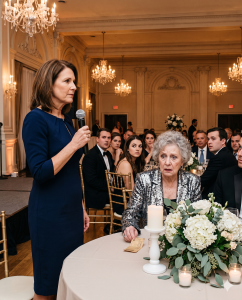
Patty stood near the stage, microphone in hand.
Their eyes met.
Loretta knew.
Derek, standing beside his mother’s chair, followed her gaze and saw Patty. His expression changed too, though more slowly. Confusion first. Then dawning recognition. Then a kind of shame so old it seemed to wake up inside him all at once.
Guests settled into their seats. Conversations dimmed.
Patty took the stage.
“Good evening,” she said.
Her voice carried cleanly across the room.
“As owner of The Civic, I want to welcome you all here tonight.”
Polite applause broke out. Patty let it pass.
“Before dinner begins,” she continued, “I’d like to share something about this room. I believe places remember things. Not the details, maybe. But the energy people carry into them. The kind of truth they can hold, even when everyone in the room would prefer silence.”
The audience grew still.
Loretta sat rigid.
Patty looked directly at her. Then at Derek. Then at the rest of the room.
“Twenty-two years ago,” she said, “I attended a baby shower in this town. I was seven months pregnant. Married into a local family. Trying very hard to belong.”
Whispers started almost immediately.
Patty reached into her bag and lifted the old ticket stub.
“A woman stood up in front of everyone there and handed me a one-way Greyhound ticket to Tulsa. She said it was more appropriate than a onesie.”
The room reacted with a collective intake of breath. Some guests looked at Loretta at once. Others looked at Derek. A few stared at Patty with open disbelief.
Patty’s face did not change.
“I kept the ticket,” she said. “Not because it broke me. Because I never wanted to forget what people do when they believe there will be no consequence.”
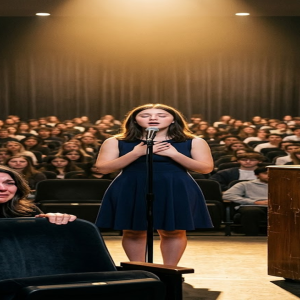
Across the ballroom, June rose from her chair.
The movement pulled attention toward the back of the room.
Patty turned slightly. “The child I was carrying that day is here tonight.”
June stepped forward, calm and steady.
Some people smiled instinctively, thinking perhaps this was about to become sentimental. Then they noticed the cream envelope in June’s hand and the look on Patty’s face.
Years earlier, Patty had found that envelope in a box of old papers returned by Derek after his father’s death. It had been misfiled among legal documents and medical receipts. Patty recognized the handwriting immediately: her mother’s.
The letter had been addressed to Derek in 2003 but never mailed.
Loretta had intercepted it.
In the letter, Patty’s mother wrote that Patty had not married Derek for security, as Loretta had repeatedly implied. Quite the opposite. Patty had been prepared to leave Branson quietly months before the shower after discovering Derek’s growing dishonesty about money. She had learned he was already deep in debt and hiding it. But when she found out she was pregnant, Derek promised he would tell his family the truth, protect her from the fallout, and start over with her honestly.
He never did.
Instead, Loretta learned about the debt herself, panicked at the possibility of family embarrassment, and decided Patty would make the easiest scapegoat. According to the letter, Patty’s mother had heard part of a conversation between Loretta and Derek in the church kitchen before the shower. Loretta made it plain: if Derek wanted financial help and a place in the family business, Patty had to go, and Loretta intended to shame her enough that she would leave without a scene.
Patty’s mother, humiliated and frightened herself, wrote to Derek afterward begging him to tell the truth and stop his mother before things went further.
Loretta made sure he never saw the letter.
Now June carried it to the head table.
She set it beside Loretta’s plate.
The front read, in faded blue ink: Derek Cahill. Personal.
Loretta’s hands began to tremble.
Patty spoke into the microphone, each word precise. “Go ahead, Derek. Read the letter your mother hid from you.”
He stared at the envelope as if it were dangerous.
One of Loretta’s friends leaned back in her chair. Another guest muttered, “My God.”
Derek picked up the letter with fingers that had lost all steadiness. He opened it. Read the first lines. His face crumpled in a way Patty had never seen before.
Loretta tried to stand. “This is inappropriate.”
Patty turned to her. “So was handing a pregnant woman a bus ticket in front of fifty people.”
No one spoke after that.
Derek kept reading. The silence stretched. Whatever self-protective story he had told himself for two decades was being dismantled line by line in front of everyone who had once admired his mother’s certainty.
Finally he lowered the paper.
“She knew,” he said hoarsely, staring at Loretta. “You knew the debt was mine.”
Loretta’s lips parted, but no answer came.
“You let them think it was Patty,” Derek said. “You let me let them think that.”
“I was protecting this family,” Loretta snapped, but the old polish had splintered. “You were weak, and she was going to drag you down—”
“No,” Derek said.
That single word sounded like a man hearing himself clearly for the first time.
Patty didn’t interrupt. She had not returned for revenge in the crude sense. She had returned because the truth had been buried beneath Loretta’s version of events for too long, and this was the first room large enough to hold the correction.
Guests shifted in their chairs, horrified and riveted.
June stood beside the table, eyes on her grandmother with a distance so complete it was colder than anger. Loretta looked at her then, really looked, perhaps for the first time not as an abstract grandchild kept at emotional arm’s length, but as the grown woman who had walked through that ballroom carrying evidence.
“You lied about my mother,” June said quietly.
Loretta’s face collapsed a little more.
Derek sank into his chair. “I let you do it.”
That was the truest thing he had said all night.
Patty stepped down from the stage and approached the head table slowly. The room parted for her without anyone being asked.
She picked up the Greyhound ticket and held it for a moment.
“When you gave me this,” she said to Loretta, “you thought you were sending me away.”
Loretta’s eyes filled, though Patty could not tell whether it was shame, rage, or simply the shock of losing control in public.
Patty placed the ticket back down.
“What you actually did,” she continued, “was send me toward the life I should have had all along.”
No one applauded. It wasn’t that kind of moment.
It was too raw for performance.
Dinner service was delayed. People stood in uneasy clusters, whispering. Several guests left early. Loretta never recovered the room. There was no keynote speech, no elegant toast, no triumphant family photo under the chandeliers. The evening she had intended as a monument to herself became something else entirely: a public reckoning she had once been certain could never happen.
Later, after most guests had gone, Derek approached Patty near the ballroom doors.
He looked older than he had at the start of the night.
“I should have stood up for you,” he said.
Patty regarded him calmly. “Yes.”
“I was afraid.”
“I know.”
There was nothing else worth saying.
He glanced toward June, who was helping staff collect personal items from tables. “She turned out incredible.”
Patty’s expression softened, but only for her daughter. “She did.”
Derek nodded once, as though accepting that he had forfeited any right to more than that.
Loretta left through a side exit with one of her friends. She did not speak to Patty again that night.
In the days that followed, Branson talked.
Of course it did.
Stories that had sat neatly arranged for years began to shift shape. People who had been at the baby shower admitted, in quieter voices, that they had known it was wrong. Some apologized. Some did not. A few still defended Loretta, though they sounded less sure than they once would have. The easiest myths to maintain are the ones no one challenges publicly. Patty had challenged this one under chandeliers in a ballroom she owned.
That mattered.
She did not give interviews. She did not post about the event. She did not need a victory lap.
The correction had been made.
On Sunday morning, before driving back to Tulsa, Patty stood alone in The Civic ballroom. Sunlight came through the tall windows in pale strips, softening the room that had held so much tension the night before. A staff member had already cleared the tables. The hydrangeas were gone. The stage was bare.
Only quiet remained.
June walked in carrying two coffees and handed one to her mother.
“You okay?” she asked.
Patty looked around the room she had rebuilt with her own money, her own judgment, her own stubbornness.
“Yeah,” she said after a moment. “I think I am.”
June slipped her arm through Patty’s.
Neither of them spoke for a while.
Some endings do not feel explosive after they happen. They feel strangely still. As if the noise was never the point. As if the point was simply to stand in the place where you were once diminished and see, with absolute clarity, that the people who misjudged you were never holding your future. They were only standing near it when it began.
Before they left, Patty took the bus ticket stub and the old letter and placed them together in a new envelope.
Not to preserve bitterness.
To preserve sequence.
This happened.
Then this happened.
And after that, everything changed.
On the drive out of Branson, June watched the town recede through the passenger-side window and finally asked the question that had been sitting between them all weekend.
“Do you forgive her?”
Patty kept her eyes on the road.
The answer took time.
“I don’t know if forgiveness is the right word,” she said. “But I know she doesn’t get to define me. Not anymore. Maybe that’s enough.”
June nodded slowly.
It probably was enough.
Maybe more than enough.
Because some people spend a lifetime trying to recover from the moment they were publicly told they were nothing. Patty had done something harder. She built a life so solid, so visible, so undeniably her own that the insult eventually became evidence against the person who delivered it.
And that is what lingered after all the whispers died down.
Not Loretta’s humiliation.
Not Derek’s regret.
Not even the old ticket.
What lingered was the question left behind for anyone who heard the story:
When someone shows you exactly who they are in the moment you need them most, what do you owe them after you survive without them?