She walked into the party as the keynote speaker.
He was sitting in the front row, trying to buy her company.
Neither of them had spoken to each other since the night he laughed her out of a meeting fifteen years earlier, and if anyone in that room had known the history between them, they would have understood why Gary Loomis stopped moving the moment her name was announced.
The gala had the warm, polished look of a company trying hard to honor its own legacy. Greenway Garden Center was celebrating forty years in business. There were string lights over the courtyard, white linens on the round tables, small centerpieces with late-season hydrangeas, and a podium set beneath a banner that read Celebrating Four Decades of Growing Together.
The event coordinator had booked a keynote speaker six months earlier, proud of the fact that Greenway had landed someone with national recognition. The guest was a gardening entrepreneur, a bestselling educator in the home-growing space, and the founder of one of the fastest-growing direct-to-consumer brands in the industry.
Her name was Ruthanne Pickett.
To most people in the room, that name meant success. It meant clean branding, sold-out seasonal kits, waiting lists for workshops, and a company called Ruthanne’s Roots that had spread from Idaho to independent garden centers across the country.
To Gary Loomis, once the emcee said it into the microphone, the name meant something much older.
It meant an all-staff meeting fifteen years earlier.
It meant a stock clerk standing in the back with an index card in her hand.
It meant a moment he had forgotten right up until the second it became impossible to forget.
Back then, Ruthanne had worked the night shift at Greenway’s Boise location. She stocked shelves, rotated inventory, and handled all the jobs people barely noticed but always depended on. She was good at the work. Quiet, efficient, and observant in a way that made her seem almost invisible to management.
Gary was younger then, more polished than wise, and very pleased with his own authority. He liked big language. He liked strategy meetings. He liked the sound of his own optimism.
The company-wide email had gone out on a Monday. Everyone welcome. Big-picture ideas needed.
Ruthanne read it three times before deciding to go.
She had not built her idea in a burst of confidence. It came to her slowly, and then all at once. Month after month on the night shift, she had watched the same pattern repeat. Customers bought plants they did not understand. They guessed at watering schedules, planted at the wrong time, used the wrong soil, and came back discouraged. Most of them were not careless. They were intimidated. They had been made to feel that gardening was either instinctive or impossible.
Ruthanne knew that if someone explained the process in plain language, people would stay with it.
She wrote the core of the idea on an index card in the bulb aisle at two in the morning. Seasonal guidance. Beginner kits. Education first. Sales built on confidence instead of confusion. A long-term relationship instead of one frustrated transaction.
When she raised her hand at the meeting, the room humored her for less than a minute.
Gary thanked her in the tone managers use when they want a person to stop being inconvenient.
Someone laughed.
Someone whispered loudly enough for others to hear.
The room moved on.
Ruthanne sat down, folded the card, and tucked it into the sleeve of her cardigan like she was putting away a wound nobody else could see.
She quit two weeks later.
The years after that did not look glamorous from the inside.
She started with a greenhouse in her backyard outside Meridian. In winter, she worried constantly about heating costs. In summer, she fought pests, cracked hoses, and the endless arithmetic of a business that barely exists until it does. Her nephew built her website for sixty dollars. Her first newsletter went to eleven people. She wrote every issue herself and answered customer emails late into the night.
But the thing that made her business grow had nothing to do with polish.
It was trust.
Ruthanne could teach.
She could tell a nervous customer why tomato leaves curled in the heat. She could explain fungus gnats without making someone feel foolish. She could show a renter with a tiny balcony how to grow herbs successfully in containers. She could rescue not only a plant, but the confidence of the person who had nearly given up on trying.
Her message spread because people shared it with friends who needed exactly that tone: clear, practical, and never condescending.
Ruthanne’s Roots became a newsletter people actually read, then a subscription service, then a product line. Independent garden centers across the country began carrying her kits because customers returned asking for them by name. Investors approached. Retail partners called. She accepted growth carefully, protecting the company’s voice and refusing to let it become another business built on making beginners feel inadequate.
Meanwhile, Greenway changed too, though not as gracefully. It remained profitable, but the market shifted. National chains undercut prices. Online competition changed how hobbyists learned. Customer loyalty became harder to earn. When Gary rose into a more senior leadership role, he began looking for acquisition opportunities that could modernize Greenway’s reach.
That was how Ruthanne’s Roots came onto his radar.
At first, he admired the numbers. Then he admired the loyalty. Then he wanted the company.
He spent months trying to arrange a meeting with the founder. He was told she was selective. Busy. Careful. He interpreted that as negotiation.
He never once imagined that the founder was the woman from the staff meeting.
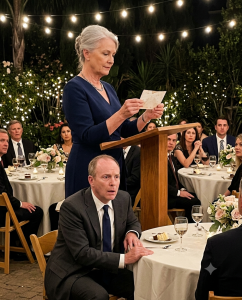
So when Ruthanne stepped onto the gala stage in a navy dress and low heels, silver hair pinned up, self-contained and utterly calm, the shock that hit him was visible even from the back of the room.
She thanked the emcee.
She set her notes on the podium.
Then she reached inside her left sleeve.
The movement was elegant and strange enough to catch attention. She drew out a folded index card, old and softened by time. One corner was stained. She smoothed it flat with great care and placed it beside her notes.
Gary leaned forward before he could stop himself.
He recognized it immediately.
A hush moved through the room, though no one yet knew why.
Ruthanne began simply. “It’s good to be back in Boise,” she said.
Then she looked down at the card, looked up at Gary, and said, “I believe you already know what’s written on this.”
The room went silent.
She told the story without ornament. Fifteen years earlier, she had stood in a Greenway staff meeting and proposed a customer-education model built on practical guidance and long-term trust. She had not been argued with. She had been dismissed. There was a difference, she said, and she had learned the cost of that difference.
A few people shifted uncomfortably.
Gary tried to recover the room with a polite expression, but his discomfort had already become part of the event.
Ruthanne lifted the card slightly. “This was my proposal,” she said. “I kept it because the room didn’t.”
Then she read from it.
Not every word, only enough.
Teach first. Sell second. The customer who feels capable comes back for years.
A murmur ran through the front tables. That line sounded familiar because it was the exact philosophy now associated with Ruthanne’s Roots. It was also, anyone paying attention realized, precisely the growth strategy Greenway had been hoping to acquire.
Ruthanne did not rush. “I was recently informed that Greenway has been trying to buy my company,” she said. “I declined.”
No one touched their food.
She let the pause lengthen before adding, “I declined because some offers arrive too late to be business. They become biography.”
Gary’s jaw tightened.
One of the board members sitting halfway down the row looked from Ruthanne to Gary, then back again with an expression that had gone from social pleasantness to professional concern.
Ruthanne continued. “I didn’t come tonight to embarrass anyone. That happened years ago, and I survived it. I came because there is something important about memory in business. Some people think the room decides whose ideas matter. It doesn’t. Time does.”
Then she reached into her folder and drew out a single crisp sheet of paper.
Gary’s face changed again, and this time several people noticed.
The page bore the logo of a regional commercial real estate and operations group. Ruthanne held it lightly between two fingers and said, “This is my answer to Greenway’s acquisition interest.”
She turned to the audience before she turned back to him.
“I won’t be selling Ruthanne’s Roots to Greenway.”
The sentence landed heavily, but it was not the end.
“Instead,” she said, “effective Monday, Ruthanne’s Roots will be purchasing the Boise flagship property, the adjacent warehouse parcel, and Greenway’s educational events division through a court-approved restructuring agreement signed this afternoon.”
The room erupted into stunned noise.
Someone actually gasped.
A woman at the second table whispered, “What?”
Gary stood up too fast, knocking his chair slightly backward. “That’s not appropriate,” he said, voice tight with panic more than authority.
Ruthanne looked at him calmly. “It’s public as of an hour ago.”
Several phones appeared instantly around the room.
One board member had already gone pale. Another was scrolling furiously, confirming what she had just heard. Greenway had been under financial strain far deeper than most employees knew. Expansion debt. Supplier exposure. A failed distribution gamble. The anniversary gala had been staged against the backdrop of emergency negotiations.
Gary had not been shopping from strength.
He had been trying to save face.
And now the person he once dismissed as laughable had not only refused to sell to him, but acquired the most valuable part of what remained.
Gary stared at her with something between disbelief and humiliation. “You set this up.”
Ruthanne tilted her head. “No. You set it up fifteen years ago. I only remembered.”
The room was absolutely still again.
Then she did something nobody expected.
She softened.
Not toward Gary, but toward everyone else.
“I know there are employees in this room,” she said, scanning the tables, “who are about to feel frightened. I remember what it is to sit in a company and realize decisions have been made above your head. So let me say clearly: the staff attached to the educational division and flagship operations will be offered positions. We are expanding, not gutting. We believe in teaching. We believe in people. And we believe beginners deserve better than being sold to without being spoken to.”
There were tears in the eyes of a woman near the back. Someone began clapping once, uncertainly. Then someone else joined. Then several more.
The applause built, uneven at first and then strong.
Gary did not clap.
He sat back down because he had nowhere else to put himself.
Ruthanne folded the old index card and slid it into her sleeve again.
She finished her speech not with triumph, but with precision. She spoke about expertise, about humility, about the danger of confusing confidence with wisdom. She spoke about customers who return because they feel respected. She spoke about the ideas that get ignored when companies stop listening to the people closest to the work.
By the time she stepped away from the podium, the room had stopped seeing her as a guest speaker and started seeing her as what she had been all along: the person with the clearest understanding of how things grow.
Afterward, the event dissolved into knots of conversation. Board members stepped outside to make calls. Employees clustered together, half-anxious and half-hopeful. A local reporter who had attended as a courtesy guest suddenly had the biggest story in the room.
Gary approached Ruthanne near the side corridor, where the noise was dimmer and the string lights reflected faintly off the glass doors.
For a moment he looked older than she remembered.
“You could have handled that privately,” he said.
Ruthanne studied him. “You had fifteen years for private.”
He swallowed. “I don’t even remember laughing.”
“I know,” she said.
That was the part that hit him hardest.
He looked away first. “I was running a meeting.”
“You were defining a culture,” she replied.
He had no answer to that.
After a long silence, he said, “You really kept the card.”
She touched her sleeve lightly. “You really kept being the kind of man who thought that made no difference.”
He stood there, stripped of the language that had once protected him.
“I built something useful,” she said, not unkindly. “Not because you doubted me. In spite of it. But it mattered that you did.”
Then she left him there and returned to the room where employees were waiting to ask practical questions, frightened questions, hopeful questions—the kinds of questions she had built an entire company answering.
In the months that followed, Ruthanne’s Roots transformed the flagship Boise property into a hybrid retail and education center. Workshops replaced dead floor space. Beginner clinics sold out. Families came in on weekends. Staff who had once felt ignored found themselves listened to, trained, and invited into planning discussions. The events division became one of the most profitable and beloved parts of the expanded company.
Greenway’s old brand faded gradually, then formally. Ruthanne kept one thing from it in the renovated main office: an unframed copy of the original all-staff email that had invited big-picture ideas from everyone.
Not as a trophy.
As a warning.
Years later, people still told the story of the gala. Some told it as revenge. Some told it as justice. Some told it as a business masterclass in underestimating the wrong person.
Ruthanne never told it that way.
When asked, she would say only this: “People think growth starts when someone believes in you. Sometimes it starts the moment they don’t.”
And that stayed with people because it forced a harder question than the dramatic reveal ever did.
Gary had laughed, yes. But the room had laughed with him. The bigger failure had not belonged to one man. It had belonged to a culture that heard wisdom from the wrong voice and mistook dignity for smallness.
Ruthanne had been right all along.
The saddest part was how ordinary that kind of mistake had been.