When Connie Marsh walked into Tidewater Marina on the day of its grand reopening, nobody gave her more than a passing glance.
That was exactly how she wanted it.
The April air in Beaufort carried the familiar mix of salt, engine fuel, wet wood, and marsh grass. Blue water glittered beyond the slips. String lights had been draped from post to post above the dock, still visible in the daylight like someone’s attempt to soften the place into a postcard. A bluegrass band played under a white event tent while servers moved through the crowd with sweet tea and trays of deviled eggs. The whole thing looked polished, expensive, restored.
Respectable.
Connie took it in slowly.
Fifteen years earlier, she had been marched out of that same marina carrying a cardboard box while people she’d worked beside for over a decade stood and watched.
Now she owned sixty percent of it.
She wore cream linen slacks, a navy blazer, and pearl studs so small they barely caught the light. Nothing flashy. Nothing theatrical. She had not come there to make a spectacle of herself.
She had come to finish something.
From a distance, Tidewater Marina looked different. The sign was newer. The office had been reframed. The dock rails had fresh paint. The fuel station had sleek pumps now. But Connie noticed what hadn’t changed too. The angle of the harbormaster’s windows. The old marsh line beyond the slips. The rhythm of boat halyards tapping against masts in the breeze.
Places hold memory even when people try to renovate it out of them.
A passing server offered her sweet tea. Connie took a glass, thanked him, and kept moving.
Nobody recognized her. Not at first.
That made sense. Most of the old staff were gone. The people working the event were younger, newer, full of the clean-faced confidence of employees who hadn’t yet learned how quickly loyalty can become disposable. To them, she was just another investor or guest.
She let that assumption stand.
Near the rebuilt office, she saw Gary Pitts speaking to a vendor with one hand tucked into his pocket and the other gesturing toward the slips. He was older than she remembered, though not gentler. His hair had thinned and gone nearly all gray at the temples. His face had softened at the jawline. But he still carried himself like a man accustomed to ownership.
Connie stood still for a moment and watched him.
Then fifteen years peeled away in her mind so suddenly it nearly felt physical.
Back then, she had known every invoice at Tidewater Marina. Every fuel account. Every slip rental. Every late payment. Every seasonal contract. She could tell you which charter captain paid cash, which tenants always renewed early, and which vendors padded their service fees whenever Gary got distracted with expansion fantasies.
She had been the bookkeeper there for eleven years.
Not the owner. Not the face of the place. Not someone people wrote about in local business profiles.
Just Connie.
Quiet Connie.
Dependable Connie.
The mouse, some of the dock crew called her, not cruelly, just casually. The quiet woman at the desk by the window who kept everything moving while louder people took credit for the machine staying on.
Connie never minded. She liked numbers because numbers made promises. If you looked at them closely enough, they told you where things really stood.
People lied. Ledgers usually didn’t.
Her mornings had always begun the same way. She would arrive early, set her blue thermos beside the monitor, unlock the office, and let the first light come through the window facing the marsh. She liked the hush before everyone else arrived. It made her feel anchored.
That steadiness was why the accusation hit so hard.
The day Gary called her into his office, the sky had been low and gray over Beaufort. She remembered that because she had looked out the window just before he shut the door and thought rain was coming in.
Linda Pitts was standing in the doorway with her arms crossed.
That, more than anything else, told Connie something was wrong.
Gary rarely involved Linda in office matters. Linda showed up when there were social events, donors, chamber of commerce mixers, photo opportunities, or decisions she wanted to influence behind the scenes. But accounting issues? Never. Linda preferred clean nails and public charm to invoices and reconciliations.
That morning, though, she was there. Silent. Sharp-eyed. Waiting.
Gary didn’t ask Connie to sit.
“We’ve been through the books,” he said.
He kept his attention on a stack of papers on his desk. Not on her. Not once.
Connie frowned. “All right.”
“Forty-two thousand dollars. Missing. Going back eighteen months.”
It took her a second to even understand the sentence.
Then she laughed once, softly, in disbelief. “That can’t be right.”
Linda stepped forward and held up printouts. “It is.”
Connie took them. At first glance, they looked legitimate. Transfer records. Approval codes. Time stamps. Her employee ID at the top of the authorization page. Her initials next to three approvals.
Her stomach dropped so fast it felt like falling.
“These aren’t mine,” she said immediately. “I didn’t authorize these. Someone used my login.”
Linda’s expression didn’t change. “We have proof.”
“Then let me look at the system logs,” Connie said. “Let me show you where this came from. There’s no way—”
“Connie,” Gary said, finally lifting his head just enough to cut her off, “we’ve made our decision.”
There are moments when humiliation arrives so fast that your mind can’t keep pace with it. Connie had worked at that marina for eleven years. She had balanced accounts through hurricane damage, tax changes, vendor disputes, fuel shortages, and late-season slumps. She had stayed late on Fridays. Covered emergencies on Sundays. Trained part-time office help who never lasted. Cleaned up mistakes that never reached Gary’s desk because she fixed them first.
And none of it bought her five extra minutes.
She looked at Gary as if he might still turn human if she gave him enough time.
Instead, he slid a cardboard box across the desk.
“Security will walk you out.”
Linda’s mouth tightened in a way Connie would remember for years. Not anger. Not even triumph.
Relief.
That was what Connie saw.
Relief that this was ending quickly.
Security didn’t need to touch her. Connie gathered her things herself. The framed picture of her parents. Her reading glasses. Her blue thermos. A paperweight shaped like marsh grass. A sweater she kept draped over the back of her chair in winter.
Then she walked through the office and out onto the dock while people went quiet around her.
A humiliation like that has a sound. It isn’t shouting. It’s the sudden absence of ordinary noise. A stopped conversation. A wrench no longer turning. A laugh cut off too fast.
She felt every pair of eyes.
Near the harbormaster’s office, the security guard turned to answer a call on his radio. Connie glanced through the open doorway and saw something resting on the corner of the desk.
A brass cleat.
Small. Old. Corroded almost green.
Anyone else would have ignored it.
Connie stopped cold.
The side of it was engraved: Marsh Harbor.
That had been the marina’s original name before Gary rebranded everything as Tidewater. Connie knew the piece at once. Years earlier, during a renovation, several fixtures from the old office dock had been removed and tossed into a back storage cabinet. Gary wanted the place to look newer, cleaner, more upscale. The old hardware didn’t fit the image.
But Connie remembered them because she cataloged everything.
She also remembered Linda asking, just a week before the first suspicious transfer, whether there was “anything interesting left in storage from the old days.” Linda had laughed when she said it, acting like she only cared about possible decorative items for the office. Connie had told her where the cabinet was.
At the time, it meant nothing.
Standing there with the security guard half turned away, Connie looked at the brass cleat and something inside her locked into place. She didn’t yet have the whole truth. But she had the shape of it.
She picked up the cleat and placed it in her box.
Then she left.
The weeks that followed were ugly.
No criminal charges were filed, which should have mattered more than it did. In a fair world, it would have been the first sign the case against her was weak. But towns like Beaufort do not run on official outcomes alone. They run on whispers, narrowed eyes, and stories told softly enough to sound responsible.
Connie became a warning in other people’s mouths.
She couldn’t find decent work in town. Temporary clerical jobs dried up as soon as employers made one or two discreet phone calls. She took whatever she could. Payroll for a church office. Invoice cleanup for a seafood distributor. Seasonal admin work for a marina supplier outside Charleston. She sold jewelry, cut every unnecessary expense, and learned how thin a person’s safety net feels once shame starts chewing through it.
Some nights she sat in her small rental kitchen and stared at the brass cleat on the table.
It made no sense as proof. She knew that. It wasn’t a signed confession. It wasn’t a document. It was an object tied to a memory, and a suspicion, and a week when everything had started to rot.
Still, she kept it.
She also kept thinking about Linda.
Not Gary’s accusation. Linda’s behavior.
Linda, who had inserted herself into the books just before the missing money appeared.
Linda, who had asked strange questions about Connie’s routines.
Linda, who once joked that Connie’s passwords had to be “something boring and honest.”
Linda, who looked relieved, not shocked, when Connie was pushed out.
That relief stayed with her.
At forty-one, Connie made a decision that surprised everyone except maybe herself. She enrolled in classes and began working toward becoming a CPA.
The first semester exhausted her. She was older than most of the students and poorer than almost all of them. She studied at a kitchen table under bad lighting after long workdays. She doubted herself often. But numbers had always been the one place where she felt in command of reality, and that mattered.
She passed the CPA exam on her second attempt.
Not long after, a small maritime investment firm in Charleston hired her to help review distressed waterfront properties. It was niche work, quiet work, exactly the sort of place where someone with her background and caution could thrive.
And Connie did more than thrive.
She developed a reputation for finding what others missed. Hidden liabilities. Misstated maintenance reserves. Partner distributions disguised as vendor payments. Sloppy fraud. Elegant fraud. Fraud so arrogant it practically announced itself to anyone patient enough to compare three years of statements side by side.
Her colleagues learned to trust her instincts. If Connie said something in the books felt wrong, they stopped talking and listened.
She said almost nothing about Tidewater Marina.
But she watched it.
She watched Gary expand too aggressively. Watched him borrow against future revenues. Watched him chase prestige projects. Watched local coverage praise his vision while the underlying numbers got shakier. Then the expansion deal collapsed. Lenders tightened. Receivership followed. Ownership was restructured under pressure.
When one of the investment groups reviewing the marina brought the file to Connie’s firm, she almost laughed at the cruelty of fate.
Instead, she read every page.
She saw exactly how vulnerable the property had become. She also saw that the restructuring would require one final capital partner to close quickly.
So Connie made a call.
No speech. No announcement. No grand revenge plan whispered into the night.
Just a call, a negotiation, and a signature.
That was how, fifteen years after being escorted off the dock, Connie Marsh became majority owner of the marina that had destroyed her reputation.
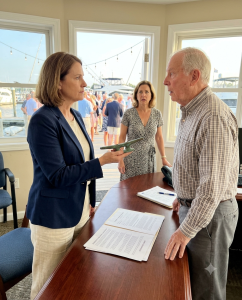
Now she set her sweet tea aside and walked toward the harbormaster’s desk.
An attorney had prepared a folder for final onsite disclosures and updated ownership documents. She placed it on the desk as Gary finished his conversation and reached for it without paying attention.
He opened the folder casually.
Then he turned the first page.
His expression altered so slightly another person might have missed it. A pause. A narrowing of the eyes. Then stillness.
He read more carefully.
The crowd continued around him, unaware.
Connie watched him reach the ownership summary.
She saw the exact second he read her full name.
Constance Marie Marsh.
He lifted his head.
For three seconds, he did not recognize her.
Then he did.
Color drained from his face.
It was not dramatic. That made it better. No one gasped. No music stopped. The world didn’t announce itself on her behalf.
But Gary knew.
Before he could speak, Connie reached into her bag and drew out the brass cleat.
Time had darkened it further. The engraved Marsh Harbor name was still visible beneath the patina.
She placed it between them.
Gary stared at it in open confusion first, then with something darker. Memory. Fear. Recognition of a detail he had once chosen not to think about too hard.
Connie picked it up again and held it out toward him.
“I think you know whose fingerprints are on this,” she said quietly.
Gary’s mouth opened.
Closed.
His eyes moved from the cleat to Connie’s face, and for the first time in fifteen years, he looked less like an owner than a man who realized he had never understood the story he had helped bury.
Then Connie saw movement behind him.
Linda Pitts was coming toward the desk.
At first she wore the polished expression of a woman used to managing public scenes. Then she saw Connie. Then she saw Gary’s face. Then she saw the cleat.
Her smile vanished.
That was when Connie knew she had been right to wait.
Linda approached with careful steps, every bit of social ease drained out of her. “What is this?” she asked.
Connie held the cleat in one hand and said nothing.
Gary still had the ownership folder open, fingers trembling slightly on the edge of the pages. He looked from Connie to Linda and back again. “Connie…”
That one word carried confusion, not outrage.
Interesting.
Linda reached the desk. “You’re making a scene.”
“No,” Connie said. “I’m correcting one.”
Gary turned fully toward his wife now. “What is she talking about?”
Linda’s eyes flashed. “Nothing. She’s trying to embarrass us.”
Us.
Not me.
That mattered too.
Connie leaned lightly against the desk. “Gary, did you ever ask where those transfer approvals were generated from?”
He frowned. “They came through her login.”
“That wasn’t the question.”
Linda cut in. “This is absurd.”
Connie ignored her. “Did you ever ask why your office terminal logged activity during times I wasn’t even in the building? Did you ever ask why your wife suddenly took an interest in archived hardware and old office storage the same week those transactions began? Did you ever wonder why she was so determined to be in the room when I was accused?”
Gary looked at Linda.
It was a long, blank look. Not yet belief. Not yet understanding. But the first fracture had appeared.
Linda’s composure sharpened into anger. “You have no proof.”
Connie lifted the cleat slightly. “You mean besides the object you used as a paperweight after pulling it out of the old storage cabinet yourself?”
Linda went still.
Gary saw it.
Connie went on. “You asked me where the original Marsh Harbor fixtures were kept. You made a joke about my passwords. You spent months hovering near the books. And when I was accused, you already had those printouts in your hand before Gary even looked at me.”
“You’re insane,” Linda snapped.
“Maybe,” Connie said. “But not wrong.”
Gary’s voice came low and strained. “Linda… why do you look scared?”
That question landed harder than anything else Connie had said.
Linda turned to him, then back to Connie. The crowd was still nearby, laughter rising and falling, plates clinking under the event tent. Nobody beyond the desk yet understood that the air had changed.
Linda lowered her voice. “You should not have brought that here.”
There it was.
Not What are you talking about?
Not I never touched that.
Not This is ridiculous.
You should not have brought that here.
Gary heard it too.
His face changed from confusion to something heavier. Betrayal beginning to take shape.
Connie reached into her bag again and removed a second folder. This one was thinner. Personal. Not public closing documents. Notes. Copies. A printed timeline she had built from old memories, staffing schedules, archived system reports later obtained through legal review during restructuring, and one overlooked maintenance access log that showed Linda entering the office after hours repeatedly during the months the money disappeared.
By itself, none of it had been enough fifteen years earlier. Together, it formed a picture.
Connie slid the folder toward Gary.
“What is this?” he asked.
“The questions you never asked.”
Linda stepped forward, panic finally roughening her voice. “Don’t touch that.”
Gary touched it.
He opened the folder.
Inside were copies of old maintenance logs, keypad entries, access notes, and a record from a technician visit showing the office terminal had been configured to retain login credentials longer than standard policy allowed. The change request hadn’t come from Connie.
It came from Linda.
Gary looked up slowly. “Why would you do that?”
Linda’s face hardened in a way Connie had not seen even during the firing. It was the look of someone who realizes denial has passed its useful life.
“For you,” Linda said.
Gary blinked. “What?”
“You were drowning,” she hissed. “That expansion, the debt, the fuel contracts, the dock repair overruns—you think I didn’t know? You think I didn’t see what was coming?”
Connie said nothing.
Gary stared at his wife. “You stole from the marina?”
Linda laughed once, bitterly. “I moved money. Temporarily. I was covering gaps until the land deal closed.”
“The land deal never closed,” Gary said.
“I know that now.”
The words seemed to hollow him out in real time.
Connie watched his face carefully. Part of her had wondered for years whether he had known. Whether he had chosen convenience over truth. But his expression told her something uglier and sadder. Gary had not masterminded the theft. He had simply been willing to believe the easiest target was guilty.
That did not make him innocent.
It just made him weak.
“You let her take the fall,” he said to Linda, voice barely audible.
Linda turned on him instantly. “No. You let her take the fall. I handed you evidence and you were relieved to use it because she was easy to sacrifice.”
That was the deepest cut of all because it was true.
Gary looked as if she had struck him.
The bluegrass band ended one song and began another. A cheer rose from somewhere near the boil station. The public celebration went on, absurdly normal around the private collapse at the desk.
Connie felt no triumph. Not exactly. Vindication rarely arrives clean. It drags grief in behind it.
Gary looked at her then, properly looked, and the shame in his face was real. “Connie,” he said, “I didn’t know.”
“I know,” she replied.
That answer seemed to hurt him more than anger would have.
Linda folded her arms, but the gesture had lost all force. “What now?”
Connie set the brass cleat on the desk one final time. “Now the truth goes where it should have gone fifteen years ago.”
As majority owner, she had already retained counsel. The marina’s restructuring records were now under review. The old theft would be formally reopened for civil action. Whether criminal consequences were still possible depended on statute limits and prosecutorial interest, but the public correction of responsibility was no longer optional. Linda’s access and conduct would be documented. Connie’s firing would be reexamined. Statements would be made.
Quietly, lawfully, thoroughly.
No screaming dockside confrontation could have given Connie what she wanted most.
She wanted the record repaired.
Over the following weeks, it was.
Lawyers met. Old files were pulled. Former employees were contacted. A local paper that had once run a flattering piece on Gary’s marina leadership published a short but devastating correction about irregularities tied to historical internal theft and the wrongful termination of a longtime bookkeeper who was now the marina’s majority owner.
People who had once avoided Connie began reaching out.
Some apologized clumsily. Some sincerely. Some mostly wanted relief from their own old guilt.
Connie accepted very few invitations and answered even fewer calls.
Gary resigned from day-to-day management within two months. He requested one private meeting with Connie in the rebuilt office overlooking the marsh. She agreed.
He looked smaller without the marina arranged around him like a stage set.
“I should have listened,” he said.
“Yes,” Connie replied.
He nodded, eyes wet but unshed. “I was a coward.”
“Yes,” she said again.
There was kindness in her tone, but no rescue.
Linda left Beaufort by the end of that summer. No dramatic goodbye. No public apology. Just a house sold quietly and a forwarding address in another state. Connie heard through attorneys that Linda still insisted she had only meant to borrow the money long enough to stabilize the business. Maybe she believed that. People often rewrite their motives to survive themselves.
Connie did not bother arguing with versions of the past that no longer had power over her.
Instead, she went to work.
She restored the marina’s original name in one small place only: a brass plaque inside the office reading Marsh Harbor, est. 1974, placed beneath a framed shadow box containing the old green-weathered cleat.
Not as a trophy.
As a warning.
She rehired carefully, promoted quietly, and ran the books with the same attention she always had. Staff stayed longer under her leadership. Vendors stopped padding invoices. Repairs were done before they became emergencies. The marina became less glamorous and more stable, which Connie considered a compliment.
On some mornings, before the office opened, she sat by the window with coffee and looked out over the marsh grass just as she had years earlier.
The difference now was not wealth, though she had that. Not ownership, though she had that too.
It was peace.
Still, peace did not erase the ache of what had been taken. Eleven years of loyalty had been thrown away in a single afternoon because she was quiet and therefore easy to doubt. That lesson stayed with her.
So did another one.
The loudest person in the room is not always the one steering the damage. Sometimes the real danger stands in the doorway, well dressed and smiling, waiting for someone else to hand her the knife.
And sometimes the woman everyone mistook for harmless comes back with the deed in one hand, the truth in the other, and enough patience to make both matter.