She had delivered mail to that house for thirty-one years without ever knowing it was killing her.
Not all at once. Slowly. The way a lie does.
—
Marlene Kowalczyk retired from the United States Postal Service on a Thursday in October, the same month the cottonwood trees along Cedar Avenue in Flagstaff drop their leaves all at once, like they’ve made a decision.
She was sixty-three years old. Her knees ached. Her route had covered the same four square miles for three decades, and she knew every cracked sidewalk, every barking dog, every family’s rhythm by the weight of their mail.
She thought she knew everything worth knowing on that route.
She was wrong about one house.
—
The first time she noticed the rubber band, she almost didn’t think anything of it.
It was faded red. Not the standard tan or brown the post office stocked. This was the color of an old barn, of something that had been left in the sun too long. It was twisted around a small bundle of envelopes addressed to 4417 Birchwood Court.
She’d slipped it off, delivered the mail, tossed the band into her truck’s cupholder.
A week later, there was another one. Same color. Same faded, almost dusty red. Twisted the same way — not looped straight, but crossed once in the middle, like a small, strange knot.
She started noticing them more after that.
Not every delivery. But often enough that over the years she had accumulated a small tin of them on her kitchen windowsill without ever quite deciding to. Dozens of them. All the same. All from that one address.
She’d asked around the Flagstaff post office more than once. Nobody stocked red rubber bands. Nobody knew where they were coming from.
Nobody thought it was worth worrying about.
Marlene had learned, over sixty-three years, that the things nobody thinks are worth worrying about are usually the things most worth worrying about.
—
It was her last day on the route — her very last day, retirement paperwork signed, cake already eaten — when she pulled up to 4417 Birchwood Court one final time.
The bundle for that address was heavier than usual.
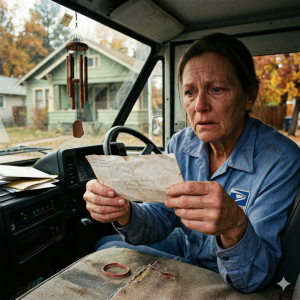
And there, twisted around it, was a faded red rubber band.
She sat in the mail truck for a moment, holding it. Rolled it between her fingers the way she had a hundred times. It felt the same as always — slightly tacky, like rubber that had aged past its purpose but refused to break.
She pulled it off and slipped it into her pocket.
Then she started sorting through the bundle.
Electric bill. A catalog. Something from a Phoenix attorney’s office.
And then, at the bottom of the stack, an envelope that made her hand go still.
The name on the front was hers.
*Marlene R. Kowalczyk.*
Not a forwarding error. Not a misprint. Her full name, her middle initial, written in careful block letters — delivered to a house she had never lived in, on a street she had only ever walked as a carrier.
Her mouth went dry.
She thought about her mother. About the property dispute after Mom passed in 1993 that she’d been shut out of entirely, told by a cousin that there was “nothing in the estate,” that the lawyers had “handled everything.” She’d been living out of state. She’d been grieving. She’d let it go because letting things go was what you did when you had no money for attorneys and no fight left in you.
She thought about how, two years after her mother died, she’d been turned down for a loan — and the officer had looked at her with something strange in his eyes and said there was “a complication” with her legal record.
A complication she’d never been able to fully trace.
She looked at the house. White trim. A wind chime on the porch she’d watched rust over the years. A family she had waved to, whose Christmas cards she had carried, whose lives she had quietly witnessed for three decades without ever being invited in.
Her hands were shaking now.
She turned the envelope over.
And in the return address corner — written in handwriting she recognized the way you recognize your own face in an old photograph, the loops, the slight leftward slant, the way she’d always written her *K*s —
Was a name.
Not hers.
A child’s name. A girl’s name. With a last name that was half hers and half someone else’s entirely.
And below the name, a date.
The date was in 1992.
Nine months before her mother died.
Nine months before everything she’d been told was the truth.
Marlene’s vision blurred. She pressed her back against the truck seat and stared at the ceiling and tried to remember how to breathe.
Because she had been told, in a hospital room, in the worst year of her life, that the baby had not survived.
She had been told there was nothing to bring home.
She had believed them.
She had believed them for thirty-one years.
And now she was sitting outside the house of the people who had stolen her mother’s land — holding an envelope, addressed to herself, in her own handwriting from a lifetime ago —
With the name of the daughter she’d been told was never born written in the corner like a small, patient ghost.
She reached for the door handle.
—
She sat there with her hand on it for a long time.
The wind moved through the cottonwoods at the end of the block. A dog somewhere behind a fence made a single, half-hearted sound and went quiet.
She had delivered mail for thirty-one years. She had learned that you do not go to a customer’s door unless you have a reason. She had a reason now. She had the only reason that had ever mattered.
She got out of the truck.
The walk up the front path felt longer than it was. Twelve steps, maybe fifteen. She had walked it hundreds of times with packages too large for the box, and each time she’d set the parcel on the porch and left without knocking. Today her knuckles found the door before she’d finished deciding to knock.
It opened almost immediately, like someone had been watching.
The woman who answered was perhaps forty-five. Brown hair going to gray at the part. Reading glasses pushed up on her forehead. She had the kind of face that has been pretty and knows it used to be, without being sad about it. She was wearing a University of Arizona sweatshirt and holding a dish towel.
She looked at Marlene. Then at the mail truck at the curb.
“You’re the mail lady,” she said.
“I was,” Marlene said. “Today’s my last day.”
The woman nodded, not unkindly. “We heard you were retiring. My husband mentioned it. He said you’d been on this route since before we moved in.”
“Since 1989,” Marlene said.
She held out the envelope. Her hand had stopped shaking. She wasn’t sure when that had happened.
“This was in today’s bundle,” she said. “Addressed to me. I don’t know how it got here. I’d like to understand that.”
The woman looked at the envelope. Something moved across her face — not guilt, exactly. More like the expression of someone who has been expecting a conversation for a very long time and is surprised only by the specific morning it has arrived.
She stepped back from the door.
“You’d better come in,” she said.
—
The house was warm and smelled like coffee and something baking. There was a Border collie asleep in a sunbeam near the back slider. Family photos lined the hallway — ski trips, a graduation, a wedding Marlene didn’t recognize.
She almost didn’t see it.
Then she did.
It was small. Framed in plain wood, hung at the end of the hall where the light didn’t quite reach. A school photo, the kind with the mottled blue background that every elementary school in America used in the 1990s. A girl, maybe eight or nine years old. Dark hair. A slightly crooked smile that pulled harder to the left than to the right.
Marlene’s smile pulled harder to the left than to the right.
She had hated that about herself in every photo ever taken of her.
She stopped walking.
The woman — she still hadn’t given her name — stopped too. She watched Marlene look at the photo. She didn’t say anything. She had the patience of someone who has rehearsed this and decided the only way through is silence.
“Who is that?” Marlene asked. Her voice was steady. She was surprised by that too.
The woman set the dish towel on the hall table.
“Her name is Jolene,” she said. “She’s thirty-one years old. She lives in Tempe. She’s a physical therapist.” She paused. “She’s been trying to find you for four years.”
The room did not spin. Marlene had always imagined that a moment like this, if it ever came, would make the room spin. Instead everything went very, very still.
“My baby died,” Marlene said. “They told me. The hospital. The doctor. My mother.”
“Your mother,” the woman said quietly, “made arrangements. That’s what the family called it. Arrangements.” She said the word the way you say a word that has been fouled by the people who used it wrong. “You were twenty-two. You were alone. Your mother decided you couldn’t manage.”
“She didn’t ask me.”
“No. She didn’t.”
Marlene looked at the photograph again. The crooked smile. The dark hair — that was someone else’s, some man’s, she didn’t want to think about which man, that whole year was a closed room — but the smile. The smile was hers. It was her grandmother’s. It was a Kowalczyk smile going back however far those things go back.
“The rubber bands,” she said.
The woman blinked. “What?”
“The red rubber bands. On the mail. For years. What were they?”
The woman was quiet for a moment, and then her expression shifted into something Marlene could only describe as fond. The kind of fond that has a little pain behind it.
“That was Jolene,” she said. “She found out about you when she was about twenty-six. We’d always told her she was adopted, that was never a secret. But when she started looking, she found the documents from the property transfer. She found your name connected to this address through your mother’s estate. She didn’t know what to do with that.” She folded her hands together. “She knew her mail came through the Flagstaff carrier system. She knew someone walked this street every day. She thought — this is Jolene, she’s always been like this, she has a theory about everything — she thought if she put something on the mail that came to this address, something unusual, something that didn’t belong, the carrier might notice. She thought if the right person was paying attention, it might eventually mean something.”
Marlene thought about the tin on her kitchen windowsill. Dozens of them. Thirty years of small signals she had held in her hands and set aside and somehow never thrown away.
“She was leaving them as a trail,” Marlene said.
“She was hoping,” the woman said. “She didn’t know any other way to reach you without upending everything. She was afraid you didn’t know about her. She was afraid you did know and had moved on. She was afraid of a lot of things.” She smiled sadly. “She still is. She’s also very brave. Those things aren’t contradictions.”
“No,” Marlene said. “They’re not.”
—
She drove home with the envelope on the passenger seat, still unopened.
She made herself a cup of coffee. She stood at the kitchen window and looked at the tin of rubber bands. Then she sat down at the kitchen table, in the October light, and opened the envelope.
It was a letter. Handwritten. Several pages.
It began: *Dear Marlene, I have started this letter fourteen times and thrown it away, so this is the one I’m sending no matter what.*
It ended, after pages she would read and reread for the rest of her life, with a phone number and a single line: *I’m not asking you for anything except to know that I exist. Everything after that is up to you. I just didn’t want to disappear the way you were told I did.*
Marlene sat with it for a long time.
She thought about thirty-one years of walking the same ground. She thought about how the things that are happening to us are so rarely the things we think are happening to us. She had thought she was delivering mail. She had been carrying her daughter’s messages home in her hands, over and over, without knowing.
She picked up her phone. She dialed the number.
It rang twice.
“Hello?” The voice was cautious. Young but not young. A little hoarse, like someone who had been keeping herself calm by force.
“Jolene,” Marlene said.
A silence. Then a sound that was not quite a word.
“I’m your mother,” Marlene said. “I didn’t know. I want you to know that first. I didn’t know.”
She heard the exhale on the other end of the line. Thirty-one years of held breath.
“I know,” Jolene said. “I know you didn’t.”
—
They met two weeks later at a diner in Tempe, on a Saturday morning when the desert light was doing that thing it does in November where everything looks slightly more real than usual.
Jolene was tall. She had Marlene’s hands — wide palms, short fingers, the kind of hands that look built for work. She was wearing her hair back and she kept touching the end of her ponytail when she was nervous, which was often, which was also something Marlene did.
They talked for four hours. They ordered coffee and then eggs and then more coffee. They talked about the adoption and the estate and the cousin, who was dead now, and the doctor, who Marlene was looking into, and what any of it meant legally, which was complicated and probably not much after this long but maybe something.
They talked about Jolene’s work, her apartment, her cat named Gerald. They talked about Marlene’s route, the families, the thirty years of other people’s lives passing through her hands.
At one point Jolene reached into her bag and set something on the table between them.
It was a faded red rubber band, crossed once in the middle.
“I have a whole jar of them,” she said. “I’ve been twisting them that way since I was a kid. Just a habit. I didn’t even know why until I figured out about you.”
Marlene reached into her jacket pocket.
She pulled out the one from the final bundle, the last delivery of her last day. She set it next to Jolene’s on the table.
They looked at them for a moment, side by side. Two small, stubborn, faded-red things that had refused to break.
“I saved every one you ever sent,” Marlene said. “I have a whole tin of them.”
Jolene looked up.
“I know,” she said softly. “I was counting on that.”
—
The property dispute, as it turned out, was more than complicated — it was a deliberate fraud, documented in papers Jolene had already found and had copied and stored with an attorney in Phoenix. Marlene’s cousin had colluded with a man named Gerald Fitch — not the cat, Jolene said, she’d named the cat before she knew, it was just a coincidence, one of those coincidences that feels like the universe has a bad sense of humor — who had handled the estate sale in 1993 and transferred a parcel of land that should have passed to Marlene into a shell company that eventually dissolved into the holdings of the couple at 4417 Birchwood Court, who were themselves not the original wrongdoers but had bought the property twice-removed and knew only some of what had happened.
The couple cooperated. The woman with the dish towel called Marlene personally and said they would sign whatever was needed. She said she’d known something was wrong with the title history the year they bought it and had told herself it was old business. She said she was sorry. Marlene believed her.
The land itself — a small lot near Williams that her mother had owned and that Marlene had not known existed — wasn’t worth a great deal of money in any world-changing sense. But it was hers. It went back to her.
She signed the papers in March, and then she drove out to Williams with Jolene, and they stood on the lot together, which was just ponderosa pines and rocky red soil and a view of a ridgeline that turned colors in the late afternoon, and they didn’t say much.
They didn’t need to.
—
Marlene turned sixty-four that spring. Jolene threw her a party. Small — a few of Jolene’s friends, a neighbor of Marlene’s who had always been kind, and the woman from 4417 Birchwood Court, who came with her husband and brought a pie and stayed for two hours and by the end of the evening was talking to Jolene about hiking trails the way people do when they have decided to move forward.
At some point in the evening Marlene found herself standing in Jolene’s kitchen alone for a moment, holding a cup of coffee, looking out a window.
She had delivered mail to that house for thirty-one years without knowing it was killing her.
She understood now that