She walked back into that auction house with one thing in her pocket.
A folded receipt. Water-stained. Sixteen years old.
It pressed lightly against the inside of her navy blazer as she stepped through the front doors of Phelps & Sons Livestock Auction at 8:58 on a warm Thursday morning, and for one strange second, the building smelled exactly the same as it had the day they threw her out.
Dust. Coffee. Feed. Paper. Sweat.
It was the kind of smell that should have meant routine. Work. Numbers. Familiar voices. Instead, it brought back the sting of public humiliation so sharply that Marlene Busby nearly stopped walking.
She didn’t.
She kept her shoulders square, her expression calm, and her pace unhurried as she moved down the same hallway she’d walked for eleven years. Past the office door where ranchers used to lean in with invoices. Past the bulletin board where notices had once been pinned in crooked rows. Past the reception desk where a younger woman, startled by the sight of her, sat frozen with a pen in her hand.
Marlene didn’t say good morning.
She didn’t need to.
Recognition was already spreading across the room in ripples.
Not everyone there had worked with her. Some were newer. Younger. Hired after the decline began. But enough old faces remained that the silence started before she even reached the conference room.
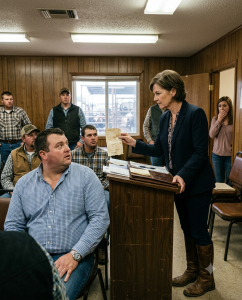
Inside, about twenty staff members were seated around folding tables arranged in a square. At the head of the room, in the chair that had once belonged to Gary Phelps Sr., sat his son.
Gary Phelps Jr.
Sixteen years had thickened him around the jaw and softened the hairline, but not much else had changed. He still had that expression Marlene remembered too well: the confidence of a man who had inherited authority before he had ever earned it.
He looked up when she entered, frowned, and then visibly recognized her.
For the first time that morning, Marlene felt something close to satisfaction.
Not victory. Not yet.
Just the clean, cold pleasure of watching certainty leave someone else’s face.
She set her leather portfolio on the podium at the front of the room. Then she reached inside her jacket and drew out the folded receipt.
The paper was old enough to tear if handled roughly. She had unfolded and refolded it so many times over the years that the creases were soft as cloth. She laid it flat on the wood with deliberate care.
No one spoke.
Marlene lifted her gaze to Gary Jr.
“I’ve been waiting to show you something,” she said.
A full minute earlier, half the room had probably assumed she was a former employee invited in by mistake, or maybe some consultant attached to the new ownership transition they’d been told was happening that morning. Now every person in that room understood, at least instinctively, that they were standing in the middle of something unfinished.
Gary Jr. leaned back in his chair and gave a dismissive smile. “I don’t know what you think this is.”
Marlene almost laughed.
That was the thing about men like Gary Jr. They still reached for contempt first, even when fear would have served them better.
“This,” she said, lifting the page, “is the transaction report I printed on the morning I was accused of stealing forty thousand dollars from this company.”
The room went still in a different way then. Not the polite stillness of a meeting waiting to begin, but the stunned stillness of people realizing a closed story might not have been closed at all.
The receptionist looked from Marlene to Gary Jr. and back again.
One of the auctioneers lowered his eyes.
Another man at the far end of the table, a foreman who had worked there nearly as long as Marlene once had, slowly sat up straighter.
Gary Jr. let out a quiet scoff. “That was handled years ago.”
“No,” Marlene said. “It was buried years ago.”
Then she opened the portfolio.
Inside were multiple folders, neatly tabbed and labeled. Copies of transaction logs. Internal account histories. audit flags. Bank records obtained later through legal channels. Documents from the acquisition. A timeline. A forensic accounting summary prepared by a firm in Oklahoma City that specialized in reconstructing internal fraud in family-owned businesses.
Marlene set the folders beside the receipt one by one.
At the far end of the table, someone whispered, “Oh my God.”
She didn’t look over.
Her eyes stayed on Gary Jr.
“As of eight o’clock this morning,” she said, “Phelps & Sons no longer belongs to the Phelps family.”
That landed like a physical impact.
The receptionist’s mouth opened.
One of the younger staff members looked at another, as if certain he’d heard wrong.
Gary Jr.’s expression changed completely. “What?”
Marlene slid a document from the portfolio and placed it at the center of the table.
“I own it now.”
The silence after that was so deep it felt almost theatrical, but no one in the room was acting.
Gary Jr. stood up too quickly, the chair scraping hard behind him. “That’s not possible.”
“It is,” Marlene said. “The sale finalized four days ago. The transition became effective this morning. Your attorneys were notified. So was your board.”
“We don’t have a board.”
“You do when your lenders lose confidence.”
The line hit with surgical precision, and a few heads turned sharply toward Gary Jr. because that, more than anything else, told them how bad things had really gotten.
Marlene rested one hand on the old receipt.
“Sit down,” she said.
He didn’t.
She didn’t repeat herself.
Instead, she pulled another page from the file and turned it so the front row could see. The original flagged transaction. The amount. The date. The notation she had made before her firing. The signature discrepancy she had spotted during routine review.
Gary Jr. stared at it.
For a second, Marlene saw something almost childlike in his face. Not innocence. Never that. Just the panicked instinct of someone raised to believe he would always have enough power to outlast the truth.
He had inherited the building, the name, and eventually the illusion of control. What he hadn’t inherited was his father’s ability to keep a secret stitched shut.
Sixteen years earlier, Marlene had come in early on that Tuesday because quarter-end reconciliations were running behind. She remembered the fluorescent lights flickering awake above her desk. She remembered the stale office coffee and the hum of the old printer. She remembered spotting the $40,000 transfer and feeling that immediate, unmistakable tug of alarm.
The amount was unusual but not impossible.
The approval chain was what bothered her.
For years, she had handled payments under a system that was half formal and half tradition. Some things were signed properly. Some things were approved verbally and documented afterward. In a business like livestock auctions, a lot of money moved fast and too much of it depended on trust. That made people careless.
Marlene had never been careless.
The transfer she found was marked with Gary Sr.’s approval, but the signature didn’t look right. Not forged exactly. More like rushed, or copied from memory. More like someone had expected no one to examine it closely.
She printed the page to review it after the morning rush.
She never got the chance.
By midmorning Gary Sr. had walked into the office with his face set in a way she had learned to distrust. He announced the missing funds in front of buyers, ranchers, and staff before she’d even pulled her chair all the way in.
Marlene had opened her mouth to speak.
Then Gary Jr. stepped forward and pointed at her.
“It was her.”
There was no hesitation. No uncertainty. Just a smooth, immediate accusation delivered with such confidence that the room took it as evidence.
Marlene could still remember the way it sounded.
Not angry. Not shocked.
Prepared.
That detail had haunted her for years.
At the time she had been too stunned to understand why. She only knew that his certainty came too fast for someone who had supposedly just learned money was missing. She knew she had no authority to move funds without approval. She knew no one asked to see her records before boxing up her desk. She knew Gary Sr. wouldn’t meet her eyes for long, and that Gary Jr. looked almost relieved the moment the accusation landed.
No police report ever came.
No formal investigation.
No charges.
Just termination. Public embarrassment. A destroyed reputation in a business community where whispers carried further than facts.
At the time, she thought that might be the end of it.
It wasn’t.
The first year after her firing was the hardest of Marlene’s life. She had some savings, but not enough to remain proud for long. She took whatever bookkeeping work she could get. Contractors. Family restaurants. A feed supply shop whose owner paid in installments and apologies. Some people hired her because they trusted her. More hired her because she was cheaper than the firms with cleaner names.
She worked. She learned. She kept going.
There were nights she sat at her kitchen table so exhausted she couldn’t finish a cup of tea before it went cold. There were mornings she thought about driving to Phelps & Sons just to stand outside and remind herself she hadn’t imagined any of it.
But slowly, the shape of her life changed.
She became the person people called when they knew something was wrong in their books but couldn’t find where it was bleeding out. She saw embezzlement hidden in supply orders, payroll leaks disguised as overtime, owners stealing from themselves through bad habits they refused to name honestly. She discovered she had a gift not just for bookkeeping, but for patterns. For reading the story that numbers told when people lied.
A local attorney sent her clients.
Then a bank officer.
Then a regional firm subcontracted her on a forensic review.
At forty-eight she earned her CPA.
At fifty-one she finished an MBA at night, walking into classrooms after full workdays and sitting beside students young enough to be embarrassed that she outperformed them on every major assignment.
By then she no longer needed work to prove anything. She chose it carefully. Built a consultancy. Hired two junior accountants. Invested in undervalued operations where bad management had depressed good assets.
She watched businesses fail from the inside often enough to understand a law of decline: what sinks a company is rarely one big event. It is the long accumulation of arrogance, denial, and habits no one dares correct.
Every rumor she heard about Phelps & Sons fit the pattern.
Vendor disputes. Tax pressure. A loan renegotiation. Deferred maintenance. Shrinking volume. Staff turnover. Gary Sr.’s health worsening. Gary Jr. taking on more responsibility with less discipline than ever.
Marlene didn’t intervene. She waited.
The receipt stayed in a manila folder in the bottom drawer of her office filing cabinet.
Sometimes she took it out and laid it on her kitchen table. The paper always felt lighter than the memory it carried.
Not yet, she would think.
Then, in March, the letter arrived from a law firm representing the Phelps family.
They were exploring a discreet sale.
Preferred local interest.
Preferred confidentiality.
Preferred a buyer prepared to move quickly.
Marlene called her attorney before she finished reading it.
From that point on, everything was strategy.
She formed a holding company. Worked through intermediaries. Demanded full records in due diligence. Hired a forensic team under the acquisition process so every financial irregularity discovered could be reviewed under privileged access before the sale closed.
The more they looked, the more the old fracture line widened.
It wasn’t just the 2008 transfer. There were later movements too. Smaller. Layered. Obscured through related accounts and vague ledger descriptions. Most had happened years ago, clustered around periods when Phelps & Sons had been under stress. Nearly all connected, directly or indirectly, to decisions authorized inside the family office.
And then there was the account destination attached to the original $40,000.
That was what finally confirmed everything.
The transfer hadn’t vanished into thin air. It had gone into an outside holding account tied to a land venture Gary Sr. and Gary Jr. had kept off company books because it had failed early and badly. Company funds were used to cover the loss. When Marlene’s audit flag threatened to expose it, they needed someone to blame before she could ask the wrong follow-up question in front of the wrong person.
So they chose her.
Because she had access to the books.
Because she was competent enough for the accusation to sound plausible.
Because she was not a Phelps.
And because they believed a woman in bookkeeping could be publicly humiliated without anyone insisting on proof.
The purchase closed in July.
Marlene spent the next four days deciding how much of the truth she wanted revealed in that first meeting. Her attorneys advised caution. Her forensic consultants suggested a phased internal review. Her own instinct, developed over years of studying people under pressure, told her one thing clearly:
Gary Jr. would lie immediately if given room.
So she would leave him no room at all.
Now, standing in the conference room where every eye was fixed on her, Marlene drew out the second set of records.
“This page,” she said, tapping the original flagged transaction, “shows the transfer authorization entered on October 14, 2008. This page”—she laid another beside it—”shows the approval code attached to your father’s credentials. And this page shows the countersignature entered later that afternoon.”
Gary Jr.’s jaw tightened. “This is ridiculous.”
Marlene turned the page toward him.
At the bottom sat a verification mark linked to his own user credentials.
The room reacted before he did.
The floor manager made a low, involuntary sound in his throat.
The receptionist took a step back.
One of the younger staff members looked openly confused, then alarmed, as the implications arranged themselves in front of him.
“You signed off on the transfer path after the funds moved,” Marlene said. “Not before. After.”
“That’s not what that means.”
“It is exactly what it means. The system logs are archived through your bank’s third-party processor. We recovered them in due diligence.”
Gary Jr. looked around the room, searching for the easy loyalty that had once protected him. He didn’t find it.
He tried a different angle.
“My father is dead,” he said sharply, as if grief itself might erase records. “You don’t get to drag his name through the mud because you couldn’t let go of some old grudge.”
Marlene’s face stayed composed.
“This stopped being a grudge when the evidence surfaced in chain-of-custody review,” she said. “Now it’s a matter of corporate fraud, wrongful termination, and civil exposure.”
He flinched at the language. Not because he didn’t understand it, but because he did.
Marlene looked around the room then, finally taking in the faces of those who had watched her fall sixteen years earlier.
“I know some of you remember that day,” she said quietly. “I know some of you said nothing because you thought it wasn’t your place. I know some of you believed what you were told because it was easier than questioning the family that owned the building. I’m not standing here for apologies.”
That landed harder than anger would have.
“I’m standing here,” she continued, “because this company is changing hands, and the first thing a business needs if it’s going to survive is the truth.”
For several seconds, no one spoke.
Then the older foreman at the end of the table cleared his throat.
“I remember the day,” he said.
Marlene turned to him.
He was a heavier man now, shoulders bent by time and labor, but she remembered him. Dale McKenna. Quiet. Reliable. Usually in the yard by dawn.
He swallowed. “I remember Gary Sr. coming out of the office before the announcement. He and Junior were already arguing. I didn’t hear much. Just… enough to know it didn’t sound like surprise.”
Gary Jr. snapped toward him. “Watch yourself.”
Dale didn’t.
“I should’ve said that years ago,” he said, not looking at Gary anymore. “I didn’t.”
A long silence followed.
Then the receptionist, the same woman who had once handed Marlene the cardboard box, spoke from near the doorway in a trembling voice.
“I was told to clear your desk before they called everyone in,” she said. “Before the announcement. Before anyone asked a question.”
Marlene looked at her.
There it was. The detail she had suspected all along. The accusation had not simply been sudden.
It had been prepared.
Gary Jr. realized it too. The confidence drained out of him in visible stages.
“This is absurd,” he muttered. “This is all being twisted.”
Marlene drew out one final page and set it down in front of him.
It was the external account trail.
The original transfer. The holding destination. The later internal adjustment entries. And from there, a subsequent movement into a shell venture account tied to a land purchase Gary Jr. had once described at a county mixer as “a family side project.” One he’d assumed no one had connected to company funds.
The color left his face.
Dale saw it first and cursed under his breath.
The younger employees didn’t understand all the details, but they understood enough. The owner’s son had gone pale at a document he hadn’t expected anyone else to have.
“You used operating cash to plug a private loss,” Marlene said. “Then your father needed someone inside the books to take the fall when the discrepancy surfaced. You helped make sure that happened.”
Gary Jr. stared at the paper.
For one astonishing moment, Marlene thought he might still try to deny it.
Instead he said, “You have no idea what that year was like.”
The room shifted.
It wasn’t a confession. Not fully.
But it was the first honest thing he had said all morning.
Marlene let the silence stretch.
He looked up at her with something feral in his expression now, some mix of resentment and panic and old entitlement collapsing under pressure.
“We would’ve lost the west parcel,” he said. “My father said it was temporary. He said we’d put it back before anyone noticed.”
No one moved.
“He said if the banks saw the land deal fail, they’d tighten everything. He said we just needed time.”
Marlene’s voice was quiet. “So you let them say I stole it.”
Gary Jr. opened his mouth, then closed it.
There was no version of that answer that could save him.
The receptionist began to cry softly.
Dale looked sick.
One of the auctioneers rubbed a hand over his face and stared at the floor, suddenly fascinated by concrete.
Marlene felt no triumph surge through her, no wild release, no vindictive joy. Only a profound stillness. The kind that comes when something twisted for years is finally pulled straight.
Her attorney, who had been waiting outside at her request, stepped into the doorway then with two other representatives from the new ownership group.
Marlene didn’t take her eyes off Gary Jr.
“This meeting is over,” she said. “Mr. Phelps is being removed from all operating authority effective immediately. Staff will receive transition instructions by end of day. Anyone with knowledge relevant to the financial review will have an opportunity to speak privately and without retaliation.”
Gary Jr. stared at her as if trying to locate the version of her he had once dismissed.
He couldn’t.
That woman no longer existed.
He straightened slowly, but there was nothing left in the gesture. No command. No inherited force. Just a man standing in a building that no longer belonged to him.
As the attorney stepped forward, Gary Jr. said, not to the room but to Marlene, “You planned this.”
She held his gaze.
“No,” she said. “You planned it sixteen years ago. I just kept the paperwork.”
That, finally, broke whatever was left of the room’s old order.
He left without another word.
Some people stepped aside for him. Others didn’t move at all.
When the door closed behind him, the conference room stayed silent for several long seconds. Then conversation returned in fragments, uncertain and low, like people relearning how to use their voices in a place where fear had lived too long.
The receptionist approached Marlene first.
“I was twenty-three,” she whispered. “I knew something felt wrong. I just… I needed the job.”
Marlene nodded once. “I know.”
It wasn’t forgiveness exactly. But it was close enough for a beginning.
Dale came next. “You deserved better.”
“Yes,” Marlene said.
He absorbed that, then gave a small, ashamed nod.
By noon, the staff had been briefed, the attorneys had secured the records room, and the first stage of internal restructuring had begun. Marlene spent the afternoon meeting department leads, reviewing payroll continuity, and making sure the sale would not become another chaos for the workers who had the least power in any of it.
Late in the day, when the building had finally quieted, she returned alone to the front office.
Her old office no longer existed. Walls had been moved. Equipment upgraded. Filing systems digitized. Yet in one corner, near the window that looked toward the loading yard, the light still fell the same way it had on cold mornings years ago.
Marlene took the receipt from her pocket and unfolded it one last time.
The page had done its job.
She studied the faded print, the date, the amount, the tiny notation she’d made in the margin all those years ago when she still believed truth moved faster than power.
Then she placed it in a new file, one labeled for legal preservation, and closed the folder.
This time, when she let it go, it felt different.
Not because the past had been erased.
It hadn’t.
Sixteen years was too long. Too much was taken. Reputation, security, ease, trust. No courtroom or confession could hand those back neatly. Even the truth, when it finally arrives, does not restore time.
But it does rearrange the weight of memory.
As evening settled over the yard, Marlene stood by the window and watched workers finish the last of the day’s tasks. Men guided cattle through the chutes. Trucks rolled out under a sky streaked orange and dusty pink. Business, stubborn and ordinary, went on.
That was what surprised her most.
Not that revenge was quieter than she’d imagined.
Not that justice felt less dramatic than films had promised.
But that the real aftershock wasn’t anger at all. It was clarity.
Gary Jr. had inherited a business and mistaken that for character.
Gary Sr. had mistaken loyalty for silence.
And everyone else in that room, back then, had mistaken uncertainty for innocence and power for truth.
Marlene had made her own mistake too, she realized. For years she thought the folded receipt meant she was waiting for revenge. Maybe part of her was. But what she had really been waiting for was the moment when the truth would no longer need permission to enter the room.
When it finally did, it didn’t shout.
It simply took a seat at the head of the table.
Later, long after the staff had gone home, Marlene switched off the office lights and stepped out into the warm Oklahoma evening. She locked the front door behind her and stood for a moment with the keys in her hand.
Sixteen years earlier, she’d left that same building carrying a cardboard box and trying not to cry where anyone could see.
Now she stood there as the owner.
Not because life had suddenly become fair.
Not because good people always win in the end.
But because sometimes the thing that saves you is not immediate justice. Sometimes it’s endurance. Competence. Patience. The discipline to keep one old piece of paper when everyone else is betting you’ll be too broken to matter later.
She walked to her truck under the fading light, calm at last.
The story had begun with forty thousand dollars and a lie.
It ended with a room full of witnesses, a truth preserved in creased paper, and one question that would probably divide everyone who heard it afterward:
Was the worst thing what Gary Phelps Jr. helped do to her?
Or was it how many people saw enough to doubt the story and said nothing anyway?