I had been a hospice nurse for nineteen years, and in all that time I had trained myself to walk into any home with the same calm face.
It didn’t matter whether the family was grieving, angry, exhausted, wealthy, suspicious, or barely holding on. I carried comfort in one hand and routine in the other. I knew how to lower my voice, how to explain morphine, how to listen to regrets no one had dared speak aloud until the end. I had sat with men who had abandoned their families, with women who had never forgiven their sisters, with strangers who wanted someone—anyone—to witness the last chapter of their lives.
I had never once flinched.
Then I drove up to the ranch house in Clover Falls, Tennessee, glanced at the patient chart, and saw the name Walter Pruitt.
For a moment, I thought there had to be another Walter Pruitt in the world. A coincidence. A cruel one, but still a coincidence.
Then I looked at the address, at the age, at the emergency contact listed as his daughter Marlene, and the past rose up so hard and fast it felt physical.
Walter Pruitt had been my stepfather.
He had also been the man who destroyed my mother.
By the time I parked the car, my palms were slick on the steering wheel.
I sat there longer than I should have, staring at the house. It was neat, comfortable, deeply ordinary. Wind chimes on the porch. White curtains in the front window. A ceramic goose beside the steps. The kind of place people pass every day without imagining the history inside.
Then I picked up my nursing bag and got out.
Marlene answered the door before I knocked twice. She was somewhere in her sixties, gray hair pinned back, tired eyes, kind enough in the distracted way relatives often are after months of caregiving.
“You must be the hospice nurse,” she said.
I nodded, and for one strange second I wondered whether she recognized me. But of course she didn’t. She had been grown when Walter married my mother. I had been a teenager, awkward and furious and easy to dismiss.
She led me down the hallway, apologizing for the clutter, telling me her father had had a rough night, saying he’d been in and out all morning.
I heard almost none of it.
Every step into that house felt like walking deeper into an old bruise.
At the bedroom door, I had to pause.
Marlene mistook it for professionalism. “He’s resting,” she whispered.
I swallowed and stepped inside.
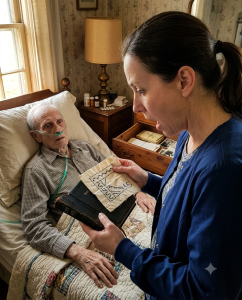
Walter lay in a hospital bed angled toward the window. His skin had gone waxy with illness. His chest rose and fell unevenly. Time had shrunk him. The man I remembered had filled every room with his certainty. This man looked breakable.
I hated that I noticed.
I set my bag down, introduced myself out of habit even though he slept through it, and began the assessment. Blood pressure low. Pulse irregular. Breathing labored but not panicked. Signs of active decline, though not immediate. I moved through the motions automatically.
That was when I saw the Bible.
Worn leather. King James Version. A square of ivory fabric sticking out from the middle.
At first it barely registered. Families tuck all kinds of things into Bibles—obituaries, prayer cards, old photographs, receipts from pharmacies, pressed flowers. But as I adjusted the bedside table, the fabric shifted, and I saw the stitching.
Double wedding ring. Deep blue thread. Tiny anchors in each corner.
My mother’s anchors.
I stared so hard my vision blurred.
When I was small, my grandmother taught my mother to sew that pattern at a quilting frame set up in the front room of our farmhouse. My mother changed it slightly, adding those tiny cross-stitched anchors and laughing that marriage needed more help staying together than people admitted. She said it jokingly back then. Before Walter. Before fear.
No one else stitched them like that.
I reached for the square with a hand that no longer felt steady.
In the lower corner were the initials E.A.P., worked so fine they almost disappeared in the cloth.
Edna Ann Pruitt.
My mother.
For a few seconds I could not hear anything but the rush of blood in my ears.
The room dissolved and I was seventeen again, jumping off the school bus and seeing my mother in the yard with a suitcase at her feet.
I still remembered every detail. Her coat buttoned wrong. Her mouth pressed into a line that wasn’t strength so much as terror held rigid. The county van idling at the end of the drive. Walter stepping out the front door behind me and saying, in that heavy voice of his, “Your mother needs help.”
She kept trying to speak, but he answered for her.
At seventeen, you know when something is wrong, but you don’t always know how deep it goes. I believed adults would sort it out if I just found the right one to tell. A pastor. A lawyer. A social worker. Somebody.
But Walter had already prepared the story. My mother was unstable. My mother was confused. My mother needed supervision.
And he had papers.
By the time I understood he had forged signatures and manipulated the county system through favors and family connections, she was locked away in Ridgecrest Psychiatric. By the time I scraped together enough help to challenge anything, he had sold the farm.
The farm had been in my mother’s family for generations. Walter treated it like inventory.
When my mother came back eighteen months later, she was quieter than silence. She flinched at sudden sounds. She stopped finishing sentences. She stopped quilting almost entirely. If I asked what happened in Ridgecrest, she’d say she was tired.
Then she got sick and died years later, and I told myself the story, awful as it was, had at least reached its end.
Until I stood in Walter’s room and saw that square of fabric.
I forced myself to finish my work before curiosity got the better of me. I checked his medication box. I reviewed comfort measures with Marlene. I documented pain indicators and appetite changes. I did every task exactly as trained.
Then Marlene went to make coffee, and I sat beside Walter’s bed and picked up the Bible.
The quilt square was thicker than it should have been.
Something had been sewn or tucked into the lining.
I hesitated. Every ethical instinct told me not to touch it. But something stronger had already taken hold of me—the certainty that my mother was reaching across time with both hands.
I carefully turned back one corner.
Inside was a folded document.
My name was written across the front.
Not in my mother’s handwriting. Not Walter’s either. It looked formal, careful, almost as if someone had copied script from a penmanship book.
I opened it.
The date was three weeks after my mother’s funeral.
The document identified itself as a sworn statement by Edna Ann Pruitt. It claimed Walter had her unlawfully committed. Claimed he forged her signature multiple times. Claimed the farm sale was fraudulent. Claimed she feared for her safety. Claimed records existed proving more than I knew.
Then I saw the witness signature.
Mildred Goss.
My mother’s aunt Mildred had died thirty years before that date.
I checked again. Same name. Same impossible timeline.
The notary seal came from a county my mother had never lived in.
My legs went weak.
Because a fake document is one thing. A planted confession is another. But this was neither simple nor random. Someone had gone to enormous trouble either to hide the truth or to distort it—and either possibility meant my mother’s death might not have been what I’d believed.
At the bottom of the page, a sentence stood alone.
If anything happens to me sooner than expected, do not believe Walter. I was not sick in the way he said. I was afraid.
A sound came from the bed.
I looked up.
Walter was awake.
His eyes, milky with age, fixed first on the paper and then on my face. He knew what I had found.
I stood so fast the chair scraped the floor. “What is this?”
His lips moved, but no sound came. I grabbed the cup of swabs from the bedside table, wet one, touched it to his mouth the way I’d done for a hundred patients before him. His next attempt came out hoarse.
“Not all of it.”
My skin prickled. “What do you mean?”
His gaze drifted to the cedar dresser in the corner. “Top drawer.”
That was all.
I crossed the room, yanked the drawer open, and found nothing unusual at first—socks, receipts, reading glasses, a flashlight. Then I noticed the base sat higher than it should have. There was a false bottom.
Underneath were letters tied with string, property papers, and a brown envelope stamped DEATH.
I opened the envelope first.
Inside was a copy of my mother’s death certificate and, clipped behind it, an unfiled medical report. The death certificate listed cardiac arrest, natural causes. The second page mentioned sedation levels inconsistent with prescribed medication.
The signing physician’s review line referenced the county medical examiner.
Raymond Pruitt.
Walter’s brother.
The room tightened around me.
I turned back to the bed. “You knew.”
Walter’s eyes filled. “I tried to stop it at the end.”
“At the end of what?”
He swallowed painfully. “She found out about the sale. About the accounts. Said she was going to court. Said she’d take you and leave.”
Cold fury spread through me. “So you had her committed.”
He shut his eyes. “It wasn’t supposed to go that far.”
“That far?” My voice broke. “You stole her farm, had her locked away, and now I’m standing here reading a report that says she was sedated before she died. Tell me what ‘that far’ means.”
His breath hitched. The fight had left him years ago, but fear remained.
“My brother handled the paperwork,” he whispered. “He said if she kept talking, everything would come out.”
Everything.
I tore open the bundle of letters next.
The first ones were from my mother to someone named Clara Bell, a cousin I vaguely remembered from childhood funerals. The letters were never mailed. In them, my mother described being pressured to sign property documents. Being threatened with losing me if she refused. Being told no one would believe her once Walter and Raymond had “put their statements in the file.”
Then I found the letter that made the entire room seem to tip sideways.
It was addressed to me.
Not the document hidden in the quilt square. A real letter, unmistakably in my mother’s hand.
My sweet girl, if you ever read this, it means he kept things the way I thought he would. Men like Walter don’t throw away proof. They save it so they can look at what they got away with.
I pressed the page so hard it trembled.
She wrote that after she returned from Ridgecrest, she started piecing together how Walter and Raymond had used forged evaluations and county favors to strip the property out from under her. She wrote that Raymond warned Walter she was talking too much. She wrote that Walter begged her to stay quiet, promised he would “fix things,” then grew frightened when she said she wanted a lawyer.
The last part was harder to read because the ink had smeared.
She wrote that Walter gave her tea one evening that made her dizzy. She woke later with Raymond in the house and heard them arguing in the kitchen. Heard her own name. Heard the words dosage and enough. After that, she wrote, she stopped eating or drinking anything Walter handed her.
I had to sit down on the floor because my knees would no longer hold me.
Marlene found me there.
She stepped into the room with a mug in hand, saw the papers scattered around me, and set the coffee down without a word. Her face shifted from confusion to dread as she recognized the names on the documents.
“What did you find?” she asked softly.
I handed her the medical page.
She read it once, then again, and I watched comprehension move across her features like a storm front. “My uncle Raymond,” she whispered.
I nodded.
Her eyes filled immediately—not with defensiveness, but with horror. “He used to come here all the time after your mother died.”
My head snapped up. “What?”
Marlene sat slowly on the edge of the chair I had abandoned. “They’d shut the door in this room and talk for hours. One time I heard Daddy say, ‘I can’t carry this forever.’ Raymond told him he’d better learn.”
Walter made a weak sound from the bed, but neither of us looked at him.
“Why keep this?” Marlene asked.
I looked at the quilt square, the Bible, the hidden compartment. “Because guilt doesn’t always make people confess. Sometimes it just makes them build a shrine.”
Marlene covered her mouth with both hands.
I wish I could say the next part happened cleanly, that truth arrived in a tidy line. It didn’t. It came in calls and copied records and one retired clerk in Boone County who still remembered my mother crying in the hallway outside the records office. It came in old signatures compared side by side. It came in Ridgecrest admission notes that had been amended after the fact. It came in Raymond’s review language on the medical report and a pharmacy discrepancy too glaring for anyone honest to ignore.
Walter died thirty-six hours after I found the papers.
Before he lost consciousness for the final time, he asked me once—only once—whether Edna had suffered.
I stood beside his bed, looked at the man who had stolen my mother’s home, her peace, and perhaps even her life, and answered as truthfully as I knew how.
“Yes,” I said. “For years.”
He cried then. Quietly. Like a man who had finally reached the part of the road where no lie could go with him.
I did not comfort him.
After his death, Marlene turned everything over. She told the authorities what she remembered, signed statements, gave names, dates, family stories. Raymond was already dead by then, gone two years and buried with military honors that turned my stomach.
There was no dramatic arrest. No courtroom confession. Time had eaten too much.
But official findings changed.
My mother’s commitment was formally questioned and later acknowledged as based on fraudulent documentation. The property transfer was ruled contaminated by forgery and coercion. Since the land had passed through too many hands, I could not get the farm back, but restitution came from what remained of Walter’s estate.
Money did not interest me much.
What mattered was my mother’s record.
Her name was cleared.
The county amended the narrative around her death, citing credible evidence of external sedation and long-standing coercive abuse, with the exact cause impossible to fully litigate because of the years lost and the deaths of key parties. It was not the perfect justice people imagine in stories, but it was the truth stepping into daylight at last.
I took the restitution and placed a stone at my mother’s grave, larger than the old one, with her full name carved deep and clean: Edna Ann Pruitt.
Below it I added one line.
She was believed.
Months later, I unfolded the quilt square again at my kitchen table. I had kept it wrapped in acid-free paper like the museum piece it had become to me. I finally understood why she had chosen that fabric.
Double wedding ring. Anchors in the corners. Love held together against force.
Inside the lining, behind the false statement and the impossible witness, was a final slip of paper I had overlooked the first time—small, almost weightless, written in my mother’s hand.
For my daughter: there is a difference between silence and peace.
I sat there a long time after reading it.
People still ask whether caring for Walter in those last days was hard. It was. But not for the reason they think. It wasn’t hard because I wanted revenge. By then, revenge felt small.
It was hard because I had to look at him and see what evil often really is. Not a monster in a storm. Not some wild-eyed villain. Just an ordinary man who loved comfort more than conscience and let that weakness ruin every life around him.
I think about that when I remember my mother now.
Not the institution. Not the forged papers. Not the hidden report.
I remember her bent over a quilt frame by winter light, pulling blue thread through ivory cloth, adding tiny anchors to every corner because she still believed some things could be kept from unraveling.
The hardest part is knowing she was right and wrong at the same time.
Love didn’t save her.
But in the end, it saved the truth.
And some days I still wonder which would hurt more to admit: that Walter was afraid of losing everything, or that he knew exactly what he was doing the whole time. I wonder whether guilt counts for anything when it comes thirty years late. I wonder what I would have done if he had asked for forgiveness instead of asking whether she suffered.
I don’t know.
I only know this:
He kept the proof because some part of him needed to be found out.
And my mother, even after everything they did to her, still found a way to make sure I was the one who found it.