My mama used to say Darlene had a smile like a screen door in a hurricane: pretty enough, but it would let anything in. At the time, I thought it was just one of Mama’s sayings, the kind country women collect over years of being proven right about people they never quite trusted.
I understand now that Mama was warning me.
My name is Patty Mullins, and I retired from the United States Postal Service after thirty-one years in Lawrenceburg, Kentucky. I sorted mail through ice storms, summer heat, election seasons, Christmas crushes, and the ordinary private chaos of a thousand households. The job taught me patience, routine, and a respect for details most people miss. Envelopes tell stories. Handwriting changes when somebody is scared. Return addresses matter. Timing matters. What belongs somewhere and what doesn’t can tell you almost everything.
That is probably why Darlene underestimated me.
Darlene was married to my younger brother, Wayne. She was one of those women who could walk into a room full of strangers and leave with three compliments, two invitations, and somebody else paying for lunch. She dressed beautifully, kept her nails perfect, and knew exactly how long to hold eye contact when she wanted to look sincere. Some people are born likable. Darlene had made likability into a profession.
My mother never bought it.
Mama lived in the old farmhouse on Benson Creek Road, the same house my grandmother helped build room by room after the war. The floors creaked in winter and the back porch leaned a little to the left, but it was family in wood form. My grandfather died in the back bedroom. My brother and I learned to shell peas in the kitchen. I learned to drive in the gravel driveway while Mama sat rigid in the passenger seat pretending not to pray out loud.
She also kept a small green leather address book in the top drawer of her nightstand. Avocado green, cracked spine, worn gold trim, pages crowded with names, birthdays, old phone numbers, new phone numbers, notes in the margins, and lines through the names of the dead. She updated it with the same blue ballpoint pen for forty years. It was the nearest thing she had to a family archive.
When we buried Mama in March of 2023, grief had all of us moving like people underwater. The reception afterward was held in the fellowship hall at church. There was ham, potato salad, pound cake, coffee, and the low, uneven murmur of people trying to comfort one another with memories.
That was when Darlene held the green book in the air and announced, “She gave this to me. She trusted me with her things.”
I remember staring at her hand, those long acrylic nails wrapped around the leather cover, and thinking the moment felt wrong without knowing why. But funerals are poor places for fights. I let it pass.
Three weeks later, the real estate agent called.
She was polite, almost apologetic. She asked whether I was finished clearing out “the sold property.” For one strange second I thought she must have the wrong number. Then she said the farmhouse address.
My body went cold.
There are shocks that arrive like explosions and shocks that arrive like doors quietly locking behind you. This was the second kind. By the end of that phone call, I knew the house had sold for $247,000. I also knew I had not signed anything, approved anything, or received a cent.
At the county clerk’s office, I got copies of the documents. That was where grief turned into clarity. The power of attorney attached to the sale was supposedly signed by my mother before her death. The notary seal belonged to a woman who had died nearly two years earlier. The deed transfer moved through an LLC designed to keep Darlene’s name from appearing too quickly to the casual eye.
It was theft, but it was polished theft. Papered theft. The kind that counts on decent people being too intimidated by official stamps to look closely.
I called one lawyer. His retainer was more than I had in my checking account. I called another. He said these things could take years. I could feel the trap closing around me exactly the way Darlene had planned it. She was betting I would grieve, panic, and then give up.
Instead, I got quiet.
Not defeated quiet. Working quiet.
I enrolled in a notary certification course at the community college in Frankfort. The class itself was ordinary enough: basic state requirements, identity verification, recordkeeping, wording, seals. But to me it was the start of learning a new language. I began to understand how much notarial practice depends on simple rules followed exactly. A person must appear in front of the notary. Identification must be verified. Dates and signatures must line up. Seals and commissions must be current. If any part of that chain is false, the whole document can rot from the center without looking damaged from the outside.
Once I knew the rules, I started studying how people break them.
I requested public records. I reviewed LLC filings. I learned to compare genuine notarizations against counterfeit ones. Under magnification, the fake seal on Mama’s document had tiny inconsistencies in ink spread and border depth. The commission number was off by one digit from the dead notary’s last valid registration. The date on the alleged signature placed Mama at home on a day she was actually in the hospital, and I had the discharge paperwork to prove it.
The deeper I dug, the more Darlene’s polished image began to crack.
By then she had reinvented herself online as some kind of wealth mentor for midlife women. She posted motivational sayings over beige backgrounds. She talked about abundance, inheritance, confidence, and “building legacy.” She wore fitted blazers and filmed videos from a tidy home office with books arranged by color.
And in photo after photo, there was Mama’s green address book in the background.
At first I wondered whether I was imagining it. Then I started taking screenshots. On the kitchen counter behind a vision board. On a shelf beside a candle. On her desk during a livestream. It became impossible to dismiss. She had not just stolen from us. She had kept souvenirs.
One evening, while tracing a link from one of her posts, I found a seminar advertisement. “Building Her Legacy: Wealth Strategies for Women Over 50.” Lexington hotel ballroom. Four hundred dollars a seat. Darlene as keynote speaker.
Legacy.
The word made me so angry I had to set my phone down.
By then I had also connected with the title insurance company involved in the farmhouse sale. Once I showed them the problems in the power of attorney, they started taking me seriously. A forged notary seal is not a family misunderstanding; it is the kind of thing that gets entire transaction files reopened in a hurry. The county clerk’s copies, the death record of the notary, the date mismatch, the hospital documents, the LLC chain, and the money trail gave them enough to launch a formal review. That review reached the sheriff’s office and, eventually, an investigator attached to the Secretary of State’s office.
Still, I wanted more than a sterile letter and a delayed consequence. I wanted Darlene to feel the floor move underneath her in public, the way she had moved it underneath me.
A week before the seminar, something happened that pushed everything over the edge.
Darlene’s assistant—young woman named Melissa, overworked and underpaid—contacted me from a private account. She had seen enough irregular paperwork in Darlene’s office to get scared. She would not meet in person, but she told me Darlene kept old family documents in a locked cabinet in the office she used for filming. She also told me the cleaning company had a Tuesday access window when the office would be empty.
I passed the information to the investigator, who handled it properly through legal channels. That is important. I did not break into anything. But Tuesday afternoon, evidence already tied to the fraud investigation was recovered from that office, and among the items documented was Mama’s green address book.
When the investigator called to tell me it had been found, I cried so hard I had to sit down on my kitchen floor.
I met them the next morning to identify it. The leather was softer than I remembered, and the pages smelled faintly of dust and old perfume. As I turned to the back, I found something I had never noticed before. Beside Darlene’s name and first phone number, Mama had written a note in small, firm script:
Do not ever let this woman sign.
For a full minute I could not breathe.
Mama had seen her. Maybe not the whole crime, maybe not the end of it, but enough. Enough to mark a warning and tuck it away where only family would find it.
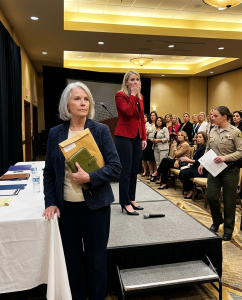
The morning of the seminar, I drove to Lexington alone. I wore a navy blouse, sensible shoes, and the expression I used to wear on difficult mail routes when the weather was bad and complaining would not improve a single thing. I registered under my maiden name so no one at the desk looked twice. The ballroom was elegant in that hotel way—carpet patterned to hide stains, soft lighting, coffee urns gleaming near pastry trays. Around two hundred women were there, chatting about retirement, divorce settlements, downsizing, starting over.
Then Darlene took the stage in a red blazer and began speaking about financial independence.
I watched her long enough to hear her tell the room, “No one is coming to rescue your future but you.”
Then she saw me.
If you have ever watched a person realize the past they buried is standing in the doorway, you know the look. It starts in the eyes. A flash. A calculation. Then the skin changes. Her confidence did not vanish, exactly, but it slipped.
I stood and walked toward the registration table. In my tote bag were copies, timelines, and the green book. Also waiting in the lobby were the deputy, the investigator, and a representative from the title insurer. We had agreed on the moment. Once Darlene identified me and could no longer claim confusion of person, they would come in.
I took out the certified envelope addressed to her.
The deputy stepped forward behind me and said, “Ms. Whitaker?”
Her microphone hit the floor before he finished the sentence.
What followed was not dramatic in the television sense. No handcuffs. No screaming. Reality is often quieter and more devastating than that. The deputy served the documents. The investigator identified himself and informed her that the property transfer, notarization, and disbursement of proceeds were under active review. The title representative stood beside him with a face like stone. Women in the front row stared openly. One whispered, “Oh my God.”
Darlene tried to recover. She said there must be a misunderstanding. She said I was grieving and confused. She said everything had been handled “through proper channels.”
That was when the investigator asked whether she wanted to explain the forged notary seal before or after discussing the recovery of family property from her office.
She looked at my tote bag and understood.
I removed the green book and held it against my chest. “This belongs to my mother,” I said.
The room went still.
Before Darlene could answer, the ballroom doors opened and my brother Wayne came in, out of breath, tie crooked, face gray with humiliation. He had been contacted that morning after the investigators concluded he might not have known the full scope of what his wife had done. He looked from Darlene to me to the deputy and asked, “What property from the office?”
No one answered quickly enough, so I did. “Mama’s. And enough paperwork to explain the rest.”
Wayne’s face changed in a way I will not forget as long as I live. People talk about betrayal as anger, but first it is confusion. It is the mind trying to reject what the eyes are already accepting.
The legal process took months after that, but the public unraveling began immediately. The title company froze disbursement pathways tied to the sale. The forged power of attorney was declared invalid. Civil action moved to unwind the transaction. Because the buyer had title insurance and had acted without knowledge of the fraud, the house itself passed through an ugly but necessary process. In the end, the sale was rescinded through settlement, the buyer was made whole through the insurer, and title to the farmhouse returned to my mother’s estate.
The money trail was uglier. A portion of the proceeds had already been spent on Darlene’s seminars, branding, travel, and a leased luxury SUV she had no business driving. But paper is stubborn. Accounts were traced. Assets were frozen where they could be. Restitution orders came later.
The criminal side moved slower, but it moved. Forgery, filing false instruments, and notarial fraud do not become less serious because the victim is family. Darlene took a plea before trial. Her wealth seminars vanished overnight. The women she had been advising on legacy planning learned, in one brutal sweep, exactly what kind of expert she had been listening to.
Wayne moved out before the leaves turned. He and I are still finding our way back to each other. Some wounds are not clean enough for a quick apology, especially when love and shame are tangled together. He swears he did not know about the forged document or the sale structure. I believe he did not know the whole of it. I also believe there were signs he chose not to see because seeing them would have required a fight at home. That is its own kind of failure.
As for the farmhouse, it is mine to care for now. The porch still leans. The back bedroom still holds more silence than I can stand on certain afternoons. I replaced two broken window latches and cleaned out the hall closet. In Mama’s room, I put the green address book back in the nightstand drawer where it belongs. Sometimes I take it out and run my hand over the cracked spine just to remind myself that some things can be stolen on paper and still come home.
People in town still ask me whether it was worth it—the classes, the records, the waiting, the public scene at the hotel. I tell them yes. Not because revenge is sweet. It isn’t, not really. It tastes more like metal. But truth needs somebody willing to carry it all the way to the door and knock hard enough to be heard.
Mama had seen Darlene more clearly than the rest of us. She left me that warning in blue ink long before I knew I would need it. I think about that often now. Not just the warning itself, but the fact that she wrote it down. As if she knew that one day details would matter more than tears.
Maybe the biggest red flag was never Darlene’s ambition or her polished speeches or even her talent for making people trust her. Maybe it was how easily she treated memory like property, as if the dead could be rearranged to suit the living. Selling a house is theft. Turning a woman’s life into a prop is something colder.
The farmhouse is still standing on Benson Creek Road. The gravel still crunches the same under my tires. And every time I pull into that driveway, I think the same thing:
Mama was right about the screen door. She was right about the storm. And in the end, Darlene let in exactly the one thing she thought she could keep out—the truth.