When Diane Holloway humiliated Patsy Merritt in front of a room full of children, she thought she was ending a minor inconvenience.
She had no idea she was creating the one witness in Hatchett Creek who would never forget a single line in the records.
Twelve years later, that mistake came back carrying a faded ledger with a magnolia stamped on the cover.
And before Patsy said a word, Diane knew exactly what it meant.
The day it started was one of those Southern summer afternoons that made the whole town feel drowsy and irritable. Heat rose from the library parking lot in visible waves. The glass doors stuck a little from humidity. Inside, the children’s room was packed for the summer reading program, with folding chairs lined against the walls for parents and grandparents, and a semicircle of little kids sitting on the rug with paper bookmarks still drying from glitter glue.
Patsy Merritt sat in the rocking chair at the front, a paperback copy of Charlotte’s Web open in her lap.
She loved story hour. Everyone in town knew that, even people who barely noticed librarians otherwise. Patsy had a gift for reading slowly enough that children leaned in instead of drifting away. She did voices without making a show of it. She remembered favorite books, allergies, birthdays, and which nervous child needed a quieter smile before they’d join the group. She wasn’t flashy. She wasn’t political. She was simply steady, which in a small town is often mistaken for smallness.
Diane Holloway swept in ten minutes after the hour.
Nobody invited Diane to lower her voice because nobody in Hatchett Creek ever told Diane Holloway what to do. She was the wife of the town council chair, the chairwoman of two charity committees, and the kind of woman whose opinions turned into decisions before anyone else realized a conversation had happened. She was immaculate in white linen, her blond hair fixed in place, pearls cool at her throat despite the heat.
Patsy looked up politely when Diane stepped close.
Diane tapped her shoulder while Patsy was mid-sentence.
Forty-seven children stared.
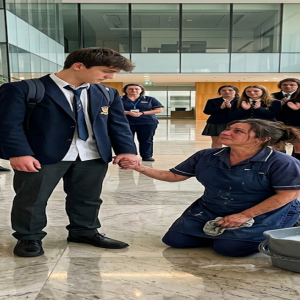
“We won’t be needing you after today,” Diane said. She did not smile. “The library deserves someone with actual qualifications. Frankly, Patsy, you’re barely educated and going nowhere. We all know it.”
The silence that followed felt physical.
A little girl in the front row blinked up at Patsy with wide, wet eyes. A mother by the window covered her mouth. One boy asked, in a whisper not nearly as quiet as he thought, “Is she in trouble?”
Patsy closed the book. She set it beside her, stood up, and smoothed her cardigan. No one who saw her that day ever forgot how calm she looked. It wasn’t numbness. It wasn’t surrender. It was control, and at the time no one understood how dangerous control can be in a woman who has just been publicly shamed.
She went behind the circulation desk, lifted her canvas tote from the hook beneath the counter, and paused by the bottom drawer where the overdue-fine ledger was kept.
The ledger wasn’t important to anyone else.
It was old, water-stained, and inconsistent with newer digital records. But Patsy trusted paper in a way some people trust instinct. She knew which pages had been entered by her own hand, which notations had been altered later, which figures didn’t match the deposits she remembered carrying to the bank.
Months before Diane fired her, Patsy had begun noticing strange patterns.
A memorial donation entered for the roof repair fund that never appeared in the monthly report.
Large overdue fines erased for families with the right last names.
Purchases labeled as “children’s literacy materials” that coincided with no boxes delivered, no invoices filed, and no new books on the shelves.
At first Patsy had assumed sloppy bookkeeping. Then she found an older page where a number had clearly been penciled lightly before being traced over in ink. She began making notes in the margins only she would understand. Dates. Initials. Deposit slips that didn’t line up.
And one afternoon Diane herself had come in through the staff entrance, closed the office door, and said in a pleasant voice, “There are some records that need cleaning up. It’s confusing for donors when small-town paperwork looks untidy.”
Patsy remembered standing by the filing cabinet with a stack of returned books in her arms.
“Cleaning up how?” she had asked.
Diane had smiled then, a thin smile with no warmth in it. “By making sure the final version reflects what should have been recorded.”
Patsy knew what she meant. She also knew that pretending not to know would buy her time.
She never changed the pages.
Three weeks later, Diane fired her in front of the children.
As Patsy lifted the ledger and slipped it into her tote, the room kept its eyes on Diane. Nobody noticed the small, decisive theft.
She walked out of the library without her dignity cracking in public.
Then she cried in her car so hard she had to pull off on a side street before she could drive home.
For a while, it looked like Diane had won completely. In Hatchett Creek, a public dismissal has a way of turning into public truth. People repeated versions of the story with each retelling making Patsy sound more incompetent, more outmatched, more temporary than she had ever been. Diane hired a new librarian with a polished résumé and a cousin on the council. The town moved on.
Patsy did not.
She enrolled in night classes at the community college in Cookeville and drove there after work several evenings a week, forty minutes each way on roads that felt longer after dark. She temped in offices. Took bookkeeping jobs. Counted inventory at a pharmacy during one ugly winter when her heat bill nearly beat her. She packed peanut butter crackers in her bag and studied in parking lots before class.
There were nights she wanted to quit.
There were mornings she heard Diane’s voice in her head—barely educated and going nowhere—and had to sit still for a few seconds before getting out of bed.
But humiliation can sharpen a person. Patsy turned her hurt into structure. One semester became two. Then a degree. Then a position at a university library in Nashville. Then another. She discovered she was exceptionally good at preservation work because she had patience, precision, and almost reverent respect for records. Old letters, county maps, family bibles, Civil War rosters—she handled them all with the same quiet discipline she had once given to overdue slips and children’s reading charts.
Eventually she became head of special collections.
Reporters interviewed her department when a restoration project saved a set of nineteenth-century court papers from permanent damage. Donors asked for her by name. Graduate students came to her with white gloves on and gratitude in their eyes. Patsy built a life that Hatchett Creek had never imagined for her.
And still the ledger stayed close.
She placed it in archival sleeves. Stabilized the paper. Cross-referenced the entries over time using public records, tax documents, board minutes, and old donor newsletters. She never rushed. She didn’t have to. Every year that passed made Diane safer in her own mind and Patsy more dangerous in reality.
Because the ledger alone was troubling.
The supporting documents Patsy assembled made it devastating.
She found copies of donation announcements in the local paper that didn’t match the deposited amounts. She identified reimbursements approved by the library board for educational supplies that corresponded neatly with charges made at a home décor store in the next county. She found a former treasurer willing, after retirement and two glasses of tea on a screened porch, to admit that Diane often “handled things informally” when donors wanted discretion.
The final piece came from the one thing Diane had overlooked: Patsy’s habit of making duplicates.
Before the firing, Patsy had photocopied several deposit slips and a typed donor list because she meant to balance the monthly report from home. The copies had been left inside a grammar workbook she used in a night class. She forgot about them for years. When she found them again, tucked between assignments in a storage box, she sat on the floor of her apartment and stared for a long time.
Insurance, she called it after that.
Her sister asked once why she still kept the ledger in her bag.
“Because one day,” Patsy said, “I may need the exact right moment.”
The exact right moment arrived with Hatchett Creek’s centennial celebration.
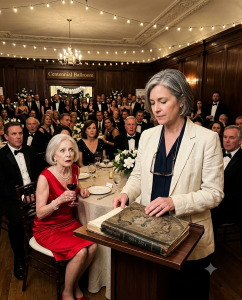
The whole town had spent months preparing. The old Mercer Hotel ballroom was restored for the gala, draped in white lights and greenery, all polished wood and careful nostalgia. Invitations went to business owners, council members, legacy families, church leaders, school administrators, and anyone else with enough standing to matter. Patsy received one because the historical society wanted to honor Hatchett Creek natives who had brought distinction to the region. On paper, it was civic pride.
In reality, it was a room full of witnesses.
Patsy accepted.
She wore a cream blazer and dark slacks, nothing extravagant. She pinned up her hair, hooked her reading glasses around her neck, and placed the ledger in her bag beneath a folder of protected copies and certified records from the university’s conservation office verifying dates, ink consistency, and document age. She was not walking into the Mercer Hotel with a grudge.
She was walking in with proof.
Diane Holloway was exactly where Patsy expected her to be: at a front table in a red dress that announced confidence before she said a word. Diane still had that same polished ease, the same casual command over everyone around her. Her husband, still influential, laughed at private jokes. People leaned toward them. Diane accepted admiration the way some people accept handed napkins—as something naturally owed.
Patsy sat quietly at table nine and waited through the meal, the speeches, and a historical slideshow set to patriotic music. She watched Diane relax further each passing minute.
Then the emcee announced the nominees for Hatchett Creek Citizen of the Year.
Diane straightened.
Patsy stood.
At first people assumed she was heading for the restroom or perhaps responding to some program cue they had missed. But she walked directly toward the podium. The emcee hesitated, recognized her name a second too late, and instinctively stepped aside. Patsy had been listed in the program earlier as an honored Hatchett Creek alumna for her archival work. That was enough. No one stopped her.
She placed her bag on the floor, took out the old ledger, and set it on the podium.
Diane saw the magnolia stamp and lost all color.
That was the moment the room changed.
Before then, people were merely curious. After that, they sensed danger.
Patsy opened the cover.
“Before I was dismissed from the Hatchett Creek Public Library,” she said, calm and clear, “I was asked to correct records. Not update them. Correct them.”
The ballroom went silent.
She turned pages slowly, explaining the discrepancies with the precision of someone who had lived among documents long enough to know emotion persuades less than sequence. Here was a memorial donation for roof repairs, publicly announced at one amount, deposited at another. Here were overdue fines erased for the families of political allies. Here were purchases logged under literacy outreach with no corresponding materials ever received. Here were duplicate entries, pencil impressions under ink, and dates that aligned suspiciously with fundraising events chaired by Diane Holloway.
Diane tried to interrupt. “This is absurd.”
Patsy didn’t even look at her yet. “I thought it might sound that way,” she said, and removed the folder from her bag.
Inside were preserved photocopies, notarized statements, authenticated comparisons, and one particularly damaging item: a typed donor summary prepared for a council review, carrying Diane’s handwritten adjustment marks in blue ink.
That was when Diane made a sharp, frightened sound.
The council chair stared at the page as though it had bitten him.
A retired bank employee in the third row stood halfway from her seat and said, trembling, “I knew those deposits were wrong.”
The room broke open after that.
Questions came from every side. Voices rose. A board member demanded to see the supporting papers. The mayor asked the emcee to cut the microphone and was ignored because half the room had already surged toward the front. Diane insisted it was all a misunderstanding, then a clerical issue, then the fault of an old treasurer no longer alive to defend himself. But each explanation came too late and contradicted the last.
Patsy finally turned to Diane.
“You fired me because I wouldn’t alter the books,” she said.
Diane’s mouth opened and closed.
“You did it in front of children,” Patsy added, and for the first time the steel beneath her calm showed through. “You thought that would make me small enough to disappear.”
The silence that followed was heavier than any shouting.
The council chair sat down hard in his seat. Whatever private things he had known, he had not expected public evidence. The historical society president quietly took the folder from Patsy and began scanning the pages with the expression of someone realizing the evening had just turned into an investigation.
It did.
Within weeks, the county opened a formal review into the library funds and related civic accounts. The amount missing was not enormous by big-city standards, but in Hatchett Creek it was enough to stain generations: scholarship money diverted, memorial gifts misused, repair funds drained, and records manipulated to shield favored names. Diane was never criminally charged because statutes and jurisdictional tangles complicated some of the oldest entries, but the scandal destroyed her standing. Her husband resigned from the council chairmanship under public pressure. Charity boards removed Diane quietly at first, then decisively. The women who once orbited her at luncheons stopped returning her calls.
The library board, facing its own humiliation, issued a formal apology to Patsy Merritt for wrongful termination and public mistreatment. They invited her back to speak at the reopening of the renovated children’s wing funded by a new transparent donor campaign.
Patsy accepted the apology in writing.
She did not take the speaking invitation.
Instead, a month later, forty-seven handmade bookmarks appeared in a display case near the children’s room, recreated by local students for a program on kindness and public memory. Beneath them sat a small plaque that read: In honor of those who protected truth, even when no one applauded.
No name was listed.
Everyone knew.
Years later, people in Hatchett Creek still argued about the story. Some said Patsy waited too long. Some said she chose the gala because she wanted maximum humiliation. Some insisted Diane had once done real good for the town before greed or vanity twisted into something uglier. Others said the firing itself revealed everything anyone needed to know.
Patsy never publicly debated any of it.
She returned to Nashville, to her archives and students and the steady work of preserving what other people overlook until it is almost gone. The ledger was eventually transferred, under controlled conditions, to a legal file and later archived with restricted access as part of the town’s centennial records. A few people found that poetic. Patsy found it proper.
Because in the end, the thing that undid Diane Holloway was not revenge.
It was documentation.
And perhaps that is what unsettled Hatchett Creek most. Not that a powerful woman fell. Not that an insult was answered. But that the quietest person in the room had seen everything, written it down, and understood from the beginning that someday the truth would need a place to live.
The town had mistaken Patsy’s silence for surrender.
They were wrong.
She had not been going nowhere.
She had been keeping records.
After everything was exposed, one question lingered in the minds of people who heard the story: what was worse, the missing money, or the certainty with which Diane believed she could ruin someone publicly and suffer nothing for it? Patsy never answered that out loud. She didn’t need to. Anyone who saw Diane’s face when the ledger appeared already knew where the real corruption had started.