The snow was already past the curb when Earl spotted her through the post office window.
She couldn’t have been more than sixteen. Standing out there in a thin green jacket — no hat, no gloves — with her arms wrapped tight around herself like she was trying to hold something together.
Earl had been the postmaster of Millhaven, Ohio for thirty-one years. He’d seen every kind of person come through that door. But something about this girl made him set his coffee down and go unlock the side annex himself.
“Come on in out of that,” he said. That was all.
She didn’t argue. She just stepped inside, shaking snow off her sneakers, and stood there dripping on his linoleum like a soaked sparrow.
Earl pointed to the old wooden chair by the space heater — the one that had sat in the same corner since the Reagan administration — and she sat down without a word.
That’s when he noticed the envelope.
She was pressing it flat against her chest with both hands. Not holding it. Pressing it. Like it was something that might float away, or might break, or might disappear if she loosened her grip even slightly.
It was a regular white envelope, but it had seen better days. The edges were soft and brown with age. A water stain had bled across the bottom corner like an old bruise. And it was sealed. Whatever was inside had never been sent.
Earl set a paper cup of hot cocoa next to her. She said “thank you” so quietly he almost missed it.
He went back to sorting the afternoon mail and let the silence do its work. That’s the thing about small-town post offices. They’re built for waiting.
He’d nearly forgotten she was there when he heard her make a sound. Not crying exactly. More like the sound a person makes when they’ve been holding their breath for a very long time.
He looked over.
She was staring at the envelope.
Still pressed to her chest. Still sealed. Still carrying whatever it was carrying.
“You need to mail something?” Earl asked gently.
She shook her head.
“You sure? That’s what we’re here for.”
She looked up at him then, and her eyes were older than sixteen had any right to be. “It’s not mine to mail,” she said. “It’s my grandma’s. She asked me to… she wanted me to…” She stopped. Swallowed. “She passed away last month. She never sent it. I don’t even know why.”
Earl nodded slow. He’d carried enough undelivered things in his time to know when not to push.
He went back to his work.
The blizzard settled in harder. The kind of Ohio snow that muffles the whole world down to just the wind and the tick of the clock.
And then, about a half hour later, the girl said something that made Earl go very still.
“The name on here… did you ever know anyone in this town with that name? My grandma said she lived here a long time ago.”
Earl kept his eyes on the mail in his hands. “What name is that, sweetheart?”
There was a pause. Just the heater humming and the snow pressing against the glass.
“Could you look?” she said softly. “I’ve been carrying it around for three weeks and I can’t… I just need to know if she was real. If any of it was real.”
Earl walked across the linoleum slowly, the way you do when you’re seventy-three and your knees know the weather better than the forecast does.
He reached out.
She let him take it.
He turned the envelope over.
And the name on the front —
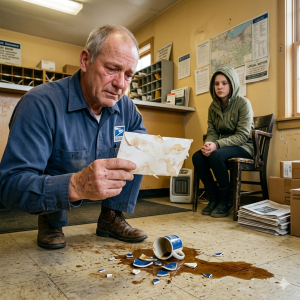
His coffee mug slipped right out of his hand.
It hit the floor and shattered. Hot coffee spread slow across the old linoleum. Neither of them moved to clean it up.
Because Earl was standing there with his hand shaking and his eyes filling with something that hadn’t had anywhere to go for thirty years.
He knew that name.
Lord help him, he knew that name.
Margaret Anne Colby.
Maggie.
He hadn’t said that name out loud in so long it felt like a word from another language. A language he used to be fluent in.
The girl was watching him. Frightened, probably, at the sight of a seventy-three-year-old man going white as the snow outside.
“Sir? Are you okay?”
Earl didn’t answer right away. He was looking at the handwriting. Even after everything, even with the water stain blurring the bottom corner, he would have known that handwriting in a dark room with both hands tied. The way she made her capital E’s in two careful strokes instead of one. The little tail on her lowercase g that curved back up, like it didn’t want to let go.
“Sir?”
“Your grandmother,” Earl said carefully. His voice came out rough and low, like an engine that hadn’t been started in years. “What was her name, sweetheart?”
The girl blinked. “Roberta. Roberta Jean Holt. Her maiden name was Calloway.”
Earl closed his eyes for just a second.
Birdie Calloway.
Of course. Of course it was Birdie.
He pulled the other wooden chair — the one behind the counter that nobody ever sat in — around to the front and lowered himself into it. His knees were the least of his problems right now.
“I knew your grandmother,” he said. “A long time ago. We were — she was my — ” He stopped. Sorted through forty-five years of practiced not-saying and couldn’t find the right word, the small enough word. “We grew up together,” he finally said. “Here in Millhaven. Before she moved away.”
The girl — he still didn’t know her name — hugged herself the same way her grandmother used to when she was thinking something through. He noticed that and it nearly undid him.
“She never talked about here,” the girl said slowly. “Not once. We didn’t even know she’d lived in Ohio until we were going through her things. We found a box.”
“What kind of box?”
“A shoebox. Under her bed. It was taped shut with like four layers of tape.” She paused. “There were pictures in it. Old ones. And some letters she’d received, tied up with a rubber band. And that envelope at the bottom, still sealed.” She looked at it, still in his hands. “We couldn’t find a last name on the address. Just Earl. And Millhaven, Ohio. And a zip code.”
Earl looked down at the front of the envelope again.
His name, in her handwriting.
Just Earl.
Because thirty years ago, there had only been one Earl in Millhaven worth writing to.
He should have been sitting down for this already. He was sitting down. His heart didn’t seem to know that.
“You said your grandmother passed last month,” he said.
“November fourteenth.” The girl’s voice got careful around the date the way you learn to be careful around something sharp. “It was her heart. She went fast. The doctor said she probably didn’t feel much.”
Earl nodded. He had the feeling he was supposed to say something consoling and couldn’t locate any words that weren’t going to crack open on the way out.
“I’m sorry for your loss,” he managed.
“Thank you.” She paused. “I’m Lily, by the way. Lily Holt. She was my mom’s mom.”
“Earl Ackerman,” he said, which was somewhat redundant given the sign on the door and the embroidery on his shirt, but it felt necessary.
Lily looked at the envelope still in his hands. “She told my mom something, at the very end. When she knew she was going. She made my mom promise to find you and bring it to you.” She swallowed. “My mom — she has my little brother, and it’s hard for her to travel right now. So she sent me. I took the bus from Columbus this morning.”
Columbus. An hour’s drive in good weather. On a day like today, with the roads the way they were, that bus ride must have been three hours minimum.
This sixteen-year-old girl had ridden a bus through a blizzard, alone, carrying a letter her grandmother wrote thirty years ago to a man she’d never met, in a town she’d never been to, because her mother made a promise to a dying woman.
“You did all that,” Earl said quietly, “on your own?”
Lily shrugged with one shoulder. The same gesture Birdie used to make when she didn’t want to be credited for something. “It wasn’t a big deal.”
It was an enormous deal. Earl didn’t say that either.
He looked down at the envelope one more time. Turned it in his hands. He felt the small hard fact of it — something sealed, something waiting, something that had traveled thirty years to get here and had only the last hundred yards left to go.
“Do you know what’s in it?” he asked.
“No. My grandma said — she told my mom it was something she should have done a long time ago. An apology, she thought. Or an explanation. She wasn’t sure which.” Lily looked at him steadily. “She said you’d know what it meant.”
Earl’s thumb rested on the sealed flap.
Nineteen eighty-three. He was twenty-eight years old. Birdie was twenty-six. They’d been together three years by then, the kind of together that has its own gravity, that bends every plan you make in its direction. He’d had the ring. He had actually, literally had the ring — his grandmother’s, a thin gold band with a small pearl, because he’d known Birdie would prefer something with a history over something flashy and new. He knew everything about her. That was the thing. He knew everything.
And then one Tuesday in October she was just gone.
No fight. No warning he could point to later, though Lord knows he’d tried. Her apartment emptied out. Her sister in Cincinnati said she didn’t know anything and said it in a way that meant she wasn’t going to say more. And no letter. No call. Nothing.
He’d told himself, over the years, that it must have been something he did. Then he told himself it must have been something she needed that he couldn’t give. Then he stopped telling himself stories about it at all and just carried the not-knowing the way you carry a stone in your shoe long enough — you stop noticing the weight and just walk a little different forever.
He’d married Patricia in 1987. Good woman. They’d been happy, genuinely happy, for thirty-one years before she passed from cancer in 2018. He’d loved Patricia. He wanted that to be clear, if only to himself, sitting in this chair right now. He’d loved her all the way.
But there are things that don’t replace each other. There are questions that just stay questions.
He carefully worked his thumb under the flap.
Lily watched but didn’t say anything. She seemed to understand that this was something to be quiet for.
The envelope opened without tearing. Like it had been waiting to be handled carefully and was grateful for it.
Inside was a single piece of paper, folded in thirds. The handwriting was the same as on the envelope. The same careful E’s. The same g that didn’t want to let go.
Earl,
I’ve started this letter eleven times in the last thirty years and thrown away every version. So I’m going to say the true thing this time, the whole true thing, even though I’ve spent a long time being afraid of it.
I left because I was pregnant.
Not with your child. I need you to know that first, before anything else, because you’ll need to understand it in the right order. It wasn’t yours. It was a man I knew from work, a mistake made during a week when I was frightened about our future and made a terrible choice and then was too ashamed to say so. When I found out, I panicked. I thought — I was so sure — that if I stayed and told you, you would stay with me out of decency, not love, and that you would spend the rest of your life knowing what I’d done, and I couldn’t stand the thought of being looked at that way by the person whose opinion meant the most to me in the world.
I know now that was wrong. I know now I should have trusted you. I spent a long time being angry at myself for being too proud to find out who you really were, because I think you would have surprised me. I think you would have been kind.
I moved to Columbus. I had the baby. I raised her. She became my whole world, and she gave me grandchildren, and I have had a life full of love, and I am grateful.
But there has never been a day in thirty years when I haven’t thought about what I did to you. Not in a guilty, punishing way. I stopped punishing myself a long time ago. Just in a true way. The way you know you left a door open somewhere.
I’m writing this now because I’m seventy-two years old and I’ve just had a diagnosis that means I probably won’t see seventy-four, and the only thing I have left to do that I haven’t done yet is tell you the truth, so you can stop wondering, if you ever did.
You deserved better than silence. You were a good man, Earl. I knew that then and I have always known it.
I hope Millhaven has been kind to you. I hope you have been happy.
With all the love I still have for you, which is more than I can write in a letter,
Birdie
Earl sat with it for a long time.
Lily didn’t move. She had that rarest of teenage gifts, patience, real patience, not the restless kind. She just sat and let him have whatever he needed to have.
The snow pressed against the windows. The space heater ticked. Outside, Millhaven was the quietest it gets, which is very quiet indeed.
When Earl finally looked up, his eyes were wet, but his face was calm. The kind of calm that comes after the storm has moved through, not before.
“She have a good life?” he asked. “Your grandmother.”
Lily nodded. “She was happy, I think. She laughed a lot. She made the best pie crust in the world and she refused to teach anyone how she did it, which my mom says was just mean.” A small smile. “She had a lot of friends. She volunteered at the library. She was the kind of person that things were always happening around, you know? Like life just followed her.”
Earl smiled at that. “Yes,” he said. “That sounds exactly right.”
He folded the letter back along its original creases and slid it gently into the envelope. Then he held it in both hands for a moment and thought about what thirty years of wondering actually weighs, and what it weighs when you set it down.
Lighter than he’d expected.
Heavier than he could have known, right up until this moment.
“Thank you,” he said. “For coming all this way. In this weather. On a bus.” He looked at her seriously. “How were you going to get back?”
Lily’s expression flickered with the particular guilt of someone who hasn’t entirely thought the return trip through. “There’s a five o’clock back to Columbus.”
“That’s four hours from now.”
“Yeah.”
Earl stood up slowly. His knees complained, as they always did, and he ignored them, as he always did. He went to the back room and came out with the spare blanket he kept there for exactly the reason anyone keeps a spare blanket in an Ohio post office in January, which is because Ohio winters don’t negotiate.
He set it on the counter.
“I’m going to close up a few minutes early today,” he said. “Which, before you say anything, I am absolutely allowed to do because I am the postmaster and the blizzard is a legitimate operational condition.” He pulled his coat off the hook by the door. “And you are going to come have dinner at my house, because I have a pot of chili on a slow cooker that has been working on itself since six this morning and it would be an insult to that chili to not eat it with someone. And at four-thirty I will drive you to the station myself, in my truck, which has four-wheel drive and winter tires, and you will get home safe.”
Lily stared at him. “You don’t have to do that.”
“I know I don’t have to,” Earl said simply. “Your grandmother did something for me today. Thirty years late, but that’s the thing about letters. They arrive when they arrive.”
He switched off the overhead light and unlocked the front door to flip the sign to CLOSED.
The afternoon had gone the soft grey-white of a full blizzard in progress. The town was hushed and gauzy. The old oak on the corner of Main and Second had its arms full of snow.
Earl turned around and found Lily standing there with the blanket over her shoulders and the empty envelope folded into her coat pocket, and for just a second, in a way that wasn’t sad at all, he saw the woman who’d written the letter, twenty-six years old and sure she knew exactly how people would disappoint her.
“Come on, then,” he said.
She did.
They walked out together into the white, and Earl pulled the post office door shut behind them, and the lock clicked the same way it had clicked every evening for thirty-one years.
Some doors close.
Some letters arrive.
And some days, right at the end of a long Ohio winter, the world settles its accounts in the most unexpected way — not to make everything right, because some things can’t be