Twelve years earlier, Donna Jean Pruitt had left Macon, Georgia before sunrise with forty-three dollars, a black garbage bag full of clothes, and a secret that felt too dangerous to say out loud.
She had not left dramatically. No shattered dishes, no screaming in the yard, no neighbors peeking through curtains. The Whitmores were not that kind of family. They specialized in quieter violence—the kind done with lowered voices, locked doors, controlled smiles, and the certainty that their last name would be believed over anyone else’s.
When Donna Jean married Richard Whitmore, she thought she understood what she was stepping into. He was older, polished, charming in public, and patient when he wanted to be. She had been thirty-three then, old enough to believe she could handle a difficult mother-in-law and a resentful teenage stepson. She told herself every family had rough edges. She told herself love would smooth them.
It did not.
Richard’s mother, Margaret Whitmore, never openly shouted at her. Donna Jean almost wished she had. Open cruelty would have been easier to name. Instead Margaret corrected, excluded, and diminished with the precision of someone who had spent her life making people feel small without ever appearing rude. She would compliment Donna Jean’s dress and then ask if it was “one of those practical Atlanta cuts” in front of women who hid laughter behind wineglasses. She would assign Donna Jean a seat slightly outside the family circle at holiday dinners and act surprised when anyone noticed. She called her “dear” in the tone other people used for stray dogs.
Bradley was seventeen when Donna Jean married his father, all lean anger and inherited arrogance. He had his father’s face and his grandmother’s contempt. At first Donna Jean excused him. Teenagers could be cruel for sport. Teenagers from broken homes were often worse. Richard told her to be patient, to give him time, that boys that age didn’t adjust well to change.
But Bradley’s hostility never softened. He refused to call her family. He corrected people who referred to her as his stepmother. Once, on the front porch, after she reminded him to lower his voice at dinner, he looked straight at her and said, “You’re not family. You’re just temporary.”
Richard heard about it and did nothing.
That became the pattern of the marriage. Something happened. Donna Jean was hurt. Richard soothed instead of defending, explained instead of acting, and gently shifted the burden back onto her for being too sensitive, too proud, too unwilling to “let people be who they are.”
The longer she lived inside that house, the more she began to feel like a guest in her own life.
And then came the spring gala.
Every year the Whitmores hosted a charity dinner for one of Macon’s old institutions. Every year Margaret oversaw the menu with the severity of a military operation. Their family silver came out, monogrammed linens were pressed, and the kitchen became sacred ground. Donna Jean had learned not to interfere when Margaret was in her element, but that year one of the kitchen staff canceled sick and the house was short-handed. Donna Jean went in to help plate desserts.
That was the first time she noticed the silver ladle.
It was small, older than the rest, not part of the matching service. Tarnished at the bowl, scratched along the handle, with a tiny engraved pattern near the neck worn almost smooth by years of handling. Margaret snatched it from the counter the moment Donna Jean picked it up.
“Not that one,” she said sharply.
Donna Jean blinked. “I was just moving it.”
Margaret took it from her and wrapped it in a dish towel herself. “It doesn’t belong with the service.”
“Then why keep it in the kitchen drawer?”
Margaret’s expression changed for the briefest second—something alert, almost alarmed—before smoothing flat again. “Because this is still my house, dear, and not every object requires your curiosity.”
It was such an odd overreaction that Donna Jean remembered it.
A week later she remembered it again when she was looking for receipt paper in Richard’s study and found an envelope tucked inside an account ledger. It was not addressed. It looked old. She would not have opened it if Richard had not walked in at that exact moment and reacted as though she had found a weapon.
He crossed the room too fast, snatching for the envelope. She stepped back on instinct.
“What is that?” she asked.
“Nothing you need to worry about.”
His voice had gone cold. Donna Jean had almost never heard that tone directed at her.
He reached again. “Give it to me.”
Something inside her shifted. Not from the envelope itself, not yet, but from the fear in him. Real fear. The kind that only appears when a person believes their control is slipping.
She opened it before he could stop her.
Inside were papers. Old hospital copies. Insurance records. A birth certificate request form that had never been filed. And folded between them, a photograph so yellowed at the corners it looked brittle.
Donna Jean didn’t understand all of it immediately. She only understood enough.
A woman’s name she had never heard.
A date that matched the first year of Richard’s marriage to Bradley’s mother.
A notation about a private placement and a sealed arrangement.
And one line, handwritten on the back of the photo in Margaret’s neat script:
Keep this buried. No one can know he isn’t hers.
Donna Jean looked up slowly.
Richard’s face was bloodless.
“What is this?” she whispered.
He tried denial first, then anger, then exhaustion. By the time the truth emerged in fragments, it was uglier than anything she had guessed.
Years before Donna Jean, before the polished marriage and club memberships and staged family portraits, Richard had had an affair with a young woman who worked briefly at one of the Whitmore businesses. She became pregnant. Margaret paid her off to disappear before anyone in Macon could connect dates and faces. Bradley had been born under circumstances that would have shattered the image of respectable lineage Margaret guarded like a religion. Richard’s wife at the time had been led to believe the details were complicated, painful, and best left unexamined. The records were altered, buried, contained.
Bradley was Richard’s son. But not the son of the woman who had raised him.
And nearly no one knew.
Donna Jean stood there shaking, the papers in her hands. “Does Bradley know?”
Richard’s answer came too slowly.
“No.”
She stared at him in horror. “You let him grow up in that house with everyone lying to him?”
“It would destroy people.”
“It’s already destroying people.”
He moved closer, voice low and dangerous now. “You do not understand what is at stake.”
“No,” she said, “I understand exactly.”
She went to leave the room with the envelope. He grabbed her wrist hard enough to bruise.
That moment changed everything.
Not because he hit her. He did not. Richard was too careful for that.
But because in that grip, in that panic, in the force of his fingers digging into her skin while he said, “Nobody will believe you without proof,” Donna Jean finally saw the whole marriage clearly.
Not love. Not partnership. Not even ordinary cowardice.
Control.
She yanked free. In the struggle, the silver ladle that had been tucked in the study drawer as a paperweight clattered to the floor. Richard lunged first for the papers. Donna Jean grabbed the ladle without thinking, then the envelope, then backed toward the door.
Margaret appeared in the hallway seconds later as if summoned by blood.
“What have you done?” she asked Richard, not Donna Jean.
That was all Donna Jean needed to hear.
Not What happened. Not Is anyone hurt. Not Donna Jean, explain.
What have you done?
It was an admission disguised as blame.
She left before dawn the next morning.
She took only what she could fit in her car. She took the envelope. She took the little ladle because some raw instinct told her it mattered, because Margaret had reacted to it and Richard had tried to grab it back, because when people that powerful panic over a small object, the object is never meaningless.
For weeks in Atlanta, Donna Jean slept on a friend’s sofa and jumped every time the phone rang. Richard sent messages ranging from apologetic to furious. Margaret sent one through an attorney hinting at legal trouble if Donna Jean “spread malicious family fabrications.” Bradley sent nothing at all.
Donna Jean almost folded.
Then she unfolded the photograph again. Read the note again. Looked at the bruise on her wrist fading from purple to yellow. And chose not to go back.
She never published the secret. Not because she forgave them, but because the truth belonged partly to Bradley, and she would not turn his life into public sport to punish his father. Instead, she used the only freedom she had left: she disappeared.
She worked every job she could find. Waitressing. Prep cooking. Baking overnight in a wholesale kitchen where no one cared who her ex-husband was. She discovered that she loved the hard certainty of food, the way heat and salt and timing rewarded precision more fairly than people ever had. She learned menus, budgets, labor schedules, wine pairings, plating. She saved. Failed. Started over. Burned sauces. Lost accounts. Got better.
Years passed.
The ladle remained with her through everything.
At first it stayed hidden in a drawer with the envelope, both wrapped in towels like relics from a fire. Later, when she had enough distance to stop shaking at the memory, she polished the ladle gently and clipped it inside her work bag as a reminder of the night she chose herself. By the time she opened Pruitt & Co. Catering, it had become part talisman, part warning, part proof that survival did not have to be graceful to count.
Twelve years after she left Macon, her company catered weddings people waited months to book. She had a leased kitchen, a trusted team, repeat corporate clients, and a reputation for elegance under pressure. She had built a life sturdy enough that the Whitmores became a story she rarely told.
Until the Saturday in May when she pulled into Riverside Events Center and saw the floral arch.
B & C.
Whitmore wedding.
She knew the family name was common enough in Georgia that she did not panic at first. Then she saw the printed materials in a coordinator’s binder.
Bradley Whitmore.
She sat in the van for a full minute, hands on the steering wheel, every old instinct telling her to leave.
Then she looked at her reflection, at the white chef’s coat, at the company name she had built from nothing, and made a different choice.
Inside, the ballroom bloomed with money. Magnolias on every table. Crystal everywhere. A string quartet in one corner. The air-conditioning set just cool enough to protect makeup and flowers. Macon society had arrived dressed in silk and inherited confidence.
No one recognized her.
Twelve years had changed Donna Jean. She wore her hair differently, carried herself differently, and moved with the assured economy of someone used to directing a room. To the guests she was simply the caterer.
That anonymity held until Margaret Whitmore got hold of the invoice.
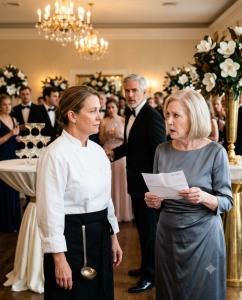
Donna Jean saw recognition hit the older woman in stages. The name first. Then the face. Then the ladle clipped to the apron.
“That’s my ladle,” Margaret whispered.
And Donna Jean, feeling every year between then and now settle into her spine like steel, answered, “No. It was in my kitchen drawer the night your son begged me not to open the envelope.”
Margaret went white.
Moments later Richard arrived and froze at the sight of her. Bradley noticed next. The three of them gathered around Donna Jean in a tight, charged circle while the wedding continued around them in blissful ignorance.
“You kept it,” Richard said under his breath.
“You told me nobody would believe me without proof.”
His jaw flexed. Margaret urged him to handle it. Bradley, hearing just enough to sense danger, stepped closer and asked the one question none of them were prepared for.
“What proof?”
The bride approached at the worst possible moment, smiling and confused.
“What’s going on?” she asked.
No one answered immediately.
Bradley looked from his father to Donna Jean. “Do I know you?”
Donna Jean met his eyes. “Yes.”
Richard cut in fast. “This is a vendor issue.”
Donna Jean almost laughed. Even now. Even here. Still trying to file her into service and silence.
But Bradley was not seventeen anymore. He was thirty, about to marry, old enough to recognize when a room had suddenly filled with a truth everyone but him seemed to understand.
“A vendor issue doesn’t make Grandma look like she’s going to faint,” he said.
The bride’s smile disappeared. “Bradley?”
Margaret straightened with visible effort. “This is a private family misunderstanding.”
Donna Jean’s gaze snapped to her. Private family. After all those years denying Donna Jean any place in that word.
Bradley heard it too. “What family misunderstanding?”
Richard turned to Donna Jean, his expression warning and pleading at once. “Not here.”
She had not planned this. She had planned only to endure the event and leave untouched. But now the lie was standing under ballroom lights in a tuxedo while the people who had carried it for decades expected her to protect it one more time.
She looked at Bradley and saw flashes of the boy he had been. Cruel, yes. Dismissive. But also young, manipulated, armed with other people’s narratives. She looked at the bride beside him, bewildered and suddenly frightened. Then at Richard, who still believed timing could save him.
Donna Jean reached into the pocket of her apron.
Margaret made a sharp sound in her throat.
Richard said, “Donna Jean, don’t.”
From the pocket she pulled not the envelope itself but the photograph folded inside a clear protective sleeve. The old picture of a newborn wrapped in a hospital blanket, the handwritten note on the back copied and preserved because the original had faded.
She held it where Bradley could see.
“This,” she said quietly, “is why your father wanted me gone.”
Richard moved as if to snatch it, but Bradley caught his wrist.
“What is it?” Bradley asked.
Richard’s charm, his rank, his ease in public rooms—none of it could help him now. The bride stepped back from them all, one hand pressed to her mouth. Guests at nearby tables had begun to notice the tension. The quartet faltered mid-phrase and recovered.
Donna Jean could have told the whole thing. She had the right. Maybe even the duty. But she did not want the first true thing Bradley heard about himself to come as gossip spilling through a wedding crowd.
So she said only, “This conversation belongs in private. But not hidden. Private is not the same thing.”
It was the most mercy Richard had ever been given in that family.
Bradley stared at her, then at the photo. Finally he said, “We’re going somewhere now.”
They ended up in a conference room off the main hall, the bride insisting on coming, Margaret refusing to be excluded, Richard already unraveling in the eyes, and Donna Jean carrying twelve years of silence like weight finally being set down.
The first minutes were ugly.
Richard lied.
Margaret interrupted.
The bride cried before she even knew why.
Bradley demanded direct answers in the sharp, clipped voice of someone feeling his entire history shift under his feet.
Donna Jean spoke only when necessary. She handed over copies, not originals. She told the truth in clean lines. She described the study, the envelope, the admission, the warning. She showed the note in Margaret’s handwriting.
At first Bradley rejected it on instinct. Then he looked at his grandmother.
Margaret had always been the strongest force in his life. The final authority. The keeper of manners, memory, and family story. Bradley asked her only one question.
“Is it real?”
Margaret sat in silence longer than anyone could bear.
When she finally answered, her voice sounded old for the first time.
“Yes.”
The room changed.
Not all at once. There was no dramatic shattering, no one collapsing to the carpet. Just the slow, devastating rearrangement of reality.
Bradley stood up and walked away from the table. The bride began crying in earnest. Richard tried to move toward his son, but Bradley put a hand up without turning around.
“Don’t.”
One word.
But it stripped Richard more thoroughly than any public accusation could have.
Then the rest came out in pieces. The affair. The cover-up. The false timeline. The woman who disappeared. The mother who had raised Bradley believing a story crafted for her. The records that had been handled quietly by people who knew what influence could buy.
Bradley asked the question Donna Jean had asked years ago.
“Who was my mother?”
Richard didn’t know where she was now. Or pretended not to. Margaret knew more than she first admitted. Enough to have sent money. Enough to have received letters never shown to Bradley. Enough to have chosen reputation over a child’s right to his own life.
The bride, whose name was Claire, sat pale and furious beside the conference room window.
“Did you know any of this?” she asked Bradley.
“No,” he said, and for the first time Donna Jean believed him completely.
Claire looked at Richard and Margaret with open disgust. “You were going to let us get married while this sat in the walls?”
Margaret bristled. “This has nothing to do with your marriage.”
Claire laughed once—a shocked, disbelieving laugh. “It has everything to do with it. Look at him.”
Bradley did look different. Not physically, not all at once. But the posture he had inherited from Whitmore certainty had fractured. He looked like a man trying to locate himself in a map someone had been redrawing since birth.
Eventually he turned back to Donna Jean.
“Why didn’t you tell me before?”
It was the fairest accusation available, and it landed.
Donna Jean answered honestly. “Because I hated your father. Because I hated your grandmother. Because I didn’t know if telling you would help you or destroy you. Because at seventeen you would have used my pain as a weapon if they asked you to. And because I wanted one thing in my life that didn’t belong to them.”
Bradley absorbed that without arguing.
Then, after a long silence, he nodded once.
“That’s fair.”
Those two words undid something in Donna Jean she had not known she still carried.
The wedding did not continue.
By the time the conference room door opened again, enough guests had sensed trouble that polite explanations no longer worked. Claire made the decision herself. She walked back into the ballroom, handed her bouquet to her maid of honor, and told the coordinator the reception was over. No further explanation. No performance. Just over.
The room rippled with confusion and scandal.
Donna Jean signaled her staff to stop service and quietly begin breakdown.
Richard tried once more to speak to Bradley in the hallway. Bradley ignored him. Margaret moved like a woman who had just lived to see her own power fail. Claire called her sister and asked to go home.
Before leaving, Bradley came to the kitchen.
Donna Jean was overseeing tray packing, hands steady from long habit. He stood just beyond the swinging doors for a moment before speaking.
“I owe you an apology,” he said.
She looked up.
He was no longer the boy on the porch. But she could still see him there, seventeen and sharp-tongued and eager to belong to the people who had taught him contempt.
“You don’t owe me one for being a child in that house,” she said.
“Yes,” he replied. “I do.”
He apologized then—not only for the porch, but for years of dismissiveness, for cruelty he had thought was loyalty, for helping make a woman feel like an intruder in her own marriage. He did not make excuses. That mattered.
Donna Jean listened. When he finished, she nodded once.
“I accept that,” she said.
He glanced at the ladle clipped to her apron. “You really kept it all this time.”
She touched it lightly. “I kept myself all this time. The ladle was just a reminder.”
He almost smiled, but it broke halfway there.
A week later Bradley called again. He had postponed the wedding indefinitely. Claire had not left him, but she had made it clear that nothing about his family could proceed as before. He had retained counsel, begun requests for sealed records, and pushed Richard for the full truth. Margaret had retreated into silence. Richard was threatening, apologizing, denying, and pleading in cycles.
Months passed before Bradley located the woman who had given birth to him. She was alive, living quietly in another state under a different last name, with children who knew nothing about the chapter Margaret had paid to erase. The reunion was private. Complicated. Painful. Not cinematic. But real.
Donna Jean was not part of that meeting. She did not need to be.
Her role had never been to become the center of their healing. Only to stop carrying their lie for them.
As for Richard, the consequences arrived not through dramatic ruin but through erosion. Claire’s family withdrew socially. Old acquaintances began asking pointed questions. Bradley cut contact for long stretches. Margaret’s authority shrank to the size of her own living room. Richard discovered what men like him often discover too late: that image can survive many sins, but not always the loss of the people who maintained it.
And Donna Jean?
She went back to work.
Back to menus, invoices, tastings, weddings that belonged to other people’s hopes. She did not become softer overnight, and she did not transform into a woman who believed all wounds existed to teach beautiful lessons. Some damage remained damage. Some betrayals stayed ugly even after truth was spoken.
But she slept better.
One evening, nearly a year after the canceled wedding, she stood alone in her kitchen after a late event and unclipped the silver ladle from her apron. The metal caught the fluorescent light the same way it had under the Riverside chandeliers.
For a long time she turned it over in her hand.
Then she placed it in a drawer.
Not hidden. Not displayed.
Just set down.
She did not need to carry proof anymore.
The truth had finally gone where it belonged.
Sometimes she still thought about the version of herself who drove out of Macon before dawn with forty-three dollars and a garbage bag, convinced she was leaving as a defeated woman. She wished she could reach back through time and tell that woman one thing:
They did not end you.
They only forced you to begin somewhere harsher.
The strangest part, in the end, was not that the Whitmores lied for so long. Families like theirs had always known how to build elegant rooms around rot.
The strangest part was that the thing that finally broke them was not a lawsuit, or gossip, or revenge.
It was one woman showing up in a white chef’s coat, carrying a tarnished little ladle, and refusing—at last—to act like what happened to her had been too small to matter.
Even now, depending on who tells the story in Macon, Donna Jean is either the woman who ruined a wedding or the woman who exposed a family built on silence.
Maybe she was both.
Maybe that is what truth looks like when it arrives late: not clean, not convenient, and never gentle.
But when Donna Jean thinks back to that ballroom, to Richard’s face when he saw her, to Margaret’s fear, to Bradley finally asking the right question, she does not wonder whether she did the right thing.
She wonders only how many years she spent believing the wrong people got to decide what counted as family.