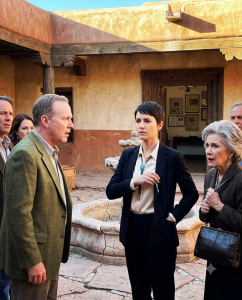
Fifteen years ago, they laughed at her boots.
Not loudly. Not in the crude, obvious way decent people imagine cruelty happens. The Whitfields were too polished for that. Their meanness came wrapped in lowered voices, angled glances, and comments made to somebody else while making sure the right person could still hear. It happened at a family reunion on the edge of Albuquerque, at a place called Las Cumbres, where old money gathered under lantern light and called itself tradition.
Las Cumbres was the kind of property that had learned to perform importance. Twelve hundred acres of high desert. A faded hacienda built in 1887. Thick adobe walls, hand-carved beams, a central courtyard with a fountain that once worked beautifully and now sputtered when somebody remembered to maintain it. The front hall was lined with framed newspaper clippings about the Whitfield family’s philanthropy, land deals, and civic presence. Guests were meant to pass them on the way in and understand, immediately, what sort of people they were dealing with.
Marlene Reyes understood something else.
She had driven there in a borrowed truck from her father’s ranch outside Tucumcari, wearing a pale blouse she had ironed twice and her mother’s silver earrings. She was twenty-six, hopeful enough to confuse love with safety, and in a relationship with Preston Whitfield that had lasted long enough for her to believe introductions meant acceptance.
It turned out introductions meant inspection.
She still remembered how pretty the evening had looked at first. The sunset over the desert. Catered trays moving through the courtyard. Cousins laughing beneath strings of warm lights. Preston had been distracted most of the night, pulled from one relative to another, but she told herself that was normal. Families like his were large and performative. She could manage a few awkward conversations.
Then she heard Preston’s aunt near the punchbowl.
“Too dirt-poor to belong here,” the woman murmured to Preston’s mother, with the effortless confidence of someone used to saying ugly things and being protected from consequence.
Marlene froze.
It wasn’t just the words. It was the fact that Preston heard them too.
She turned toward him. For one suspended second she expected him to laugh awkwardly and say his aunt was being ridiculous. Or even just step to her side, place a hand at her back, make it clear whose company he was keeping.
He did none of that.
He looked away.
That small motion—so slight another person might not have noticed—collapsed everything.
Marlene set down her glass of iced tea carefully, because if she did anything too quickly she was afraid her hands would expose her. Then she walked through the courtyard, across the front hall, and out to the borrowed truck. She did not cry until she was on the highway and the estate lights were gone in her rearview mirror.
She never spoke to Preston Whitfield again.
But before she left that night, something happened that stayed with her.
In the front hall, beneath all the framed clippings and family self-congratulation, there was a glass display case. Inside it rested a turquoise-and-silver bolo tie mounted on dark velvet. A small brass plaque said it had belonged to Elias Whitfield, the family patriarch, and had been gifted to him by a Navajo silversmith in 1902. The Whitfields treated it as proof of their history. Guests were expected to admire it.
Marlene stood there staring at the bolo tie while the humiliation from the courtyard still burned hot under her skin.
She could have touched the case. She could have done something reckless and angry and satisfying for five seconds. But she didn’t. Her father had raised her on the idea that you leave with your name intact, even when other people deserve less courtesy than you’re giving them.
So she walked out empty-handed.
Still, something about that moment stayed lodged in her. In the years that followed, whenever she had reason to be near Whitfield business—court records, land notices, legal filings—she carried a bolo tie of her own. Turquoise and silver, plain and affordable, the kind her father wore on Sundays. It wasn’t a weapon. It wasn’t a vow. It was simply a reminder that she came from people who worked for what they had and did not need old newspaper clippings to prove they mattered.
The next fifteen years were built quietly.
Marlene finished her accounting degree at night while working days. She studied in fluorescent classrooms with tired adults who had mortgages and children and no patience for fantasy. She learned to survive on little sleep and clear priorities. After graduation she took a job at a land development firm in Santa Fe, where she discovered she had a rare talent for two things most people hated: complexity and patience.
Land, she learned, was never just land. It was boundary disputes, tax burdens, mineral rights, easements, environmental restrictions, probate headaches, title defects, family feuds, and hidden opportunity. Most people wanted the simple deals, the clean parcels, the obvious wins. Marlene learned to read the hard cases instead.
Her father used to say that stubborn ground teaches you more than easy soil ever will. She approached business the same way. One problem at a time. One document at a time. One call returned. One mistake avoided. She built a reputation for competence first, then discretion, then results.
Years passed. Her salary improved. Her instincts sharpened. She started investing in distressed parcels other people ignored, buying tangled properties at the right price and untangling them through persistence instead of drama. Eventually she left the firm with a business partner and opened a company of her own. They were not flashy. They were effective. Banks took their calls. Counties respected their paperwork. Lawyers stopped underestimating them after the first loss.
Around that same time, the Whitfields began to unravel.
When Preston’s grandfather died, he left Las Cumbres trapped inside a flawed estate plan: an outdated will, contradictory handwritten notes, family promises that had never been formalized, and heirs who all believed memory counted as law. There were six principal heirs at first, then spouses, then cousins with opinions, then competing attorneys. The case entered probate and seemed unable to leave.
What should have been a straightforward transition turned into a decade-long bleed.
Marlene watched from a distance at first, reading court records as part of a broader professional habit. She told herself that was all it was. The Whitfield matter was interesting because it showed what happened when pride collided with bad paperwork. Nothing more.
But the longer she watched, the more she saw Las Cumbres turning into exactly the kind of asset she specialized in: beautiful, burdened, and badly managed. The heirs argued over control while the property itself deteriorated. Maintenance got delayed. Roof repairs were postponed. Insurance costs climbed. Tax obligations bit harder every year. One side wanted to sell, another wanted to preserve, another wanted to wait for a better market, and none of them trusted the others enough to act decisively.
The family that once measured her worth by her boots was now being measured by judges, mediators, and bank deadlines.
She never celebrated that. Not exactly.
But she noticed.
One afternoon, fourteen years after that reunion, Marlene sat in her office reviewing the latest filings. Her business partner, Elena, looked over from across the desk.
“You’ve gone very still,” Elena said.
Marlene tapped one page. “They’re almost out of options.”
Elena skimmed the numbers and whistled softly. “This place is going to sell.”
“It has to.”
“You interested?”
Marlene should have laughed. Instead she looked out the window for a long moment at the dry Santa Fe light and thought of adobe walls, a dead fountain, and a glass case in a front hall.
“Yes,” she said.
The offer went in through a shell company. That wasn’t theatrics; it was business. Distressed sales get emotional fast, and anonymous buyers are often the only way to reach a fair number. Marlene structured the offer carefully—strong enough to survive scrutiny, clean enough for the court, practical enough to appeal to heirs who were exhausted by legal fees and diminishing returns.
For months the case dragged on. Motions. Objections. Mediation. More paperwork. More delays. Yet every alternative fell apart for the same reason: the Whitfields could not agree with one another long enough to save what they said they loved.
Finally, the court approved the sale.
The closing was set at Las Cumbres itself, in the courtyard, on neutral ground per the mediator’s agreement. Eleven Whitfield family members attended. Preston was there, older and softer around the edges than Marlene remembered. Time had thinned his confidence without improving his courage. His aunt was there too, immaculate and brittle, still carrying herself as if money could protect a person from memory.
Marlene arrived early and stood near the back, unnoticed. She wore a dark blazer, cream blouse, and low heels suited for gravel. Her hair was shorter now. She had the composed, exact presence of a woman accustomed to running rooms where others assumed they outranked her until she spoke.
In her jacket pocket rested her bolo tie, cool against her fingers.
The courtyard looked tired. The fountain was dry. One shutter on the far side hung slightly crooked. The place still had grandeur, but it was the grandeur of something that had survived on reputation longer than on care.
The attorney cleared his throat and began reviewing the final terms. Nobody listened closely. The Whitfields were too busy grieving the version of themselves this sale made impossible.
Then the attorney read the name of the buyer.
“Marlene Reyes.”
Silence hit the courtyard like weather.
Preston turned first. It took him a second to place her, which told her everything she needed to know about what she had once been to him. Then recognition struck and all the color drained from his face. His aunt stared in open disbelief. Preston’s mother looked from Marlene to the paperwork as if checking whether reality had been notarized correctly.
Marlene let the moment breathe.
She did not smile. She did not gloat. She had not spent fifteen years building a life just to waste the best moment of it looking petty.
The attorney asked whether the buyer wished to say anything for the record.
Marlene stepped forward.
“Actually,” she said, “I do.”
Every eye in the courtyard fixed on her. She drew the bolo tie from her pocket and held it in her palm where the turquoise caught the sun.
“I remember standing here the first time,” she said. “I remember learning exactly what kind of person this family believed belonged on this property.”
Preston’s aunt stiffened. “This is inappropriate.”
“No,” Marlene said, and her voice was calm enough to be devastating. “What was inappropriate happened fifteen years ago.”
No one interrupted after that.
She looked around the courtyard—the cracked fountain, the sun-faded wood, the family who had let a place they claimed to revere decay while they fought over status.
“You called this legacy,” she said. “But legacy isn’t what you inherit. It’s what you can keep standing.”
The words landed hard because everyone there knew they were true.
Preston stepped toward her. “Marlene, I was young.”
She met his eyes. “You were old enough.”
There was no cruelty in how she said it. That made it worse.
A cousin began riffling through the closing documents with the panicked energy of someone hoping legal language might still reverse humiliation. It couldn’t. The sale was final.
Marlene slipped the bolo tie back into her pocket. “I’m not here to embarrass anybody,” she said. “I’m here to take responsibility for a property none of you could agree to protect.”
Then she added, almost casually, “Before renovation begins, though, there’s one item in the house that doesn’t appear to have been included in the transfer inventory.”
The attorney frowned. “What item?”
“The bolo tie from the display case in the front hall.”
Something electric passed through the Whitfields.
Preston’s aunt went pale.
Marlene saw it immediately.
So did the mediator.
The attorney turned pages. “The historical item should have been listed.”
“It wasn’t,” Marlene said. “And when I walked in this morning, the display case was empty.”
What followed was ugly in the way only family truth can be ugly. Voices rose. One cousin accused another. Preston’s mother demanded to know who had removed it. The aunt insisted the piece had been moved for safekeeping, but she could not explain where it was, who authorized it, or why the court had not been informed. The mediator, now fully alert, asked for a private accounting. The attorney’s face tightened with professional horror.
Within twenty minutes, the story cracked open.
The aunt had taken the heirloom weeks earlier and quietly arranged to sell it through a private broker to cover personal debts she had concealed from the family. Years of maintaining appearances, sustaining a lifestyle on shrinking resources, and assuming the estate would eventually save her had finally cornered her. She had gambled that nobody would notice the bolo tie missing before the sale. If questions came later, she planned to blame the inventory confusion on the probate mess.
What she had not expected was Marlene.
Not Marlene remembering exactly where the display case stood. Not Marlene noticing what was gone. Not Marlene standing there as owner, forcing truth into the open before the family could bury it in one more layer of whispered protection.
Preston looked shattered. Not by losing the property—that wound had already been dealt—but by the sudden understanding that the family myth he’d defended with silence had been rotting from the inside the whole time.
The broker was contacted. The sale was halted. Because the piece carried disputed historical value and should have been included in estate accounting, the attempted private sale exposed the aunt to legal consequences she had clearly believed she could evade. By sundown, what remained of Whitfield dignity had collapsed in front of witnesses, lawyers, and one woman they had once dismissed as beneath them.
After the courtyard emptied, Marlene stood alone in the front hall.
The newspaper clippings were still there, lined up in their frames, preserving versions of the family that no longer existed. The empty display case sat beneath them like an accusation.
Preston found her there.
“I’m sorry,” he said.
She turned. He looked older than he had that morning.
“I should have said something that night.”
“Yes,” she said.
There was nothing else to add to that.
He nodded once, as if accepting a sentence that had been waiting for him a long time. “Are you really going to restore this place?”
“I am.”
“Why?”
Marlene glanced toward the courtyard. “Because it deserved better than what all of you did to it.”
That was the closest thing to mercy he was going to get.
In the months that followed, Marlene and Elena began the restoration of Las Cumbres. The roof was repaired. The fountain was rebuilt. Water lines were replaced. Historical consultants came in. Local craftsmen were hired. The old house began to look less like inherited prestige and more like what it had always needed to become: cared for.
The Whitfield heirloom was eventually recovered through court action and transferred properly as part of the estate settlement. When it returned to the front hall, Marlene changed the display plaque. She kept the factual history, but removed the self-important language. The artifact was no longer presented as proof of family grandeur. It was described simply, accurately, and with respect.
She never placed her own bolo tie in any case.
That one stayed with her.
Years later, people would tell the story badly, as people always do. They would say she bought the estate out of revenge. They would say she planned the entire thing from the night she left in the borrowed truck. They would call it poetic justice, fate, karma, a perfect ending.
It wasn’t an ending. It was a result.
Revenge is hot and fast. What Marlene built was colder than that, steadier and far more difficult. She did not destroy the Whitfields. They did that themselves. She simply outlasted their assumptions, outworked their pride, and arrived prepared when their own failures finally opened the gate.
The strange part, later, was not that she had won. It was how small the victory felt compared to the life she had built getting there. Las Cumbres mattered. The moment in the courtyard mattered. Seeing Preston’s face when her name was read aloud mattered too, more than she liked to admit.
But what mattered most was something quieter.
The girl who had once left that property feeling humiliated had believed worth could be granted or withheld by people with money, lineage, and confidence. The woman who returned knew better. By then, ownership had become secondary. She had already reclaimed herself long before the deed ever reached her hands.
Still, if someone asked what the biggest red flag had been, she knew the answer instantly.
It wasn’t the aunt with the cruel mouth.
It was Preston saying nothing.
Because sometimes the person who wounds you most is not the one who speaks first. It’s the one who watches it happen, decides silence is easier, and lets you leave alone.