For most of his adult life, Earl Denton believed that grief was something a person could organize.
You put it in labeled boxes. You tucked it behind routines. You learned which doors in your mind stayed closed if you wanted to keep functioning.
That was how he survived what happened in 1983.
He did not survive it by getting justice.
He did not survive it by understanding.
He survived it by becoming a man who no longer expected the world to explain itself.
At fifty, people called him dependable. At sixty, they called him unshakable. By sixty-six, Earl had become one of those men whose habits seemed built from stone. He ironed his shirts with hard, straight creases. He ate lunch at the same time every day. He balanced his checkbook in ink. He drove a county sedan that smelled faintly of paper and coffee and old air-conditioning.
He worked in the county assessor’s office because records soothed him. They had rules. Parcels began and ended on lines. Names followed signatures. Errors, when they appeared, could usually be corrected if someone cared enough to trace them to the source.
It was not lost on Earl that his own life had been derailed by a document no one had wanted to examine too closely.
Still, he built a career reading what others skimmed.
On a dry Tuesday morning in June, a file landed on his desk marked for review. A tax dispute involving a cattle ranch outside Haskell. An acreage miscalculation from the late 1980s had apparently inflated the property tax burden for decades, and the current owner was asking for a reassessment.
Earl had handled dozens of such cases. He opened the folder without interest.
The first photograph caught him anyway.
It was an aerial survey shot, the sort used to establish fence lines and structures from above. At the edge of the frame, near an old water trough, stood a fence post with something draped over it.
A glove.
Earl’s eyes narrowed. He pulled the photograph closer.
The leather was cracked. Weather-faded. Handmade.
He turned the page.
Another angle. Same glove.
He sat very still.
Maybe it meant nothing. Rural properties were full of forgotten objects. Maybe the photographer had been sentimental about ranch details. Maybe the same fence post appeared by coincidence in more than one shot.
Then he read the name typed on the first page of the report.
Denton-Calloway Ranch.
The office around him kept moving. Phones rang. Someone laughed down the hall. A copier groaned to life. But inside Earl, something old and sealed shifted with a terrifying clarity.
He picked up the deed history and started reading.
His father, Harold Denton, had owned the ranch until his death in early 1983. Probate documents followed. Then a transfer dated several weeks later. Travis Denton. Earl Ray Denton. Another party involved in the transaction. Subsequent consolidation. Eventual sale to the Calloway family in 1989.
Earl’s gaze locked on the signature attached to his own name.
It looked right to anyone who didn’t know him.
That had probably been the point.
The E was oversized. The last name trailed too weakly. The whole signature sat oddly to the right, as though whoever wrote it had been positioned uncomfortably or rushed.
Or sedated.
The memory of that spring came back in fragments, as it always had.
The hospital smelled like bleach and plastic curtains.
His head had pounded so badly he could barely track conversations.
He remembered his mother standing over him, tired but hard around the mouth. He remembered Travis pretending concern while never quite meeting his eyes. He remembered a lawyer presenting papers and saying there were practical decisions to make. He remembered being told things were already difficult enough, that the accident changed everything, that he had agreed to protect the family from debt.
He remembered feeling too weak to argue against three people speaking as though the decision had already been made.
In the years that followed, he let himself believe that uncertainty was the same as possibility. Maybe he had signed something before the accident. Maybe his father had changed his mind. Maybe land and family and illness had tangled together in some ugly but legitimate way.
It had hurt less to think the truth was murky.
Now the ink on the page looked like a stranger wearing his face.
He set the deed aside and returned to the photographs.
The third image showed the side of the barn in warm afternoon light. The glove still hung from the fence post.
And then he remembered.
Not vaguely. Not like an old movie clip.
He remembered exactly.
That morning had begun before sunrise. He had been patching fence near the trough after one of Travis’s bulls pushed through a weak section. His father’s old work truck had been in the drive. Rain threatened. He had tugged off one glove because the seam at the thumb was rubbing a blister raw. He hung it on the nearest post, planning to grab it when he loaded the wire spool back into the truck.
Then Travis had shouted something from the yard. There had been an argument. Earl could no longer recall the words, only the heat of it, the way Travis always turned everything into a dare. Then came the drive into town. Then rain on glass. Then impact. Then darkness.
He had not seen that glove since.
He thought about it only once in all the years after, in a half-sleeping moment when memory pressed hard enough to leave a bruise. He had imagined it ruined by weather long ago.
Instead, it had stayed.
Like proof.
The woman requesting the reassessment arrived shortly before noon.
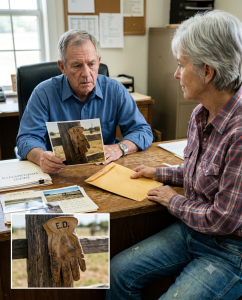
Naomi Calloway was in her sixties, maybe a few years younger than Earl. She wore pressed work jeans, boots with dust in the seams, and a pale western shirt with the sleeves rolled neatly to the forearms. She had a rancher’s posture—balanced, efficient, impossible to intimidate with office furniture.
Earl introduced himself in the professional tone he used with everyone. Naomi did the same. If she noticed the way his fingers rested on the edge of the photo folder, she did not mention it.
She explained the acreage issue calmly. A 1987 boundary adjustment had not been properly reflected in the tax rolls. Her late husband had tried to correct it once. Their son had tried later. Both efforts had stalled. Rising taxes and poor cattle prices had made the problem urgent.
Earl asked for dates, documents, parcel numbers, survey references. He wrote in a careful hand. On the surface, it was an ordinary meeting.
Underneath, he could feel the air changing.
At a pause in the conversation, he turned to the final photograph in the stack.
It was a close-up of the glove.
Time had thinned the leather to a gray-brown shell, but the stitching remained tight. On the cuff, darkened into the hide, were two burned initials.
E.D.
Earl looked up.
Naomi was already watching him.
She did not look startled to see his expression. She looked as if she had been waiting for it.
“You know what that is,” she said quietly.
Earl’s mouth had gone dry. “It was mine.”
For a long moment, she said nothing. Then she reached into her purse and withdrew a long, folded envelope gone soft at the edges with age. She set it gently on the desk between them.
“I thought so,” she said. “I wasn’t sure whether to mail it. Then I decided I wanted to see your face when you read it.”
Earl looked at the envelope. His name was written on the front in blue ink. No stamp. No address. Just Earl.
He slid a finger beneath the flap.
Inside was a faded Polaroid of the bunkhouse, a folded note on legal paper, and a photocopy of a deed draft unlike any document in the county file.
He opened the note first.
If anything happens to me before I can fix this, give this to Earl. Travis made their mother sign. Earl was still in the hospital.
At the bottom, beneath the message, was a witness line.
Walter Pike.
Earl closed his eyes for one second.
Walter Pike had worked for Earl’s father for years. He was broad-shouldered, church-quiet, and loyal in the old-fashioned way that men once gave their word to landowners and kept it beyond reason. Walter had died in 1991. Earl had not thought of him in years.
When he opened his eyes again, Naomi was still watching him steadily.
“My husband found that in a lockbox under loose floorboards in the bunkhouse,” she said. “Along with the deed copy.”
Earl unfolded the photocopy.
It was dated six days before the transfer currently on record. In it, Harold Denton’s ranch was to be distributed according to his original plan: Earl would retain controlling ownership of the land itself; Travis would receive livestock assets and cash equivalents structured through sale rights and inventory. It was not equal. It was also not ambiguous.
Their father had intended Earl to have the ranch.
“Where did your husband get this?” Earl asked.
“Under the bunkhouse floor, same place as the note.” Naomi folded her hands. “He found them after Travis sold us the property in ’89.”
Earl raised his eyes slowly. “And he said nothing.”
Naomi absorbed the accusation without protest. “At first, he thought the papers were copies from some old dispute that had already been settled. Then he asked questions.” Her jaw tightened. “The more he learned, the less settled it looked.”
“What did Travis say?”
“He said your mother corrected the paperwork after your accident. Said you weren’t fit to manage land. Said there were debts and risks and family reasons that didn’t concern us.” She paused. “He also made it very clear he wanted the sale completed quickly and quietly.”
“Your husband bought anyway.”
“He did.” Naomi did not look away. “He had loans coming due. Travis was selling far below market. My husband told himself that whatever happened before us was already done. He convinced himself buying the place didn’t make him responsible for the way it changed hands.”
She let out a brittle breath.
“He carried that shame longer than he admitted.”
Earl could not decide which hurt more: that strangers had found proof and buried it, or that everyone involved had assumed he would never come back for it.
“Why tell me now?” he asked.
Naomi looked toward the window for a moment, then back at him. “My husband is dead. Travis is dying. And I’m too old to keep paying taxes on a ranch that started with a lie.”
The room was silent except for the hum of fluorescent lights.
Then Naomi reached into her purse again and placed a brass key on the desk.
It was small, worn smooth, old enough to have belonged to another era of locks and boxes and hidden things.
“Last month my grandson found a metal box inside the barn wall,” she said. “Not under the floor. Inside the wall itself.”
Earl stared at the key.
“My husband never found where this fit,” Naomi continued. “But the boy noticed one wall in the tack room sounded hollow. We opened it.”
“What was in the box?” Earl asked.
Her face changed.
He would think about that expression later—how it was not shock exactly, not fear, but the strain of someone deciding whether another person was strong enough to carry what came next.
“Not much,” she said. “Some papers. A cassette tape. A few receipts.”
Earl felt something cold move through him. “A tape?”
Naomi nodded. “Dated May 14, 1983.”
Three days before the transfer deed.
He could hear the buzz of the lights again, louder now.
“What’s on it?”
Naomi glanced down at her hands before answering. “I listened to the beginning only once.”
“And?”
“I heard your mother crying.” Naomi’s voice stayed even, but softer now. “Then I heard Travis tell someone to keep the recorder running.”
Earl’s fingers curled around the arm of his chair.
A memory surfaced then, sharp and unwelcome: Travis as a boy, forever staging scenes, making people repeat things, twisting words into dares and evidence and jokes. Travis had always loved control more than money. Money was just the cleanest way he had learned to hold it.
“Who else was on the tape?” Earl asked.
Naomi hesitated.
“I don’t know. Maybe the lawyer. Maybe someone at the hospital. I turned it off.”
“Why?”
“Because after your mother started crying,” Naomi said, “I heard a man say, ‘He won’t remember this clearly enough to challenge it.’”
Earl went completely still.
Every year since 1983, he had forced himself to live with uncertainty. He had told himself that memory failed people. That trauma blurred edges. That maybe he had lost not only the ranch but the right to be sure of what happened.
Now a single sentence threatened to collapse all of that mercy into something uglier.
He stood and walked to the window because sitting felt impossible.
In the glass he saw his own reflection—gray at the temples, face drawn tight, shoulders still straight out of habit. A respectable county employee. A man who had spent four decades behaving as if dignity could substitute for justice.
Behind him, Naomi remained seated.
“There’s more,” she said.
He turned.
She took the Polaroid from the desk and flipped it over. On the back, barely visible in faded marker, was a date and a line of handwriting.
Harold’s original kept in office safe until county filing.
Earl stared. “Whose writing is that?”
“My husband thought it was the lawyer’s. We found old closing documents to compare. He wasn’t certain, but he thought so.”
“What office safe?”
Naomi gave a small, tired shake of her head. “That’s what my husband never learned.”
The county office.
The lawyer’s office.
A bank.
A storage unit.
Any of a dozen places.
But if an original existed somewhere, then the filed deed might not be the only surviving story of what happened.
Earl returned to his chair slowly.
All these years he had believed the past was sealed because everyone who mattered had already spoken. His mother had died in 2002. Walter Pike was gone. The lawyer might be dead or retired. Travis, Naomi said, was dying.
And yet the land had kept secrets better than people had.
The glove.
The hidden papers.
The tape.
The note from a witness who tried, however weakly, to leave a trail.
“When did Travis sell to you?” Earl asked.
“August of ’89.”
“Did he ever come back after?”
“A few times. Mostly to argue boundary lines or water rights. Once to drink with my husband in the barn and talk too much.”
Earl’s eyes lifted. “Talk too much about what?”
Naomi held his gaze. “About how some men are born to own land and some are only born on it.”
The sentence hit him with immediate recognition. Harold Denton used to say something similar, but never cruelly. To Harold, it meant stewardship. To Travis, Earl realized, it had probably always meant entitlement.
“Did Travis believe father favored me?” Earl asked.
Naomi did not answer at once. “I think Travis believed anything your father gave you was something stolen from him.”
That, too, rang true.
As boys, Earl and Travis had shared a room and almost nothing else. Travis was louder, hotter, easier to notice. Earl was steadier. Their father trusted Earl with accounts, fence plans, feed orders. Travis could work hard when watched, but resented instruction from any man alive. Their mother had always patched over the tension by pretending it was ordinary sibling rivalry. It was not ordinary. It was a slow war made of comparison.
When Harold died, whatever balance remained in the household died with him.
Earl drew a breath and reached for the brass key.
It was warm now from sitting under the fluorescent lights.
“Where is the tape?” he asked.
“In my truck.”
He looked at her.
Naomi nodded once. “I brought everything.”
The implication settled between them like a verdict. She had not come only to argue taxes. She had come because she believed the rightful witness had finally appeared.
They walked out together into the heat.
The parking lot shimmered under a white noon sun. Earl’s pulse felt wrong in his throat. Naomi opened the rear door of an aging pickup and lifted out a locked tin cash box. The brass key slid into the latch with a tiny metallic click.
Inside lay a cassette tape labeled in black marker, several folded hospital forms, a carbon copy of an insurance disbursement, and a small stack of receipts from May 1983. Earl picked up the tape as though it might burn him.
On the label, in cramped handwriting, was one date:
May 14, 1983.
Three days before the deed.
He turned it over. No other markings.
Naomi handed him a portable cassette player from the same box. “My grandson uses it for old music,” she said. “That’s how I listened.”
Earl looked from the tape to the machine.
He had imagined answers before. Imagined some lost witness speaking clearly enough to restore everything. But now that the proof sat in his hands, fear rose sharper than hope. Because evidence could do more than confirm theft. It could tell him who had stood by and let it happen. It could show him exactly how helpless he had been.
He inserted the cassette.
The machine clicked.
Static hissed.
Then came the scrape of movement, a muffled voice, and his mother crying.
Earl closed his eyes.
He knew that sound.
Not grief. Not clean grief. This was the frightened crying of someone already committed to the wrong thing and terrified it was too late to undo it.
Then Travis’s voice came through, younger but unmistakable.
“Keep it running.”
A male voice he did not recognize answered, “She’s upset.”
“That’s fine,” Travis snapped. “Just keep it running.”
Paper rustled. A chair scraped.
Then another man spoke, calm and irritated at once. “If he’s still disoriented, he won’t remember the details clearly enough to challenge this later.”
Earl’s hand clenched so hard around the cassette player Naomi reached toward him instinctively, then stopped herself.
His mother whispered, “This isn’t right.”
Travis answered, low and dangerous, “It’s already done.”
The tape crackled.
Then came a sentence that hollowed the air out of Earl’s lungs.
Not from the lawyer.
From his mother.
“He always trusted us.”
Earl opened his eyes.
The parking lot, the sun, the county building—everything seemed to recede from him. For forty-three years he had reserved one last chamber of mercy for her. She was pressured. She was grieving. She didn’t understand. She was covering for Travis because she was afraid.
But on that tape, she knew.
She knew.
Naomi touched his elbow lightly this time, enough to steady, not enough to intrude. “There’s more,” she said.
Earl swallowed and forced himself to keep listening.
The rest of the tape was a chaos of arguments, legal terms, and fragments of panic. The lawyer insisted on signatures and witness lines. Travis pushed, cajoled, threatened. Earl’s mother cried harder. At one point, Earl heard his own faint voice in the background, slurred and confused, asking why everyone was there.
He had no memory of saying it.
Then the tape ended with a dull click.
No signature was captured. No clean confession. Nothing theatrical enough for a courtroom ending in a movie.
What it captured was worse.
Intent.
Knowledge.
Strategy.
The use of his injury as an opportunity.
Earl handed the player back to Naomi with both hands because one was no longer steady enough.
For a while neither of them spoke.
Finally Naomi said, “My husband should have brought this to you years ago.”
Earl stared at the tin box. “Yes.”
“He was wrong.”
“Yes.”
“He knew he was wrong.”
Earl looked at her then. Naomi’s eyes did not ask forgiveness on her husband’s behalf. That mattered more than apology.
“I’m not here to ask you to excuse him,” she said. “I’m here because whatever happens next ought to happen before Travis dies and takes his version with him.”
A breeze scraped hot dust through the parking lot.
Earl thought of the glove hanging on the fence post. The one thing he had left behind on the last morning the ranch had truly been his. It had remained there through sun and rain and decades of silence, as if the land itself refused to let the day be erased.
He also thought of his own life. Not as wasted—never that—but altered by theft so old it had hardened into biography. The jobs he took. The town he chose. The family he never started because instability made him wary of promises. The carefulness that had become personality rather than scar.
You put grief in boxes, he thought.
But truth did not stay where you left it.
“Do you still want the tax reassessment?” he asked suddenly.
Naomi blinked, almost laughed, then saw he was serious. “Yes.”
Earl nodded once. “You’ll get it.”
She drew in a breath. “Thank you.”
“That’s separate from this.”
“I know.”
And that was the beginning of the strangest afternoon of Earl Denton’s life.
He filed the reassessment review before the day ended, attaching recommendations, corrections, and procedural notes so airtight no clerk could lose them and no supervisor could postpone them without explaining why. Then he made copies of every paper Naomi had brought. Then he drove home with the tape in his briefcase and sat in the dark of his living room until the shadows filled the corners.
The next morning he began making calls.
The lawyer was dead.
His records, however, had been purchased during retirement by another firm two counties over and placed in storage.
Walter Pike’s daughter remembered her father mentioning “bad blood over the Denton place” before he died, but she knew no details. Still, she agreed to search his old trunk in the garage.
A retired probate clerk remembered irregularities in a 1983 Denton filing but had never spoken because the presiding attorney was politically connected at the time and “people knew better than to start fires they couldn’t put out.”
By Friday, Earl had learned enough to understand two things.
First, reclaiming the ranch legally after so many years would be brutally complicated, perhaps impossible in any simple sense. There were statutes, sales to good-faith buyers, chain-of-title issues, limitations, and generations of financial reliance. The land had passed through too many hands and too much time.
Second, proving the fraud itself was not impossible.
And proving it mattered.
Because some wrongs do not need to be reversed perfectly to be named accurately.
Ten days later, Earl drove to Grady County for the first time since 1983.
The road in was narrower than he remembered and the sky wider. He passed feed stores, cut hay, rusted gates, and fields gone rough at the edges. Time had changed everything and nothing. When he turned down the ranch road, his hands tightened on the steering wheel.
The house had been painted. The barn roof had been replaced on one side. The corrals were newer. But the bones of the place were his childhood.
And near the old trough, on a fence post silvered by sun, hung the glove.
Naomi met him in the yard and said nothing as he walked to it.
Up close, it looked impossibly fragile. He reached out and touched the cuff with two fingers. The leather gave slightly but held.
E.D.
Burned there by his father’s hand.
Earl did not cry. He was not a man who cried easily, and the moment did not ask for softness. What he felt was stranger and deeper: the violent stillness of a truth finally landing in its proper place.
Naomi stood beside him after a minute.
“My grandson asked why I never took it down,” she said.
Earl kept his eyes on the glove. “Why didn’t you?”
“Because my husband said it didn’t belong to us.”
They stood there together in the heat, the thief absent, the dead everywhere, the evidence weathered but stubborn.
Weeks later, Travis Denton agreed to speak only after receiving notice that sworn statements, the tape transcript, and archival deed discrepancies had been forwarded to counsel. Earl met him in a hospice room that smelled faintly of antiseptic and wilted flowers.
Travis was smaller than Earl remembered. Meaner, too, somehow, because illness had stripped away the force but not the bitterness.
He denied everything for six minutes.
Then Earl placed the tape recorder on the bedside tray and pressed play.
By the time their mother’s crying filled the room, Travis had shut his eyes.
When the recording ended, he did not apologize. Men like Travis rarely do. Instead he said, “Dad was wrong to favor you.”
Earl looked at him for a long time.
“This was never about favor,” Earl said. “It was about you taking something because you couldn’t stand that it wasn’t yours.”
Travis’s mouth twitched. “And what are you going to do now? Take it back?”
No.
Not in the pure way Earl once might have wanted.
The law would do what it could. Records could be corrected. Fraud could be documented. Probate findings could be challenged posthumously. Financial remedies might be sought against the estate that remained. Public truth could be established where private lies had lived too long.
The ranch itself, under Naomi’s stewardship, had become part of another family’s survival. Earl understood that with painful clarity. They had not stolen it. They had inherited the cost of a theft.
So he answered honestly.
“I’m going to make sure the record says what happened,” Earl told his brother. “For once.”
Travis turned his face to the wall.
He died three weeks later.
In the months after, affidavits were filed. Old records were amended with notations. A formal finding acknowledged substantial evidence of fraudulent transfer during Earl’s incapacity. Naomi received her corrected tax assessment and later negotiated a legal settlement with Earl that preserved the ranch’s operation while recognizing his claim and the fraudulent history behind the title chain. It was not perfect justice. It was paperwork, money, signatures, compromise.
But it was not silence.
On a cool morning that fall, Earl returned to the ranch one more time. Naomi met him by the barn. Together they walked to the fence post.
“Take it,” she said.
He looked at the glove.
For years he had imagined that recovering what was lost would feel like getting his youth back, his father back, his future back. It did not. Nothing gives those things back. Justice is not resurrection.
Still, he lifted the glove carefully from the post.
The leather trembled in his hands but did not fall apart.
He brought it home and placed it in a shadow box above his desk, not because he needed a relic, but because he wanted one piece of the story to remain where he could see it without flinching.
People at the office noticed he had changed in small ways. He laughed more easily. He no longer stayed late unless necessary. He took a week of vacation for the first time in years and drove nowhere anyone could track. When asked about retirement, he said he was considering it.
At night, he sometimes thought about his mother’s voice on that tape and felt the old hurt rise fresh and merciless. Some betrayals do not soften with explanation. He also thought about Naomi’s husband, dead before he corrected what he knew. About Walter Pike trying, in his own incomplete way, to leave a trail. About Travis, who spent his life mistaking possession for worth.
Mostly, though, Earl thought about the long cost of one stolen decision.
Not only land.
Identity.
Trust.
The shape of a whole life.
He had not gotten all of it back. Maybe no one ever does.
But the record now told the truth.
And sometimes, in the quiet of his living room, Earl would look up at the glove his father made with his own hands and wonder which mattered more in the end: that the ranch had been taken, or that after forty years, the lie finally stopped being the official version of his life.