Millie Fontaine almost skipped the grocery store that Tuesday.
The heat in Galveston had settled in early, thick and sticky, the kind that made the air feel chewed before you ever breathed it. By eleven in the morning, her hearing aids had begun giving off that maddening little whine that always came when the humidity turned cruel. Her fingers ached from arthritis. Her lower back complained every time she stood too long. She had been putting off the trip for two days already, but there was no more tea in the pantry, no bread left, and she was down to the last spoonful of sugar.
So she drove.
Millie was seventy-two and moved through the world slowly now, but not weakly. There was a difference, and she cared about it. She parked under the one skinny strip of shade she could find and sat in the car for a moment before going in, gathering herself the way people her age often do before ordinary tasks. Purse. List. Reading glasses. Cardholder.
Inside the store, she followed the same path she always did, not because she liked routine, but because routine liked her. It kept things from slipping. Bread first. Tea next. Soap, canned tomatoes, a box of crackers. She glanced at prices without really meaning to. Once you’ve spent enough years stretching money until it almost tore, price tags become a second language.
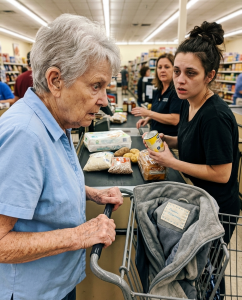
At the register, she joined the shortest line and rested both hands on the cart handle.
That was when she noticed the young woman ahead of her.
Late twenties, maybe thirty. Dark hair twisted up, though several strands had fallen free and stuck to the damp sides of her face. No jewelry except a thin chain at her neck. No makeup beyond what looked like yesterday’s mascara. She had the posture of someone who hadn’t slept properly in weeks. Her cart held diapers, wipes, rice, dried beans, apples from the markdown bin, generic cereal, pasta, off-brand baby lotion, and a loaf of bread with the store’s discount sticker slapped across it.
Millie knew that cart.
Not literally, of course. But she knew what it meant. She had raised four boys after burying a husband too young and learning exactly how far a dollar could be pushed before it snapped. There were years when groceries were math and shame and prayer all at once. Years when she could look at a woman’s checkout belt and tell whether she was surviving, drowning, or pretending not to drown.
This girl was barely holding the seam.
Then Millie saw the can of condensed milk.
Bright yellow label. Eagle Brand.
The young woman picked it up from a display, looked at the price, and set it into the cart. A minute later, she took it back out. Then she found another one near the register, stood there with it in her hand, and returned it to the shelf. The third time, her expression tightened in a way that made Millie’s chest hurt.
That tiny struggle said more than tears would have.
Condensed milk wasn’t survival. It was something else. Something soft. Something for sweetness. A want dressed up as a maybe. Maybe I can make flan. Maybe I can make arroz con leche. Maybe I can give my child one small thing that feels like comfort instead of scraping by.
Millie watched the girl put it back for the third time and knew, with complete certainty, what that pause meant. It meant there wasn’t room in the budget for tenderness.
When the young woman started unloading her groceries, Millie leaned forward and tapped her arm.
The girl jumped and tugged one earbud out. “Sorry?”
“Go get your milk, honey,” Millie said.
The woman blinked. “What?”
“The condensed milk. Go get it.”
She looked instantly embarrassed. “Oh, no. I’m okay, ma’am. Really.”
“I know you’re okay.”
The girl gave a strained little smile meant to close the matter politely.
Millie didn’t move. “Go on.”
Something in the older woman’s face must have reassured her, because after a second, she nodded and hurried back for the can. She returned red-cheeked and quiet, placing it on the belt like contraband.
Then, when the total came up, Millie paid before the young woman could protest effectively.
“Please, no,” the girl said, flustered and near tears. “You don’t have to do that.”
“You’re right,” Millie said. “I don’t.”
That made the cashier bite back a smile.
Millie accepted the receipt, folded it into a small square out of habit, and placed it in the woman’s hand. Then she closed her fingers around it.
“Every woman deserves something sweet,” she said. “Even on a hard week.”
The girl’s eyes filled immediately. “Thank you,” she whispered. “I don’t even know what to say.”
“You don’t have to say anything.”
But the young woman turned anyway, maybe out of manners, maybe because gratitude made her want to face the person helping her. And as she shifted, a coat draped over the cart’s child seat slipped sideways.
It was a child’s coat, though large enough for a toddler, maybe older. Wool. Gray. A little faded. The cuffs had been worn soft with time. One pocket had been repaired neatly by hand. It was too heavy for that weather, but people keep all kinds of things in grocery carts when they have children.
Millie might not have looked twice if the collar hadn’t folded open.
There, stitched into the inside neckline, was a small cream fabric label with a pale blue blanket stitch around the edge.
Millie stared at it.
The store sounds went distant. The register beeped, someone laughed two lines over, a child asked for candy, and still Millie stared.
She knew that label.
Not the style.
Not the idea.
That exact label.
Thirty-one years earlier, she had made a baby coat by hand during the worst week of her life. She had cut the wool herself, lined it with soft cream cotton, and stitched the seams with the concentration of a woman trying not to fall apart. She had embroidered no name, because there had been no guarantee she’d be allowed one. Instead she made a tiny label from muslin, rounded the corners with her sewing scissors, and edged it in blue blanket stitch. On the left corner she pulled the thread a little too tight because her hands were shaking.
She remembered every flaw in that stitch.
Now it was right in front of her.
Her fingers tightened against the counter.
“Ma’am?” the young woman asked. “Are you all right?”
Millie heard herself speak from a great distance. “Your coat. Where did you get your coat?”
The woman’s expression shifted from gratitude to confusion. “My coat?”
“That one.” Millie pointed.
The young woman picked it up and looked at it. “It was my mother’s. Why?”
Millie swallowed. “Who made it?”
“I don’t know.”
Millie pointed at the label with a trembling finger. “I did.”
The girl gave a startled laugh, uncertain whether this was some strange old-lady joke. “You made this?”
Millie nodded, unable to look anywhere else. “Thirty-one years ago.”
The woman’s face changed.
Not belief yet. Not quite. But the first crack in disbelief.
“What are you saying?” she asked.
Millie’s mouth had gone dry. “What’s your name?”
The woman hesitated. “Elena.”
The name hit like a wrong note. Millie had never named her baby Elena. She had never officially named her anything at all. The child had been taken before papers, before time, before courage.
But names changed. Lives changed. Stories changed hands.
Millie forced herself to breathe. “What is your birthday?”
Now the caution sharpened. “Why?”
“Please.”
The girl’s eyes flicked to the cashier, then back to Millie. “June twelfth.”
Millie grabbed the cart handle to steady herself.
June twelfth.
Same day. Same year.
“What was your mother’s name?” Millie asked.
“Renee Morales,” the woman said slowly. “She died last year.”
That was not the name Millie had been told. For decades, she’d believed a church family in Houston took the baby. Alma, her older sister, had arranged everything with the smooth certainty of someone who believed she was saving everyone trouble. Millie had been widowed, exhausted, and deep in grief after a surprise late-in-life pregnancy that the whole family treated like a catastrophe. Four sons already grown or nearly grown. A little house barely paid for. Not enough money. Not enough time. Not enough support.
And Alma had taken over.
There were forms. Voices. A hospital room that smelled like bleach and milk and fear. One day of holding her daughter. One night of bargaining with God. By the next morning, the baby was gone.
Millie had never forgiven herself for how little fight she found in her own body then. Shock is a thief that steals even your right to understand yourself.
“Renee Morales,” Millie repeated faintly.
Elena looked frightened now. “Why are you asking me all this?”
Millie turned the coat collar back so both of them could see the label. “Because I made this coat for my baby girl.”
Silence dropped over the checkout lane.
Elena stared at her, then at the coat.
“No,” she said, but weakly.
Millie kept going because stopping would kill her. “The left stitch pulls tighter than the others. See that? I messed it up and left it because I’d already redone it twice. The lining was cut from an old church blouse I couldn’t bear to throw out. The right pocket wasn’t even at first. I fixed it after midnight.”
Elena’s face lost all color.
“How would you know that?” she whispered.
“Because she was born in June,” Millie said. “And when nobody was around, I called her Junebug.”
The young woman made a sound that wasn’t quite a sob and wasn’t quite a gasp.
“My mother,” she said, gripping the cart, “my mother told me once, when I was maybe sixteen, that if I ever had questions about where I came from, I should remember two things. She said there was a coat, and there was a name I wasn’t supposed to know until I was old enough to carry it.” Tears filled her eyes. “She said someone used to call me Junebug.”
The cashier stepped back instinctively, giving them room.
Millie pressed one hand to her mouth.
Elena was crying openly now. “I thought she meant my birth name. I thought maybe she was confused by medication by then. She got sick so fast, and after she died, I found the coat packed away with my baby box. There was no paperwork. No adoption file. Nothing except a photo of my mom younger, holding me in that coat, and a note with half a sentence torn off.” She swallowed hard. “I never knew what any of it meant.”
Millie’s knees threatened to give. The cashier dragged over a small stool from behind the counter, and Millie sat without remembering how.
“Your mother,” Millie asked. “Renee. Did she adopt you?”
Elena shook her head. “I thought so. Sort of. She always just said I was hers. But after she died, my aunt Letty told me Renee took me from someone connected to the church where they both worked. Not stole me,” she added quickly, seeing the alarm in Millie’s face. “But there was money exchanged. Maybe unofficially. Maybe legally on paper somewhere, maybe not. Letty wouldn’t say more. She said Renee spent years terrified someone would come back for me, but no one ever did.”
Because Millie had never known where to look.
Because the trail had been buried before she could stand up.
Because Alma had told lie after lie in the name of mercy.
“Alma,” Millie whispered aloud before she could stop herself.
Elena heard it. “Who’s Alma?”
“My sister.”
The answer came to both of them at once.
Millie looked up slowly. “She arranged everything.”
Two hours later, they were sitting in a diner across the street from the grocery store because neither of them could bear to part yet and neither could continue this conversation under fluorescent lights and public curiosity. Elena had called her babysitter to say she’d be late. Millie had called her youngest son, Daniel, and told him she was fine, only delayed. Fine was a lie, but it was the best she could do.
In the booth, the child’s coat lay between them like evidence.
Elena told her life in fragments. Renee Morales had been warm and inconsistent, loving and secretive. She worked two jobs, never married, and could swing between fierce devotion and strange silence whenever Elena asked about her father or where she came from. There were no baby photos before six months old. No pregnancy stories. No labor story. No relatives who resembled her. When Elena pressed as a teenager, Renee would say, “You were wanted. That’s what matters.” Later, when she was sicker, she would say, “There’s more to it, but not everything kind is clean.”
Those words had haunted Elena after the funeral.
Now Millie understood why.
Then Millie told her own story. Widowed at thirty-nine. Pregnant at forty. Ashamed of how relieved and terrified she had been in equal measure. Her sons bewildered. Her sister practical to the point of cruelty. The church whispering about “starting over” as if she’d committed an embarrassment instead of carrying a child. Then the birth, the exhaustion, the pressure, the papers she barely remembered signing because Alma said it was temporary foster placement while Millie “got on her feet.”
But the baby never came back.
Alma insisted the adoptive family had moved. Then she insisted all records were sealed. Then she stopped discussing it altogether and told Millie the kindest thing she could do was let the child have a stable life without confusion.
Millie had believed just enough of that to survive.
She had also hated herself for believing it.
By the time the waitress refilled their tea a second time, both women knew there was only one person left to confront.
Alma was eighty and living in assisted housing twenty minutes away.
Millie drove. Elena sat beside her clutching the coat in her lap so tightly it wrinkled. Neither said much. Some silences are too full to improve with words.
When they arrived, Alma was in the common room doing a crossword puzzle she no longer had the eyesight to finish honestly. She looked up, annoyed at first, then confused, then pale when she saw Elena.
She knew immediately.
“Don’t,” Alma said before either of them had spoken. “Millie, don’t do this here.”
“That’s interesting,” Millie said, her voice so calm it frightened even herself. “Because you did it to me in a hospital room.”
Alma’s mouth tightened.
Elena stood rigid beside the door. “Tell me the truth.”
Alma looked from one face to the other and seemed to understand that whatever lie she’d been rehearsing for thirty years would not survive the next minute.
“She was drowning,” Alma said finally, nodding toward Millie. “You were all drowning. Widowed, broke, exhausted, pregnant at forty-one. You weren’t thinking straight.”
“So you sold my child?” Millie asked.
Alma flinched. “No.”
Elena’s voice sliced through the room. “Then what did you do?”
Alma folded her hands over the crossword book. “Renee couldn’t have children. She worked with a couple at church who handled private placements. Back then, things were different. Messier. There were papers. Maybe not the right ones, but papers. Renee saw the baby at the hospital nursery. She fell in love immediately.”
Millie stared at her sister in disbelief. “You told me a family in Houston took her.”
“I told you what I thought you could survive.”
“That wasn’t your decision.”
“No,” Alma snapped, old fire flashing for the first time. “But somebody had to make one, because you were falling apart and everyone around you knew it. I thought she’d have a better life.”
Elena stepped forward. “Did my mother know my birth mother wanted me?”
Alma’s expression shifted, and that was answer enough before she even spoke.
“Renee knew Millie was unsure,” Alma said carefully. “I may have… emphasized the practical reality.”
Millie let out a stunned laugh. “You lied to both of us.”
“I protected both of you.”
“No,” Elena said. “You protected your own idea of what life should look like.”
The room went quiet.
For the first time, Alma looked old rather than forceful. “Renee loved you,” she said to Elena. “Whatever happened, that part was true.”
Elena’s face crumpled, but she nodded. “I know she did.”
It mattered. It mattered deeply. Renee was not erased by truth; she was complicated by it.
Millie sat down because her legs had started shaking again. “Did she ever try to tell me?”
Alma looked ashamed. “Once. Years later. She asked if maybe the two of you should know each other somehow. I said no. I said it would only tear everything open again.”
Millie closed her eyes.
An entire stolen second life. School recitals. First fever. Lost tooth. Teenage heartbreak. Graduation. All of it lived by someone else while she lit candles on June twelfth and pretended she was only mourning an idea.
Elena sat beside her.
It was the first voluntary closeness between them, and both women seemed to feel the magnitude of it.
“I had a good mother,” Elena said quietly. “She wasn’t perfect. She lied. Or maybe she repeated lies she’d been given. But she loved me.”
Millie nodded, tears slipping free again. “I’m glad.”
“And you,” Elena continued, voice shaking, “you didn’t throw me away?”
Millie turned to her. “Never.”
That word settled something fundamental in Elena’s face, though it did not erase the pain.
They talked for another hour. Not neatly. Not with instant forgiveness. There were questions no one could answer and explanations too thin for the damage they had covered. But a shape emerged.
Renee had been complicit in a private arrangement that should never have been hidden the way it was. Alma had manipulated a grieving, frightened woman and then buried the truth under decades of silence. Millie had failed to fight hard enough, though not because she did not love her child, but because she had been cornered in the fog of shock and pressure. Elena had built an entire life atop a false origin and now had to make room for two mothers, one beloved and dead, one living and newly found.
Nothing about it was simple.
Everything about it was real.
Over the next few weeks, they moved carefully. Elena brought her son, Mateo, to meet Millie. Watching the toddler run toward the same older woman who had once bought his mother condensed milk felt so absurdly tender that it made Elena laugh through tears. Millie, who had lost a daughter and unknowingly found a granddaughter’s child in the same lifetime, sat on the floor with creaking knees and stacked wooden blocks while Mateo climbed into her lap as if he had always belonged there.
Daniel and Millie’s other sons took the news badly at first, not because they rejected Elena, but because they had no idea. They were furious at Alma, ashamed they had never noticed what their mother carried, and stunned to learn they had a sister. But blood, once named, has a stubborn way of reaching. One by one, they came around. One by one, they met Elena. One by one, they saw their mother’s mouth in her smile, their father’s brow in her expression, and stopped needing proof.
The biggest proof, strangely, came from an old box.
A week after the confrontation, Millie found a tin in the back of her closet. Inside were scraps from the coat’s lining, the paper pattern she’d altered by hand, and a tiny note in her younger handwriting: For June baby, even if only for one day.
Elena held that note and cried so hard she had to sit down on the kitchen floor.
By late summer, they had begun building something neither dared name too quickly. Not a replacement for the lost years. Nothing so impossible. But a relationship. Sunday coffees. Long phone calls. Shared recipes. Stories told twice because both women were trying to memorize each other in real time.
Elena made flan one evening using the exact same brand of condensed milk from the grocery store. She brought it to Millie’s house in a chipped glass dish and laughed when Millie started crying before the first bite.
“It’s not that good,” Elena said.
“It’s not the flan,” Millie answered.
They never fully resolved what to do with Alma. Some betrayals don’t end in clean speeches. Millie visited her less. Elena once, and only once, after deciding she wanted answers more than revenge. Alma apologized in the way people do when they remain half in love with their own justification. It was not enough, but it was all she had.
Renee, meanwhile, remained present in nearly every room of the new life they were building. Her photographs stayed on Elena’s shelves. Her recipes stayed in the kitchen drawer. Millie never asked Elena to choose between loving the woman who raised her and loving the woman who lost her. She knew too much about impossible choices to create another one.
Some endings don’t arrive as endings at all. They arrive as a checkout line, a yellow can of condensed milk, a tired stranger, and a seam only one person in the world could recognize.
Months later, Millie would still replay that moment in the store and wonder what force had made her stay in line instead of switching registers, what mercy had placed that coat in the cart that day, what terrible and beautiful accident had let thirty-one years collapse into a single question.
Where did you get your coat?
There are people who will say fate had a hand in it. Others will say it was coincidence, that enough lives overlap and sometimes impossible things simply happen. Millie no longer argued with either view. She had spent too much of her life trying to decide whether what hurt her had meaning.
What she knew was this: kindness opened the door truth walked through.
A can of condensed milk. A receipt folded into a square. One woman seeing another woman’s private surrender and refusing to let it pass unnoticed. That was all it took to crack open a hidden life.
Even now, the sharpest part of the story wasn’t the lie, or the stolen years, or the fury that followed. It was the smallness of the beginning. How life changed in the space of one ordinary gesture.
Every woman deserves something sweet, Millie had said.
She meant dessert.
Instead, she got her daughter back.
And if there was any aftershock left once the truth settled, it lived in a question neither woman could quite stop asking: if one act of quiet interference could save a moment, uncover a lie, and return a family to itself, then what was the greater tragedy—that Millie had lost thirty-one years, or that all along, the thread leading home had been there, waiting in plain sight, sewn into a collar no one had thought to read?