They say the best revenge is served cold.
If that was true, then Darlene Hutchins had spent fourteen months keeping hers on ice, carrying it from church potlucks to courthouse fundraisers in a plain manila envelope while the man who betrayed her kept smiling for photographs and shaking hands like he still owned the county.
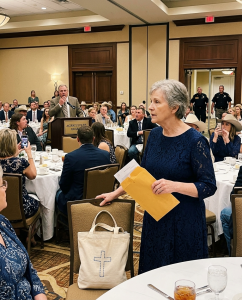
By the time she stood up at 7:43 on a Saturday night in the ballroom of the Marriott in Cookeville, most people in that room thought they knew exactly who Darlene was.
She was Greg Hutchins’s wife.
The quiet one.
The gracious one.
The woman in the good blue dress who never made a scene, never interrupted, never seemed to mind standing half a step behind her husband while he accepted plaques and applause and praise he wore like another tailored jacket.
No one in that room understood that Darlene had not come to support him.
She had come to end him.
It had started fourteen months earlier, in the silence that follows surgery.
Darlene had been home from the hospital for three days after a hip replacement. The house smelled faintly of antiseptic wipes, canned soup, and the lilies somebody from church had sent over. She was still sleeping in short stretches and moving through the house with a walker, each step deliberate. Her daughter Emma had stayed the first night, then gone back home after being reassured a dozen times that her mother would be fine.
Greg had been in and out, distracted, pressed for time, muttering about county business and a commissioner’s meeting and one urgent phone call after another. Darlene noticed he never quite met her eyes for long, but after thirty-one years of marriage, people learn to file away small discomforts. You tell yourself there will be time to ask later.
Then the certified letter came.
She nearly left it unopened.
It sat on the counter while she lowered herself into a kitchen chair and caught her breath. Her hip throbbed. The pain medication made the print on the envelope swim slightly. County deed office, it read.
Routine, she thought at first.
Tax matter. Filing issue. Paperwork.
She slit it open with a butter knife.
A few seconds later, she forgot about the pain in her hip entirely.
Her name was no longer on the deed.
There it was in black and white, impossible to misread. The Hutchins Family Cattle Ranch, four hundred and twelve acres, now recorded without her. Not jointly held. Not amended with explanation. Removed.
Quietly. Legally enough to pass at a glance. Deliberately enough to be devastating.
For a long time, Darlene just sat there.
The refrigerator hummed. Somewhere beyond the kitchen window, cattle moved in the winter pasture. The clock over the stove clicked forward one minute and then another. She looked back down at the page as if reading it twice might force it to become a clerical mistake.
It did not.
The filing date hit her next.
The papers had been processed while she was in surgery.
While she lay under anesthesia at St. Anthony’s with monitors beeping around her and Emma squeezing her hand in recovery, Greg had not been at some innocent meeting delayed by county business.
He had been making sure the land was no longer hers.
That ranch was not just property.
It was history.
Her grandfather had bought the first parcel after years of tenant farming, scraping together enough money to put a down payment on bad soil and then spending a decade making it good. Her father added acreage one hard season at a time. Darlene had known every fence line before she knew all fifty states. She had bottle-fed calves there, buried her old collie there, stood under those wide fields and listened to men in her family talk about weather as if it were a living enemy.
Greg had married into the ranch.
Darlene had belonged to it.
She should have called him immediately. That was what anyone reasonable would have done.
But outrage can be noisy only when there is still something left to argue over. Darlene understood, with a clarity that surprised even her, that the argument had already happened without her. Greg had planned it, timed it, signed it, and counted on her finding out too late to stop him.
So she folded the letter neatly.
She went back to bed.
She pulled the quilt up to her chin and stared at the ceiling until the shadows changed position.
Then she reached for her phone and called Pastor Wayne’s wife.
“Tell the ladies I’ll be there Thursday after all,” she said.
The woman sounded pleased. “We’ll save you a chair.”
That Thursday, Darlene attended Bible study in a cardigan, with a careful smile and a canvas tote bag hanging from her shoulder. Her granddaughter Emma had made it for her the previous Christmas, stitching a slightly lopsided blue cross on the side. Inside the tote sat the deed letter.
The first page in the envelope.
Not the last.
Over the following weeks, people watched Darlene return to normal life. She moved more slowly because of her hip, but otherwise she seemed unchanged. She attended church, took casseroles to new mothers, mailed birthday cards, and stood beside Greg at events where he worked every room with his county-politician ease.
At a fundraiser dinner, someone complimented Greg on his recent land stewardship project, and Darlene smiled as if the word stewardship no longer made her sick.
At the Republican Women’s Club luncheon, she brought buttermilk pie and accepted praise for the flaky crust.
At the annual county gala, she sat three seats down from Greg, laughing at a story he told about cattle auctions, even refilling his water glass while people around them admired what a devoted couple they still were after all these years.
Greg seemed relieved by her silence.
That was useful.
What nobody noticed was how much Darlene had begun to listen.
Men revealed a great deal in rooms where they believed women were only pouring tea or setting down dessert plates. They bragged in fragments. They grumbled carelessly. They used names they assumed no one would remember. They spoke around money with the lazy confidence of people who had never been made to account for it.
Darlene remembered everything.
So did someone else.
Six weeks after the deed letter arrived, she drove forty minutes to a Cracker Barrel off I-40 to meet Russell Pitts.
Russell looked older than she remembered, and not in the harmless way people say after a long season. He looked hollowed out. His suit had once been expensive and now hung on him like borrowed clothing. He stared at the menu longer than necessary, maybe to avoid looking directly at her.
For eleven years, Russell had served as Greg Hutchins’s campaign treasurer. He was known for precision, discretion, and a near-religious loyalty to recordkeeping. Then a campaign finance discrepancy surfaced. The official story blamed sloppy oversight and a trusted employee who had made unauthorized decisions.
That trusted employee was Russell.
Everyone in county politics knew Greg had approved the transactions himself. Everyone also knew Greg had enough friends to ensure the mess landed on the one man least powerful enough to survive it. Russell lost his CPA license. His wife, exhausted by debt and disgrace, left within the year. He ended up teaching substitute classes and renting a small house off Highway 9.
Darlene ordered him the Sunday roast before he could object.
He talked for nearly an hour.
At first it came out jagged and bitter: names, meetings, old humiliations, half-finished accusations. Then the details sharpened. Transfers. Reimbursements. Vendor invoices. Cash movements disguised as outreach expenses. He spoke like a man who had spent months trying not to remember and years failing.
Darlene listened without interruption.
When he finally fell silent, she slid a legal pad across the table.
“Write down everything you remember,” she said. “Dates, amounts, who told you what. Start with the earliest thing you can prove.”
Russell looked at her carefully then.
“You know this won’t stay small,” he said.
Darlene stirred cream into her coffee. “It stopped being small when he signed my name out of my own family land.”
That was enough.
Russell began writing.
The envelope in Darlene’s tote grew thicker one document at a time.
Copies of records Russell had quietly kept because some men save evidence the way other people save spare change. A property appraisal Darlene commissioned under her maiden name so word wouldn’t circle back to Greg. Notes from a Nashville attorney who specialized in marital asset fraud and asked crisp, unsettling questions in a voice so calm it made Darlene trust her immediately.
“Did you ever sign a durable power of attorney?”
“No.”
“Did he present deed amendments during a period of medical impairment?”
“Yes.”
“Did he benefit financially from the transfer?”
Darlene had paused before answering that one.
“I think I haven’t found the full answer yet,” she said.
The attorney told her to keep looking.
So she did.
She learned that Greg’s recent obsession with county development committees had less to do with civic service than with positioning. Land-use rumors were moving quietly through certain offices. Road expansion. Utility access. Private buyers circling parcels that would become dramatically more valuable once the right approvals came through.
The ranch, stripped of Darlene’s name, could be leveraged, pledged, or partially sold with far less resistance.
Legacy, Greg called it in public.
Liquidation, the attorney called it in private.
The anger Darlene felt never erupted. It hardened instead. That was more useful.
She carried the envelope everywhere.
At church fellowship dinners, her fingers sometimes slipped into the tote just to touch its edge, to reassure herself it was still there. Linda Faye from the altar guild noticed one night and asked, smiling, what she was always guarding in that old manila packet.
“Insurance,” Darlene replied.
Linda Faye laughed.
Darlene smiled back.
Over the next year, Greg never suspected the depth of what she knew. He saw what he expected to see: a recovering wife who had accepted things she could not change. He remained careful in the way a practiced liar is careful—more affectionate in public, slightly inattentive in private, forever certain that performance was enough.
Meanwhile, Russell found another piece.
Then another.
A vendor account tied to a shell entity. Campaign reimbursements that seemed to overlap suspiciously with personal expenditures. A consulting fee with no real consultant attached. Enough to interest investigators, but not necessarily enough to break Greg in one blow.
Then Darlene found the page that mattered most.
It was buried in a records packet tied to a private financing arrangement, and when she first saw it, she had to set it down because her hands began to shake.
The ranch was collateral.
Not in theory. Not someday. Already.
Greg had pledged the property through a layered structure tied to debt, development money, and a pending transfer option contingent on county approvals he had publicly claimed no personal interest in. If the deal matured, the land would not remain in the family at all. It would be carved, sold, and turned into the kind of project men in pressed shirts call opportunity and women like Darlene call losing everything your dead spent their lives protecting.
That page was the final document.
The one she told no one about.
Not Emma. Not Russell. Not the attorney, at first.
She kept it folded at the very bottom of the envelope, because once that page surfaced, everything changed. It was no longer only a betrayal inside a marriage. It was a fraud wrapped around public office, private money, and a man who had built his reputation on pretending the land was sacred.
When the Tri-County Agriculture Banquet approached, Darlene understood that Greg would use the event the way he used every public honor: as insulation. The Citizen of the Year award would place him on stage before judges, donors, commissioners, clergy, business owners, and half the people most likely to defend him later. It would also gather them in one room, with cameras ready and witnesses impossible to isolate.
So she made arrangements.
A quiet conversation with the attorney.
A careful delivery of selected documents to the right county office.
One call that ensured the proper officials would arrive discreetly but not silently.
And then Saturday night came.
The ballroom glittered with the kind of temporary elegance hotels rent out by the hour. White linens, iced tea sweating in glasses, floral centerpieces nobody would remember the next day. Two hundred people filled the room in blazers and polished boots. The emcee made jokes. Plates clinked. Greg basked.
Darlene wore the good blue dress.
She sat at the back.
Her tote bag hung on the chair beside her.
During the speeches, Greg looked almost radiant with self-satisfaction. He shook hands with the county judge, accepted the plaque, and launched into a speech about values, stewardship, and what the county meant to him. He thanked the agricultural community. He thanked the chamber. He thanked every institution that had ever helped polish his image.
Then he leaned toward the microphone and said, “And I couldn’t have done any of it without the support of—”
The sound system squealed.
Every head turned.
And Darlene rose.
She was not physically imposing. At five-foot-four, recovering from a hip replacement, she would have been easy to overlook in almost any room until the moment she chose not to be overlooked. Her voice, when it came, was perfectly steady.
“Actually, Greg,” she said, “I believe the fire marshal has a question for you first.”
At that exact moment, the banquet hall doors opened.
A uniformed fire marshal entered, followed by another official, a county investigator, and a woman carrying a thick folder. The sudden shift in the room was almost physical. Conversations snapped off. Chairs scraped faintly. The first person lifted a phone to record, then another, then nearly everyone.
Greg turned toward the doorway.
The color drained from his face.
Darlene would remember that more vividly than the applause he had enjoyed seconds earlier. Not because it made her happy, but because it proved he recognized danger on sight. A guilty man often knows which knock at the door is ordinary and which one means the story is over.
He came down from the stage trying to look offended rather than frightened.
“What is this?” he asked when he reached her table, his voice low and sharp.
Darlene looked up at him and saw, with sudden absolute certainty, that she had spent years married to a man who mistook gentleness for weakness.
“This,” she said, sliding out the second document for the investigator to see, “is where your commission money went.”
At the next table, someone gasped.
Across the room, Russell Pitts stood near the back doors exactly where Darlene had told him to stand if he decided to come. Greg’s eyes flicked to him, and panic flashed there before he could hide it.
The investigator reached for the file. Darlene surrendered page after page.
Bank records.
Property filings.
Appraisals.
Correspondence.
Then she kept one page in her hand.
The last one.
Folded in thirds, edges softened from months of carrying it everywhere.
Greg saw it and went utterly still.
“Darlene,” he said, and for the first time that night his voice no longer belonged to a public man. It belonged to a husband who understood he was about to lose control. “Don’t.”
The room leaned inward.
Darlene unfolded the page.
“It says here,” she told him, not loudly, “that the family ranch was already pledged as collateral against a private development structure tied to county action you were publicly advising on.”
The county judge closed his eyes.
Someone near the front whispered, “Oh my God.”
The woman with the folder stepped forward at last. “Mr. Hutchins,” she said, “we need to ask you to come with us.”
He tried denial first. Then confusion. Then indignation. He claimed the documents were being misread, that Darlene was upset and mistaken, that political enemies had manipulated facts. He even reached once for her arm, not hard, but with the old instinctive entitlement of a man accustomed to guiding her physically and publicly where he wanted her.
Darlene stepped back.
“No,” she said.
That single word cut deeper than any speech could have.
Because it was not only a refusal in that room.
It was the end of every quiet concession that had made him believe he could take from her without consequence.
The officials escorted Greg out under a storm of camera phones and stunned silence. The plaque with his name remained on the podium, absurd and forgotten. People began talking all at once, voices breaking into frantic fragments. Some rushed toward Darlene. Others rushed away from the scandal.
Russell approached slowly.
“I didn’t know about the ranch collateral,” he said.
“I know,” Darlene replied.
He looked at her with something like awe and sorrow mixed together. “You carried that alone?”
“For a while,” she said.
The legal aftermath stretched for months.
Investigations widened. Records were subpoenaed. Greg’s allies grew selective in their memories. Some insisted they knew nothing. Some had known enough to be afraid. The deed transfer was challenged and reversed. The financing structure around the ranch unraveled under scrutiny. There were accusations, hearings, and a parade of men in suits trying to rename greed as misunderstanding.
Darlene filed for divorce before the season changed.
Emma cried when she read the full case file and then apologized over and over for not seeing it sooner. Darlene held her and told her the truth: some betrayals are built so carefully they are meant to survive a daughter’s love, a wife’s trust, and a whole town’s assumptions.
The ranch stayed in the family.
That mattered most.
In spring, Darlene stood at the edge of the south pasture, wind lifting the hair at her temples, and watched fresh calves stumble after their mothers in the new grass. The house was quieter without Greg, but it was an honest quiet. No performance. No hidden papers moving beneath the surface of ordinary days.
People in town still talked, of course. Some said Greg had gotten what he deserved. Some said Darlene had humiliated him too publicly. Others said she should have handled it privately, as though privacy had not been the weapon used against her from the start.
Darlene never answered those opinions.
She had no interest in teaching lessons to people determined not to learn one.
Now and then, someone would mention the banquet, the exact time, the way the room changed when she stood, the strange calm in her face. They spoke of it like a legend, something larger than a woman simply telling the truth.
But Darlene knew what it really was.
It was a line drawn too late, perhaps, but drawn all the same.
The most unsettling part was not that Greg had lied. Men like Greg lie every day and call it strategy. The unsettling part was how easily an entire community had accepted the image of him while overlooking the cost paid by the people closest to him. Russell lost his career. Darlene nearly lost her land. Both losses had been wrapped in Greg’s charm and handed back as collateral damage.
That was the red flag, if there had to be one named.
Not the grand betrayal.
The smaller rehearsals before it.
The way he disappeared during her surgery and expected the excuse to hold.
The way he spoke of legacy while hollowing it out.
The way he relied on Darlene’s decency as if it were just one more asset he could convert to his advantage.
Sometimes, standing on the porch at dusk, Darlene thought about the moment he said don’t.
Not because she regretted ignoring him.
Because after thirty-one years, it was the first honest thing he had said to her in a long time.