Twenty years ago, Loretta Vance walked out of a union hall in Pittsburgh with a cracked laminated index card in her hand and a sound in her ears that followed her for years afterward: men laughing while she stood there trying not to break.
By the time she returned, she had enough money to save the very institution that had failed her.
And the man who had laughed at her was seated at the head table.
Loretta had not planned her life around revenge. If anything, she had spent years trying to survive without the luxury of thinking about revenge at all. Revenge was for people with spare time, spare money, spare energy. Loretta had none of those things after Dale died.
Dale Vance had been a steelworker in the old-fashioned sense of the word. He believed in showing up early, keeping his mouth shut, and finishing the job before he talked about how hard it was. He had grown up with the union as a fact of life, not an abstract principle. To him it meant wages you could count on, a little protection from management, and paperwork somebody smarter than you would help sort out when life went bad.
He met Loretta in Kentucky, in Harlan County, where she was known as the quiet girl with quick hands and serious eyes. She was not timid, exactly. She simply had no habit of making herself the center of attention. She married Dale young. Not foolishly young, just young enough to still believe effort was always rewarded and decency would be recognized when it mattered.
When the work dried up in Kentucky, Dale moved them north to Pittsburgh because there was still steel, still overtime, still hope. They rented a small place first, then bought a modest house after a few better years. Loretta kept books for the household in a spiral notebook, stretching every paycheck. Dale liked to say she could make a dollar feel like two.
She always smiled when he said that.
The truth was she had never been taught the larger language of money. Mortgages, benefits, pension elections, tax implications, death claims—those belonged to a world of offices and men in pressed shirts who spoke fast and assumed everyone had the same education they did. Loretta understood groceries, heating bills, school shoes, timing. She understood sacrifice. But the systems built around grief? Those were another matter.
Then Dale had a collapse at work that became a hospital stay, then complications, then the kind of terrible conversation that turns the air to static. He died on a Tuesday in October. People brought casseroles. Family stood in dark clothing near the grave. Someone from the pension office sent letters almost immediately, each one full of deadlines and choices that felt indecently urgent.
Loretta read them three times and still could not make sense of them.
For a week she was too stunned to do more than stack them neatly on the kitchen table. Then panic set in. She had a mortgage. Utilities. A daughter still half-dependent on her. She needed help, real help, and the union hall felt like the obvious place to go. Dale had paid into that system for years. Surely someone there would sit down and explain what came next.
Because she was nervous, she wrote down her questions on an index card.
She printed carefully, line by line, wanting to be sure she would not forget anything once she got into the room. What benefits had to be claimed first? Was there a deadline for survivor elections? Could someone explain the forms in plain English? If she made the wrong choice, was it permanent? Who should she call? What happened if a widow signed something she did not understand?
She put on her good wool coat and drove to Local 1219 on a bitter November evening with the card in one hand and the paperwork in a manila envelope under her arm.
Gerald Murtaugh was there that night.
Gerald had married Dale’s sister years earlier and had the kind of confidence that comes from being the man everyone expects to speak first. He was a union representative, broad-shouldered, loud, comfortable behind desks and at microphones. He told stories too long and laughed at them before anyone else could decide whether they were funny. He had never liked Loretta much. She noticed too much and praised too little.
Still, she had not expected cruelty.
He looked over the envelope she handed him. Flipped through pages. Asked her one or two quick questions. Then he spotted the index card in her hand.
“What’s that?” he said.
“My questions,” she answered.
He gave a sharp laugh and turned slightly so the other men in the room could hear.
“Loretta,” he said, “you can barely manage a household budget. You think you can handle a business decision?”
There are humiliations that burn hot and fast and then pass. This was not one of them. This one settled into her bones.
The other men did what people often do when someone else is being diminished. One looked away. One smirked. One pretended to focus on papers. Nobody told Gerald to stop. Nobody took the card from her and said, Let’s go over your questions one by one. Nobody treated her like a widow trying not to drown.
Loretta took her papers and left.
In the parking lot she sat in her car with the dome light on and stared at the index card through tears she refused to let fall until the doors were locked. She turned it over. On the front were her questions. On the back, with a pen she found in the glove compartment, she wrote five promises to herself.
Learn every word they think you’re too small to understand.
Never ask the cruel for permission again.
Become the person widows need when the room turns cold.
Come back when it matters.
And finally, after a long pause, she wrote a sentence meant for Gerald Murtaugh.
Someday, you will hear my name in a room where yours no longer matters.
She did not know then whether that line was prophecy, fantasy, or simply a lifeline thrown to a version of herself she hoped might still exist.
What she did know was that she could not remain helpless.
The next years were ugly. There was no cinematic transformation, no sudden mentor, no miraculous break. There was paperwork first. Long nights with library books, free workshops, patient clerks, and dictionaries open beside forms. She learned benefit language by necessity and shame. She called offices and forced herself not to hang up when people sounded impatient. She made mistakes. Corrected them. Learned which questions mattered and how to ask them.
Money got tighter before it got better. She took in hemming, repairs, and alterations because sewing was one of the few skills she could monetize quickly. She bought a secondhand sewing machine for four hundred dollars and nearly threw up after handing over the cash. It was too much for her then. Also not enough to build a future. But it was a start.
She advertised online in the most basic way possible. Hemming. Repairs. Curtains. Uniform alterations. Fair prices. Reliable.
The first months brought just enough work to keep lights on. Then a property manager asked if she could fix torn drapes across several units. She said yes. A restaurant needed aprons and bench covers repaired in batches. She said yes again. A small contractor asked if she could source tougher materials and handle larger jobs.
She had no idea how, but she learned.
This was how Loretta built things: not by grand vision, but by refusing to waste a door once it cracked open.
Soon she understood that sewing was only part of the business. She needed pricing, schedules, invoicing, tax records, vendor relationships, insurance, payroll. Each new layer frightened her, so she learned that too. She listened more than she talked. She paid close attention to the people who underestimated her because underestimation made them sloppy.
When men in supply warehouses directed answers toward whichever man happened to be standing nearest her, Loretta started responding before the men could. When clients assumed she would lower her price out of gratitude for the work, she learned to let silence embarrass them first. When one banker spoke to her like she was applying for permission to play at business, she went home furious, came back with cleaner books than half his commercial clients, and got the line of credit anyway.
There were losses. A major customer defaulted. A landlord raised rent. One winter she came within sight of losing everything and did, in fact, lose the house for a time before fighting her way into stability again. There were years she thought the promises on the back of the card were foolish. Years she carried it because she needed not inspiration, but spite.
And still she kept going.
Her daughter, Ava, became the first person to understand that the card was not just a memory. It was equipment. Once, when Ava was in her twenties, she found Loretta sitting in a bank parking lot gripping the card to her chest before a meeting about financing. Another time, before a hospital board presentation for a contract Loretta desperately needed, Ava saw her tap the left side of her blazer twice, then smooth the fabric.
“What is that thing?” Ava asked.
Loretta looked at her in the mirror.
“The reason I don’t back down,” she said.
By then the sewing business had evolved into something far bigger. Loretta had moved into specialty textile services, then industrial fabric contracting, then facilities support agreements. She hired people. Then managers. Then an operations lead who tried once to explain to a vendor that Loretta was “not really the owner-owner type” and found himself unemployed by the end of the week.
Her first company became stable enough to attract interest. Her second company, built with hard-earned confidence and far sharper instincts, became genuinely valuable. She knew markets now. She knew leverage. She knew how to walk into conference rooms where everyone else had degrees and pedigrees and still leave with terms tilted in her favor.
She also knew how often powerful people mistake polish for intelligence and grief for weakness.
When the second company sold, the amount was large enough to shock even those who had watched her climb. Her accountant, Martin, who had worked with her for years, once asked why she still carried that old index card after all this time.
“A reminder of where you started?” he guessed.
Loretta smiled.
“A reminder of what the room sounds like before it learns your value,” she said.
She had choices then. Real ones. She could have traveled, retired, donated quietly elsewhere. But the older she got, the more she thought about widows at kitchen tables, staring at forms they did not understand, trying not to choose wrong while grief was still fresh in the walls around them. She thought about how thin the line was between surviving and slipping under. She thought about what one respectful conversation could have changed for her in 2004.
That was when she began planning the endowment.
Not a vanity project. Not a building with her name on it. A hardship relief fund. Something practical. Immediate. Medical emergencies. Housing crises. Funeral support. Bridge money for families in the days after catastrophe, when paperwork lagged behind real life and pride made people wait too long to ask for help.
Two-point-four million dollars, structured to last.
She did her homework before approaching Local 1219. Met with attorneys. Studied the union’s financial mechanisms. Required transparency provisions and independent oversight. She had no intention of handing anyone a blank check wrapped in sentiment. The fund would serve members and widows for generations, but it would do so properly.
The union leadership, separate from Gerald’s old guard, were stunned by the gift. Grateful too. When they asked whether she wanted public recognition, Loretta said she would speak at the banquet where the endowment would be announced.
There was one additional condition.
Her name would remain undisclosed until the moment she took the podium.
The banquet happened to be Gerald Murtaugh’s retirement celebration.
When the committee mentioned that detail, Loretta merely nodded.
Gerald, meanwhile, had spent the last two decades becoming exactly the sort of man he had always been, only older and less careful. He still liked a microphone. Still believed he had built the room. He had heard vague things about Loretta over the years—something about Virginia, something about business—but none of it mattered to him because he had never really considered her a person whose story might continue beyond his line of sight.
That was his flaw. He assumed the people he dismissed remained small forever.
The night of the banquet he wore a polished expression and a tie chosen by his wife. He shook hands, accepted congratulations, told old labor stories, and ate chicken under hotel ballroom lighting while waiting for the surprise keynote speaker. He guessed politician. Maybe state-level. Someone who would flatter the union, praise his years of service, and help end the evening with applause.
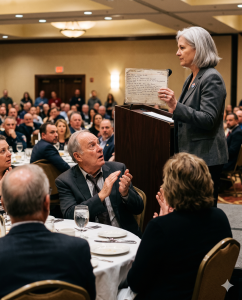
He did not recognize Loretta when she first walked toward the podium. Not fully. He saw a silver-haired woman in a charcoal blazer and low heels. Saw posture shaped by years of command. Saw a face that looked familiar in the way old photographs can. Then the MC began.
“Our keynote speaker tonight has asked to remain anonymous until this moment. She is the sole donor behind the two-point-four-million-dollar endowment that will fund this union’s hardship relief program in perpetuity—covering medical emergencies, housing crises, and family losses for members and their widows for generations to come.”
Gerald began clapping with everyone else.
“She asked us to introduce her simply as a steelworker’s wife who learned to figure things out.”
Loretta turned.
Gerald’s hands stopped.
Recognition spread across his face in stages: confusion, disbelief, calculation, then fear. The fear came last and strongest because by then he understood two things at once. First, that Loretta had become someone the room would listen to. Second, that he had no idea what she intended to say.
She gave him three full seconds to see her.
Then she reached into the left side of her blazer and removed the index card.
Even from the head table he recognized it—not the words, but the fact of it. Small. Laminated. Worn. Impossible.
A murmur passed through nearby tables as she laid it on the podium and smoothed it with her palm.
“I want to thank the union for having me tonight,” she said.
Her voice was even, and that steadiness cut deeper than anger would have.
“And I want to say that I believe in this organization. I believe in what it means to protect workers and their families when the worst happens.”
The ballroom quieted.
“I know what it costs when that protection fails.”
Now there was no sound at all beyond the faint clink of melting ice in glass.
“I wrote down everything you said to me that night, Gerald,” she said.
The head table froze. Gerald went pale.
“Every word.”
She touched the card.
“Would you like me to read it to the room,” she asked, “or would you prefer I just show them what’s on the other side?”
Gerald tried to force a laugh, but it snagged halfway out of his throat. He pushed back his chair as if standing might restore some authority.
“Loretta,” he said, too loudly, trying for familiarity and landing on panic. “Now hold on—”
She didn’t raise her voice. She didn’t need to.
“The front is your voice,” she said. “The back is mine.”
People were leaning forward now. Union officers. Retirees. Spouses. Young members who knew Gerald only as an old labor name and were watching him unravel in real time.
Loretta lifted the card.
“The front says exactly what he told me after my husband died and I came here with questions because I didn’t understand my pension paperwork. It says: ‘Loretta, you can barely manage a household budget. You think you can handle a business decision?’”
The sentence landed with an audible reaction from the room—sharp inhales, one muttered curse, the scrape of a chair.
Gerald looked around as if searching for allies and found only faces trying not to be seen siding with him.
Then Loretta turned the card.
“The back,” she said, “is what I wrote in the parking lot after I walked out.”
She read the first four lines slowly.
“Learn every word they think you’re too small to understand.
“Never ask the cruel for permission again.
“Become the person widows need when the room turns cold.
“Come back when it matters.”
By now some people in the room were crying quietly. Not because the words were ornate. Because they were plain enough to feel true.
Loretta looked straight at Gerald for the final line.
“And last,” she said, “I wrote: ‘Someday, you will hear my name in a room where yours no longer matters.’”
Nobody laughed.
Gerald opened his mouth, shut it, and sat back down because there was nowhere for him to go. The old power had vanished so quickly it was almost embarrassing to watch. Men who had once covered for his sharpness were staring at their plates. Others looked at Loretta with something closer to awe.
She let the silence do its work before continuing.
“I didn’t come here tonight to humiliate an old man,” she said. “Life has already done enough of that for all of us. I came because no widow, no spouse, no family member in shock should ever walk into a room asking for help and leave feeling smaller than when they entered.”
Then she did the thing that secured the room completely.
She pivoted away from Gerald.
Not because he deserved mercy, but because her story was never only about him.
She spoke about forms that arrive too fast after funerals. About people who nod while professionals speak because they are too ashamed to admit they are lost. About the dangerous gap between institutional promises and human compassion. She explained the endowment in detail—how it would work, who it would serve, what safeguards were attached. She made clear that the fund existed because worker protection must include dignity, especially in the hours when grief makes people easiest to ignore.
By the time she finished, the room rose to its feet.
Not all at once. It began in pockets, then rolled outward, table by table, until the applause became something larger than celebration. It sounded like correction. Like the room had finally decided what kind of story it wanted to belong to.
Gerald did not stand.
He remained seated, hands clasped too tightly, looking smaller than Loretta had ever seen him. For one brief second she thought about the November night in 2004 and the version of herself who had sat in a cold car trying to understand how humiliation could feel so permanent.
Then she put the card back into her blazer.
After the speech, people lined up to thank her. Widows. Adult children. Younger union members. One woman in her sixties took both of Loretta’s hands and said, “You said what some of us have carried for years.” A young organizer asked whether she would advise a committee on family support policy. A man with tears in his eyes told her his mother had been brushed off after his father died, and he wished someone like Loretta had been there then.
Gerald approached once, later, when the crowd thinned.
He looked old now. Not retired-old. Hollow-old.
“I was out of line,” he said.
It was, perhaps, the closest he had ever come to a sincere apology.
Loretta studied him. For years she had imagined this moment and thought it might feel triumphant. Instead it felt clarifying.
“Yes,” she said. “You were.”
He waited, maybe expecting absolution, maybe hoping she would soften for the sake of shared family history.
She didn’t.
“An apology after consequence isn’t the same thing as kindness when it’s needed,” she said. “That was the point then. It’s still the point now.”
He nodded once, because there was nothing else available to him.
She left him standing there and went to speak with the committee about rollout dates for the fund.
In the months that followed, the hardship relief program began helping families exactly as she intended. Emergency grants went out quietly. Funeral support bridged impossible weeks. Rent crises were addressed before eviction notices became actual loss. One widow received money for travel and lodging so she could sit beside her husband in a trauma unit in another state. Another family stayed in their home long enough to regroup instead of spiraling after a medical catastrophe.
Loretta reviewed reports, insisted on plain-language forms, and required one additional policy that some administrators first considered unnecessary until she overruled them.
Every applicant would be offered a real conversation with a trained person who could explain the process without jargon, condescension, or haste.
No one would leave holding papers they did not understand and shame they did not deserve.
As for the index card, she kept carrying it.
Not because she still needed Gerald Murtaugh.
Not because she lived in the old hurt.
She carried it because memory, when used correctly, can become architecture. It can build the room you once needed. It can warn you when power is beginning to harden into cruelty. It can remind you that dignity is often protected not by grand speeches, but by whether the most frightened person in the room is treated like they belong there.
People later told the story in different ways. Some said a widow returned rich and humbled the man who mocked her. Some said a businesswoman saved a union and exposed its failure. Both versions were true, but incomplete.
The truest version was simpler.
A woman once went looking for help and found contempt instead.
So she built enough strength to come back carrying help in both hands.
And somewhere in the aftershock of that night, a harder question lingered—one no one in that ballroom could answer comfortably. Was Gerald the villain because he said the cruel thing out loud, or was the room just as guilty because it let him say it without consequence? And if Loretta had never come back, how many people would have gone on calling that silence normal?