Thirty years ago, they laughed at Darlene Holt in a law office and handed her a crumpled twenty-dollar bill as if humiliation were a legitimate form of inheritance.
By the end of a Friday auction three decades later, she owned nearly everything the Whitfield family had left.
And the thing that shattered the room was not the money.
It was a mason jar.
Half-full of cloudy water from Harlan Creek.
The kind of creek nobody respectable ever bragged about, because respectable people tended to brag about what was obvious. White-column houses. Route 76 parcels. Club memberships. Investment properties. Last names that opened doors. Harlan Creek was just muddy water on the back edge of rural Missouri, running brown after storms and low in hot weather, cutting through land most people ignored unless a fence post washed loose.
But Darlene had spent half her life learning that what people ignored usually mattered most.
She grew up outside Hollister on forty acres where almost everything useful had to be repaired twice before it was replaced. Her father kept ledgers in a biscuit tin, sharpened nails for reuse, and could identify weather by smell. Her mother set a neat table every night, even when dinner was beans and cornbread. Darlene inherited both habits: discipline from one, dignity from the other.
She learned young how to stretch what she had without ever making it look like lack. She ironed aprons, fed chickens before school, and understood the difference between being poor and being careless. Poor, her daddy said, was temporary. Careless was expensive.
By the time she was twenty-two, she had a reputation for being quiet, capable, and prettier than she seemed at first glance because she did not present herself like someone fishing for admiration. Curtis Whitfield Jr. noticed her at a church fundraiser. He was handsome in the easy way that comes from being told you are handsome all your life. He wore polished boots, laughed at the right moments, and seemed relieved by Darlene’s steadiness.
She loved him, though later she would admit to herself that she also loved how simple love felt before families got involved.
The Whitfields did not object to the marriage openly. They were too polished for open objection. Instead, they perfected the softer violence of social rejection.
At dinners, Darlene’s recipes were described as “rustic.”
At holidays, someone would ask whether her family still raised chickens “for actual income” with a smile too sweet to challenge.
When she offered practical suggestions about land management or tenant issues, the men would smile past her and continue talking to one another as if she had commented on the weather.
The worst of them was Curtis Whitfield Sr.
He never shouted. He did not need to.
He had the crisp, surgical manners of a man who believed exclusion counted as refinement. When Darlene spoke, he listened with theatrical patience. When she finished, he would say, “That’s an interesting perspective,” in the tone of someone indulging a child’s guess.
Curtis Jr. loved her, but not bravely enough. That was one of the hard truths Darlene only named years later. He defended her in private, appeased his family in public, and believed time would soften things that were actually hardening. He was not cruel, but weakness in a family like the Whitfields had consequences all its own.
Then he died younger than anyone expected, after a sudden illness that left Darlene widowed and half-numb before she had fully understood how sick he was.
Grief changed the temperature of the family at once.
Without Curtis Jr. there to occupy the space between Darlene and the Whitfields, every old contempt surfaced. Calls were not returned. Information arrived late. Decisions happened around her instead of with her. She learned through paperwork and whispers how little anyone thought she should receive, despite the years she had spent supporting her husband, helping on properties, keeping his books when he was careless, and holding together the quiet labor no family ever admits depends on a woman until she is gone.
Then came the estate reading in October 1994.
The law office smelled faintly of leather polish and old paper. Darlene remembered the room for the rest of her life with the painful precision of humiliation. Her burgundy wool coat. Her black pumps pinching one heel. The pearls at her mother-in-law’s throat. The attorney’s polished cuffs. The way everyone carried themselves with anticipatory solemnity, as though the transfer of wealth were a sacred rite.
It ended with a crumpled twenty-dollar bill.
“To my daughter-in-law,” the attorney read, careful now, “I leave the sum of twenty dollars, which is approximately what her contributions to this family were worth.”
The room had gone still for half a breath, then laughter spread in tiny bursts. Someone near the back snorted. Someone else coughed into a hand, pretending not to laugh while clearly doing so. Her mother-in-law lowered her eyes, not in shame but in satisfaction.
Darlene picked up the bill.
Folded it once.
Placed it in her purse.
She said nothing because any words spoken in that room would have belonged to them too. So she left with silence, and when she got home to her kitchen and took off that burgundy coat, she let herself shake.
Then she opened her ledger.
That moment became the seam between one life and another.
She had $4,200 in a savings account she had built quietly, skimming grocery money, garden income, egg sales, and tiny efficiencies no one else would have respected enough to notice. Her father’s forty acres were in her name alone, free and clear. The old house on that land was modest, but the acreage had clean title, usable pasture, timber, and water access.
Most of all, she had no one left to impress.
That freed her in a way the Whitfields would never understand.
She started by doing what she already knew how to do: keeping records. Every fence repair. Every lease option. Every late payment. Every tax sale notice in surrounding counties. She subscribed to local legal notices and read them with the attention other women gave seed catalogs or church newsletters.
She bought small parcels when debts forced neighbors to sell. Not enough at once to attract attention, just enough to connect the edges of what she already owned. She sold selective timber rights during favorable markets but never stripped the land. She leased pasture to Gerald Pruitt, a reliable cattleman whose checks arrived on the first of every month and whose respect for land matched hers.
Gerald was one of the first people to understand that Darlene’s quiet was not passivity.
One summer, while they were standing by a fence line discussing drainage, he asked, “You ever think about getting into development?”
Darlene looked across the pasture, where heat shimmered over the grass.
“No,” she said.
“Too risky?”
“No,” she said again. “Too noisy.”
Gerald laughed, but he never underestimated her after that.
The Whitfields, meanwhile, remained busy being visible. New ventures. New debt. New public generosity funded by increasingly complicated private leverage. They went into Branson real estate at the wrong moment, then doubled down when they should have retreated. They borrowed on holdings with the confidence of people who believed the family name itself had cash value. For a while, it worked well enough to preserve appearances.
Appearances, Darlene observed, were the Whitfields’ favorite crop. They watered them constantly.
Through all those years, she kept one peculiar habit that no one in town considered important. Every spring, after the heaviest rains, she walked Harlan Creek where it ran through the back section of her property and crossed land tied to old Whitfield acreage farther downstream.
At first it was practical. Flood inspection. Fence checks. Debris. Then it became investigative.
She noticed unusual sediment after one storm.
Then a change in color after another.
Then she found tiny mineral flecks trapped in roots along a bend where the current slowed.
The first time she saw the glint, she crouched for a long moment and let muddy water run through her fingers. She did not know exactly what she was seeing, only that it was not ordinary silt.
A year later, a pair of men in boots came through adjoining land with sample equipment. They told Gerald they were conducting routine environmental assessments for a company evaluating water impacts. Darlene happened to be nearby, mending a gate, and overheard enough to know they were interested in more than runoff.
She said nothing.
Silence, in her life, had evolved from wound to weapon.
A few months after that, a letter meant for a Whitfield holding company ended up misdelivered at an old mailbox attached to acreage near one of her parcels. By the time it made its way correctly, Darlene had seen the sender: a geological consulting firm.
She never opened the envelope.
She did not need to. Curiosity had become method. She began checking county recordings more closely, following survey references, tracing legal descriptions, and matching them to parcels around Harlan Creek. Most people would have needed an attorney to do it. Darlene needed only time, patience, and the stubborn refusal to assume complicated things were beyond her.
What she pieced together over years was simple in outline and astonishing in consequence: parts of the Harlan Creek watershed sat atop valuable mineral deposits. Not enough to turn the region into a boomtown, perhaps, but enough to make the associated rights extraordinarily valuable to the right buyer. Enough to transform “worthless creek land” into strategic land.
Enough that somebody in the Whitfield orbit had known.
Maybe not all of them. Maybe not the women who hosted luncheons or the cousins who spent too much. But someone had known, because surveys had been commissioned, entities had been restructured, and certain properties had been held despite bleeding money elsewhere. The family had ignored or concealed the creek’s importance depending on who was asking. Either way, they never imagined Darlene would connect the dots.
Then greed and arrogance did what years of insult could not: they made the Whitfields sloppy.
Taxes mounted. Federal scrutiny followed one spectacularly mismanaged venture. Lawyers billed by the hour. Lenders lost patience. Holdings were sold, refinanced, shifted, and exposed. By the time the liquidation auction was announced, old protections were gone. Anything still tied together in the estate package was vulnerable to being sold in a way that overlooked the hidden value nested inside it.
Darlene saw the public notice in the paper and read it twice.
Then she went to the drawer by her stove, removed the same folded twenty-dollar bill she had kept all those years, and laid it on the table next to her current ledger.
She smiled.
It was not joy. Not exactly. More like balance approaching.
The morning of the auction was bright and already warming by eight. People arrived early for the usual reasons: bargains, gossip, collapse. The Whitfields clustered in tense little groups, dressed as though proper fabric might still hold back disgrace. Darlene drove in with dust on her truck and no interest in performance.
She wore jeans, a plain blue blouse, and her good boots.
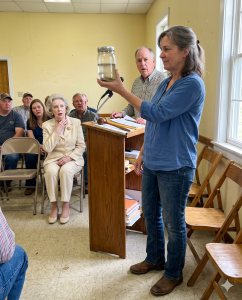
In her hand she carried a mason jar half-full of cloudy water from Harlan Creek.
She had collected it at dawn from the bend where the sediment always settled in strange, promising ways. The jar was not proof on its own, but it was a message. A private one for the Whitfields. A public one if necessary.
The auctioneer, a capable local man not easily rattled, raised an eyebrow when she set it on his table.
“Need this here?” he asked.
“Yes,” Darlene said.
He considered that, then nodded. “All right.”
The first lots sold without drama. Equipment. Furnishings. Small outbuildings. Then the real property began, and the mood shifted. Darlene bid sparingly at first, forcing no one to notice patterns too early. But as the major pieces came up, she became relentless.
The main house.
A commercial parcel on Route 76.
The lake lot.
The storage facility.
Remaining undeveloped acreage.
Some bidders dropped out because they reached their limit. Others because they began to understand Darlene had come with one. She never overreacted, never gloated, never even changed expression. She just kept lifting her paddle.
Around noon, whispers gathered force.
“Where’s she getting this money?”
“She can’t be serious.”
“Does she know what she’s buying?”
Darlene heard every bit of it and answered none of it.
At the back of the room, her former mother-in-law stood rigid in an expensive suit that had probably cost more than Darlene’s truck payment, though it hung on her now like certainty on a wrong woman. Several Whitfield relatives stared at the mason jar whenever they thought no one would notice. One cousin finally moved closer to the table, squinting at the muddy water as if the contents might explain the impossible.
By midafternoon, Darlene had acquired nearly everything meaningful that remained.
The auctioneer turned to the final packet pages. He slowed. Frowned. Then looked at one legal attachment again. His face changed slightly, the way faces do when paperwork stops being routine and starts becoming revelation.
He cleared his throat.
“Included in the transfer of the remaining acreage and associated rights,” he read, “the successful bidder will assume title to all recorded and appurtenant mineral interests related to the Harlan Creek watershed—”
He paused and looked up at Darlene.
“Ma’am, that would make you the sole owner of—”
A sound cut him off.
Darlene’s former mother-in-law had made it. It was part gasp, part moan, a small sound with enormous history packed inside it. The room turned toward her.
Her face had gone white.
One of the Whitfield nephews muttered, “No. No, no, no.”
Darlene stood, reached for the mason jar, and held it to the light.
Sediment swirled. Tiny metallic flecks caught the sun through the side window. Subtle, but unmistakable once you knew to look.
An out-of-town investor stepped closer. “What is that?”
Darlene did not take her eyes off the Whitfields.
“Something your family should’ve respected,” she said quietly.
The auctioneer, now fully unnerved, shuffled the packet until he found the attached geological survey reference. He scanned it, then looked up, stunned.
One of the Whitfields lunged verbally before he could speak. “That report was preliminary.”
“So was your fortune,” Darlene replied.
A small ripple of shocked laughter moved through the room.
The auctioneer went on, voice uneven now, explaining what the legal transfer actually meant: the mineral rights under the Harlan Creek watershed had remained bundled into the final estate holdings due to a chain of bad restructuring decisions, unresolved tax complications, and one catastrophic oversight in the liquidation process. Any future extraction lease, licensing agreement, or buyout negotiation connected to those rights would now run through the successful bidder.
Darlene Holt.
The woman they had valued at twenty dollars.
The room changed in an instant. Not because people suddenly admired her, though some did. Because they recognized power shifting in real time, and nothing sobers a crowd faster.
Her former mother-in-law took two stiff steps forward. “You knew.”
Darlene lowered the jar. “I paid attention.”
“You manipulated this.”
Darlene almost smiled. “No. I let your family keep doing what it always did.”
“What’s that?”
“Assume the wrong person was ignorant.”
That landed harder than a slap.
There were lawyers involved after that, of course. Protests. Challenges. Angry calls. Attempts to delay transfer, reinterpret documents, pressure county offices, question valuations. But the records were clean, the auction valid, and Darlene had done something the Whitfields never believed she could: she had prepared as thoroughly for conflict as they had for comfort.
Within months, exploratory negotiations began with an energy and materials firm interested in the mineral rights. Darlene did not rush. She hired experts. Real ones, not cousins or club acquaintances. She read every page. She retained environmental protections in any agreement, required restoration provisions, and structured the deal so revenue would come in stages rather than vanish in one dazzling, taxable burst.
She became wealthy in a way that could no longer be hidden by other people’s assumptions.
But what mattered to her was not the money alone.
It was the correction.
She kept the main Whitfield house for less than a year, then sold it to a retreat organization that turned the place into a recovery center. She said nothing publicly about why, though privately Gerald told his wife it was the most elegant revenge he had ever seen.
The country club membership she had acquired along with other assets caused considerable local fascination. Darlene never used it. Instead she sold the transferable rights and directed the proceeds into a scholarship fund for county girls studying agriculture, accounting, land management, or environmental science.
The storage facility remained profitable. The commercial parcels appreciated. The lake lot she kept for exactly one summer before deciding she preferred creeks to views designed for brochures.
As for the twenty-dollar bill, she framed it.
Not in the house. In her office.
Folded once exactly as she had placed it in her purse that day in 1994.
Visitors sometimes asked about it.
She would say, “That was the price of their mistake.”
Years later, after the first major royalties had stabilized and the gossip had thinned into legend, Darlene ran into her former mother-in-law outside a pharmacy in town. Age had sharpened the older woman’s bones and dulled the force in her voice.
They stood for a moment in the awkward weather of people who know too much about one another.
“I suppose you think you won,” the older woman said.
Darlene considered that.
“No,” she said. “I think y’all confused humiliation with finality.”
Then she nodded politely and walked away.
People still tell the story in Taney County, though details shift depending on who is talking. Some swear the mason jar glittered like treasure. Others insist Darlene had known for decades exactly how rich the creek would make her. A few romanticize it into fairy tale, as if endurance automatically becomes triumph if a woman waits long enough.
Darlene herself never told it that way.
Because the truth was rougher and more useful.
She had not been rescued by destiny. She had been underestimated by fools.
She had not stumbled into justice. She had documented it, endured for it, and recognized it when it finally opened a door.
The Whitfields thought value was something they assigned.
Darlene spent thirty years proving value exists whether arrogant people can see it or not.
And that may be the part that lingers longest after the story is over: not that she bought their estate, not that a muddy creek hid wealth, not even that the woman they mocked became the one signing the final papers.
It is that the family’s biggest red flag was visible from the start. They dismissed patience because it looked too much like silence. They mistook humility for lack. They believed someone without their polish could not possibly be building something stronger than appearances.
By the time they realized what Darlene Holt was worth, the ink was dry, the creek was hers, and the only thing left for them to argue over was whether the crueler mistake had been the twenty-dollar insult—
or laughing while they handed it to her.