Marvelle Hensley had kept bees for fifty-one years, and over time she had developed a private theory about suffering.
The loudest creatures, she believed, usually wanted attention. The quietest ones were the ones carrying weight.
That was how she noticed the young man at the Walmart customer service counter in Maryville, Tennessee, on a gray Thursday afternoon that had begun like any other. She was there to return a package of mason jar lids she’d bought in the wrong size. It was the kind of errand that made a person feel faintly annoyed and then bored, and she was expecting nothing more dramatic than a refund receipt and a slow drive home.
The store was busy in the usual messy way. A toddler near the pharmacy was crying with complete commitment. Two teenagers were arguing over phone chargers in electronics. The front entrance sighed open and shut every few seconds, dragging in cold air and the smell of exhaust from the parking lot. There was a line at customer service, though not a terrible one, and Marvelle settled into it with the patient stillness of somebody who had lived long enough to know that impatience never made anything move faster.
The man in front of her was holding a birthday cake.
That was the first thing that made her pay attention.
It was one of Walmart’s sheet cakes, still boxed, still neat, the kind with piped trim and little frosting flowers made by someone in a bakery apron at six that morning. White icing. Blue edging. The sort of cake a child would be thrilled to see simply because it was a cake and birthdays still felt magical at that age.
The second thing she noticed was the way he held it.
Not casually. Not like groceries. He held it with both hands, too carefully for a man simply returning dessert. He was maybe twenty-eight, maybe younger, but he already wore exhaustion like a permanent layer. His work boots were caked with dried red clay. His Carhartt jacket was faded and torn at one elbow, the rip stitched back up with thread that didn’t match, the kind of repair that told its own story about money. His face wasn’t dirty exactly, but it had the rough, sleepless look of somebody who had not had the luxury of proper rest in a long time.
When the clerk asked whether something was wrong with the cake, he said, “No, ma’am. Nothing’s wrong with it.”
His voice made Marvelle go still.
There was no anger in it. No embarrassment either, or not the kind that flares into defensiveness. It was worse than that. It was the voice of a man who had been knocked down so many times he had started conserving even his reactions.
Then he reached into his jacket pocket and pulled out a square of folded notebook paper.
He didn’t open it. He didn’t read it. He pressed it flat against his thigh for one second, as if checking that it was still there, then put it back.
That tiny movement did something to Marvelle’s chest.
She had seen that sort of touch before. Men fingering wedding rings after funerals. Mothers checking their purse for a hospital bracelet they could not throw away. People did not reach for paper like that unless the paper held more than words.
The clerk tried to process the return and then ran into the policy problem. The cake had been paid for with a debit card that was no longer active. Store policy did not allow a cash refund. She apologized, in the distant and helpless tone of someone who had delivered the same sentence all day, and the young man simply nodded.
No argument. No pleading.
He picked the cake back up and turned as if disappointing news was exactly what he had come expecting.
“Excuse me, honey,” Marvelle said before she could stop herself.
He looked at her, surprised.
“Would you sell that cake to me?”
He frowned slightly, thrown off by the question.
“I’ve got a granddaughter,” she said. “And I forgot to order a cake.”
It was only half true, but it was enough.
He told her the price. Twelve dollars and some change. He did not try to make a cent on it. He did not round up. He looked like a man too tired for pride and too decent for opportunism. Marvelle paid him, took the cake, and watched him leave.
Something in her refused to let the story end there.
She completed her own return, then carried the cake outside. She found him near the far end of the lot, climbing into an old pickup truck that looked as exhausted as he did. The paint was sun-beaten. One panel was a different color than the rest. Rust had bitten into the wheel wells. There were blankets piled behind the seat, plus a small duffel bag and a gallon jug of water on the floorboard.
Marvelle knocked on the passenger window.
He rolled it down a few inches, cautious.
She lifted the cake and held it out to him. “I don’t need it,” she said. “And I have a feeling you do.”
He stared at the box. His mouth tightened. His eyes went shiny in that dangerous way people’s eyes do when they are trying with their whole body not to cry.
His hand slid into his pocket again and found the folded paper.
Marvelle rested one hand on the truck door. “You want to tell me about it?”
At first she thought he might refuse. Then something in his face broke open.
His name was Cody.
His daughter was turning six on Saturday.
He had been laid off from a sheet metal plant eleven weeks earlier, and since then he had been patching together odd jobs that never lasted. Construction cleanup, unloading trucks, helping a cousin’s friend do roofing for three days, cash work here and there. Nothing stable. Nothing enough. His wife had left four months before the layoff, and the marriage had apparently been fraying for longer than he cared to describe. There had been fights about money, fights about his hours, fights about his silences. Then one day she had taken what she wanted and gone.
His daughter, Emma, was staying with his mother while he “got straight,” as he put it.
Only getting straight had turned out to be more expensive than he could manage.
He had been sleeping in his truck for three weeks.
Not in one place. He rotated. Church parking lots. Grocery store edges. A rest stop once, though he did not like it there. A dark stretch behind a tire shop. He tried to stay invisible. He kept his clothes folded. He shaved when he could. He showered at a truck stop once a week and at a community center when he had the few dollars for it. He did not tell many people because shame, once it sets in, teaches a person to whisper around their own life.
That morning, his mother had called. Emma had been asking every day if Daddy was coming to her birthday. Every day. Not whether there would be presents. Not whether Grandma would make the macaroni she liked. Whether Daddy would be there.
“I saved up for the cake,” he said, staring through the windshield. “A little at a time.”
The words came slowly, but once they started they kept coming. He had skipped meals. He had stretched gas farther than was wise. He had turned down using what little money he had for himself because he could not bear the thought of showing up to Emma’s sixth birthday empty-handed.
Then, that same morning, he got a call. A real interview. Monday morning. Full-time sheet metal work at a plant an hour away. Not a sure thing, but close enough to taste. Better pay than his last job. Insurance after ninety days. Something that could become rent money. Stability. A bed. A chance to stop being the father who arrived from a truck.
He had done the math in the cab of his pickup.
If he kept the cake, he did not have enough gas to make the interview.
If he returned the cake, he did.
“So you chose the interview over the birthday,” Marvelle said softly.
He shook his head. “I chose her future over her Saturday.” His jaw flexed. “I just needed it to feel like the right choice.”
His hand found the folded paper again.
Marvelle looked at him with the steady directness age gives a woman when she no longer sees much use for dancing around what matters. “What’s on that paper, Cody?”
He went quiet.
Then he stepped out of the truck.
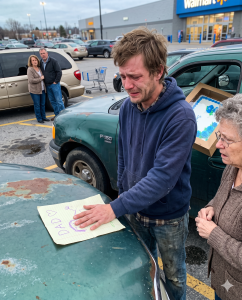
He took the paper from his pocket and moved to the hood. He unfolded it with care, smoothing each crease with both hands. Marvelle thought suddenly of old photographs laid on gravesites, the way people handled them gently because the paper had become stand-in skin.
When he stepped back, she saw why.
Across the top of the page, in thick purple crayon, were the words: TO MY DADDY FOR WHEN YOU FEEL SAD.
Beneath that was a list written in a child’s awkward handwriting:
- You are not a bad daddy.
- I still pick you when we play teams.
- I know you will come get me soon.
- You are my home even if you don’t got one.
- I love you bigger than cakes.
At the bottom was a drawing of a little girl and a tall man holding hands beneath a square yellow sun.
Marvelle actually put her hand to her chest.
Cody kept his eyes on the note. “Mama said she wrote it after I left Sunday. Emma made her spell some of the words. She carried it in her backpack all week, then told Grandma to give it to me because I looked sadder than usual.”
He let out a laugh so broken it sounded like pain. “I was standing in there trying to return her birthday cake while carrying a note that says she loves me bigger than cakes.”
There are moments when life narrows so fast that strangers become witnesses before they become anything else. This was one of those moments.
A voice from nearby said, “Ma’am? Is everything okay?”
Marvelle turned. A woman stood by a minivan three spaces over, one hand still on the sliding door. Beside her was a man carrying a case of bottled water. Both of them were looking toward the truck hood, where the crayon note lay flattened under the afternoon light.
“I’m sorry,” the woman said immediately. “I wasn’t trying to overhear.”
But she had overheard enough.
Her eyes moved from the note to the cake on the passenger seat to Cody’s face, and tears rose in them with startling speed. “You said sheet metal? Where’s the interview?”
Cody named the plant.
The man with the bottled water lowered it to the pavement and stared. “My brother supervises there.”
Everything seemed to pause.
Cody looked at him as though hope was a language he no longer spoke fluently.
The man was already pulling out his phone. “I can’t promise anything,” he said, “but I can call him.”
Marvelle reached into her purse, pulled out the twelve dollars Cody had charged her, and laid the bills on the hood beside Emma’s note. “That cake was never mine.”
Cody shook his head. “No, ma’am, I can’t—”
“Yes, you can.”
The woman from the minivan looked into the truck and took in the blankets, the duffel bag, the water jug. Whatever softness had been in her face sharpened into decision.
“Are you sleeping in here?” she asked.
Cody said nothing.
That was answer enough.
Before anyone else could speak, Cody’s phone rang.
He looked at the screen and went pale.
“Who is it?” Marvelle asked.
He swallowed. “My ex-wife.”
He answered. None of them could hear the other side, but they did not need to. Cody’s posture changed with each second. First confusion. Then alarm. Then something close to disbelief.
“What do you mean she knows about the cake?” he said.
The woman on the minivan side exchanged a look with her husband.
Cody listened again. His free hand gripped the truck so hard his knuckles blanched.
“No,” he said. “I never told Emma that.”
A pause.
Then he closed his eyes.
When he hung up, nobody rushed him. Marvelle had lived long enough to know that people tell the truth faster when you do not crowd it out of them.
Finally he said, “My mother told my ex I might miss the birthday. She didn’t want Emma waiting at the window all day. I guess Emma heard.” He looked down at the cake. “She cried for an hour. Then she told her mom not to be mad at me because maybe I was trying to buy tires or medicine or something important.”
His voice split on the word important.
The woman from the minivan covered her mouth. Her husband swore softly under his breath and then looked back at his phone, impatient for the call to connect.
“What else did your ex say?” Marvelle asked.
Cody rubbed his face. “She said Emma wants me there even if I bring nothing. She said if I show up without a present, without a cake, without… anything, Emma won’t care.”
“That true?” Marvelle asked.
He laughed again, bitter at himself this time. “Probably. But kids remember things, too. I didn’t want her sixth birthday to be the one where her daddy came empty-handed and smelled like truck stop coffee.”
That landed heavier than anything else he had said.
The man’s phone finally connected. He stepped away a few feet, spoke quickly, then turned half aside and began telling his brother what he knew. His voice was low, but Marvelle caught phrases.
Good worker.
Laid off, not fired.
Interview Monday.
Deserves a shot.
Meanwhile, the woman from the minivan opened her purse, pulled out a card from the side pocket, and handed it to Cody. It had the name of a small church on it.
“My sister runs the family resource office there,” she said. “They help with emergency motel vouchers sometimes. Sometimes gas cards, too. You call her. Today. Don’t wait.”
Cody stared at the card like it might vanish.
“I can’t just take people’s—”
“Yes,” Marvelle said, cutting him off. “You can. This is what people are for.”
That sentence seemed to break something loose in the air.
A cart pusher who had slowed nearby pretending not to listen finally walked over and pulled a twenty out of his pocket. “My little girl just turned seven,” he muttered, stuffing the money awkwardly into Cody’s hand before backing away like he was embarrassed by his own heart.
Then an older man loading fertilizer into a pickup asked, “What’s going on?” and the woman from the minivan, crying openly now, said, “His little girl wrote him a note.”
It sounded absurdly simple. It was somehow enough.
Within ten minutes, a small cluster of strangers had formed in the parking lot. Nobody made a spectacle of it. That was what Marvelle would remember most. No shouting, no clapping, no phones raised high. Just quiet people doing the math of someone else’s emergency and deciding to enter it.
A young mother added a gift card she had been saving for groceries. A retired teacher scribbled the number of a cousin who managed apartments and sometimes knew who needed maintenance help. A man in a paint-stained hoodie said his brother sold used tires cheap and he’d make a call. Someone else bought bottled water and sandwiches and left them on the passenger seat without requiring gratitude.
Cody accepted it all with the look of someone trying not to drown in front of witnesses.
The man with the bottled water came back from his call wearing a grim, hopeful expression. “My brother says come Monday fifteen minutes early and ask for him by name. He’ll make sure you get seen.”
Cody’s face went blank. “You serious?”
“I’m serious.”
That should have been the biggest turn of the day.
It wasn’t.
Because just as the little parking-lot rescue was settling into possibility, another car pulled up.
A silver sedan. Clean. Tense stop. Driver’s side door opening before the engine fully died.
A woman got out, jaw set, a little girl in the back seat craning to see over the window.
Cody went rigid.
“My ex-wife,” he said.
The woman strode toward them, anger arriving ahead of her. Marvelle braced for a public explosion. Maybe custody threats. Maybe accusations. Maybe old wounds turning into fresh humiliation in front of strangers.
Instead the woman stopped dead when she saw the note on the hood.
She looked at it. Looked at the cake. Looked at the cash and cards and people gathered around her ex-husband’s old truck. Something in her expression faltered, then cracked.
“She wrote that before school,” she said quietly. “I found the other half of the crayon box on the floor this morning.”
Nobody spoke.
The back door of the sedan swung open and Emma jumped out before anyone could stop her.
She was tiny. Pink sneakers. One side of her ponytail lower than the other. She ran straight across the parking lot and slammed into Cody’s legs so hard he stumbled backward against the truck.
He made a sound Marvelle would think about for weeks. Not a word. Not even crying at first. Just the raw noise of a man who has been holding himself together too long and suddenly can’t.
He dropped to his knees and held his daughter like she was the only solid thing on earth.
“I don’t care about the cake,” Emma announced into his jacket, loud enough for all of them to hear. “I care about you.”
The ex-wife turned her face away and wiped both eyes fast, as if annoyed to be caught doing it.
Cody leaned back enough to look at Emma. “I got your cake,” he said hoarsely.
Emma looked over at the passenger seat and gasped with the reverence only six-year-olds reserve for frosting. “With flowers!”
“With flowers,” he said.
She threw both arms around his neck again.
The ex-wife stepped closer after a long pause. The anger had not vanished, but it had changed shape. “My mother can keep her this weekend,” she said. “If you still have that interview Monday, I’ll drive her to your mom’s on Saturday so you can see her. And…” She glanced at the truck interior, taking in what perhaps she had not fully believed before. “You can’t keep doing this.”
It was not forgiveness. It was not reconciliation. It was simply the truth.
Cody stood slowly, Emma still clinging to one hand. “I know.”
Marvelle expected the next part to be awkward. Maybe impossible. But the ex-wife surprised everyone.
She looked at the note again and said, not to Cody but almost to herself, “She adores you. I’m angry at a lot of things, but I’m not going to let her think you don’t love her.”
It was the kindest sentence she could have offered without pretending the past had not happened.
The man with the connection at the plant cleared his throat. “He’s got a real shot Monday.”
The ex-wife nodded once. “Then he needs sleep before Monday.”
There it was. The practical mercy nobody else had yet named.
The woman from the minivan raised her phone. “My sister says the church can cover two motel nights. Starting tonight.”
Cody just stared.
Marvelle picked up Emma’s note from the hood and held it out to him carefully. “Put that back in your pocket,” she said. “Looks like it’s working.”
He took it with both hands.
By the time the sun dropped lower over the lot, the shape of the weekend had changed. Cody had gas money for the interview and more. He had a motel room for two nights, food in a bag, a confirmed contact at the plant, a used-tire lead, and a birthday cake back in his possession. More than that, he had been seen—fully, painfully seen—at the exact moment he had reached the edge of what he could carry alone.
Marvelle drove home later than expected, the mason jar lids forgotten on the passenger seat and her mind full.
On Monday, Cody got the job.
The supervisor’s brother had not lied. Cody arrived early, clean-shaven, wearing the best shirt he owned and the same repaired jacket. He interviewed. He was honest. He admitted the layoff, the gap, the desperation. He did not mention the cake or the parking lot or the note in purple crayon because some things were too sacred to spend as leverage.
By Tuesday afternoon, he had an offer.
The church helped him cover one more week in a motel. The used tire lead turned into a set cheap enough to afford. His mother kept Emma after school while he worked his first shifts. Three weeks later, he rented a room from a widower who wanted extra income and did not ask too many questions. Two months after that, he had saved enough to put down on a tiny apartment with stained carpet and a rattling heater that worked only when kicked on the side.
Emma called it “Daddy’s castle” because children know how to rename what adults are ashamed of.
The marriage did not come back. Some breaks do not mend just because kindness shows up late. But the fighting eased. The ex-wife saw him keep showing up. Saw him stop making promises he could not afford and start keeping the small ones. Pickups on time. Clean sheets on the little bed he bought for Emma. A lunch packed for the zoo on his weekend. One steady job becoming another six months, then a year.
Marvelle saw him twice after that.
The first time was at a gas station, where he introduced her to Emma, who hid shyly behind his leg for all of ten seconds before announcing, “I’m the cake girl.”
The second time was almost a year later, at the farmer’s market. He was carrying a box from a bakery and grinning like a man who recognized the shape of his own life again. Emma was skipping beside him in a denim jacket, and when Marvelle asked where they were headed, Cody said, “My mama’s seventy-fifth. Emma says every party deserves flowers in the icing.”
Then he reached into his wallet and pulled out a plastic sleeve.
Inside was the note.
Still folded. Still worn. Still held together.
“I keep it where I can reach it,” he said.
Marvelle touched two fingers to the sleeve and smiled. “Good.”
Later, thinking back on it, she decided the most remarkable part of the whole story was not the money strangers gave or the job lead or even the motel room.
It was line four in that note.
You are my home even if you don’t got one.
Children had a terrifying habit of telling the truth in plain language while adults wasted years circling around it. Cody had thought he was failing because he did not have a place to bring his daughter. Emma, in the unschooled wisdom of six years old, had already separated shelter from safety. She knew the difference between a roof and a person.
Some people would say the red flag had come earlier—with the layoff, the marriage falling apart, the weeks in the truck. Others would say the real wound was pride, that dangerous kind that makes people return cakes before they ask for help. Maybe both were true. Maybe the biggest mercy in the whole thing was that he ran out of room to hide before he ran out of chances.
Marvelle still keeps bees. She still says the quietest creatures usually carry the heaviest loads. But now, when she tells that story, she adds one more thing.
Sometimes the load breaks open in a Walmart parking lot.
And sometimes, if grace is paying attention, it looks like a crayon note, a cake with plastic roses, and a little girl who understood before anyone else that a man could lose nearly everything and still be someone’s home.
As for who was right and who was wrong, Marvelle never answers that cleanly. Life rarely offers clean verdicts. Cody made mistakes. His ex-wife carried resentments that were not born from nowhere. Pride cost him time. Circumstance cost him more. But on the day he nearly traded his daughter’s birthday for a tank of gas, the truth turned out to be simpler and harder than blame:
He was not deciding whether he loved his child.
He was deciding how to survive long enough to keep proving it.