She didn’t expect a volunteer shift in a church-basement-style community center to split her life cleanly in two.
Before the quilt, and after it.
Before the label, and after the thread.
Before Mara looked up from a faded Polaroid and asked a question Carol Ann had spent forty years trying never to hear.
The Millhaven Community Center basement was not a dramatic place. That was part of why Carol Ann had agreed to go. The room smelled like old cotton, furniture polish, and those lavender sachets older women seemed to tuck into everything they loved. Folding tables lined the cinderblock walls. Plastic bins held fabric scraps sorted by tone and age. Donated quilts waited in stacks—some folded neatly, some collapsed in tired heaps—as if they had simply run out of strength.
Patty, her neighbor, had talked her into volunteering.
“You need to get out of that house,” Patty had said, marching into Carol Ann’s kitchen with a tuna casserole and her usual certainty. “Not shopping, not church coffee, not one of those widow support luncheons where everybody talks about blood pressure. Real out.”
Carol Ann had tried to protest. She did not quilt. She did not restore heirlooms. She did not need a project. But Patty had waved all that away like steam.
“You sew. You have patience. You’re careful. That’s enough.”
So Carol Ann had gone, intending to stay one afternoon and then return to her ordinary routines—grocery lists, phone calls with her son, laundry folded in front of the evening news, a life so manageable it often felt airless.
Instead, she found herself assigned to a medallion quilt that changed everything.
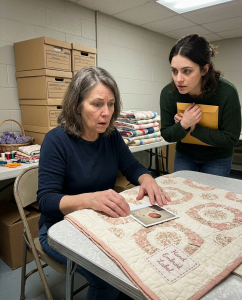
It was laid out for her on a long table under fluorescent light, and even damaged, it was exquisite. A double wedding ring pattern bloomed at the center, flowing outward into a starburst of ivory and blush pink. The curves were balanced, the piecing exact, the handwork disciplined in a way that suggested not just skill but pride. Someone had made it with serious intent.
It had also suffered.
Water damage shadowed one side. A corner was gone. Several seams in the center medallion had split, exposing the fragile batting. It had survived, but not untouched. Carol Ann stared at it longer than she meant to.
“Beautiful, isn’t it?” said Mara, the project coordinator.
Mara was young, maybe twenty-six or twenty-seven, with dark hair, thoughtful eyes, and a quiet way of speaking that made people lower their voices around her. She carried herself with a kind of guarded grace. Not shyness exactly, Carol Ann thought. More like caution learned young.
“It is,” Carol Ann said.
Mara smiled faintly. “It’s the hardest one we’ve got.”
That should have put Carol Ann off. Instead it pulled her in.
The work was slow. She learned the quilt inch by inch—where the fabric had weakened, where the seams had warped, where the maker’s hand had been firm and where it had hurried. As she stabilized the damaged sections and documented the construction, she developed an odd feeling she couldn’t explain. Not recognition, exactly. Something beneath that. A physical sense that the quilt was familiar in the way a melody can be familiar before you know where you’ve heard it.
During her third session, she turned the quilt over to examine the backing.
Mara had instructed the volunteers to always inspect reverse sides carefully. Labels, dates, initials, mending histories, notes tucked into the batting—anything could matter.
That was when Carol Ann found the embroidered label.
It was small and neat, stitched by hand. A date. Initials. A border of tiny flowers. Nothing strange about that in itself.
But the thread used for the embroidery stopped her cold.
Dusty rose.
Not bright pink. Not lavender. Not burgundy faded by time. Dusty rose—soft, complicated, muted, and unmistakable.
Her mother had kept that color in a blue oval tin on the kitchen windowsill when Carol Ann was growing up. The tin had a dented lid. Inside were buttons, needles, a silver thimble, scraps of ribbon, and wound balls of thread. Carol Ann could see it as vividly as if the community center table had vanished and the old kitchen had taken its place. Afternoon sun. Her mother at the table. The dusty rose thread glowing in the light.
She told herself the reaction was ridiculous.
A thread color was not a revelation. Thousands of women owned dusty rose thread in the 1970s and 1980s. Memory could be triggered by anything. That did not make it meaningful.
Still, she folded the quilt carefully that day with shaking hands.
And she came back the following Tuesday.
Then the next.
Then the next.
At home, the quilt followed her. She found herself awake in the dark thinking about the label, the color, the precision of the stitches. Thinking, against her will, about 1984.
She had been nineteen then.
Too young, everyone said. Too emotional. Too unprepared. Her mother had sat across from her at the kitchen table and told her there was only one way forward, and had done it in such a calm, practical tone that Carol Ann had almost mistaken it for mercy.
Her father had barely spoken during those months. The baby’s father—Tommy, with his soft laugh and terrified promises—had disappeared after one brutal argument with Carol Ann’s parents on the porch. By the time Carol Ann delivered the baby, the arrangement had already been made. Papers. Plans. A family selected through the agency. A future designed by adults who spoke about shame and stability as though they were accounting terms.
Carol Ann remembered the hospital room in flashes. White sheets. A nurse with a sympathetic face. Her mother standing too straight in the corner. The unbearable weight of her daughter placed in her arms for a few precious hours, then taken. She remembered asking if she could keep one blanket. Her mother saying no, because it had been chosen to go with the baby.
Afterward, everyone in the family behaved as though survival depended on silence. Carol Ann finished the semester at community college. She found work. Years later she married a decent widower named Frank, became stepmother to two boys, had one son of her own, and built a respectable life. She learned how to move through years without touching the raw edge beneath them.
She never spoke the baby’s name.
She had whispered one to herself in the hospital, though no one else had used it.
Rose.
It was not rational, then, that a dusty rose label in the basement of the Millhaven Community Center should shake her. But it did.
Five weeks into the project, on a rainy Tuesday in November, Mara came downstairs carrying a manila envelope.
“I found some documentation connected to the quilt,” she said.
Carol Ann looked up. Mara’s expression was composed, but something in it seemed unusually taut. She set the envelope on the table and pulled out a faded Polaroid.
“There was no formal provenance,” Mara said, “but this was tucked into a file with the donation paperwork.”
She handed it over.
Carol Ann looked down and felt the room tilt.
A baby lay in the center of the medallion quilt, wrapped in its ivory and blush rings. A newborn. Tiny face, eyes closed, fist tucked near the cheek. The quilt was unmistakable.
Carol Ann stared at the photo so long Mara stopped speaking.
When she finally raised her head, Mara was watching her with open intensity.
And that was the moment Carol Ann truly saw her.
Not just a young volunteer coordinator with a calm voice and dark hair. A woman with hazel eyes flecked green and gold. Eyes Carol Ann knew in the most primal way possible because she had carried their blueprint in her own face all her life.
Mara lowered herself into the chair opposite her.
“I was hoping,” she said slowly, “you might recognize the quilt. Or know who made it. Because the woman I’ve been trying to find…” Her voice faltered for the first time. “She would be about your age.”
Carol Ann’s mouth opened. No words emerged.
Mara reached into the envelope and took out another item. A folded letter. The paper had yellowed with time.
“It came with the photograph,” Mara said. “Not originally. My adoptive mother gave it to me last year before she died. She said she’d been told never to send it unless I started looking on my own.”
Carol Ann felt cold from scalp to heel.
Mara unfolded the letter, then paused. “I think it’s from the woman who made the quilt. Or from someone close to her. The handwriting looked old-fashioned. I brought it because…” She swallowed. “Because you looked at the label like it hurt.”
Carol Ann did not trust her own hands, so Mara set the letter on the table between them.
Carol Ann recognized the handwriting instantly.
Her mother’s.
The slant was elegant, precise, almost severe. Seeing it again was like hearing a dead voice speak from behind a locked door.
Mara said nothing while Carol Ann opened it.
The letter was dated March 1984.
To the family entrusted with this child, it began.
Carol Ann nearly stopped breathing.
The words that followed were careful in the same way her mother had always been careful when trying to disguise control as dignity. She wrote that the quilt had been made by hand for the baby by “her maternal grandmother.” She wrote that the child’s birth mother was “young and under difficult circumstances.” She wrote that placing the baby was “the right decision for all involved.”
Then came the line that made Carol Ann grip the table hard enough to whiten her knuckles.
The child’s mother asked that no attempt be made to contact her in the future, it read. She wishes for a clean break so that the infant may settle fully into her new life.
Carol Ann heard herself make a sound that wasn’t quite a gasp and wasn’t quite a sob.
“I never said that,” she whispered.
Mara’s face drained of color. “What?”
“I never said that.” Carol Ann looked up, the letter trembling in her hand. “I never wrote this. I never asked for that. I begged to know where you were sent.” Her voice cracked open on the final word. “I begged.”
Mara went utterly still.
For several seconds neither woman moved. Rain tapped against the basement windows. Somewhere upstairs a chair scraped faintly across a floor.
Then Mara asked, “You think this was written by your mother?”
“Yes.”
The answer came out with terrible certainty.
Carol Ann could see it all now—not every detail, but enough. Her mother, who had insisted she was protecting everyone. Her mother, who believed pain could be made manageable if it was made orderly. Her mother, who would absolutely have written such a letter if she thought it would prevent future upheaval.
“She told me the adoptive family wanted privacy,” Carol Ann said. “She told me it was best not to interfere. She told me letting go cleanly was the kindest thing.”
Mara’s eyes filled. “My parents told me my birth mother didn’t want to be found.”
Carol Ann shut her own eyes for one raw second. “Then we were both lied to.”
The words seemed to land physically between them.
Mara laughed once—small, broken, disbelieving. “I’ve spent three years doing genealogy subscriptions, request forms, courthouse archives, every legal route I could find. I didn’t even know if this quilt would lead anywhere. I only knew my mother had hidden it in the hall closet and never let me use it. After she got sick, she admitted it came with me.”
Carol Ann looked down at the Polaroid again. The baby. The quilt. Proof that love had been present even where truth had not.
“I made up a name for you,” Carol Ann said, before she could stop herself.
Mara blinked. “What?”
“In the hospital. They wouldn’t let me name you officially. But in my head…” She pressed her lips together, embarrassed by the intimacy of it and unable to keep it back. “I called you Rose.”
Mara stared at her.
Then she began to cry.
Not quietly, not prettily. The kind of crying that comes from a place below language. Carol Ann’s own tears came hard and fast after that, and for a moment they were simply two women at a folding table in a basement, with forty years of stolen truth breaking loose between them.
It was Mara who reached across first.
Carol Ann took her hand.
The resemblance that had hovered unresolved all fall now became undeniable in the contact—the shape of the knuckles, the warmth of the skin, even the way their fingers curled inward when they were afraid.
“I’m Mara,” she said through tears.
Carol Ann gave a shaking laugh. “I know.”
“No,” Mara said, wiping at her cheeks. “I mean… if you want to know me now. I’m Mara Ellison. I teach art part-time at the middle school. I hate green peppers. I talk too much when I’m nervous. And I almost didn’t come downstairs with that envelope because I was scared you’d say no.”
Carol Ann let out a sob that turned into a smile. “I don’t know what to say.”
“You don’t have to say everything today.”
That kindness undid her more than anything else.
They stayed in that basement for more than two hours. They compared fragments. Dates. Agency names. Hospital possibilities. The timeline lined up with terrible clarity. Carol Ann told Mara about 1984 in pieces, stopping whenever the memories cut too sharply. Mara told Carol Ann about growing up loved but always vaguely aware something in her story had been sealed off. Her adoptive parents had been kind people, but the subject of her origins carried a tension she only understood as an adult. After her adoptive mother became ill, guilt loosened old loyalties. The quilt and the photograph had finally been handed over. The letter had come with a confession: there had always been uncertainty about whether the birth mother truly wanted distance.
By the time the basement lights flickered for closing, one truth stood clear.
Neither of them had abandoned the other.
Someone else had chosen silence for them both.
The aftermath was not easy. Discoveries like that never are. Carol Ann spent weeks revisiting memories she had locked away. She found herself furious with a dead woman she had also loved deeply. Mara cycled through grief, relief, anger, and protectiveness toward the adoptive parents who had raised her. There were practical awkwardnesses too. How often do you call? What do you ask first? Do you start with birthdays missed or ordinary coffee?
They started with lunch at a diner halfway between Mara’s apartment and Carol Ann’s house.
Then a walk in the park.
Then a Sunday afternoon at Carol Ann’s kitchen table, where Mara noticed a blue oval tin on the windowsill.
Carol Ann had found it in the back of a hall closet two days after their meeting. She didn’t know whether her mother had hidden it or merely stored it away, but there it was: dented lid, old buttons, silver thimble, and one remaining spool of dusty rose thread.
Mara touched it with reverence.
“That’s the color,” she said.
“Yes.”
Together they opened the tin. Together they sat in the same patch of afternoon light Carol Ann had remembered. Together they examined the tiny domestic relics of a woman who had done immense damage while perhaps convincing herself she was preserving order.
Months later, after many conversations and several painful truths, Carol Ann asked Mara whether she wanted the medallion quilt once restoration was complete.
Mara considered the question carefully.
“Not yet,” she said. “I want us to finish it together first.”
So they did.
Week after week, mother and daughter sat side by side in the basement of the community center, repairing the split seams, rebuilding the missing corner, securing the weakened backing. Carol Ann taught Mara invisible mending techniques. Mara, who worked with visual art, had a steadier hand with color matching than anyone expected. The quilt slowly came back to life under both their hands.
It was impossible not to feel the symbolism, though neither woman joked about it. Some things are too true to say lightly.
On the final day, Mara turned the quilt over and reattached the old embroidered label after conservation treatment. Beneath it, on a separate archival patch, she and Carol Ann added a new note for the historical record.
Restored in 2025 by Carol Ann Whitaker and Mara Ellison.
Original maker identified through family reunification.
Preserved with love, after many years apart.
Carol Ann cried when she saw it stitched in place.
The project coordinator position eventually passed to someone else. Mara said she needed fewer ghosts in her free time. Carol Ann understood. But the basement no longer felt haunted anyway. It felt reclaimed.
The first holiday they spent together was awkward and tender and imperfect. Mara came for Thanksgiving. Carol Ann’s son was warm but bewildered. Patty cried in the kitchen after being told the story and loudly insisted she had known “those eyes meant something.” There were too many dishes and not enough chairs and more emotion than anybody knew what to do with. It was, in other words, a family gathering.
That winter, Carol Ann and Mara took the restored quilt outside just after the first snowfall and shook it open in the pale afternoon sun. The ivory sections brightened. The blush pink deepened. The repaired corner held beautifully. For a moment they both stood there with mittened hands gripping the edges, looking at what had once been broken, hidden, misnamed, and nearly lost.
“It’s strange,” Mara said softly. “I thought finding you would answer everything.”
“Did it?”
“No.” She smiled through tears. “But it answered the thing that hurt the most.”
Carol Ann looked at her daughter—because she could finally use the word now, out loud, without anyone stopping her—and understood something that had taken a lifetime to reach.
Love had never been the missing piece.
Truth was.
Later, she would still wrestle with what to do about her mother’s memory. Some days she felt only anger. Other days she could see the frightened woman beneath the control, shaped by a generation that treated scandal like fatal disease and tenderness like weakness. Mara did not excuse what had been done, but neither did she force Carol Ann into simple conclusions. That, perhaps, was the final unexpected gift of finding her: the permission to hold grief and fury in the same hand.
The quilt now lives folded in acid-free tissue in Mara’s home, though not hidden. Sometimes it comes out across the back of the sofa on winter evenings. Sometimes Carol Ann reaches over and smooths the dusty rose label with one careful finger, still amazed that such a small thing could have opened such a locked life.
A thread. A photograph. A lie in elegant handwriting.
That was all it took to unravel forty years.
And yet when Carol Ann thinks about it now, she thinks less about the lie than about the repair. About the strange mercy of being brought back to the wound not to suffer it again, but to finally see what had been taken and what remained.
She had gone to the community center believing she was there to help restore someone else’s heirloom.
She did not know she was putting herself back together, too.
And if there is any part of the story that still stings, it is this: the biggest red flag was never youth, or fear, or the impossible circumstances of 1984. It was the certainty of people who believed they had the right to decide which truths other hearts could survive.