I’d been running the fish-and-chip shop on Rogers Street for thirty-one years, and in a town like Gloucester, that taught you more than the trade.
It taught you how to tell who was lonely and who only wanted quiet. It taught you which men would flirt harmlessly for an extra pickled onion and which ones couldn’t bear to go home. It taught you when children were spending their dinner money on chips because the cupboards were bare, and when old women ordered too much because they couldn’t stand eating alone. Most of all, it taught you to recognize hunger.
Real hunger.
Not greed, not cravings, not the kind that complains loudly. The quiet kind. The kind that hollows the face and dries the lips and makes a body fold in on itself as if it would rather disappear than ask.
That was what I saw in the waiting room at Gloucester Memorial on a bitter January evening when I went in for a routine follow-up on my hip.
The girl was asleep in one of the molded plastic chairs beneath the television no one watched. She looked young, maybe twenty-five, though hunger and cold could age a person cruelly. Her denim jacket was too thin for the weather. Her trainers were damp at the toes. One sleeve had a torn cuff she had stitched badly by hand. She was curled sideways, her hands tucked under her cheek like a child pretending the world couldn’t reach her if she stayed small enough.
Then I saw the ribbon tied around her left wrist.
It was a washed-out blue, faded nearly gray in the fluorescent light. Cheap ribbon. Frayed ends. Tied in three neat knots.
The sight of it struck me so hard I stopped where I was.
I couldn’t have said why, not then. Only that something about it pressed against a door in my mind that had stayed shut a very long time.
My name was called a few minutes later, but before I went in, I slipped a folded twenty-dollar bill into the left pocket of her coat. Grocery money, truth be told. Money I couldn’t spare easily. But her face had gotten under my skin.
She never stirred.
My appointment took less than an hour. When I returned, she was gone.
The twenty sat smoothed flat on her seat. Under one corner was a note folded into a small square.
The message inside was four words long:
I know who left.
There was no signature. But above the message she had written the name only one person in the world had ever called me.
Nellie.
My younger sister Mara used to call me that. No one else did, not after childhood. She was the only one who could put that name on a page and make my whole body go cold.
The trouble was, Mara had vanished thirty-one years earlier.
In Gloucester, people still remembered the November storm, though memory had twisted it into ten different versions over time. Boats came in damaged. One man was lost. One came back late and lied about where he’d been. A line snapped on the east quay and nearly killed two boys. The harbor lights failed for twenty minutes at the worst possible time. Men shouted. Wives prayed. Police took statements no one could repeat exactly the same way twice.
That was the night Mara disappeared.
She was twenty then, wild in the quiet way. Not loud. Never reckless for show. But once something lodged in her mind, she couldn’t let it go. That evening she had seen something she wasn’t meant to see, and she came to me at the shop after dark white-faced and shaking.
“Tell me I’m wrong,” she said.
I was closing up. The fryer had just gone silent. The room smelled of old oil and vinegar.
“About what?” I asked, though I knew from her face this wasn’t about what but who.
She stared at me. “I saw Patrick leave Bay 4 after midnight last week.”
The name hit between my ribs.
Patrick Vane owned two trawlers, drank too much, and thought money turned sin respectable. He was also my supplier then, and without him the shop would have folded. My husband had been dead six months. The rent was behind. I was drowning in debts I hid from everyone.
“You’re imagining things,” I said.
Her expression hardened at once. “Don’t lie to me, Nellie.”
I turned away, busying my hands with nothing. “You don’t know what you saw.”
“I know he wasn’t alone.”
That made me face her.
She stepped closer and dropped her voice. “I saw Tommy Reed with him.”
Tommy Reed was a deckhand. Barely twenty-two. Good-natured, gullible, too eager to please the wrong men. The sort who got used by harder people and apologized for inconveniencing them. He had been reported missing two days before the storm, and most people believed he had gone off drinking and drifted somewhere along the coast.
I had known better.
I had also kept quiet.
Because Patrick Vane had come into my shop three nights earlier and told me, in the softest voice imaginable, that if I valued my business and my home, I would forget what I’d heard through the storeroom door after closing. He hadn’t needed to say more. Men like Patrick rarely did.
I had heard enough. Tommy’s voice. Patrick’s voice. A crash. Then silence. Later, I saw Patrick drag something wrapped in tarpaulin across the back lane with the help of his cousin Len.
I should have gone to the police then.
Instead I thought about rent. Suppliers. My husband gone. The shop as the only thing standing between me and ruin.
Cowardice never feels like cowardice while you’re choosing it. It sounds practical. Temporary. Necessary. It tells you that one more day won’t matter.
By the time Mara confronted me, I was neck-deep in that lie.
“You tell no one,” I said.
Her mouth opened in disbelief. “You know.”
“I know enough to know you keep your head down.”
She stepped back as if I’d struck her.
“Nellie.”
“Not here.”
“You’re protecting him?”
“No. I’m protecting us.”
She laughed once, but there was no humor in it. “Us?”
I still remember how small that word made me feel.
Outside, the wind had begun to rise. Storm warnings were already spreading along the harbor, and every house in town seemed lit. Men were returning to secure boats. Women were calling children in from the lane. Gloucester always changed before a storm, the whole town tightening by instinct.
Mara looked toward the window, then back at me. “I’m going to the police.”
I caught her wrist. “You don’t know what you’re doing.”
She pulled free. “Neither do you.”
We argued all the way to the harbor. Even now I can’t remember every word. Only fragments. Her saying Tommy had a mother who deserved truth. Me saying Patrick had friends everywhere. Her saying fear wasn’t innocence. Me saying survival wasn’t guilt.
At the quay, the crowd swallowed us. Rain hit sideways. Somebody shouted about a damaged line. Someone else was yelling names over the water. I was terrified of losing sight of her, terrified of what she might say, so I dug in my coat pocket and found a strip of blue ribbon from the shop supplies. I tied it around her left wrist in three knots, the way my mother taught us when we were children heading into a festival crowd.
One to hold.
One to keep.
One to bring home.
“Stay where I can see you,” I said.
She stared at the ribbon, then at me. Her eyes were full of tears or rain or both.
“You should have been the one to tell,” she said.
Then she turned away.
That was the last time I saw her. Or so I believed.
By dawn she was gone.
The police searched. The harbor was dragged. Stories bred like flies. Some claimed she had fallen in during the storm. Others said she’d boarded a freight lorry south. A few swore she’d been seen weeks later in Portsmouth, in Bristol, even in Cardiff. Nothing stuck. No body. No proper goodbye.
My guilt became a house I lived inside.
Months later Tommy Reed’s remains were found in a collapsed boat shed outside town. The official story was accident. People muttered, but Patrick walked free. Len Vane left Gloucester not long after. Patrick drank himself into an early grave six years later, still rich enough to be buried under polished stone.
I told myself the truth died with them.
For thirty-one years I ran the shop, paid my bills, smiled at customers, buried my husband, minded my grandchildren, and never once said aloud that Mara disappeared after discovering I had stayed silent about a killing. Not an accident. A killing.
Then a starving girl in a hospital waiting room returned my money and handed me a note.
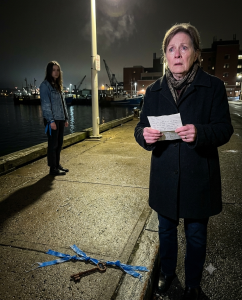
After reading it, I found a second message outside with an old harbor key pinned beneath a strip of blue ribbon.
Nellie, come alone.
I should have turned around.
Instead I went to Bay 4.
The old harbor looked like memory with the color drained out of it. The bait shop shuttered. The slipway cracked. Half the lamps dead. The wind carried salt and engine oil and that damp mineral smell old piers keep in their boards. At the far end of the row, beneath a broken light, stood the girl from the hospital.
Up close she looked even younger, though hardship had weathered her face. She wore the same thin jacket. The blue ribbon was still tied around her left wrist. Her eyes were gray. Not exactly like Mara’s, but enough to twist something in me.
She lifted her chin. “Nellie.”
No one had said my name like that in decades.
My voice came out rough. “Who are you?”
She studied me in silence first, as if checking whether time had done what she expected. Then she reached into her pocket and held out a photograph. It was old, curled at the edges, damp-stained. In it, two girls stood in front of the fish-and-chip shop when the sign was still new. Me at twenty-three, already tired. Mara at nineteen, laughing at something outside the frame.
Written on the back in Mara’s unmistakable hand were the words: Nellie hates having her picture taken.
My knees nearly gave way.
“Where did you get that?”
The girl swallowed. “My mother gave it to me.”
The world seemed to stop at that sentence.
“No,” I said at once. “No.”
Her eyes did not leave mine. “Her name was Mara Doyle.”
I had imagined this moment in a hundred impossible ways over the years. A body found. A witness appearing. A confession unearthed after a death. I had never imagined my sister living long enough to have a daughter.
“You’re lying,” I whispered, though the photograph shook in my hand.
“She said you’d say that first.”
Those words hit with a strange intimacy, as if Mara herself had stepped out from the dark and spoken.
The girl pulled her jacket tighter. “My name is Eliza. She was my mother. She died nine days ago.”
Something hot and painful tore through me. “Died?”
Eliza nodded once. “Cancer. She’d been ill a while.”
I could not seem to catch my breath. Thirty-one years vanished and all that remained was the fact that somewhere, all this time, Mara had been alive. Alive and dying and choosing not to come home.
“Why now?” I asked. “Why didn’t she—why didn’t she write? Why didn’t she call? Why didn’t she come back?”
Eliza’s face changed then. Not harder. Sadder.
“She tried once.”
I stared at her.
“She came back two years after she left. She stood outside your shop. She saw Patrick Vane inside talking to you.” Eliza paused. “She thought that meant you were still protecting him.”
I shut my eyes.
Patrick had still supplied me then. By necessity, by cowardice, by habit. I had hated every pound of fish that came through his hands, and still I took it.
“She left again,” Eliza said. “She told herself she’d made the right choice.”
“What choice?”
Eliza looked past me toward the black water. “Not to speak. Not if speaking would put more people in danger.”
I felt the old anger rise with the old shame. “Danger from a dead man?”
“He wasn’t dead then,” Eliza said quietly. “And Len wasn’t gone as far as everyone thought. He kept finding her.”
That chilled me. “Len Vane?”
She nodded. “She had proof, Nellie. Not enough at first. Later, enough. Tommy Reed wasn’t killed by accident. Patrick beat him after Tommy threatened to go to the police over the fuel smuggling through Bay 4. Len helped move the body. Your sister saw more than you knew.”
I gripped the rusted key so tightly the edge bit my skin.
“She kept a ledger,” Eliza went on. “Names, dates, payments, boats. She took it the night she left.”
Bay 4. The old lockup. The key.
“She hid it?” I asked.
Eliza nodded. “In the bay locker. She meant to go back for it when things were calmer. Then everything spun out of control. Len started looking for her. She fled south. Changed names. Worked wherever she could. Eventually she had me.”
“Why didn’t she tell me any of this?”
“Because she never forgave you,” Eliza said, and there was no cruelty in it, only fact. “But she never stopped loving you either. That was the worst part for her.”
I looked away because I could not bear the steadiness of her gaze.
The wind off the water sharpened. Somewhere metal clanged against metal.
“She kept the ribbon,” Eliza said after a moment, touching her wrist. “All these years. She said it reminded her of two things at once. The last moment she felt looked after by you… and the moment she understood you would choose fear over truth.”
There are sentences that cut deeper than shouting ever could. That was one of them.
Tears blurred the harbor lights. “Did she tell you to come here?”
“Yes.”
“Why?”
Eliza reached into her other pocket and produced a third note, this one sealed in a small plastic sleeve against the damp. “For after I knew whether you came alone.”
My fingers trembled as I opened it. The handwriting was older, shakier than I remembered, but it was Mara’s.
Nellie,
If you’re standing where this note found you, then you came. I don’t know if that’s guilt or love, but maybe at our age they look the same.
The key opens Bay 4. The ledger is hidden where only family would think to look: inside the tea tin behind the broken tackle shelf. Give it to the police. Tell the truth this time.
I was never overboard. I left because I was afraid, then stayed away because pride is a stubborn poison. I should have written sooner. I should have let you answer for yourself instead of answering for you.
If my daughter chose to trust you enough to come, don’t waste it.
And Nellie—I’m sorry I never came home.
I had to stop reading because the words swam.
For a long while neither of us moved. Then Eliza said, very softly, “She didn’t know if you’d come. She genuinely didn’t know.”
That hurt more than all the rest. My sister had died uncertain whether I was still the woman who failed her.
“Will you take me to the police?” I asked.
Eliza searched my face, measuring. At last she nodded.
We opened Bay 4 together first.
The lock resisted, swollen with rust, but the old key still turned. Inside, the air was rank with mildew and salt. Nets rotted in heaps. A broken tackle shelf leaned against the wall. Behind it, exactly where Mara had written, sat an old tea tin wrapped in oilcloth.
The ledger inside was real.
Names. Dates. Fuel theft. Cash transfers. Boat registrations. A record of smuggling and the payoff trail that ended with Tommy Reed threatening exposure and disappearing days later. There were enough details to reopen old files, enough surviving names to rattle families that had spent decades pretending not to remember.
I gave my statement before sunrise.
Not part of it. All of it.
The threat from Patrick. My silence. Mara confronting me. The ribbon. The storm. Every rotten choice. The detective who took it down was younger than my grandchildren, but he listened without interruption. Beside me, Eliza sat with both hands wrapped around a paper cup of tea she never drank.
In the weeks that followed, Gloucester shifted under the weight of what surfaced. The papers picked it up. Tommy Reed’s death was formally reclassified. Len Vane, living under another name in Lincolnshire, was arrested pending charges tied to conspiracy, obstruction, and manslaughter evidence newly supported by the ledger and two old witnesses who finally spoke. Other harbor men, old and frightened, began remembering details they’d buried.
Truth has a strange effect on towns. It humiliates some people and frees others.
Tommy’s mother, ninety if she was a day, asked to see me. I went expecting her to shut the door in my face. Instead she sat me at her kitchen table, poured tea, and let me apologize until I ran out of words. When I finished, she looked at me for a very long time and said, “You were weak. That’s true. But weak and wicked aren’t always the same. Don’t confuse them now just because it hurts less.”
I still don’t know whether that was forgiveness.
Maybe it wasn’t meant to be.
As for Eliza, she didn’t forgive me either. Not then. Maybe not now. But she allowed me to attend Mara’s burial, a small service on a hill overlooking the water. My sister’s ashes had been kept for months because Eliza couldn’t decide where to scatter them. In the end she chose Gloucester.
“She belongs to the harbor and she hates the harbor,” Eliza said afterward with the ghost of a smile. “That feels honest.”
We stood side by side in the wind, neither of us pretending the years between us could be bridged in a day. She had my sister’s hands. I noticed that when she tucked her hair behind her ear. Mara’s hands, and some of her suspicion too.
Before leaving, Eliza untied the blue ribbon from her wrist.
It was almost colorless by then.
She placed it in my palm and closed my fingers around it.
“She wanted you to have it back,” she said.
I keep it now in the till drawer at the shop, inside the old tea tin once the police were done with it. Some days I take it out before opening and run the frayed edge through my fingers. Not as punishment, though maybe I deserve that. As remembrance.
Because one knot held.
One knot kept.
And one, after all those years, finally brought something home.
People still come into the shop and talk about the story in lowered voices. Some say Mara was right to leave. Some say she was cruel not to write. Some say I was a coward. They are correct. Some say fear can ruin more lives than malice ever could. They may be right too.
What I know is simpler and harder than any of that.
A starving girl sat in a hospital waiting room with my sister’s ribbon on her wrist, and for the first time in thirty-one years, I was offered the chance to tell the truth before it was too late.
The worst thing I ever did was stay silent when silence felt safest.
The strangest mercy of my life was learning that even after all that damage, the truth still waited for me to choose it.