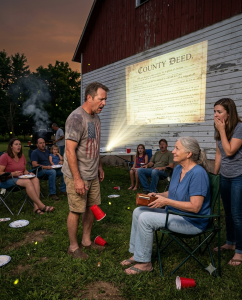
By the time the projector hummed to life on that warm July evening, Gary had already made himself the center of the party.
He had a red plastic cup in one hand, a spatula in the other, and the easy booming laugh of a man who had convinced himself he belonged exactly where he was. Children ran through the yard with sparklers. Burgers hissed on the grill. A Bluetooth speaker crackled from the farmhouse porch. Cousins drifted in folding chairs under strings of lights Gary had installed the previous spring, as if hardware-store bulbs could rewrite who had built that home and who had merely taken shelter in it.
He called it his place now.
His farm.
His porch.
His back field.
And every time he said it, some people winced privately, some looked away, and some said nothing at all because three years is a long time for a lie to sit in a family before it starts wearing the shape of truth.
Dottie heard him say it twice that evening before sunset. Once to a neighbor near the grill. Once to one of Linda’s nieces while pointing toward the tree line.
“My property runs clear back past that fence.”
Each time, Dottie only folded her hands in her lap and looked toward the barn.
She had chosen her chair carefully, in the same patch of grass where Raymond used to sit after supper when the days were hot and long. He liked to watch the fireflies rise from the field and joke that they were the farm clocking in for the night shift. He would lean back, boots crossed, cap in his lap, and ask Dottie whether there was any place on earth better than home.
There had not been.
Until Raymond died.
He died suddenly on a Tuesday in November, at sixty-one, before the frost had fully set in. One heart attack. One ambulance ride that solved nothing. One waiting room. One doctor using the kindest voice available for unbearable facts.
By the time Dottie returned to the farmhouse from the funeral home, carrying a coat she had forgotten to put on, Gary was already there.
He had arrived before several cousins, before the casserole dishes, before Dottie’s mind had even absorbed the shape of widowhood. Raymond’s younger brother stood in the kitchen in a dark jacket, hands loosely folded, expression arranged into sympathy.
Gary had always been that kind of man. Not openly cruel. That would have been easier to fight. He preferred the polished version of selfishness, the kind wrapped in concern and practical advice. He remembered technicalities. He listened for weaknesses. He knew how to turn urgency into pressure and pressure into agreement.
He sat across from Dottie at her own kitchen table and told her there was a serious problem.
Raymond, he said, had left no will.
No formal estate plan. No recorded wishes. Nothing simple. Nothing clean.
He let the words hang, giving them weight.
The farm, he explained, was now legally complicated. Probate could drag on. Lawyers could drain funds. Family disputes could get ugly. The best thing—the only sensible thing—was to let him step in and manage everything temporarily. He said he knew how these things worked. He said Raymond would not have wanted the family torn apart. He said Dottie needed peace, not paperwork.
She was sixty-three years old, exhausted with grief, and still hearing funeral hymns in her head.
He told her he and Linda should move into the farmhouse quickly to “stabilize the asset.”
The asset.
Not her home. Not the place where she and Raymond had spent thirty-eight years. Not the porch beam with Raymond’s name carved into it beside his father’s and grandfather’s. Not the pantry shelf with penciled dates from summers when peaches had been canned until midnight. Not the red barn smelling of cedar, machine oil, and old winters.
The asset.
Dottie said, “Okay, Gary.”
Later, she would remember that moment with a kind of detached disbelief, as though she were watching another woman nod from very far away. But grief makes strange hostages of people. In the stunned hours after burial, certainty can sound a lot like mercy.
She packed a single suitcase.
Within a week, Gary and Linda had moved into the farmhouse.
Within a month, Gary was discussing fence repairs as if he had inherited not just land but authority. By Christmas, he was speaking in first person: my barn, my acreage, my responsibility. By the next summer, he was hosting cookouts and standing where Raymond used to stand, telling stories as though being present often enough could make memory take his side.
Meanwhile Dottie rented a room above Beaumont’s Laundromat on Caldwell Street.
It had two narrow windows, a hotplate, a small sink, and walls thin enough that she could hear the dryers rumble below. At night, headlights from the parking lot moved across the ceiling. On Thursdays she carried her laundry downstairs and folded it beside Mrs. Perkins from the Lutheran church, who never once asked the question half the town wanted answered.
Why are you here?
Dottie loved her for that.
Renee asked instead.
Renee, their daughter, was not built for silence. She had Raymond’s dark eyes and Dottie’s patience only in limited supply. At first she assumed her mother had signed something. Then she assumed Gary had manipulated the courthouse somehow. Then she assumed there had to be a lawyer somewhere who could untangle it in a week.
But every time she pushed, Dottie answered in the same quiet way.
“Not yet.”
It sounded like surrender.
It was not.
What nobody understood—not Renee, not Gary, not even the cousins who whispered that Dottie had let grief make her foolish—was that Dottie knew one thing Gary did not know she knew.
She had proof.
Not a dramatic proof. Not a movie kind of proof hidden in a vault. Just a small laminated index card inside the billfold of the brown leather wallet she had carried since 1987.
On the front, in fading blue ink, was the filing reference for a deed recorded at the county clerk’s office the year she and Raymond refinanced the farm after paying off a brutal stretch of operating debt. Raymond had insisted both their names be placed on the property properly and permanently.
“If anything happens to me,” he had told her in the truck afterward, tapping the card the clerk had handed them with the deed book and page number written neatly across it, “nobody gets to wave you off your own porch.”
Dottie had laughed at the time. Raymond was healthy. Strong. The kind of man who looked planted in the world. But she kept the card because she kept everything that mattered.
Years later, after his death, she went looking for the actual deed.
It should have been simple.
It was not.
The county had undergone archive transfers. Older records had been moved, some to microfilm, some to off-site storage. Worse, the deed had been indexed under a variation of her legal name from early in the marriage, which meant a routine search would not easily surface it. Gary either knew that or had stumbled into luck so outrageous it might as well have been intent.
Dottie did not confront him immediately. She did not scream. She did not gather the family. She did not tell him she had the card.
Instead, she called an attorney. A careful one. The kind who listened before speaking.
He looked at the card and said, “If this deed is what I think it is, the farm passed to you automatically the moment Raymond died. But we need the county to prove it cleanly and officially.”
That became the work.
Fourteen months of letters, archive requests, verification forms, title tracing, and patient correspondence with Harold Briggs at the county clerk’s office. Fourteen months while Dottie lived above a laundromat and let Gary keep believing silence meant defeat.
Harold turned out to be the kind of public servant small towns sometimes produce: dry, exact, impossible to charm, and quietly offended by dishonesty. Once he understood what Dottie was describing, he started digging. He found the original recording reference. Then the microfilm. Then the corrected index notation. Then evidence that notices related to the estate had been sent in ways that omitted the controlling deed altogether.
And then came the ugliest part.
A signed statement from a local title runner indicating that Gary had been informed, early on, that a survivorship deed might exist but had dismissed it and advised everyone to “leave the old paper buried until probate clears.” In plain language, he had known enough to suspect Dottie owned the farm and chose to move in anyway.
That was not confusion.
That was misrepresentation.
Dottie waited.
Maybe that was what made Gary misjudge her most. He mistook stillness for weakness. He thought because she did not make scenes, she did not make plans. He had never understood the difference.
So when he sent a family group text before the Fourth of July—flag emoji, burger emoji, come celebrate summer at the farm—he was inviting witnesses without knowing it.
Dottie saw the message and smiled.
“We’re going,” she told Renee.
Renee stared at her. “To his party?”
“To Raymond’s farm,” Dottie corrected.
She made potato salad that afternoon, the mustard-and-egg one Raymond liked best. She put on a blue blouse. Slipped the wallet into her purse. And on the drive out, while Renee gripped the steering wheel and muttered dark predictions about Gary’s behavior, Dottie looked straight ahead and seemed almost peaceful.
At the farm, people noticed her arrival immediately.
Gary came down the porch steps with exaggerated warmth, hugged her briefly, and thanked her for coming. His smile had that familiar glossy finish. Dottie returned it politely.
“Wouldn’t have missed it,” she said.
As evening fell, she settled near the barn. The children played. Linda refreshed trays. Gary worked the yard, laughing, topping off his red cup, enjoying the role he had written for himself. Once, Dottie heard him tell a cousin, “Takes a lot to keep a place like this going.” The cousin nodded without enthusiasm.
At 7:52, Dottie checked her watch.
Renee leaned close. “Mom, are you sure?”
Dottie took the laminated card from her wallet and looked at it one last time. The ink was fading now. The corners were rounded from decades of careful handling. Raymond’s protection had fit in her wallet all this time.
“Baby,” she said, “I am perfectly sure.”
At exactly 7:53, Harold Briggs drove up in a white county sedan.
The chatter in the yard thinned. Harold unloaded a hard case, a small projector, and a folding card table. Without explanation, he set the projector facing the white wall of the barn.
Gary approached with his cup, smiling in the brittle way men do when they feel control slipping but have not yet admitted it.
“Harold? What’s all this?”
“Evening, Gary,” Harold said. “Just a formality.”
The projector came to life with a low hum.
A square of light appeared on the barn.
Then the image sharpened.
Across the siding, larger than life, appeared the certified county record of the 1987 deed: Raymond Talbot and Dorothy Talbot, husband and wife, as joint tenants with right of survivorship.
A collective sound moved through the yard. Not quite a gasp. Not quite a murmur. Something between recognition and embarrassment.
Gary froze.
“What in the hell is that?” he demanded.
Dottie opened her wallet, looked at the card once more, and tucked it away.
“That, Gary,” she said, “is your checkout time.”
Harold clicked through the supporting documents one by one. The deed. The recording stamp. The corrected index reference. The clerk’s certification. Then the correspondence showing how the record had been recovered and confirmed. Every image was big enough for the whole family to read.
Linda turned slowly toward Gary. “You told me there was no legal way this place belonged to her.”
Gary swallowed. “It’s more complicated than—”
“It isn’t,” Harold said.
That shut the yard down completely.
Then Harold held up a manila envelope and removed a typed affidavit. He read aloud the title runner’s statement, including the part where Gary had been informed there might be a survivorship filing and chose to proceed as though Dottie had no claim.
By the time Harold finished, Gary’s face had gone gray.
One of his sons, standing near the grill, stared at him in open disbelief. “Dad, you knew?”
Gary started talking then, fast and angry. He said it wasn’t like that. He said the paperwork was messy. He said everybody had been emotional. He said he had only been trying to keep the property from falling apart. But every excuse sounded smaller than the one before it.
Linda set down her plate.
“You let me move into another woman’s house,” she said.
Nobody spoke.
Then Dottie did.
Not loudly. Not theatrically. Just with the clean steadiness of a person done paying rent on somebody else’s lie.
“You moved into my home,” she said. “And you watched me leave with one suitcase.”
Gary looked at her, maybe for the first time in three years not as a grieving widow or a problem to manage, but as the owner he had displaced.
Harold handed Dottie a packet. Her attorney, who had arrived quietly during the reading, stepped forward and explained the next part in plain terms. The deed had vested title in Dottie automatically on Raymond’s death. Gary had no ownership interest. Notices had been prepared. A court filing seeking immediate possession and damages for wrongful occupancy was already underway, supported by the certified record and affidavit. Because Gary had obtained occupancy under false pretenses, his position was even worse than he thought.
Gary tried to laugh, but the sound broke apart halfway out.
“This is insane.”
“No,” Renee said from beside her mother. “This is late.”
The humiliation was complete before the legal consequences even began. Family members avoided Gary’s eyes. A cousin muttered, “Lord have mercy.” One of Linda’s relatives quietly gathered children and moved them toward the porch. The party had died without anybody announcing it.
Gary took one step toward the projector table.
“Don’t,” Harold said.
For the first time all evening, Gary obeyed someone instantly.
What followed moved faster than even Renee expected. Within days, formal notices were served. Gary tried to hire a lawyer, but there was no miracle argument hiding in the weeds. The certified deed was clean. The survivorship language was clear. The affidavit damaged his credibility badly. Linda, furious at having been lied to, stopped defending him almost immediately. By the second week, she had rented an apartment in town.
Gary lasted less than a month in the farmhouse after that.
The sheriff was present the day he handed over the keys.
Dottie did not attend that exchange. She did not need to see him leave to know he was gone.
Instead, she drove out later with Renee on a bright morning that smelled of cut hay and dust. The porch looked smaller than memory but warmer. The green shutters needed paint. The kitchen still had Linda’s curtains hanging where Dottie’s old ones had been. In the mudroom sat a pair of boots that were not Raymond’s, and seeing them there made something cold move through her chest.
Renee started to apologize for all of it, for not doing more, for not forcing harder, but Dottie stopped her.
“No,” she said. “We’re home now.”
Cleaning took weeks.
Repairing trust took longer.
The family learned things from that summer. Some apologized openly. Some hid behind phrases like we didn’t know what to say or we thought it had been settled. Dottie accepted certain apologies and let others float past her like seed fluff. She did not have energy for performance anymore.
Harold came by once with final paperwork for her signature. Before leaving, he glanced at the barn and said, almost shyly, “Never used a projector for a deed before.”
Dottie laughed for what felt like the first time in years.
“Well,” she said, “some records deserve a bigger audience.”
By autumn, she had moved fully back into the farmhouse. Mrs. Perkins came for coffee. Renee helped repaint the shutters. The old feed-store receipt and pressed wedding flower returned to their places. And one evening, sitting in the yard as fireflies rose from the field, Dottie opened her brown leather wallet and took out the laminated card.
The ink was nearly too faint to read.
She thought about Raymond in the truck all those years ago, tapping the card and promising that nobody would wave her off her own porch. He had kept that promise in the only way he could: by planning quietly, long before planning seemed necessary.
She did not cry.
She sat with the card in her hand until dark settled in.
People in town still talk about the Fourth of July projector. They call it Gary’s reckoning, Dottie’s reveal, the night the barn told the truth. Stories grow around events like that. Some details sharpen. Some blur. But one fact remains fixed.
Gary was not beaten by theatrics.
He was beaten by a widow he underestimated, a county clerk who did his job, and a piece of paper he thought grief had buried.
Sometimes the loudest person at the party looks powerful right up until the record comes on.
And maybe that is the part that lingers. Not just that Gary lied, but that so many people found it easier to let his confidence stand in for truth. Dottie never outshouted him. She outlasted him. She trusted the fact that what is real does not become less real just because someone louder starts using the word mine.
If you ask different members of the family who was most wrong, you will get different answers. Some say Gary, obviously. Some say the relatives who suspected and stayed silent. Some say Linda should have asked harder questions before hanging new curtains in another woman’s kitchen. Dottie never answered that question directly.
But once, when Renee asked whether she could ever forgive Gary, Dottie looked out toward the barn and said, “A lie can take your house before it takes your peace. You have to decide which one you’re reclaiming first.”
Then she slid the old laminated card back into her wallet, where it remained—not because she still needed proof, but because some things deserve to be carried even after they have done their work.