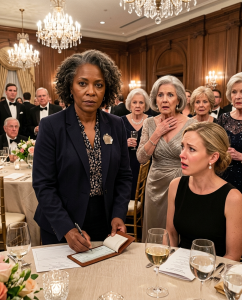
She walked back into Whitfield Academy with a checkbook in her purse and a tarnished silver pin on her lapel.
Nobody recognized her.
That, more than anything, gave Ruthanne Mobley a strange, private kind of peace.
It had been fifteen years since she had last stood in that ballroom, fifteen years since a room full of polished women had reduced her sacrifice to a punchline. Time had done what time always does. It had softened some things, sharpened others, and rearranged a face enough that people who once looked straight through her could now glance over her without the slightest flicker of memory.
But Ruthanne remembered everything.
She remembered the chandelier. She remembered the cream-colored walls and the silver serving trays and the way the carpet swallowed footsteps. She remembered the scent of expensive perfume and white wine and flowers that had no business being that fresh in October. Most of all, she remembered the sound.
Counting.
One bill at a time.
The memory lived in her with perfect clarity, untouched by the years that followed. It lived right beside other details too: the green blouse she had ironed twice, the wrinkled envelope she had carried in both hands, the way she had stood just a little straighter because she wanted her daughter to see that dignity was something you carried yourself, not something other people granted you.
Her name was Ruthanne Mobley, and she had been poor in all the ways that make wealthy people uncomfortable.
Not because poverty itself was shameful, but because it stripped away the illusion that hard work always arrived wrapped in prestige.
She grew up outside Valdosta, Georgia, in a house where the windows never quite sealed and the winter found its way indoors whether you invited it or not. Her mother had taught her how to hem a skirt, patch a screen door, season beans to taste like there had been meat in them, and greet visitors without ever letting them feel sorry for you. Pride mattered where she came from. Not the loud kind, not the kind that bragged. The quiet kind. The kind that said this is what I have, and I have earned every inch of it.
By twenty, Ruthanne was cleaning hotel rooms off the interstate.
She stayed for nineteen years.
There was nothing glamorous about it. The carts were heavy. The sheets fought back. Her knees ached. The cleaning chemicals dried out her hands until winter made them sting. Guests left all kinds of things behind: lipstick on towels, muddy footprints, crumpled receipts, half-eaten room service, ugly notes to one another, wedding rings, lies.
Ruthanne saw more of human nature with a housekeeping cart than some people saw in a lifetime.
And still, she took pride in her work.
Every mirror she polished, she polished until it gleamed. Every bed she made, she pulled tight enough to bounce a coin. She folded towel swans no one noticed, lined up toiletries no one thanked her for, and left behind the kind of order that let strangers feel cared for without ever wondering who had cared for them.
Her supervisor, Miss Delores, noticed.
Miss Delores was the kind of woman who had no patience for nonsense and no problem speaking truth plain. On Ruthanne’s fifth work anniversary, she handed her a tiny silver pin shaped like a room-service tray.
“For five years of showing up,” she said.
Ruthanne had laughed softly. “For making beds?”
Miss Delores shook her head. “For showing up even when they don’t see you.”
Ruthanne wore that pin home in her pocket that day and pinned it to her uniform the next morning. Later she wore it to other moments that mattered, though she rarely explained why. It was not about the hotel. It was about being witnessed by the right person, once, in a world that often made people like her invisible.
The year Camille won a scholarship to Whitfield Academy, Ruthanne cried in the parking lot of the grocery store before she even started the car.
Camille had always been exceptional. She was quick, curious, disciplined, and full of a steady kind of confidence that did not come from arrogance. Teachers loved her. Neighbors asked her for help with forms and homework and computer glitches. She moved through the world like she trusted it to make sense eventually, which was a gift Ruthanne had never quite possessed.
When the scholarship letter came, Ruthanne read it three times before calling Camille into the kitchen.
“You got in,” she said, then had to sit down because her legs had gone weak.
Camille screamed. Ruthanne laughed. Then both of them cried.
Whitfield Academy was one of those schools people talked about with a certain tone. Legacy. Excellence. Connections. The kind of place where buildings had names instead of numbers and where children learned to carry entitlement so casually it looked like posture.
But it also had resources. Labs, tutors, college counselors, opportunities. If Camille could thrive there, doors would open that had never opened for Ruthanne.
And Camille did thrive.
Not immediately. The first months were rough. The clothes were different, the speech was different, the assumptions were different. Camille came home once and asked, carefully, whether it was strange that one girl had never heard of anyone cleaning their own bathroom.
Ruthanne had snorted. “Baby, some people think labor is a rumor.”
Camille smiled at that, but she also noticed what her mother noticed: that gratitude and belonging were not the same thing. A scholarship let you in. It did not guarantee acceptance.
Then came the annual gala.
Ruthanne learned quickly that Whitfield had its own rituals. There were donation drives, volunteer committees, silent auctions, and the kind of polished charity that often seemed designed to display the giver more than to help the cause. Still, she wanted to contribute. She wanted it known, if only to herself, that she had not sent her daughter there on charity alone. She wanted to stand in that room and say, in the only language those people fully respected, that she had something to offer too.
So she saved.
For four months she packed leftovers instead of buying lunch. She took extra shifts. She passed up replacing her work shoes even when the insoles thinned. At night she smoothed out bills and tucked them into an envelope in the back of a drawer.
By the time the gala arrived, she had three hundred and forty-two dollars.
Every bill she had.
She wore her best green blouse, a black skirt, low heels that pinched a little, and the silver tray pin on her lapel. Camille looked beautiful and young and proud. Ruthanne told herself that was what mattered.
At first, the evening passed well enough. People smiled in the way people smile when they know exactly where to place you. Ruthanne ignored it. She had spent too many years serving customers not to recognize condescension dressed up as charm.
Then, near the donation table, everything changed.
A woman named Diane took the envelope from Ruthanne’s hand.
Diane was elegant in a brittle sort of way. She wore pearls and touched them often, like a habit she thought made her seem refined. Ruthanne remembered her because she had one of those faces that never fully smiled, only arranged itself into the idea of pleasantness.
“Oh, how lovely,” Diane said, opening the envelope.
Ruthanne reached out instinctively. “That’s all right, I—”
But Diane had already begun counting.
One bill.
Then another.
Then another.
Slowly.
The table around them quieted just long enough for people nearby to understand what was happening. Then came the laughter. Soft at first. Then spreading.
“Oh, how precious,” someone murmured.
Another woman did not say anything at all. She only smiled, thin and amused, and looked straight at Ruthanne as if waiting to see how much humiliation a person could swallow before it showed.
Ruthanne felt heat rush into her face and then drain out just as quickly. For one terrifying second the room tilted. She heard the count continuing in Diane’s manicured hands, the paper snapping lightly as each bill was turned. It sounded obscene.
She did not remember what she said, if she said anything. She only remembered taking the envelope back with fingers that no longer felt attached to her, walking away before her eyes spilled over, and holding herself together until she got to the parking lot.
There, she broke.
She cried with both hands over her mouth so no one passing could hear. She cried because she was angry, because she was ashamed, because she had done nothing wrong and still felt stripped bare. She cried because Camille was inside that building, trying to build a future, and Ruthanne had just been reminded exactly what some people thought of women like her.
When she finally drove home, she did not speak.
The next morning, she got up and went to work.
And from that day forward, something in her shifted.
Not all at once. Not in the dramatic, cinematic way people like to imagine. It happened in smaller steps. A conversation with a hotel guest who owned rental units and complained casually about tenants. A maintenance worker explaining property taxes while fixing a leak. A woman at church mentioning an estate sale. A cheap duplex outside town that everyone said was too much trouble.
Ruthanne listened.
Then she learned.
Then she bought.
The first property terrified her. The roof needed work, the plumbing was old, and she signed the papers with a hand that shook so badly she had to steady it against the desk. But the numbers made sense if she worked hard enough. So she worked.
She painted on weekends. She learned which repairs to do herself and which to hire out. She kept spreadsheets in a notebook before she could afford software. She watched every dollar. She rented the place, refinanced it later, and bought another.
One became two. Two became four.
Years passed. Camille graduated, then college, then nursing school. Ruthanne kept going. By fifty-four, she owned eleven rental properties across three counties.
She still lived sensibly. Still drove a sensible car. Still folded sheets with precision. Wealth had entered her life, but it had not rewritten her values. It had simply widened her choices.
Then, one Thursday evening, an email arrived.
Whitfield Academy facing foreclosure. Emergency gala. All alumni and families welcome.
Ruthanne stared at the screen for a long time.
She should have deleted it. Instead, she clicked.
The school was short one hundred and twelve thousand dollars. Without it, the bank would move forward. Three weeks remained before the deadline.
She read it three times. Then she closed the laptop and sat in her kitchen without moving.
Memory rose with startling force. The green blouse. The laughter. The parking lot.
She opened the drawer where she kept the silver pin.
By the next evening, she had decided.
She wore a navy blazer, simple earrings, and the tarnished room-service tray over her heart. She drove herself to Whitfield and parked under the same line of trees where she had once sat crying.
The ballroom was both exactly the same and much smaller.
Fear had a way of shrinking impressive places.
People moved in clusters, speaking in lowered voices. Their faces carried worry, even when their mouths smiled. Ruthanne took a glass of sparkling water and stood by the windows, watching. She saw Diane near the center of the room almost immediately.
The pearls were gone.
Diane looked older, naturally, but not fragile. More tightly wound than before, maybe. Ruthanne wondered, not unkindly, what life had done to her since then. Enough, apparently, to strip away some ornaments. Not enough, perhaps, to teach her humility.
When the headmistress took the microphone, the room quieted.
She was young, polished, and scared beneath the polish. She spoke about legacy, teachers, students, community. She tried to be composed, but when she said the number—one hundred and twelve thousand—her voice nearly broke.
Ruthanne touched the pin.
Even when they don’t see you.
She waited.
When the crowd loosened and the room grew ragged around the edges with desperation, she approached the donation table and placed her checkbook down.
The headmistress looked at it, then at Ruthanne. “Can I help you?”
“I’d like to cover the remainder,” Ruthanne said.
The woman blinked. “The… remainder?”
“Yes.”
Tears filled the headmistress’s eyes immediately. She fumbled for a pen and slid it over. “I don’t know what to say.”
Ruthanne picked up the pen.
The room had gone still around them.
She could feel the attention before she fully heard it. Chairs shifting. Whispering. The subtle pull of bodies angling closer.
Then she set the pen back down.
The headmistress looked startled.
Ruthanne lifted her gaze and let it pass slowly over the crowd. Faces turned toward her. Curious. Hopeful. Tense. A few irritated at the interruption.
Then her eyes landed on Diane.
Recognition did not strike Diane all at once. It arrived in stages. First confusion. Then scrutiny. Then a faint tightening around the mouth. Then, unmistakably, memory.
Ruthanne placed her fingers over the silver pin.
“Before I sign this,” she said, and her voice was quiet enough that the room leaned in to catch it, “I think it’s only right you all know who you’re asking.”
The silence that followed was absolute.
“My daughter came here on scholarship,” Ruthanne continued. “Fifteen years ago, I stood in this room with three hundred and forty-two dollars. It was everything I had to give.”
Diane’s face lost color.
Ruthanne did not look away.
“One of you opened my envelope in public,” she said. “Counted my bills one by one. Some of you laughed. Some of you watched. I remember both.”
No one moved.
The headmistress stared between Ruthanne and the crowd, stunned.
Ruthanne went on. “I went home that night and promised myself no one would ever make me feel that small again. So I worked. I cleaned rooms. I learned. I saved. I bought one property, then another, then another.”
A woman in the back lowered her eyes. Another covered her mouth. Somewhere near the wall, someone whispered, “Oh my God.”
Ruthanne’s voice stayed level. “Tonight, I came here because children should not lose their school because of the cruelty or failure of adults.”
Diane finally found her voice. “Ruthanne, I—”
“No,” Ruthanne said, not sharply, but with enough force to stop her.
At that moment the side doors opened, and Camille walked in.
She was still in her scrubs, hair pulled back, exhaustion on her face from what looked like a long shift. She had come straight from Savannah after Ruthanne’s brief text: I’m at Whitfield. You may want to come.
Camille looked from her mother to the room and understood immediately that she had entered the middle of something sharp.
“Mom?”
Ruthanne’s expression changed for the first time all evening. It softened. “You made it.”
Camille stepped closer. “What happened?”
Ruthanne looked at the crowd. “I was telling them about the last time I was here.”
Understanding settled over Camille with painful clarity. She had not known the full story. She had known her mother stopped attending events after that year. She had known something happened. But not this.
Camille turned slowly toward the room. “You laughed at her?”
Nobody answered.
It was Diane, of all people, who spoke first. “We were insensitive. It was years ago.”
Camille’s eyes flashed. “Insensitive?”
The word sounded too small in the air.
The headmistress straightened then, perhaps realizing leadership had finally demanded something of her more difficult than fundraising. “Is this true?” she asked the room, though the answer was already visible everywhere she looked.
No one denied it.
Diane swallowed. “I was wrong.”
Ruthanne looked at her for a long moment. “That was the first honest thing you’ve said to me.”
The room shifted with discomfort.
The headmistress turned to Ruthanne. “I am so sorry. I can’t undo what was done, but I am deeply sorry that this institution allowed it.”
Ruthanne studied her. The apology seemed real. More importantly, it had come without excuses.
Camille stepped beside her mother and took her hand.
For the first time that evening, Ruthanne felt the tension inside her begin to move. Not disappear. Not melt. Just loosen enough to let her breathe.
She looked back at the checkbook.
“I have the means to save this school,” she said. “But I won’t hand over money just to preserve a building or a reputation. So here are my conditions.”
The room braced.
“First, there will be a scholarship fund created in my mother’s name,” Camille said suddenly, and then smiled faintly. “Actually, in my grandmother’s and my mother’s names. For students from working families.”
Ruthanne glanced at her daughter, surprised and proud.
Ruthanne nodded. “Yes. A permanent scholarship fund. Second, mandatory financial inclusion training for staff and volunteer leadership. Third, no donor, parent, or guest will ever again be publicly identified or treated differently by the size of a gift.”
The headmistress answered immediately. “Agreed.”
“Put it in writing,” Ruthanne said.
“We will.”
Diane took one step forward. “Ruthanne, I would like to apologize to you personally.”
Ruthanne considered her. “You may,” she said. “But understand something first. I did not come back here for your apology. I came back to decide whether this place deserved saving.”
The sentence landed harder than any raised voice could have.
Diane’s eyes filled. Whether from shame, regret, or simply the shock of being seen clearly at last, Ruthanne could not tell. Perhaps all three.
“I was cruel,” Diane said. “And cowardly. I’m ashamed of it.”
Ruthanne held her gaze. “You should be.”
No one flinched. No one laughed.
A strange mercy lived in the truth when spoken cleanly.
The school’s attorney was called. Papers were drafted. The headmistress insisted everything be written exactly as promised. Ruthanne signed only when the scholarship language was included and reviewed twice.
Then, finally, she wrote the check.
One hundred and twelve thousand dollars.
The room exhaled as though it had been underwater.
But the relief in that ballroom was not the same as triumph. It was humbler than that. More chastened. Because this was not rescue handed down from someone desperate to be admired. This was grace offered by the very woman they had once mocked for offering all she had.
When the paperwork was complete, the headmistress asked, quietly, if Ruthanne would allow the school to name the scholarship fund at the spring ceremony.
Ruthanne looked at Camille.
Camille squeezed her hand. “Let them say your name this time.”
Ruthanne smiled then, small and tired and real. “All right.”
As the evening thinned out, people approached in ones and twos. Some thanked her. Some apologized awkwardly. Some said nothing at all because there were no words big enough. Ruthanne accepted what she wanted to accept and let the rest pass by.
When Diane came again, near the end, she no longer carried herself like the center of any room.
“I keep replaying it,” she said softly. “The way I acted.”
Ruthanne nodded. “I replayed it for fifteen years.”
Diane looked stricken.
“I don’t say that to punish you,” Ruthanne added. “I say it because people like you often think the moment ends when your own discomfort does. It doesn’t.”
Diane’s eyes filled again. “I know that now.”
Ruthanne did not offer absolution. Some lessons were better left fully felt.
Outside, the night air was warm and still. The parking lot lights cast long reflections on the hoods of cars. Ruthanne stood for a moment under the trees and looked at the building.
This time, she was not crying.
Camille came beside her. “Are you okay?”
Ruthanne let out a breath. “I think I am now.”
Camille leaned her head lightly against her shoulder. “You know what my favorite part was?”
“What?”
“You made them listen.”
Ruthanne looked down at the little silver tray pin and touched it with one finger. Miss Delores had been right. The world often failed to see people like her. But invisibility was not the same as worthlessness. Sometimes all it meant was that the wrong people had been doing the looking.
A few months later, Whitfield Academy held a ceremony announcing the new scholarship fund. Students from working families and first-generation college-bound households would receive support not only with tuition, but with uniforms, fees, travel, and books—the invisible costs that so often exposed who belonged and who did not.
The fund was named the Mobley Family Scholarship.
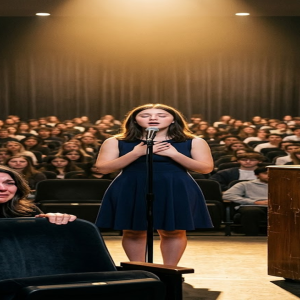
Ruthanne stood at the podium in a navy dress, the silver pin on her lapel, while the audience applauded. Not the thin, polished applause of obligation. Real applause. The kind that carried respect.
She did not speak long.
She thanked the school for changing course. She thanked the teachers who had served students well. She thanked her daughter for walking through doors that were not built with her in mind and still refusing to shrink.
Then she said, “No child should ever have to carry the weight of an adult’s class prejudice into a classroom. And no parent should ever be humiliated for giving what they can with love.”
The room rose to its feet.
Afterward, one of the scholarship recipients, a quiet girl with nervous hands and bright eyes, approached Ruthanne with her mother. The mother looked overwhelmed just standing there.
“I clean houses,” she said, almost apologetically.
Ruthanne smiled. “That means you know how to build a life from the ground up.”
The woman’s eyes filled.
On the drive home, Camille asked, “Do you forgive them?”
Ruthanne watched the road for a while before answering.
“I forgive enough to be free,” she said. “Not enough to forget what matters.”
Camille nodded.
That seemed right.
Because the truth was complicated. Whitfield had helped her daughter. It had also humiliated her. Diane had been cruel. The headmistress who came later had been brave enough to face it. Ruthanne had offered grace, but not cheaply. She had insisted that grace cost something from everyone involved.
Maybe that was the real lesson.
Not that success is the best revenge. It rarely is.
The real power was in returning unchanged at the core. Still dignified. Still precise. Still unwilling to let cruelty define the story’s ending.
Years earlier, Ruthanne had stood in that ballroom with three hundred and forty-two dollars and a heart full of hope, and they had laughed.
This time she returned with enough money to save the place, and the room finally learned the difference between wealth and worth.
The red flag had never been Ruthanne’s wrinkled envelope.
It had been the people who could look at sacrifice and see something to mock.
And whether Diane deserved forgiveness was almost beside the point.
Whitfield’s future had been secured by a woman they once failed to recognize.
That was the part none of them would ever forget.