When Dottie Mayes walked into the ballroom of the Hartwell County Club, nobody paid much attention at first.
The chandeliers were already glowing warm over white linen and silver chargers. Women in silk dresses were leaning toward one another over salad plates, comparing auction items and committee plans in voices polished smooth by decades of practice. Men in tuxedos stood along the edge of the room with bourbon glasses and patient smiles. At the front, a printed easel welcomed guests to the Junior League of Hartwell County Annual River Gala, the fundraiser everyone in that part of Georgia knew mattered if you cared about appearances, influence, or both.
Dottie wore a navy dress, low heels, and a strand of earrings Trina had insisted made her look expensive, though Dottie had laughed when she said it. She wasn’t trying to look expensive. She was trying to look steady.
Steady enough to stand in front of everyone who had once made her feel small.
Tucked inside the front of her dress, pressed close to her skin, was a folded index card softened by time and stained by butter, cornmeal, and years of being touched. Her mother’s handwriting still clung to it in fading blue ink. Not every word was fully legible anymore, but Dottie didn’t need the words. She knew the recipe. What she carried now was not instruction.
It was memory.
It was proof.
It was a witness.
At the front of the room, the emcee tapped the microphone and thanked the sponsors. A server drifted past with a tray of wine. Somewhere behind her, two women were discussing centerpieces as if floral arrangements were a matter of public consequence. Dottie stood near the back doors and let the room settle into her.
Twelve years, she thought.
Twelve years since the day they laughed.
The memory could still rise clean as a bell if she let it.
Back then, it had been a June garden party at the Whitfield estate, bright with hydrangeas and white tablecloths and women wearing broad hats to show they knew how. Trina had invited her with such hope in her voice that Dottie had said yes before thinking about whether she belonged. Trina had recently married Dottie’s son, and she loved both sides of her life fiercely. She moved easily between people who wore boots and people who wore pearls, and she honestly believed kindness was enough to bridge any difference.
“You have to bring the cornbread,” Trina had said. “They’ll lose their minds over it.”
Dottie had smiled and pretended to be shy, but inside she glowed. She chose her best church blouse, the pale blue one with tiny covered buttons. She baked the cornbread in cast iron the way she always did, the skillet preheated until the batter sizzled at the edges the second it touched. She wrapped the handle in a dish towel and carried it herself into the garden, warm and fragrant and proud.
The bake-off table was crowded with polished things. Lemon cakes with sugared flowers. Petit fours in pastel stacks. Cheese straws twisted into perfect spirals. Dottie set down her skillet among them, wrote her name carefully on the auction card, and stood back.
Dottie Mayes, Beaumont’s Fish Camp.
She could still feel the tiny pulse of satisfaction that had gone through her. It was a simple thing, being proud of what you made. But simple things matter when they are yours.
Then she heard the laughter.
It wasn’t dramatic. Nobody pointed. Nobody said anything loud enough to demand a response. That would have been almost easier. No, this was the quieter cruelty of practiced women. A cluster of them by the tea urn, shoulders leaned inward, smiles hidden behind glasses. Carol Ann Whitfield, then president of the Junior League and queen of any room she entered, lifted Dottie’s skillet by the edge with two fingers.
“Mercy,” she murmured, not quite softly enough.
The woman beside her bent closer. Another smiled. Someone made a little face like amusement had become concern. Then a hand reached down and slid the skillet to the far end of the table, away from the decorated pastries. A few minutes after that, when Carol Ann thought nobody important was watching, the skillet was moved off the table completely and set near a side station beside extra napkins.
Not thrown out. Not confronted. Just quietly removed, the way people remove something that does not fit the picture.
Dottie had seen enough.
Trina found her in the parking lot sitting in her Buick with the air conditioning running hard enough to rattle the vent. The dish towel lay beside her on the passenger seat. In her hands was the index card with her mother’s recipe.
“You okay?” Trina had asked through the half-open window, already knowing the answer.
Dottie looked at the card for another second before folding it carefully, exactly along the old crease lines.
“I’m fine, baby,” she said.
But Trina’s face tightened. “What happened?”
Dottie tucked the card into her bra, where she kept important things when she didn’t trust a purse clasp or a glove compartment. Then she started the car.
“Nothing I need to discuss today.”
That was Dottie’s way. She did not explode. She did not crowd pain with noise. She absorbed it, turned it over, and waited to see what shape it really had.
At Thanksgiving that year, she never mentioned the party. At Christmas, she never brought it up. Even when Trina gently circled the subject once or twice, Dottie only smiled and changed it. Her son thought maybe she’d been embarrassed. Trina suspected something deeper. But neither of them understood what was happening inside Dottie until much later.
She had not let it go.
She had filed it.
Two years after the garden party, Beaumont’s Fish Camp closed.
It had been a fixture on the Savannah River longer than many people in Hartwell County had been alive. Fishermen stopped there at dawn for coffee and biscuits. Church families filled the place after Sunday services. Summer tourists found it by accident and then returned every year as if answering a promise. But time had a way of wearing down beloved things. The owner got old. The roof needed work. The river traffic shifted. One winter the books stopped making sense, and by spring the place shuttered for good.
People sighed over it the way they sigh over old landmarks. Then they moved on.
Dottie did not.
She stood in the empty kitchen one afternoon after the keys were handed over for inspection and listened to the silence where fryers used to hiss. The floor was scarred. The windows needed replacing. The dock out back tilted a little more than she remembered. But beyond the dining room, the property opened to a broad sweep of grass descending toward the river, and the water flashed gold in the late sun.
She saw what it was.
Then she saw what it would become.
Everyone else thought the value was nostalgic. Dottie knew the value was inevitable.
Three acres of riverfront in Hartwell County would not stay overlooked forever.
When she told her son she planned to buy it, he nearly dropped his sweet tea.
“With what?” he asked.
“With my savings,” she said.
“That’s not enough.”
“I know.”
Trina stared at her over the table. “You’re serious.”
Dottie buttered a biscuit and nodded. “I’ve been serious for months.”
Her son rubbed a hand over his face. “Mama, the place needs work. The taxes alone—”
“It won’t stay a fish camp,” Dottie said.
He frowned. “Then what will it be?”
Dottie looked out the window. “Something people like Carol Ann Whitfield will eventually want.”
Neither of them knew what to say to that.
The deal nearly fell apart twice. Dottie put in every dollar she had saved from decades of work and borrowed the rest with a loan that made the banker look at her like she had mistaken courage for arithmetic. But she signed anyway. She took the keys in both hands. She walked the property line herself. And for the next several years, she did almost nothing public with it.
That was the part people misunderstood.
They assumed she lacked a plan because she wasn’t flashy about one. In truth, Dottie had a plan exact enough to require patience. She leased out small parts of the land for seasonal uses, kept the taxes paid, allowed modest maintenance, and waited. Property values rose. Development crept closer to the river. Hartwell County changed the way small Southern counties change when money starts sniffing around old ground: quietly, then all at once.
Meanwhile the Junior League of Hartwell County began searching for a permanent venue.
Their fundraisers had outgrown borrowed lawns and hotel ballrooms. They wanted a property they could claim as an institutional home, somewhere beautiful enough to photograph well and historic enough to flatter donors into generosity. Water would help. Oaks would help. Southern atmosphere would help most of all.
They made offer after offer around the county. One property sold before they could secure financing. Another had zoning problems. A third looked lovely in pictures but turned into a mosquito swamp by sunset. The fourth, their dream property, had all of it: river views, mature trees, a broad lawn, and the kind of local history that could be polished into prestige.
The old Beaumont’s Fish Camp land.
By then the property was held under Mayes Riverfront Properties, a modest LLC Trina had helped Dottie set up after insisting that no one should ever underestimate a woman with documents in order.
The first call from the Junior League was cordial and professional. The second was warmer. The third mentioned “community legacy.” By the fifth, they were sending follow-up emails with artist renderings of string lights under the trees and white tents near the riverbank.
Dottie listened to every voicemail and answered none.
Seventeen calls came in over the course of months.
Trina sat with her at the kitchen table one evening while Dottie played one after another from speakerphone. Their voices blurred together into the same polished cadence.
“We would be honored to discuss partnership opportunities…”
“…such a meaningful fit for our organization…”
“…a chance to preserve the property’s heritage…”
Dottie pressed stop.
Trina leaned back in her chair. “You know they have no idea how much this is making me enjoy myself.”
Dottie smiled faintly. “I imagine some of them know exactly who I am by now.”
“Then why not just tell them no?”
Because no would have been easy.
Because Dottie had spent twelve years understanding the difference between revenge and reckoning.
She folded her hands over her apron. “I think I’d like to hear them listen for once.”
So when she finally returned the call, she spoke with the current events chair in the same gentle tone she used ordering feed at the supply store.
“Yes,” she said. “I’m open to selling.”
The relief on the other end crackled through the line.
“But I have one condition.”
Anything, the woman said too quickly.
Dottie let the pause sit for a second.
“I’d like a few minutes at your annual gala. At the podium. Before the sale is finalized.”
There was a beat of hesitation, then immediate agreement. They wanted the property badly enough to treat the request as charming eccentricity.
A local owner speaking about heritage would even play well with donors, somebody probably said afterward.
When the printed programs came out, her name appeared near the bottom.
Keynote: Dorothy “Dottie” Mayes, Mayes Riverfront Properties.
The night of the gala, Trina zipped Dottie into the navy dress and stepped back with wet eyes.
“You sure?” she asked.
Dottie touched the neckline where the folded card already rested. “I’ve been sure for twelve years.”
At the club, most guests didn’t notice her until the emcee introduced her after dinner. But Carol Ann Whitfield noticed. Seated at the front in pearls as eternal as her confidence, she looked up at the name and went very still.
That alone might have been enough for Dottie.
It wasn’t.
She walked to the podium on steady legs. No notes. No slides. No dramatic flourish. Just the card inside her dress and the memory of heat rising in a June parking lot years before.
The room quieted with the kind of polite inattention reserved for real estate remarks.
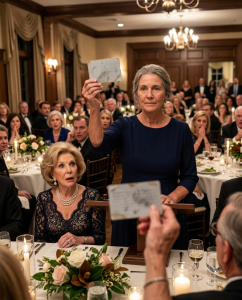
Then Dottie reached into the neckline of her dress and drew out the folded index card.
The shift in the room was instant. People sat up. Heads turned. Even the servers paused.
She laid the card on the podium and smoothed it flat.
“I believe y’all already know what this is,” she said.
Her voice carried cleanly through the ballroom.
Some people looked confused. Others glanced toward Carol Ann, because social rooms are full of instinctive weather-watchers and something had changed in the air. Carol Ann’s expression had gone careful, which is what some people look like when panic is trying not to show itself.
“Twelve years ago,” Dottie said, “I came to a Junior League garden party with a cast-iron skillet of cornbread made from this recipe. My mother wrote it for me in 1987. It fed my family. It fed customers down at Beaumont’s. It fed grieving people after funerals and hungry people after church and children who came in wet from the river with not enough money for pie.”
No one made a sound.
“I set that skillet on an auction table and wrote my name on a card. Then I watched a group of ladies decide both my food and my name belonged somewhere less visible.”
She did not raise her voice. She did not need to.
Across the room, a woman at one table lowered her fork as if suddenly ashamed to be holding it.
Dottie kept going. “I sat in my car that day with this recipe in my hand and asked myself whether I was the one who ought to feel embarrassed. Took me a while, but I reached a conclusion.”
Her gaze settled on Carol Ann.
“I was not.”
The words landed harder than a shout would have.
Carol Ann straightened. “Now just a minute—”
“No,” Dottie said, still calm. “I’ve had twelve years of minutes. You can spare me three.”
The room froze.
Even people who did not know the original story understood instantly that they were watching a balance shift in public.
Dottie reached down beside the podium and lifted a silver-domed tray the staff had placed there at her request. She removed the lid.
A fresh cast-iron skillet of cornbread sat underneath, still warm.
The smell spread through the ballroom so quickly it was almost indecent. Butter, cornmeal, heat, memory. It moved across linen and crystal and polished shoes until the room no longer belonged entirely to donors and committees and pearls. For one disorienting second, it belonged to kitchens, labor, mothers, and places where worth was proven without applause.
On top of the skillet lay a handwritten card.
Dottie picked it up and read it into the microphone.
“Dorothy Mayes, Beaumont’s Fish Camp.”
Then she set it down.
“I thought it only fair,” she said, “to bring it back where it was removed.”
No one breathed.
“You’ve spent years trying to buy my property because now you can see the value in it. Riverfront. Oaks. History. Atmosphere.” Her mouth tightened slightly. “Funny thing about value. It doesn’t appear the moment rich people notice it. It was there all along.”
At one of the side tables, Trina put a hand over her mouth.
Carol Ann’s face had begun to shine under the lights. “We were running an event,” she said weakly. “I’m sure nobody intended—”
“That’s usually how people describe what they’re ashamed of,” Dottie replied. “As if intention is the only thing that counts.”
There was a murmur then. Not loud, but unmistakable. Agreement, maybe. Or shock curdling into recognition.
Dottie let the silence ripen.
“I accepted your invitation tonight because I wanted to know whether this organization wanted my land because it respected what stood there, or because it assumed everything can be bought once enough years pass.” She rested her hand lightly on the old recipe card. “Now I know.”
The room seemed to lean toward her.
She reached into a folder on the podium and withdrew a single sheet of paper.
“An hour before I arrived, my attorney sent notice to your board that my property has been placed into a permanent heritage trust.”
Confusion rippled. Chairs creaked. Somewhere in the back, a man whispered, “What?”
Dottie continued. “The land will remain public green space and community use property. No private gala venue. No donor compound. No exclusive events. The old fish camp building will be restored as a local culinary training kitchen and river museum. The lawn will host school functions, church suppers, and public gatherings. There’ll be a memorial plaque for the cooks and workers who built that place, because they are the ones who gave it value.”
Carol Ann stared at her as if the words refused to assemble.
“You can’t be serious,” she said.
Dottie met her gaze. “I have never been more serious in my life.”
One of the board members, a younger woman with pin-straight posture and a fixed expression, spoke up from her table. “You let us pursue this for months.”
“Yes,” Dottie said.
“Why?”
And there it was. The question underneath all the rest.
Why not simply say no?
Why make them come this far?
Why this room, this night, this stage?
Dottie looked around the ballroom, taking in all the faces.
“Because some lessons only stick when everybody sees them.”
Silence held for half a beat.
Then, from somewhere near the back, someone started clapping.
It was one clap at first, uncertain and alone. Then another joined it. Then Trina stood up completely, tears running down her cheeks, and clapped hard enough to make the bracelets on her wrist shake. A man near the bar followed. Then two women at a side table. Then half the room.
Not everyone stood. Not everyone clapped. But enough did.
Carol Ann remained seated.
Dottie waited until the applause died down. Then she folded her mother’s recipe card again, careful with the corners.
“I don’t need an apology tonight,” she said. “Not because it isn’t owed. Because I learned a long time ago that dignity given back by the wrong hands is still borrowed dignity. I kept mine.”
Her voice softened then, but only slightly.
“And for the record, the cornbread did win something after all.”
A few startled laughs broke through the tension.
“It taught me exactly who I was dealing with.”
She stepped away from the podium to stronger applause this time, and when she passed Carol Ann’s table, Carol Ann looked up as if to speak. Dottie did not stop.
Outside, the night air by the river terrace felt cool against her face. Trina hurried after her in heels she regretted the second she hit the grass.
“Dottie!” she called, laughing and crying at once.
Dottie turned.
Trina reached her and threw both arms around her. “That was the finest thing I have ever seen in my life.”
Dottie held her close. “You think I overdid it?”
Trina pulled back, eyes wide. “Absolutely not. I think half those women are going to have to change zip codes.”
They both laughed then, and the sound loosened something old inside Dottie’s chest.
Her son came out a minute later shaking his head in disbelief. “Mama, there are people in there acting like they just watched the Civil War end.”
“Well,” Dottie said, smoothing her dress, “some wars take longer than others.”
Within a week, the story had traveled farther than Hartwell County. Some people called Dottie petty. Some called her brilliant. A few insisted public embarrassment was never graceful. Others argued grace had never protected women like Dottie in the first place.
The heritage trust moved ahead exactly as planned. Local tradesmen restored the fish camp building. A retired history teacher volunteered to curate photographs and oral histories from workers who had spent decades there. A culinary program for teens opened the following spring, and one of its first classes learned to make cornbread from copied recipe cards headed in careful script: Dorothy Mayes, after her mother.
The Junior League issued a statement about regret, reflection, and organizational growth. Carol Ann Whitfield resigned from her honorary advisory position two months later. No one could say for certain whether shame forced it or merely inconvenience. In the end, it did not matter much to Dottie.
What mattered was the first public supper held on the restored lawn that autumn.
Families came with folding chairs. Children ran under the oaks. Old Beaumont’s regulars stood around telling stories that grew bigger with each retelling. Trina carried trays. Dottie stood at a long table by the serving line cutting squares of cornbread from a dozen black skillets.
People took one bite and went quiet.
Just like always.
As sunset turned the river gold, Dottie slipped a hand into the neckline of her blouse and touched the old index card resting there. She still carried it. Maybe she always would.
Not because she needed the reminder anymore.
Because some things deserve to stay close to the heart once they’ve earned their place there.
And maybe that was the part Hartwell County would be arguing about for years: whether Dottie had been too hard, or exactly hard enough. Whether Carol Ann deserved public humiliation, or whether public humiliation was simply the first language certain people ever truly understood. Whether forgiveness was noble, or just another demand made of women who had already swallowed too much.
Dottie herself never wasted much time on that question.
She had offered no cruelty.
Only memory.
Only truth.
Only a room full of witnesses.
And sometimes that was more than enough.