Twenty years ago, a developer laughed Celestine Mabry out of a closing room.
He thought that was the end of the story.
He had no idea she would one day own his building.
On the South Carolina coast, where the marsh stretched gold in the evening and the tides carried memory better than any archive, Celestine had grown up with a different understanding of value than the men who would later sit across polished tables and talk about property as if land existed only when it could be marketed. In her family, land was not inventory. It was witness. It was inheritance. It was proof that people before you had survived enough to leave something behind.
Her first language was Gullah, spoken on porches and in kitchens and over baskets woven by hand from sweetgrass gathered carefully and prepared with patience. Her grandmother, Odessa Mabry, could take a bundle of marsh grass and make something beautiful enough that strangers would call it art, though to her it was also memory, skill, and lineage. As a child, Celestine sat at her feet and watched those baskets take shape one coil at a time. Her grandmother’s fingers moved steadily, almost without looking, while she told stories about storms, taxes, cousins, funerals, births, and the old days when keeping land was a fight people waged with paperwork as often as prayer.
“Our people don’t just lose land,” Odessa used to tell her. “They get separated from it on purpose.”
Celestine never forgot that.
By the time she was in her thirties, the pressure around their family property had grown more sophisticated. No one came with crude demands. They came with smiles, feasibility studies, artist renderings, and phrases like regional investment and mixed-use opportunity. The stretch of Sea Island land where her family still lived had become desirable to people who saw beauty only after profit translated it for them. The water views. The access. The tourism potential. The illusion of untouched authenticity, ready to be packaged and sold.
The developers wanted control of a broad tract that included parcels held by several Black families whose ties to the land went back generations. Some residents were elderly. Some were tired. Some had already spent years fighting taxes, zoning changes, and legal language designed to exhaust them. Celestine was one of the few younger family members willing to sit in meetings and ask uncomfortable questions.
That was how she ended up in the closing room.
She was thirty-four. She had taken the day off work. She wore her good blouse, pressed carefully that morning, and the gold earrings her grandmother always said made her look like she came from women with standards. In her hand she carried a small sweetgrass basket Odessa had woven herself, tight and elegant, the color of dried marsh in late summer. She had not planned to make a statement with it. She simply wanted something of home with her in that room.
The conference room belonged to a law office in Charleston, all glass and expensive silence. The documents were stacked neatly. Bottled water stood untouched beside notepads bearing a corporate logo. Men in jackets spoke to one another in the low confident tones of people who were accustomed to being listened to even when they were wrong.
At the center of it all sat Preston Hadley.
He was already a rising force in coastal development then. Charming when he needed to be, dismissive when he didn’t. He had the kind of easy confidence that comes from years of being rewarded for talking over other people. He greeted Celestine with professional politeness and the faintest suggestion that she was a formality.
She sat down anyway.
When the papers began moving and the legal language started flowing, she waited for an opening and asked what would happen to the families still living along that stretch of land. She asked whether access to the water would be restricted. She asked what protections existed for those who remained nearby. She asked what exactly was guaranteed and what was merely being “anticipated.”
She did not make it through her second question.
Preston leaned back in his chair, loosened his expression into something half amused and half annoyed, and said, “Ma’am, I don’t think you quite understand how money works.”
A few people smiled instantly, as if summoned by his confidence. Someone near the end of the table let out a laugh. Then another. Not everyone joined in. A couple of faces tightened. One man looked down at his papers. But enough people laughed that the insult landed with full force.
Celestine felt the heat rise from her collar to her face. It was not just humiliation. It was the old familiar sting of being told that concern, memory, ancestry, and caution were inferior to capital because capital arrived in a nicer suit.
She picked up the basket.
She stood.
No one stopped her.
She walked out with as much dignity as she could gather and did not cry until she was in her car, windows up, the marsh moving outside in long calm gestures under the late-day sun. She cried hard enough to shake. Hard enough to be angry at herself for crying. Then, when it passed, she looked at the basket in her lap and realized something had changed.
The insult itself would fade.
The lesson would not.
Celestine did not spend the next twenty years plotting revenge. Revenge was noisy, obvious, and often short-lived. What she built instead was discipline.
At the time, she was working an operations job for a regional logistics company, steady work with long hours and just enough flexibility for her to attend classes at night. After that meeting, she enrolled in a finance program she had once considered too expensive, too ambitious, too difficult to manage while working full-time. She made it work anyway. She slept less. She read more. She learned the mechanics beneath the polished language: debt ratios, loan structures, refinancing traps, risk exposure, cash-flow illusions, special-purpose entities, acquisition strategy.
What struck her most was how often power depended on ordinary people not understanding the documents in front of them. Men like Preston Hadley thrived in that gap. They counted on opacity. They counted on intimidation. They counted on people walking away convinced they were simply not sophisticated enough to question what was happening.
Celestine became sophisticated enough.
Then more than enough.
She earned her degree. Moved into commercial finance. Built a reputation slowly, first as an analyst who could identify trouble before others saw it, then as an advisor who knew how to structure purchases of distressed assets without wasting motion or ego. She did not chase headlines. She did not cultivate a personal brand. She listened more than she spoke, and when she did speak, people learned her caution usually turned out to be foresight.
Years passed.
Preston Hadley grew larger in public as Celestine grew stronger in private.
His developments multiplied along the waterfront. Condominiums with marina access. A boutique hotel pitched as an elevated Lowcountry experience. Restaurants, event spaces, private memberships, curated aesthetics built on land histories that marketing teams carefully sanded down into charm. Magazine spreads praised his vision. Business profiles called him transformative. He liked to speak about preserving local character while charging enough to make locals irrelevant.
But underneath the gloss, his empire relied on debt stacked too aggressively and projections that assumed a permanent upward climb. New projects covered old weaknesses. Refinancing disguised strain. Investors were reassured, then reassured again. By the time the hotel and marina complex was considered his crown jewel, Celestine had already reviewed enough public filings and private reports to know the structure beneath it was more fragile than people understood.
She did not act immediately.
Patience was part of the work.
For three years, Preston’s empire bled money. The losses appeared manageable until they didn’t. Rising costs. Softening demand. Loan terms that left no room for delay. Units that moved slower than promised. Hospitality revenue that looked glamorous in brochures and miserable in ledgers. People around him kept insisting the downturn was temporary. The phrase they used most often was weathering the moment.
Then the lenders stopped speaking in euphemisms.
By the time the acquisition group stepped in, the unraveling had accelerated. The Columbia-based firm approached the deal with unusual discretion. No splashy press campaign. No leaks to business reporters. No visible appetite for grandstanding. They simply began purchasing positions, consolidating leverage, and preparing to take control of the assets Preston could no longer protect.
The lead investor’s identity was withheld until the transition gala.
That detail amused Celestine more than she let anyone know.
The gala took place in the ballroom of Preston’s boutique hotel, the one built close enough to the old family stretch that standing near the terrace at dusk still gave you a sliver of the same marsh light her grandmother used to watch from the porch. The invitation described the evening as a celebration of continuity and future stewardship. Celestine thought that was almost funny.
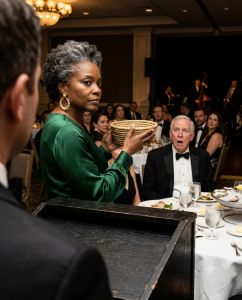
She arrived at seven in a deep green silk dress the color of marsh water at dusk. She wore Odessa’s earrings. And in her hand she carried the same sweetgrass basket she had taken from that conference room twenty years earlier.
It was smaller than people expected from an object carrying that much history. Beautiful, yes, but quiet. It sat on the table beside her plate while the ballroom filled with investors, attorneys, civic figures, and social regulars accustomed to treating galas as half performance and half battlefield. Oysters gleamed on crushed ice. The jazz quartet played softly in the corner. Waiters moved like choreography.
The woman seated beside Celestine smiled at the basket and asked, “Did you make that?”
“My grandmother did,” Celestine replied.
She let the answer end there.
People noticed the basket before they noticed her. It did not belong among the crystal and linen, which made it impossible to ignore. By the second course, it was drawing glances from across the room. By the third, it had become a quiet topic of speculation. Was it an auction item? A gift? A centerpiece? A symbolic gesture from a donor? No one could place it, and because they could not place it, they could not stop looking.
Preston worked the room in a tuxedo, still performing the role of host despite the fact that legal control had already slipped beyond his reach. He laughed loudly, clasped shoulders, thanked people for support, promised bright things. But the strain had begun to show around the eyes. He was still handsome in the polished, aging-developer way of men who believe certainty is part of their appeal, yet something about him looked thinner at the edges.
He passed Celestine’s table more than once without really seeing her.
Then the emcee announced the lead investor.
The room quieted.
The jazz softened into silence.
There was polite applause as the emcee described a respected businesswoman with deep roots in the Lowcountry, someone whose long-term vision had made the transition possible.
Celestine stood.
It took only a second for curiosity to sharpen across the ballroom. She was not physically imposing. She moved with controlled grace, not theatrical authority. But there was something about her stillness that altered the room. People leaned in.
She walked toward the podium.
Preston turned lazily at first, perhaps expecting another banker, another gray-haired executive, another familiar face from the circles that had always validated him.
Then recognition hit.
It showed plainly. The hand around his glass stopped moving. His mouth parted slightly. The color drained from his face in a wave so visible that several people near him turned to see what had caused it. Memory had reached across two decades and seized him in front of everyone.
Celestine saw it and kept walking.
At the podium, she rested one hand on the polished wood. With the other, she lifted the sweetgrass basket and placed it in clear view. She did not rush. The room had gone fully silent now, the kind of silence found only when people sense they are about to witness something irreversible.
Only then did she look directly at Preston Hadley.
“Mr. Hadley,” she said, her voice calm and carrying effortlessly through the ballroom, “I believe you remember this.”
No one laughed.
No one even shifted.
Preston’s face told them all they needed to know: whatever this basket represented, it had reached far behind business and into something personal, unfinished, dangerous.
Celestine opened the basket.
Inside was a clear protective sleeve containing a folded set of documents. She removed them carefully and laid them on the podium. Even from a distance, people could see notations on the margins, aging ink, signatures, tabs marking critical pages.
“Twenty years ago,” she said, “I attended a meeting about the sale and redevelopment of family land on the Sea Islands. I came with questions about what would happen to the people still living there. I was told”—she paused just long enough for the memory to sharpen—“that I didn’t understand how money works.”
The room remained motionless.
Preston swallowed visibly.
Celestine continued. “That turned out to be useful motivation.”
A few uneasy smiles flickered from those who sensed the force beneath her restraint. She wasn’t grandstanding. That made it worse.
She touched the top page of the document stack.
“This is a marked copy of the original land-use agreement distributed after I left the room that day. Not the version presented publicly. The internal revision. The one noting anticipated displacement impacts, water access limitations, and private concerns about title vulnerabilities among families whose holdings were considered easier to fracture over time.”
A murmur moved through the ballroom like wind shifting direction.
Several attorneys in the room stood straighter.
Preston took one step forward as if to interrupt. “Now see here—”
Celestine raised one finger, and astonishingly, he stopped.
Not because she had power in the room now, though she did. He stopped because for the first time in a very long time, he sensed that saying the wrong thing might destroy what remained of him.
She reached back into the basket and removed something smaller: a folded handwritten note on yellowing paper. She opened it with care.
“My grandmother asked me to keep this,” Celestine said. “I didn’t understand why at the time.”
She looked up at Preston, then read aloud.
The note was from one of the attorneys who had been present at the original meeting, written privately to Odessa Mabry after the deal advanced. It acknowledged that the family’s concerns had been dismissed, that verbal assurances given in earlier conversations had not been included in final language, and that once construction began, future access restrictions were likely inevitable. The writer described discomfort with how aggressively the families had been managed and specifically referenced Preston’s insistence that objections be contained before they affected closing momentum.
The room seemed to contract around the words.
One older man at a nearby table removed his glasses and pressed his fingers to his mouth. A woman from a preservation nonprofit looked openly horrified. Someone in the back whispered Preston’s name as if saying it might explain him.
Celestine folded the note again.
“I kept the basket,” she said softly, “because it reminded me of the day I learned what people are willing to do when they think history belongs only to whoever can afford the deed.”
Preston’s composure cracked. “You have no idea what you’re talking about. Those projects created jobs, tax revenue, growth—”
Celestine turned fully toward him at last. “And debt,” she said. “A great deal of debt.”
That line landed harder than any accusation.
A few scattered heads turned toward him with sudden comprehension. In one sentence, she had shifted the evening from moral history to present vulnerability. This was not merely about old shame. It was about the present collapse, and about who now controlled the ground beneath his polished shoes.
She returned her gaze to the audience.
“My team has acquired controlling interest in this property and the related waterfront assets. Effective tonight, management changes begin immediately. We will also be establishing a community review board for land-use decisions affecting adjacent historic families and access corridors, and we will fund a legal and historical audit of all original agreements tied to the development.”
Now the murmurs became a wave.
It was one thing to humiliate a man at his own gala. It was another to announce that the future of the empire he built on old dismissals would now be governed by the very kind of voice he once laughed at.
Preston looked as though the room had tilted beneath him. “This is vindictive,” he said, but the force had gone out of him.
Celestine regarded him with a calm that made the moment almost unbearable to witness. “No,” she replied. “Vindictive would have been making tonight about embarrassment.”
Then she placed a hand lightly on the basket.
“This is about stewardship.”
A silence followed that felt cleaner than the earlier one. Less theatrical. More final.
There were questions after that, of course. The emcee, rattled but professional, invited them. Reporters and local business figures pressed for details. Celestine answered with precision. Yes, the acquisition had been under negotiation for months. Yes, ownership changes would be phased in immediately. Yes, a review of prior land-related commitments would be undertaken. No, this was not symbolic. Yes, public records would be made available where appropriate. No, there would be no further comment on private correspondence at this time.
Preston tried twice more to regain control of the evening and failed both times. The first attempt came in the form of a strained speech about legacy and complexity. No one wanted it. The second came when he approached the podium after the formal remarks ended, perhaps hoping for a private exchange. By then, three members of Celestine’s legal team had already stepped subtly into place. He stopped several feet away.
For a long moment, the two of them simply looked at each other.
“I built this place,” he said quietly.
Celestine glanced around the ballroom, at the polished surfaces and curated elegance. Then beyond them, through the terrace doors, toward the dark edge of the marsh.
“No,” she said. “You financed it. There’s a difference.”
He flinched as if she had struck him.
It would have been satisfying enough to leave it there, but the real reckoning came later.
The legal and historical audit uncovered a pattern of pressure, omissions, and procedural manipulation surrounding several parcels in the original development footprint. Some actions had been technically lawful. Others lived in murkier territory. A handful resulted in reopened claims, negotiated restitution, easement restoration, and a public reassessment of how heritage and access had been handled in the early phases of coastal redevelopment. Celestine did not reverse history. No one can. But she forced it into the record.
Under her stewardship, the hotel remained open, but the branding shifted. Marketing language was stripped of its appropriated nostalgia. Local history was rewritten in consultation with actual descendants and historians rather than lifestyle copywriters. Community access points were restored where possible. A permanent cultural program supporting Gullah artisans and preservation work was established, not as décor but as paid partnership. The rooftop bar survived. The pretension softened.
As for Preston Hadley, his fall was not cinematic. It was quieter than that, which somehow suited the truth better. There was no dramatic handcuff moment, no tabloid scandal, no one final public implosion. He lost control piece by piece: properties, board support, invitations, authority. People who once laughed at his jokes began speaking of him in the past tense while he was still in the room. For a man who had built so much of himself out of public certainty, irrelevance was a harsher punishment than disgrace.
Months after the gala, Celestine visited her grandmother’s old porch, the basket resting in her lap. Odessa had died before any of this happened, but Celestine could still hear her voice in the wind through the grass. The marsh looked the same in the evening light as it had the day she cried in the car twenty years earlier. Golden. Unbothered. Old.
She ran a finger along the basket’s edge and thought about all the things people mistake for weakness: softness, silence, patience, rootedness. Preston Hadley had made that mistake. So had everyone in that room who laughed because they assumed financial power and moral authority naturally traveled together.
They do not.
Sometimes the person dismissed for asking the wrong question is the only one who sees the whole trap.
Sometimes the thing carried out of the room is not humiliation.
Sometimes it is evidence, memory, and the beginning of an education no one there is prepared for.
And sometimes, twenty years later, the woman they laughed at returns not to destroy what they built, but to prove they never understood what building meant in the first place.
That was the part people still argued over afterward. Some said Celestine’s public confrontation was too deliberate, too pointed, too personal to be called pure stewardship. Others said she had shown more restraint than most people would have in her place. Both were probably true. Justice and satisfaction are not always strangers.
But nearly everyone agreed on one thing.
The biggest mistake Preston Hadley made was not underestimating her intelligence.
It was underestimating her memory.