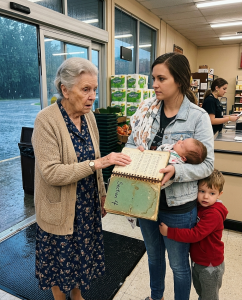
The storm rolled in off the river like it had somewhere to be.
By the time the first hard sheet of rain slapped the windows of the Piggly Wiggly on Highway 61, most of the shoppers had already made their dash to the parking lot. A few had given up and drifted back into the aisles to wait it out, pretending they needed one more can of soup or one more loaf of bread. Eula Mae Thibodaux stood near the front with a small hand basket hanging from her arm and watched the weather with the detached patience of a woman who had long ago stopped arguing with things she couldn’t control.
At eighty, she no longer hurried for rain, telephones, or foolish people.
In her basket sat a pound of butter, two cans of field peas, and a box of cornbread mix. Supper. Enough for one, with leftovers she would complain about tomorrow and eat anyway.
That was when she noticed the young woman in line at register two.
She had a baby balanced on one hip and another child holding tight to the hem of her jacket. She was young, maybe twenty-four, with damp curls escaping from a clip and the particular look of exhaustion that belonged to mothers with no room to fall apart. Eula Mae saw her counting money. Then counting it again.
Seven crumpled dollars.
The register total came up: $11.43.
The young woman looked at the little glowing numbers with the same expression Eula Mae had seen on choir members, widows, single mothers, and proud old men too many times to count. It was not surprise. It was the look of someone arriving at the exact hardship they had feared all along.
Eula Mae did what she always believed grace required. She moved quietly.
She went two registers over, paid for a box of crackers she did not need, then leaned toward Destiny, the teenager running register two.
“Ring that young lady’s groceries on my card, sweetheart,” she said softly. “Don’t tell her who.”
Destiny blinked, then smiled. “Yes, ma’am.”
Eula Mae drifted toward a paper towel display and pretended to compare prices. She watched out of the corner of her eye as Destiny said something to the young mother, who shook her head immediately, confused. Destiny said it again. Then the girl went very still.
A few seconds later, the groceries were bagged. The young woman gathered her children and stepped away from the register with a stunned gratitude she didn’t know where to place. Eula Mae saw it in the set of her shoulders—the way strain loosened by a fraction when somebody was shown mercy at the exact right moment.
That was enough. That should have been the end of it.
But as the storm thickened and both women ended up trapped near the sliding doors waiting for the rain to ease, Eula Mae noticed the book tucked under the younger woman’s arm.
It was an old spiral-bound hymnal, the kind First Baptist of Clarksdale used decades ago before they switched to big hardcover editions. Its green cover had faded almost gray in places. The lower edge was water-stained. Rust had eaten at the spiral corners.
Then she saw the spine.
Section 4, written in black marker.
Her section. The altos.
She felt a flicker of recognition so odd it made her step closer before she’d fully decided to. The hymnal had slipped partly open. On the inside cover, there was handwriting in faded blue ink.
She turned it just enough to read.
Eula Mae Thibodaux. Clarksdale First Baptist. Choir, Section 4.
For a moment, nothing in her body moved.
She knew that handwriting because it was her own.
The young woman turned and caught her reading. There was no alarm on her face. No embarrassment. No immediate attempt to take the hymnal back. She only looked at Eula Mae with an expression that was calm, watchful, and unsettlingly prepared.
“I’m sorry,” Eula Mae said. “This… this belongs to me.”
“I know,” the young woman replied.
Those two words changed everything.
Rain hammered the glass. Destiny called out a cheerful goodbye to someone behind them. The world kept behaving normally while Eula Mae felt her own certainty peel away.
“Where did you get it?” she asked.
“My grandmother gave it to me.”
The answer was simple enough, but the tone was not. Eula Mae heard the restraint in it, the carefulness.
“What was your grandmother’s name?”
The girl hesitated. “Laverne Jackson.”
The name did not land anywhere at first. It brushed past old church directories, old choir rosters, old funeral programs. Nothing.
Yet Eula Mae kept staring.
The face was familiar in the way strangers sometimes are in a small town. Then it struck her that it was not familiar because she had seen the girl before. It was familiar because parts of her belonged unmistakably to someone Eula Mae had once loved and later lost.
The eyes.
The mouth when holding back.
The stillness before answering a question.
“My grandmother told me if I ever saw you, I’d know you,” the girl said.
Eula Mae’s hand tightened on her basket. “Who are you?”
“My name is Ruth.”
She waited.
“My mother’s name was Delilah.”
The old memory came back in pieces. Delilah, shy and soft-spoken, who had joined choir for one Easter season. Delilah, who sang low and sweet and disappeared before summer. Delilah, whom the church stopped mentioning because churches, like families, often preferred explanations to truth.
Eula Mae’s pulse began to pound.
“Who was your father?” she asked.
Ruth looked at her for one long, weighted second.
“Isaiah Thibodaux.”
The name opened a chamber in Eula Mae she had kept shut for years.
Isaiah had been her only child. Handsome, restless, adored too easily by people who mistook charm for character. He had left Clarksdale young, drifted, called less and less, and eventually died in Baton Rouge with too little money and too many unfinished things. Eula Mae had mourned him, defended him, and buried him with the stubborn loyalty only mothers know how to carry.
Now a stranger stood in front of her saying he had left behind a daughter.
“Why have I never heard of you?” Eula Mae whispered.
Ruth’s expression changed then. Not into anger exactly. Something older than anger. Something worn smooth by time.
“My mother wrote to you,” she said. “Twice. Once when she was pregnant. Once after I was born.”
Eula Mae stared.
“She never got an answer.”
The floor seemed to shift under her feet.
“I never saw any letter,” Eula Mae said at once, and believed it even as guilt surged through her. If there had been letters, then where had they gone? Had Isaiah intercepted them? Had her late husband, Leon, hidden them to avoid scandal? Had they arrived during the season when Leon paid all the bills and sorted all the mail while Eula Mae practically lived at church preparing Easter music and spring revivals?
Memory was no help. It was a room full of half-open drawers.
Ruth reached into her jacket pocket and took out an envelope. Worn. Creased. Carefully preserved.
The old Magnolia Street address was written in blue ink. Delilah Jackson appeared in the corner.
Eula Mae felt her face go cold.
Then Ruth pulled out a photograph.
It showed Isaiah and Delilah standing beneath the side awning of First Baptist, young and close, his hand at the small of her back. Too intimate to misread. Across the bottom, in Isaiah’s own unmistakable handwriting, were the words:
Mama can never know yet.
Eula Mae nearly dropped her basket.
“Read the letter,” Ruth said.
She unfolded the first page with trembling fingers. Delilah’s writing was neat but pressed hard into the paper.
Mrs. Thibodaux,
I know you may not want to hear from me, but I don’t know what else to do. Isaiah says he will tell you when the time is right, but I am carrying his child now and the time does not feel right to me. I am not asking for money. I am asking for the truth to have somewhere to stand…
By the second paragraph, Eula Mae could barely see. Delilah wrote that Isaiah had promised not to leave her alone in it. That he had gone quiet. That she had been ashamed to come to church once people started looking at her too closely. That she had almost turned around three times before mailing the letter.
The second letter was worse.
The baby is a girl. Her name is Ruth. She has his eyes. I told myself maybe no answer means you are angry, but my mother says silence usually means somebody else made the decision for you…
Eula Mae lowered the pages. Rain still battered the doors. Her own breathing sounded thin and foreign in her ears.
“I swear to you,” she said, looking up at Ruth, “I never knew.”
Ruth’s eyes filled, but she didn’t cry. “My mother died when I was sixteen. My grandmother kept these in a cedar box. She told me not to hate people I had never met, but not to rewrite the truth either.”
The little boy at Ruth’s side tugged at her sleeve. “Mama, I’m hungry.”
She smoothed his hair automatically. “I know, baby.”
Eula Mae looked at him then. Really looked. Then at the sleeping infant on Ruth’s shoulder. Her great-grandchildren. The thought landed so suddenly it was almost impossible to hold.
“Come with me,” Eula Mae said.
Ruth stiffened. “Where?”
“To my house. It’s dry, and it’s five minutes away if this rain lets up any.” Eula Mae steadied herself against the cart rail and lifted her chin. “If there were letters I never answered, I won’t have this conversation standing between the gum display and the lottery machine.”
Ruth hesitated. Years of caution moved behind her eyes. Then thunder rolled again, the baby stirred, and the little boy pressed closer.
“All right,” she said quietly.
They drove through the rain in separate cars. Eula Mae’s hands shook on the steering wheel more than she liked. She had not expected a trip to the grocery store to split her life into before and after. Yet as she pulled into the driveway of the small white house on Magnolia, she knew that was exactly what had happened.
Inside, she set a kettle on. Ruth sat at the kitchen table with the children. The boy accepted crackers. The baby woke and took a bottle with the greedy relief of a child who had been patient too long.
On the wall above the sideboard hung framed choir photos spanning decades. Ruth’s gaze moved over them slowly.
“That’s him,” she said at last, pointing to a 1986 Christmas program photo.
Isaiah stood in the back row, smiling like the world owed him affection.
Eula Mae nodded once. “That’s him.”
There was no use polishing the truth now. Over tea gone lukewarm, Ruth told her what Delilah had said. Isaiah had been sweet, charming, and utterly unprepared to be responsible for another human life. He swore he loved Delilah. He swore he would tell his mother. Then he delayed. Then he vanished into excuses. Then he left town.
Laverne Jackson had raised Ruth alongside Delilah, who worked two jobs until illness overtook her early. They were not destitute every year, but some years came close. Ruth had grown up with fragments: a name, two letters, one photograph, and an old choir hymnal her grandmother said proved Delilah had once belonged somewhere before shame pushed her out of it.
“She kept saying there was one person she was never sure about,” Ruth said. “She wasn’t sure whether you turned away… or whether the truth never reached you.”
Eula Mae sat in silence for a long time.
Then she rose, crossed the kitchen, and opened the narrow drawer of the old secretary desk by the window. At the very back lay a bundle of rubber-banded envelopes tied with a fading church ribbon. Leon’s papers. Things she had not touched since his death.
Her fingers moved through receipts, insurance forms, notes from deacons, and one yellowed stack of mail still sealed but slit open at the top.
There they were.
Two envelopes addressed in Delilah’s hand.
Opened.
Never shown to her.
Eula Mae closed her eyes.
For one terrible moment, Leon stood before her exactly as he had been twenty-eight years ago: proud, stern, convinced that protecting a family’s reputation was the same thing as protecting a family. He had loved her, yes. He had provided, yes. But Leon had believed some truths should be smothered before they spread. And she had lived beside that belief long enough not to be shocked by it now—only gutted that this was where it had landed.
She carried the envelopes back to the table and placed them in front of Ruth.
“I found them,” she said.
Ruth looked down, then up. “He hid them?”
Eula Mae’s voice broke. “I think he did.”
Nobody spoke for several seconds.
Then Ruth did the unexpected thing. She didn’t accuse. She didn’t storm out. She simply exhaled, long and tired, as if a battle she had been fighting with ghosts had finally produced one living answer.
“So my mother was telling the truth,” she said.
“Yes,” Eula Mae whispered. “And I failed her even without knowing it.”
The little boy reached for another cracker. The baby made soft sucking sounds against the bottle. Life, stubborn as ever, kept moving through the room.
Eula Mae looked at Ruth fully, without the shield of uncertainty. “What do you need from me?”
Ruth’s eyes finally brimmed over. She brushed at them impatiently. “I don’t know. I thought maybe I wanted proof. Or maybe I wanted to see your face when you heard my name. Maybe I just got tired of carrying a family that only existed in papers.”
That answer undid something in Eula Mae.
She reached across the table slowly, giving Ruth plenty of time to pull back. Ruth didn’t. Eula Mae laid her hand over the younger woman’s trembling fingers.
“You should not have had to arrive like a stranger,” she said. “Not to me.”
Ruth started crying then—quietly, not theatrically, the way exhausted people cry when they are finally somewhere they do not have to be strong for one full minute. Eula Mae cried too. For Delilah. For Isaiah. For the years stolen by cowardice and pride. For every Sunday she had directed alto section while one of her own was growing up elsewhere, wondering whether she had been rejected.
By the time the rain slowed to a soft tapping at the windows, the house no longer felt like it belonged only to Eula Mae.
She fed the boy leftover banana pudding from the refrigerator. She found an old quilt for the baby. She pulled out the family Bible and, with hands unsteady but determined, turned to the births page.
There were spaces enough.
She wrote carefully:
Ruth Delilah Jackson Thibodaux — daughter of Isaiah Thibodaux and Delilah Jackson.
Then below that, after asking the children’s names twice to get the spellings right, she added them too.
Ruth watched her do it without speaking.
When Eula Mae finished, she closed the Bible and pressed her palm flat against the cover.
“I can’t repair what was taken from your mother,” she said. “And I can’t answer for Isaiah. But I can answer for myself from this day forward.”
Ruth gave a shaky nod.
It was late before she gathered the children to leave. At the door, she paused with the old hymnal tucked in her arm again.
“You should keep this,” she said.
Eula Mae looked at it, then at Ruth. “No.”
Ruth frowned slightly.
“It got you to me,” Eula Mae said. “Looks like it still knows where it belongs.”
For the first time that evening, Ruth smiled without pain overtaking it.
Weeks later, people at First Baptist would talk in whispers when Eula Mae walked in with a young woman and two children no one had seen before. Let them whisper. Eula Mae had spent too many years living around other people’s silence to honor it anymore.
She seated Ruth in the alto section.
Section four.
When the first hymn began, Ruth sang softly at first, uncertain, almost shy. Then stronger. Her voice was not Delilah’s. It was not Isaiah’s. It was entirely her own, and still somehow braided out of both.
Eula Mae stood at the front, spine straight, tears already threatening, and lifted her hand to conduct.
Some reunions arrive with speeches. Some with apologies rehearsed for decades. This one arrived with rainwater, hidden letters, grocery bags, and an old spiraled hymnal that refused to stay buried.
After service, Eula Mae watched Ruth gather her children while church ladies pretended not to stare. She thought about how close mercy and truth had come to missing each other all those years. How easily one man’s decision had sent pain traveling through three generations. How a simple act in a grocery line had opened a door nobody living had expected to walk through again.
She still did not know whether forgiveness belonged to Isaiah. She was not sure Leon deserved the gentler version of the story she had once told herself about him. She knew only this: the worst red flag had not been sin, or shame, or even youth. It had been silence dressed up as protection.
And silence, once broken, had finally brought her family home.