Twenty years ago, they left her loon on the floor.
Today, Marlene Bressette set it on their table.
She did not hurry when she entered the conference room at the Beltrami County courthouse. People noticed that before they noticed anything else. Not the bankruptcy lawyers. Not the lenders. Not the tired men in expensive shoes trying to look optimistic over a failing resort portfolio. They noticed the woman in the deep blue blazer with silver threaded through her dark hair, moving with the calm of someone who had stopped needing approval a long time ago.
She carried a leather briefcase that looked older than some of the junior associates in the room. She set it down beside her chair. Opened it. Reached inside.
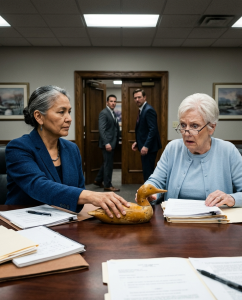
And before a single contract came out, before anyone could launch into courtesy introductions or dull financial language, she placed a small carved loon on the conference table.
It was made of white birch aged to the color of honey. Its paint had faded in the places fingers had touched it most. A hairline crack near one wing had been repaired with such care that only someone who loved the piece would have noticed it. It was not decorative. It was not expensive. It did not belong in a room full of acquisition documents and debt schedules.
Which was exactly why it belonged there.
Then Marlene Bressette took her seat, folded her hands, and waited.
Across the table, Patricia Knutson kept reading the packet in front of her.
Seventy-eight, still sharp, still elegantly severe in a pale blue cardigan, Patricia had spent decades making authority look like a personal virtue. Even now, with the Knutson resort empire collapsing around her, she held her reading glasses low on her nose and turned each page as if the room should be grateful for her attention.
She did not look up right away.
Marlene let her take her time.
There was no point rushing a moment she had carried for twenty years.
She had been six years old when her grandfather first placed a block of birch in her lap and told her to feel the grain before she looked at the wood. “Your hands know before your eyes do,” he said. He was an Ojibwe carver who lived on the north shore of Leech Lake in a house he had built himself from salvaged timber and stubbornness. He carved birds because birds were honest. He said that often, especially about loons.
“They never pretend,” he told her once as they sat listening to the water in the dark. “That cry of theirs? That’s the truth coming out.”
He made the little loon for her when she was fifteen. Not polished like the pieces tourists bought from roadside stands. This one was meant for keeping. For remembering. For taking into the world when the world forgot how to behave.
At twenty-six, Marlene still believed in decency enough to think marriage might widen her life rather than narrow it. Dale Knutson was handsome in the easy way men from money often are. Confident. Friendly. Quick to laugh in public. He made her feel chosen, and for a woman who had spent enough time on the edge of rooms, that feeling could be dangerously persuasive.
She believed she was marrying a man.
What she actually married was a family system.
The Knutsons owned resort cabins, slips at the marina, shoreline property on the eastern side of the lake, and a last name that opened doors before they knocked. They were involved in everything that counted. Tourism boards. Chamber dinners. Seasonal fundraisers. They knew exactly how to perform generosity in public.
In private, they were less polished.
No one insulted Marlene directly in the beginning. Patricia Knutson was too experienced for that. She preferred smaller cuts. The sort you could deny later.
“You’re so articulate,” Patricia said once at a dinner party, smiling over her wineglass.
“We should teach you how these events usually work,” she said another time, after Marlene spoke too plainly at a resort planning meeting.
There were glances. Pauses. Corrective little laughs. A constant undercurrent suggesting Marlene might be tolerated but never fully accepted. Dale always found a way to minimize it.
“That’s just how Mom is.”
“You know she doesn’t mean anything by it.”
“Don’t be so sensitive.”
Each excuse moved a brick. By the time Marlene realized she was standing inside a wall, years had passed.
The moment everything sharpened came one July afternoon at an outdoor property auction.
Eleven acres of shoreline had become available. The parcel bordered Knutson property on one side and land near Marlene’s family on the other. To most people it was a real estate opportunity. To Marlene, it was more than that. It was a chance to hold ground her people had lived beside for generations. A chance to stake a future in her own name, not as someone’s wife, not as a tolerated outsider, but as herself.
She scraped together every dollar she could. Borrowed more. Filled out the registration forms with a hand that shook only once.
She brought her grandfather’s loon with her.
She told herself it was for luck. Deep down, she knew it was for steadiness.
The auction crowd wore summer money casually. Linen shirts. Sunglasses. Boat shoes on gravel. Men joked near the podium while women watched each other and pretended not to. Marlene stood with her bidder card, pulse pounding.
Patricia stood nearby in a pale sleeveless dress, chatting as if the outcome had been decided long before anyone arrived.
Marlene placed the loon on the podium beside her papers while she checked a figure on the form. She remembered the heat. The smell of sunscreen and dust. The sound of distant water.
Then Patricia leaned toward another woman and said, in a voice just clear enough to carry, “Not the kind of person who belongs on this side of the lake.”
Marlene heard every word.
She turned just as Patricia stepped past the podium.
An elbow clipped the wooden loon.
It struck the gravel with a hard little crack.
Patricia kept walking. Never looked down. Never apologized.
Marlene stared at the bird in the dirt.
Something broke in her then, but not in the way people think. She did not collapse. She did not lash out. She bent, picked up the loon, brushed the gravel from its wing, and put it in her pocket.
Ten minutes later she lost the bid.
At the time she believed she lost because the other bidder had deeper pockets. She would only learn years later that the auction had been manipulated, nudged by side agreements and quiet promises to make certain the parcel ended up where Patricia thought it belonged.
That night Marlene asked Dale whether his mother meant what she said.
He kissed her forehead and told her she must have misheard.
She knew he was lying. Not because of the words, but because he could not look at her while saying them.
The marriage did not end all at once. Betrayal rarely arrives that cleanly. It settles in layers. You realize he never defended you. Then you realize that was a choice. Then you realize the choice was made long before that day.
By the time the divorce came, Marlene was exhausted enough to welcome the silence that followed it.
She was forty when she returned to school.
People like to romanticize reinvention, but most of it is dull. She drove long distances. Worked during the day. Studied at night. Read textbooks at the kitchen table while coffee went cold beside her. She sat in classrooms with younger students who assumed she was either faculty or lost. She listened. Learned. Refused to be embarrassed by beginning again.
Business made sense to her in a way family politics never had. Numbers were not moral, but they were honest. Contracts could still hide knives, but at least the knives had signatures. She earned a business degree, then an MBA in Duluth. She began consulting on tribal economic development projects. Helped small groups secure grants. Built partnerships others overlooked. One careful success led to another.
She did not build quickly. She built correctly.
Years later, at a development conference in Minneapolis, she met two women who had also learned what it cost to be underestimated. One came from commercial finance. The other from municipal redevelopment. Together they formed the backbone of a firm that specialized in distressed properties and strategic acquisition. Their work was quiet, methodical, and extremely profitable.
Marlene always carried the loon.
Her partners teased her about it. “Still bringing your little bird into negotiations?”
“Always,” she said.
They thought it was superstition.
It was memory.
Every time she set it on a table, she remembered kneeling in the gravel while people who thought they owned the shoreline walked away from what they had broken. She remembered how small they wanted her to feel. And she remembered that she had survived it long enough to become dangerous in a completely different language.
The Knutsons, meanwhile, mistook reputation for competence.
They expanded when they should have stabilized. Invested in the wrong ventures. Lost a lawsuit they had treated like a formality. Borrowed against optimism. Then the pandemic gutted their margins and exposed everything rotten beneath the varnish. Within a few years, the resort group was in Chapter 11.
Their lenders wanted order. Their attorneys wanted a buyer. Their sons wanted to salvage something. Patricia, people said, wanted dignity. But dignity is hard to protect when numbers stop cooperating.
The buyer emerged through a holding company: Bizhiw Development LLC.
The name meant lynx in Ojibwe. Quiet. Sure-footed. Patient.
The proposed deal was serious. Assume key liabilities. Retain some staff. Restructure the shoreline properties. Close fast.
The Knutsons accepted the meeting without learning much about the lead investor. They assumed, naturally, that whoever had the capital would also have the type of face they were used to respecting.
That mistake sat in front of them now, hands folded, eyes steady.
At last Patricia looked up.
Her gaze landed on the loon.
And everything in her expression changed.
It was not instant recognition of Marlene. Patricia had already recognized her when the introductions began, though she had hidden it well. No, what changed her face was the bird. The object. The return of something she had treated as disposable, now positioned at the center of a table where she no longer controlled the terms.
Her mouth parted.
“That’s… where did you get that loon?” she asked.
The room fell quiet.
Marlene met her eyes. “My grandfather carved it.”
Patricia stared.
Marlene reached into her folder and slid a single sheet of paper across the polished wood.
Patricia read the heading. Then the first paragraph. Then the notarized attachment underneath.
Her fingers tightened on the page.
It was a compiled exhibit drawn from older filings. A land transfer record. An affidavit. And the most devastating piece of all, a statement Dale had signed during divorce disclosures years earlier while untangling hidden assets and family-side financial arrangements. Buried deep in those documents was confirmation that Patricia had arranged a side agreement through an associate bidder at the auction. The price had been pushed just far enough to force Marlene out, after which the parcel had been folded into a shell purchase designed to move it back under Knutson control.
Dale had known.
More than that, he had helped conceal it.
Patricia read the page twice. When she looked up, there was real fear in her face for the first time in her life.
“You knew,” she whispered.
Marlene’s voice was calm. “Yes.”
The side door opened before Patricia could say more. Her sons, Evan and Ross, returned from the hallway mid-conversation about marina slips and lender conditions. They stopped when they saw the room.
“What happened?” Evan asked.
Ross noticed the paper first, then the loon. “What is that?”
“It’s the truth,” Marlene said, “about the auction your mother arranged twenty years ago.”
Patricia said, “This is not relevant.”
The attorney nearest the window cleared his throat. “It may become relevant depending on what follows.”
Ross stepped closer and picked up the sheet. He read carefully. Evan grabbed it next and read faster, his jaw tightening line by line.
“This can’t be right,” Evan said.
“It’s notarized,” the attorney said again.
Ross looked at Patricia with a stunned expression that seemed to age him. “Mom?”
Patricia lifted her chin. “It was business.”
“No,” Marlene said quietly. “Business is fair competition. This was gatekeeping with paperwork.”
No one corrected her.
Ross looked from the document to Marlene. “Why bring this now?”
Because I wanted you to know exactly who you’re negotiating with, she thought.
Instead she said, “Because for twenty years your family believed the story ended with me losing.”
Then she opened another folder and slid a fresh set of documents across the table.
This packet was not about the auction. It was about the future.
Bizhiw Development intended to purchase the core Knutson holdings, but not to preserve the empire as it had been. The marina would be restructured as a community-access model with protected seasonal slips for local families and tribal members who had long been priced out. One set of shoreline cabins would be converted into a cultural and ecological education center. A workforce housing plan was included for year-round employees. The disputed eleven acres, long ago folded into Knutson holdings through the manipulated transfer chain, would be placed into a conservation trust with co-management protections and public easements honoring long-standing Indigenous use of the area.
Evan read the terms and went pale. “You’re carving it up.”
“I’m restoring balance,” Marlene said.
Patricia’s voice rose. “You can’t erase this family.”
Marlene finally let a sharper edge into her tone. “No one can erase what your family did. Least of all me.”
The banker asked the practical questions. Funding was solid. Regulatory issues had been addressed. The trust structure was legal. The assumptions were stronger than anything else on the table. The deal, financially, was excellent.
That was the part Patricia could not fight.
Not because she had become humble. Because there was no move left.
At last she said, “What do you want from me?”
The room went still again.
Marlene looked at the loon before answering.
“I want you to say it,” she said.
Patricia blinked. “Say what?”
“What you did. Why you did it. Out loud. In front of your sons. In front of counsel. No polishing. No code words.”
Patricia’s breathing changed. Age, pride, panic, all working together. For a moment Marlene thought she might refuse.
Then Ross spoke, not to Marlene but to his mother. “Do it.”
Evan looked sick. “Mom, if this is true…”
Patricia closed her eyes. When she opened them again, the performance was gone. What remained was smaller and meaner and more ordinary than anyone in the room expected.
“I did not want her owning land next to ours,” Patricia said. “I did not want people thinking she was the same as us.”
Silence.
Then, because the truth once started has its own momentum, Patricia added in a flatter voice, “And yes. Because she was Ojibwe.”
No one moved.
Marlene felt the words land not like a blade but like something much older finally put down after being carried too long.
Evan sat back as if struck. Ross lowered his face into one hand. Across the room, even the attorneys seemed unsure where to look.
Patricia, having said it, appeared almost relieved for a fraction of a second. Then she saw her sons’ faces and understood what had changed.
She had not lost a negotiation.
She had been seen.
Marlene stood.
The movement drew every eye in the room. She picked up the little carved loon and held it in her palm for a moment.
“My grandfather used to say loons don’t pretend,” she said. “That’s why I kept this.”
She looked at Patricia. Then at the sons. Then at the stack of documents that would end one chapter of the shoreline and begin another.
“I didn’t come here for revenge,” she said. “Revenge would have been letting you fail slowly and calling it justice. I came here because this land deserved better stewards than pride and fear.”
The closing itself took another hour. Signatures. Revisions. Final acknowledgments. Patricia signed with a hand that was still steady, but only because she forced it to be. Evan asked almost no questions after the confession. Ross, to his credit, asked practical ones about staff retention and housing commitments. Somewhere beneath his shock was an understanding that repair, when it arrives, rarely looks clean.
When the last paper was signed, Marlene gathered her folders.
Patricia stopped her before she turned away.
“I was wrong,” Patricia said.
Marlene considered her.
The apology had come too late to heal what it should have prevented. But lateness did not make it worthless. It only made it expensive.
“Yes,” Marlene said. “You were.”
Then she left the conference room with the loon in her hand.
Outside, the afternoon light over Beltrami County had gone soft. The sky carried the pale brightness that comes before evening on lake country roads. Her phone buzzed with messages from her partners. One of them had sent only three words: Did she see it?
Marlene smiled and typed back: She did.
A week later, local papers reported the sale as a major regional redevelopment. There were quotes about economic revitalization and stewardship and smart transition planning. The articles did not mention the wooden loon. They did not mention the confession in the courthouse. They did not mention the July day twenty years earlier when a woman in a pale dress knocked a carving into the dirt and kept walking.
But stories do not need newspapers to survive.
Word moved in the older ways. Through cousins. Through dock workers. Through clerks who knew how to keep straight faces in public and tell the truth over coffee later. People talked about the sale. About the trust. About who the buyer really was. About Patricia’s face when she realized.
The following month, Marlene drove out to the eleven acres just before sunset. The land looked different than she remembered and exactly the same. Pines leaned toward the water. Wind moved through brush. Somewhere out on the lake, a loon called.
She stepped carefully over the uneven ground and stood where she thought the edge of the old auction crowd might once have been. Then she reached into her bag, took out the carving, and held it against the evening light.
The repaired crack near the wing flashed gold for an instant.
Broken things, she thought, do not return untouched. But sometimes they return stronger because the break taught someone to hold them correctly.
She slipped the loon back into her pocket and looked out over the water that had outlasted every insult, every title deed, every family who believed they owned more than a temporary claim.
The land would now hold cabins, access points, jobs, education, and legal protections the old system never intended. That mattered. It mattered more than humiliation ever had.
And still, as she stood there listening to the fading cry across the lake, one question lingered in the quiet after everything was over:
What causes more damage in the end—the cruelty people admit, or the cruelty they teach their children to call normal?