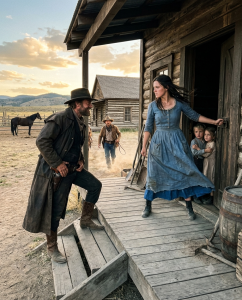
The stagecoach rolled into Red Hollow in a cloud of heat and pale dust, and when Mara Whitlock stepped down to the street, she did it with the kind of stiff dignity that only comes from having lost nearly everything and deciding no one would be allowed to see the damage.
Her dress had once been a respectable traveling blue, but after days on the road it was powdered beige from the trail. Her gloves were worn through at the fingertips. She carried a cloth suitcase with one broken clasp and kept one hand tucked inside her coat, touching the edges of three folded letters as if they were still proof that she had not made a terrible mistake.
She had come from Pennsylvania alone.
To get there, she had sold her mother’s sewing machine, the one machine in the house that had ever earned them money when times were lean. She had sold her father’s watch, though she had sworn she never would. She had sold the last chairs and side table the bank had not taken after the debt notices started arriving. The small house she grew up in no longer belonged to her. The town she left behind no longer had room for an unmarried woman with no dowry, no land, and no family left living to shelter her.
So when the letters came, offering the possibility of marriage in the West, she had allowed herself to believe what she had never believed for long before. That perhaps effort could still be rewarded. That perhaps character still mattered. That perhaps a woman’s future did not always have to be decided by the worst thing that had happened to her.
The first letter had come from Harold Sutter, a grocer in Red Hollow who wrote in careful penmanship and signed his name with a proper flourish. He described a respectable business, a growing town, and a practical need for a wife who could help with accounts and stock. He said he valued seriousness, thrift, and honesty. Mara had answered him with the same honesty. She told him exactly what she was: not pretty enough to turn heads, not rich enough to tempt fortune hunters, but educated, orderly, hardworking, and unafraid of difficult days.
His reply had arrived two weeks later.
That was all it took to start a future in her mind.
She found his grocery store first, a neat place with barrels of flour outside and sacks of beans stacked by the door. She paused only once before entering, straightened her collar, and walked inside.
Harold looked up from behind the counter.
His expression drained so quickly it was almost grotesque.
“Miss Whitlock,” he said. “You really came.”
It was not the voice of a man pleased to see the woman he had invited across the country.
Mara understood that much immediately, but she still answered with dignity.
“You said you would be waiting.”
His hands moved uselessly against the counter’s edge. “There’s been a change.”
“What kind of change?”
He swallowed. “I’m engaged. To Ruth Anne Briggs. It happened three weeks ago.”
Mara heard the words clearly. She felt them too, like a narrow knife sliding in between her ribs. Yet somehow what rose in her first was not grief. It was disbelief.
“You knew I was traveling here.”
“I meant to write.”
“One letter,” she said. “That was all it would have taken.”
His shame never matured into courage. He muttered an apology, but he could not meet her eyes long enough for it to matter. Mara left before he could say anything else.
Outside, the little brass bell over the door rang as it closed behind her. It sounded bright. Almost cheerful.
She hated it instantly.
The second name in her pocket was Thomas Garvey. He had written less elegantly than Harold but more warmly, speaking of his farm east of town and the loneliness of frontier life. He had made room in his letters for weather, for crops, for ordinary irritations. That had made him feel real in a way Harold had not. So even after the humiliation at the grocery, Mara told herself there was still reason not to panic.
She walked the two miles beneath a punishing sun, sweat gathering beneath her collar, dust rising around her hem. She rehearsed the conversation as she went. She would be calm. She would not mention Harold. She would simply present herself and let Thomas see that she was exactly what she had claimed to be.
He opened the door after her second knock.
For one stupid second, relief flared in her. At least he was there.
Then he stepped outside and pulled the door behind him until it was mostly shut. Over his shoulder Mara glimpsed an older woman at the window, her mouth already tightened with disapproval.
“My mother came unexpectedly,” Thomas said.
He looked embarrassed, but embarrassment was a useless thing when what she needed was backbone.
“She doesn’t approve of these arrangements. She says a man ought to marry close to home.”
Mara held his gaze. “And what do you say?”
He looked away first. “She’s all the family I have.”
“That did not answer my question.”
His face hardened, not with conviction but with cowardice. “I can’t go against her.”
From inside the house, the woman’s voice cut through the space between them.
“Thomas, your supper is getting cold.”
He turned as though summoned by law.
Mara waited, almost against her will, for him to stop, to reconsider, to at least offer her water before sending her back down the road in the heat.
He did none of those things.
The door closed in front of her.
She stood there one moment longer than pride allowed, then turned and walked back to town with the taste of dust and humiliation in her mouth.
By the time she saw Red Hollow again, something inside her had gone hard.
The final name was William Pratt.
He was meant to meet her in the saloon at four.
That detail alone had troubled her when she was still back east. A saloon was not where a serious man first greeted his future wife. But William’s last letters had become hurried, apologetic, and vaguely desperate. He claimed long workdays and little privacy. He insisted the saloon would be easiest. After two other failures, easiest no longer sounded like a flaw. It sounded like the last bridge left standing.
Mara arrived early. She chose a table near the wall and asked the bartender for water.
He gave it to her without charge, taking in her suitcase, her careful posture, her obvious expectation.
Four o’clock passed.
Then half past.
Men came and went. Boots thudded against floorboards. Laughter rose and dropped. The room slowly became aware of the woman waiting alone.
At five, the bartender approached.
“You expecting somebody, miss?”
“William Pratt.”
His face shifted.
It was a small change, but enough.
“Pratt left for California four days ago.”
Mara stared at him. “He knew I was coming.”
The bartender did not insult her by pretending otherwise. “I expect he did.”
That was the moment the day stopped feeling like bad luck and became something uglier. A pattern. A public stripping. Three men had looked at her circumstances, her distance, her vulnerability, and decided her inconvenience was less important than their comfort.
By evening, the whispers had started.
“That’s her.”
“The one from Pennsylvania.”
“Rejected by all three.”
“Pratt crossed half the map to avoid marrying her.”
Mara heard every syllable. She sat still enough to make people uneasy, and when tears pressed hot behind her eyes, she swallowed them. No one in that room would get the satisfaction.
When closing time came, the bartender slid a key toward her.
“There’s a cot in the storeroom out back. You can sleep there tonight.”
She bristled. “I don’t accept charity.”
“Then accept wages in advance. Sweep my porch in the morning.”
His name, she learned, was Finnegan.
That night Mara lay awake on a narrow cot in a room that smelled like burlap and spilled whiskey. Dawn seeped in around the cracked boards before she had truly slept. She rose with a headache, tied back her hair, and swept the porch with a ferocity that made Finnegan watch her over the rim of his coffee mug.
“You know figures?” he asked.
“Yes.”
“Sewing?”
“Yes.”
“Cooking? Children?”
“I know how to do whatever needs doing.”
He considered her for a long moment.
“There’s a man out west of town. Rancher. Elias Mercer. Widower. Two children. The place has been coming apart since his wife died. He doesn’t need romance. He needs order.”
Mara leaned on the broom. “Why are you telling me this?”
“Because he needs help and you need somewhere not to be.”
“That is not the same thing as needing a wife.”
“No,” Finnegan said. “But in places like this, people often call survival by nicer names.”
She almost laughed at that, but the sound died before reaching her mouth.
“Is he decent?”
Finnegan shrugged. “He doesn’t drink his money away, doesn’t beat his stock, pays what he owes. Around here that passes for promising.”
It was not much of a recommendation.
It was enough.
She found Elias Mercer near the corrals at midday. He was lifting feed sacks onto a wagon, moving with the controlled fatigue of a man who had been working past his limits for too long to remember where those limits were. He was not handsome in the polished way eastern novels described men. He was harder than that. Sun-browned skin, shoulders bent from labor, dark hair threaded with early gray, eyes like green glass left out in a storm.
When she spoke his name, he turned and measured her in one glance.
“Mr. Mercer, I’m Mara Whitlock.”
Recognition flickered with resignation.
“Finn talks too much.”
“This time he talked enough.”
She explained her situation without embellishment. No performance, no tears, no attempt to flatter either of them. She could manage a household, keep books, mend clothes, stretch provisions, teach children their lessons, and work from dawn until dark if necessary. In exchange, she required honest terms.
He listened with both hands resting on the wagon rail.
“At the risk of sounding rude,” he said at last, “why marry a stranger after what happened yesterday?”
“Because yesterday taught me what kindness costs. More than I can afford.”
The bluntness of that answer startled something in him. She saw it.
He looked down toward the dust. “My wife died eleven months ago. Fever. Fast. Clara still looks for her in doorways. Jonah gets into fights and pretends he doesn’t cry after. I don’t want a new love story, Miss Whitlock.”
“I don’t want one either.”
“I need help. That’s all.”
“So do I.”
His jaw shifted slightly, as if he disliked how cleanly the truth fit between them.
“My children may hate you.”
“Children are allowed to hate what they fear.”
“And what do they fear?”
“That you’re asking them to survive.”
He studied her more carefully after that.
By three in the afternoon they stood before the justice of the peace in Red Hollow’s land office. The judge smelled faintly of tobacco and old paper. He read the words. They answered when required. Mara signed her new name with a steady hand, though her stomach twisted at the sight of it.
Mercer.
Elias did not reach for her after.
No one kissed.
There was no witness beyond the clerk, no music, no flowers, no smile. But as they stepped back into the sunlight, Elias leaned close enough for only her to hear and murmured, “Be the mother of my children.”
Mara turned toward him, startled.
He was not flirting. He was pleading.
Not for himself, she realized. For them.
The ranch lay beyond a sweep of dry grass and split-rail fencing, with low hills crowding the horizon and a cottonwood standing sentinel beside the house. The place was larger than she had expected but worn almost to the bone. One shutter hung crooked. The porch steps sagged at one end. A broken hinge on the chicken coop gate had been mended with rope.
A house does not decay that way in a month. It decays that way when grief settles in and makes every ordinary task feel like betrayal.
Clara stood in the doorway when they arrived, narrow-shouldered and watchful, clutching the frame with both hands. Jonah appeared behind her, all angles and anger.
Elias crouched and spoke quietly to them.
Mara could not hear the first words, only the change that came after. Jonah’s face flushed dark.
“No!” he shouted. “She is not replacing Mama!”
The cry seemed to strike every wall, every fence post, every empty place in the yard.
Clara flinched but said nothing.
Elias straightened slowly. “No one asked you to forget your mother.”
“You married her!”
“I did.”
“You lied!”
The boy’s eyes flashed toward Mara with open hostility, then back to his father. Elias’s shoulders tightened, but he did not raise his voice. He said something lower, something Mara could not catch, and Jonah spun away, kicking at the dirt.
When Elias finally turned back to her, his expression was carved from fatigue.
“Welcome home,” he said.
She stepped down from the wagon, every board on the porch suddenly feeling like a test.
Inside, the house still belonged to Sarah Mercer.
A blue shawl hung by the back door. A jar of buttons sat beside the mending basket. Three school slates rested on a shelf, one smaller than the others. Someone—Sarah, almost certainly—had tucked dried lavender into a crack near the stove months ago, and the faint scent still lingered.
Mara understood in one breath what Elias had not said aloud. He had not cleared the signs of his wife away because he did not know which things belonged to memory and which things the children needed to keep breathing.
Clara moved aside to let Mara pass. It was a tiny gesture, almost nothing. Yet Mara recognized it for what it was: the first mercy she had been offered since arriving in Red Hollow.
The first evening passed in fragments of strain. Mara cooked because the kitchen clearly had not seen an orderly meal in weeks. Jonah refused to sit until Elias ordered him to. Clara ate silently and watched Mara with grave, unsettling attention. Elias thanked her for the food but not in the tone of a husband. In the tone of a man who had hired someone to help pull his life back from a cliff.
After supper, Mara washed the dishes while the children went to their rooms. Elias stood at the sink beside her, drying plates.
“You don’t have to do everything tonight,” he said.
“If I stop moving, I’ll start thinking.”
“About leaving?”
She glanced at him. “About whether I made another mistake.”
His mouth tightened, but he nodded as if he had earned that answer.
Later, when the house had gone quiet, voices rose outside the kitchen window.
“You said she was just coming to help,” Jonah hissed.
“I said what would get you through the day,” Elias replied.
“You want us to forget her.”
“No.”
“Then why’d you do it?”
A long silence followed.
Mara moved closer to the curtain but kept out of sight. Through the narrow gap she saw Elias on the porch, bent over the rail as though the night itself had weight. Jonah stood in front of him, fists clenched.
“Because I can’t keep this place together alone,” Elias said at last. “And because you and Clara need more than what I’ve been able to give.”
Jonah’s face crumpled before he masked it again. “She’s not our mother.”
“No,” Elias said quietly. “She isn’t.”
The answer should have soothed him. Somehow it did not.
Mara stepped back before either could see her.
She found Clara in the kitchen a little later, bare feet soundless on the floorboards.
“She still wears Mama’s ring,” the girl whispered.
Mara looked down at the plain wedding band on her own hand, then back at Clara. “I didn’t ask for anyone’s ring.”
Clara tilted her head. “I know.”
It was such an old answer from such a small girl that Mara had no idea what to say.
The next morning she began with the things grief often ruins first: breakfast, laundry, inventory, schedules. There was relief in work because work had edges. It could be counted, scrubbed, folded, repaired. Emotions could not.
By noon she had reorganized the pantry, discovered that Elias had been paying too much for feed from a supplier in town, and learned that Clara read well above her age while Jonah had stopped doing schoolwork altogether. She also discovered that every room in the house held a quiet fault line where Sarah’s absence still split the air.
And then, near dusk, she found the blood.
She was reaching for kindling by the woodbox when she noticed a child’s shirt shoved deep behind the stacked logs. It was Jonah’s size. One sleeve had dried stiff and dark.
Mara pulled it free, frowning.
A floorboard creaked behind her.
“Don’t ask about that,” Elias said.
She turned. The force in his voice had nothing to do with anger. It was fear.
That, more than the blood itself, tightened something cold under her ribs.
“This belongs to your son.”
“I know.”
“Then why is it hidden?”
He looked past her to the shirt and then away. “Because not everything that happens here is fit for children to relive.”
“That’s not an answer.”
“No,” he said. “It’s the only one I can give you tonight.”
She took a step toward him. “If I’m expected to keep your house, feed your children, and stand in front of this town wearing your name, I deserve the truth.”
Something flickered in his face then. Weariness. Guilt. The instinct to protect colliding with the exhaustion of carrying too much alone.
Finally he exhaled.
“It wasn’t Jonah’s blood.”
Mara’s fingers tightened around the shirt.
“Whose was it?”
Elias looked toward the back window, where the last light was dying over the fields.
“My brother’s.”
There was no brother on the ranch. No mention of one in the children’s conversation. No trace of another adult in the house.
Mara’s pulse kicked harder.
“Where is he now?”
Elias met her eyes, and for the first time since she had arrived, she saw the full shape of the trouble he had married her into.
“Gone,” he said. “And if I’m right… not gone for good.”
That night the wind scraped against the house while the children slept upstairs and Mara sat awake at the kitchen table across from the man she had married hours after meeting him.
He told her then, not everything, but enough.
His younger brother Gideon had drifted in and out of the ranch for years, charming when sober, dangerous when cornered, and permanently pursued by the consequences of his own choices. Sarah had distrusted him. Elias had tried to believe blood could still be trusted. Eleven days after Sarah died, Gideon had shown up asking for money. Elias refused. Jonah had overheard the argument. Gideon had grabbed the boy by the arm when he tried to interfere. Elias stepped in. There was a struggle. Blood. A split lip. A torn sleeve. Gideon rode out swearing he would come back for what was “owed.”
Since then, every broken fence section, every missing tool, every horse spooked in the night had felt like a message left at the edge of their lives.
“Why not tell the sheriff?” Mara asked.
Elias gave a humorless laugh. “Because Gideon knows how to vanish before dawn and charm a room before breakfast. Because the sheriff would want proof. Because out here, by the time the law arrives, damage is usually already done.”
Mara sat in silence.
At last she understood the desperation behind his whisper at the land office. Be the mother of my children. He had not meant simply feed them, wash them, guide them. He had meant stand with them. Shield them. Help him hold a fraying line against whatever was coming.
She should have been furious.
Instead, to her own surprise, what she felt first was clarity.
She had crossed half a country only to be discarded by cowards. She had been treated like baggage by men who wanted a wife only when she was still imaginary. Elias Mercer had not offered romance. He had offered the one thing the others had refused: truth once forced to it, and a place in a struggle that was at least real.
“Next time,” she said quietly, “you tell me before I find blood in the woodbox.”
A shadow of something almost like relief crossed his face.
“Next time,” he agreed.
There was, in fact, a next time.
Three nights later the dogs started barking after midnight. Elias reached for his boots and rifle, but Mara was already awake, already moving. They found the barn door open, one horse cut loose, and a warning carved into the outer post with a knife.
MINE.
Jonah saw it the next morning before Elias could steer him away.
Clara began sleeping with the lamp lit.
Mara did not panic. She tightened every loose part of the household instead. She changed where the spare keys were kept. She inventoried what could be sold, hidden, or defended. She sent a discreet note to Finnegan asking what he knew of Gideon Mercer’s habits. She spoke to Jonah more sharply than sweetly and earned, little by little, the boy’s reluctant respect by refusing to flinch from his temper. She taught Clara to knead bread and read figures from the account book. She learned which floorboard outside the children’s room creaked and which one did not.
And in that strange, frightened, exhausting week, something impossible began to take root.
Not romance. Not yet.
Trust.
Jonah stopped calling her “her” and started saying “Miss Mara,” then once, by accident, just “Mara.” Clara began bringing her the comb each morning to have her hair braided. Elias started asking her opinion before making decisions about feed, money, or repairs. More than once Mara caught him watching her across the kitchen with an expression she did not know how to hold.
As for Mara, she discovered that there was a difference between being chosen for convenience and being needed with honesty. One humiliates. The other, however imperfectly, can become a bond.
The final confrontation came on a wind-heavy evening when Elias was late returning from town and the children had just finished supper.
A knock sounded at the door.
Not a polite knock. A deliberate one.
Mara opened it only enough to see a man on the porch with Elias’s eyes and none of his steadiness. Gideon Mercer smiled like someone who had spent a lifetime mistaking audacity for charm.
“Well now,” he drawled, glancing past her into the house. “My brother finally replaced the dead wife.”
Mara kept one hand on the door. “Elias isn’t here.”
“Then I suppose I’ll wait.”
“You won’t.”
His smile thinned. “You must be the mail-order bride.”
Behind Mara, Jonah appeared in the hallway, face already going pale.
That decided everything.
She stepped onto the porch, pulled the door shut behind her, and looked Gideon Mercer full in the eye.
“You don’t come into this house,” she said. “You don’t speak to those children. And whatever debt you imagine this family owes you died the first time you put your hands on that boy.”
For a second his expression cracked. Not because she had frightened him, but because she had named the truth without hesitation.
He took one step closer.
Then another horse thundered into the yard.
Elias.
He came off the saddle before it stopped moving and crossed the distance with a violence so tightly controlled it was more frightening than shouting. The brothers faced each other in the dust while the wind snapped at Mara’s skirts and Clara cried softly behind the door.
“Leave,” Elias said.
Gideon laughed. “Or what?”
“Or I stop treating you like blood.”
Some men hear a threat and test it. Gideon did. He lunged first. The fight was brutal, fast, and ugly in the way family fights often are, full of old grievance and no grace. Elias took one blow to the mouth and gave back two. Gideon swung wildly, then slipped in the dust when Jonah shouted from inside the house. In the half second that followed, Elias pinned him hard against the porch post.
The sheriff, warned earlier by Finnegan after receiving Mara’s note, arrived with two deputies before Gideon could break free. This time there was proof enough: the carving on the barn, the trespass, Jonah’s testimony, and a long list of quieter crimes that suddenly found witnesses once Gideon’s charm stopped protecting him.
When they hauled him away, he twisted in the saddle and shouted toward the house, “You think she’ll stay when she sees what this place really is?”
Mara stood on the porch beside Elias and answered before Elias could.
“I already have.”
Gideon laughed once, bitter and empty, and then he was gone down the road under guard.
The silence after felt unreal.
Elias touched his split lip and looked at her with something raw in his eyes. “You should have been told everything before I married you.”
“Yes,” Mara said.
“I was afraid if I did, you’d leave.”
She looked out over the yard, the barn, the children peering from the doorway, the home she had entered as a stranger and defended as if it were already hers.
“I almost did leave,” she admitted. “Not the ranch. Just the idea of trusting you.”
“And now?”
Mara considered him carefully before answering.
“Now I think we begin honestly.”
It was not a grand declaration. It was better.
Clara ran to her first, wrapping both arms around Mara’s waist with enough force to nearly knock the breath from her. Jonah came slower, embarrassed by his own emotion, and stopped close enough that Mara could rest a hand on his shoulder without him shrugging it off.
That night, for the first time, the house did not feel like Sarah Mercer’s ghost had to be erased for the living to continue. It felt like grief and hope had made an uneasy peace under one roof.
Mara would never be the woman they had lost.
She did not need to be.
In the weeks that followed, she repaired accounts, mended linen, argued with suppliers, and taught Jonah fractions at the kitchen table while Clara learned to laugh again without looking guilty for it. Elias fixed the porch, rehung the shutter, and began—awkwardly, slowly—to tell the truth before she had to drag it out of him. He was still a difficult man in many ways. She was not soft enough to pretend otherwise. But he listened. He apologized when apology was due. He showed up.
For Mara, that last thing mattered more than any elegant promise ever written in ink.
Three men had failed her before she ever unpacked her suitcase in Red Hollow.
One by cowardice. One by obedience. One by outright abandonment.
The man she married had offered her none of the romance she once imagined and more honesty than she had reason to expect. Not at first, not perfectly, and not without fear. But in the end, when danger came to the door, he stood where he should have stood. And so did she.
Sometimes that is how a future actually begins—not with certainty, not with flowers, not even with love at first sight, but with two wounded people deciding that when trouble comes, neither one will leave the other to face it alone.
Years later, people in Red Hollow would still talk about the Pennsylvania bride rejected three times in a single day.
But those who knew the whole story told it differently.
They said she arrived in town with nothing but a suitcase and three bad letters, and by winter she had become the beating heart of the Mercer ranch.
They said Elias Mercer had once whispered, “Be the mother of my children,” like a desperate bargain.
What no one expected was that she would become the fiercest defender any of them had ever known.
And depending on who told it, that was either the luckiest thing that ever happened to Elias Mercer…
or the moment Red Hollow learned exactly how badly it had underestimated Mara Whitlock.