They laughed at her in front of the whole town.
And for three years, Connie Briggs let them.
—
That’s the part nobody understood. Not her sister Carol. Not the women at Millhaven First Baptist who brought her casseroles that first winter. Not even her daughter Ruthie, who was eleven years old the night her mama came home from that council meeting, sat down at the kitchen table, and didn’t cry — just folded her papers very carefully, one crease at a time, and put them in the drawer by the stove.
Connie didn’t explain herself then.
She doesn’t explain herself much.
—
You have to understand what that meeting was.
The Denton Mill had been the heartbeat of Millhaven, Kentucky for sixty-one years. Six hundred and forty jobs at its peak. Three generations of the same families on the same floor. When it shuttered in the spring of 2019, it didn’t just take the paychecks — it took something out of the air in that town. You could feel it driving down Route 9 past those dark windows.
Connie had worked that floor for twenty-two years.
So she did what she knew how to do. She sat at her kitchen table for four months, and she drew up a proposal. A real one — market analysis, community investment models, a partnership framework she’d pieced together from library books and late nights on a county computer. She hand-drew the charts because she didn’t own the right software.
She was fifty-two years old. She’d never done anything like it before.
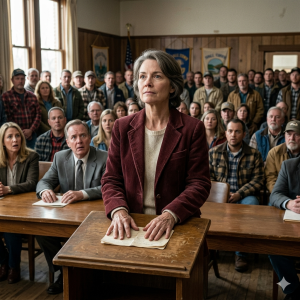
She walked into that town council meeting in her good burgundy blazer with her proposal in a manila folder and her reading glasses on a beaded chain, and she asked to be heard.
—
That’s when Gerald spoke.
Gerald Pruitt. Her brother-in-law of nineteen years. Third-term council member. Man who ate her peach cobbler every Thanksgiving and called her “the best cook in three counties.”
He looked at her proposal for approximately forty-five seconds.
Then he looked at the room and said — on the record, into the microphone — *”That’s just Connie being Connie.”*
The room laughed.
Not everyone. But enough.
—
She folded her papers.
She drove home.
She didn’t bring it up again.
—
But here’s the thing people in Millhaven started noticing, maybe six months after that meeting, then more and more as time went on:
Connie always seemed to be writing something on an index card.
Not typing. Writing, in that small, careful hand of hers, in blue ink. The card was worn soft at the edges, like it had been folded and unfolded a thousand times. She kept it tucked inside her left sleeve — you’d catch just a glimpse of it when she reached for something at the diner, or handed over money at Kroger, or passed the collection plate at church.
People asked her about it.
She’d just smile and say, *”Just keeping track of something.”*
Nobody could ever read it.
Ruthie said once she’d seen numbers on it. Carol said she thought she saw a name. Old Mae Hutchins at the beauty shop swore up and down it looked like a diagram of some kind.
But Connie never said.
—
Three years passed the way years do in a small town — slowly and then all at once.
The mill sat empty. There were rumors every few months: a developer from Nashville, a distribution company, a storage facility nobody wanted. Each one fell through. Each time, you could feel Millhaven sink a little lower.
Then, two weeks ago, word got out that the building had actually sold.
And this past Tuesday morning, the new owner came to introduce herself to the town council.
—
The room was full. Word travels fast.
Gerald was in his usual seat at the center of the table, already looking important about it.
The woman who walked in was maybe forty, sharp suit, leather briefcase, the kind of calm that fills a room. She set that briefcase on the table like she’d done it a thousand times before and she introduced herself without a lot of fanfare.
She talked about the mill. She talked about jobs — real ones, local ones, the kind that didn’t require anyone to leave Millhaven to find a future.
People were leaning forward. Mae Hutchins had her hand pressed over her mouth.
And then the woman paused.
She looked directly at Gerald Pruitt.
And she said:
*”Before we go any further — I believe you already know my silent partner.”*
Gerald’s face did something complicated.
Every head in that room turned toward the back.
Connie Briggs was standing in the doorway in her good burgundy blazer.
And she reached into her left sleeve, pulled out that worn, folded index card — the one nobody had ever been able to read — and she walked to the podium.
She smoothed it flat with both hands.
She looked up.
She had been waiting three years to do exactly this.
—
The room had gone the kind of quiet where you can hear the fluorescent lights.
Connie put on her reading glasses. The beaded chain was the same one she’d worn to that first meeting. People noticed.
She looked down at the card, then back up at the room. Then she did something nobody expected.
She turned it around so everyone could see it.
On one side: a number. $2.3 million. On the other side, written in her small blue hand: *Denton Mill — Community Manufacturing Cooperative. Phase 1 complete.*
That was it. That was the whole card.
Forty-seven words between the two sides if you counted the dollar figure. Three years of work folded into something you could tuck in your sleeve.
Mae Hutchins made a sound.
Connie set the card on the podium and began to speak.
—
She didn’t grandstand. That’s not who she is.
She explained it the way she explained everything — plainly, in order, without decoration.
After that council meeting in 2019, she’d gone home and put her proposal in the drawer. But she hadn’t stopped thinking about it. What she’d kept thinking about was one specific piece: the community investment model. The part Gerald hadn’t bothered to look at long enough to laugh at.
The idea was simple in the way that hard things sometimes look simple once someone’s done them. A cooperative ownership structure. Former mill workers buying in as partial owners, not just employees. Revenue sharing built into the founding documents. Local supply chains given contractual preference.
She knew she couldn’t do it alone. She didn’t have the capital, didn’t have the legal background, didn’t have the connections to find a buyer who’d be willing to operate that way.
So she spent three months after that meeting writing letters.
She wrote to every development nonprofit she could find in a five-state radius. She wrote to a Small Business Administration field office in Lexington. She wrote to a woman named Darlene Achebe who’d been quoted in a Louisville Courier-Journal article about rural economic revitalization, whose email address Connie found by writing to the newspaper directly and asking them, please, to forward it.
Darlene Achebe was the woman standing at the council table.
She’d been running a community development firm out of Louisville for eleven years. She’d worked mill conversions in three other states. When Connie’s letter arrived — handwritten, six pages, with hand-drawn charts she’d photocopied at the library — Darlene had read it twice and then called the number at the bottom.
Connie had answered on the second ring.
—
That was two years and eight months ago.
The index card was what Connie used to track the milestones. Every time something moved — a legal filing, a funding commitment, a conversation with a potential anchor tenant — she’d update the number on the card. She’d fold it back up. She’d put it away.
She wasn’t tracking it to show anyone. She was tracking it because it was real, and she needed it to stay real on the days when it felt like it might not be.
The name Carol thought she’d seen? Darlene’s. Written there from almost the very beginning.
The diagram Mae thought she spotted? A rough sketch of the mill floor, redrawn whenever the conversion plans changed.
The number Ruthie had glimpsed at various points over three years was never the same number twice. It kept going up.
—
Here is what the Denton Mill is going to be.
A light-manufacturing cooperative, majority-owned by a trust whose founding members are sixty-three former mill workers and their families — the ones who wanted in, who bought shares at a tiered price structure specifically designed so that nobody was priced out. Some bought in for as little as two hundred dollars. The documents are signed.
An anchor tenant, a regional outdoor goods company looking to onshore part of their production, has committed to a ten-year lease on forty percent of the floor space. That lease alone covers the building’s operating costs. Everything the cooperative produces and sells on top of that goes back to the members.
Phase one is expected to bring back one hundred and twelve jobs. Union-negotiated wages. Health coverage. The kind of benefits that used to exist in that building when it was still running.
Phase two, if the projections hold, gets them to two hundred and thirty.
Darlene Achebe has done this before. The projections tend to hold.
—
Gerald Pruitt sat very still through all of this.
When Connie finished, Darlene opened her briefcase and slid a packet of documents to each council member. Everything was already in order — zoning, financing, the cooperative charter, the anchor lease. They weren’t there to ask permission. They were there as a courtesy. To introduce themselves.
There was a long pause.
Then Rondell Fitch, who’d worked the second shift at Denton for fourteen years before the closure and now coached junior varsity baseball, started clapping. Not the polite, tentative kind. The sustained kind that means something.
It moved through the room fast.
Mae Hutchins was crying, which surprised nobody who knows Mae Hutchins.
Gerald Pruitt eventually clapped too. Connie didn’t look at him when he did. She didn’t need to. She wasn’t there for that.
—
After the meeting, someone asked her about the index card. A young woman from the Harlan County paper who’d driven up to cover the announcement.
Connie thought about it for a moment.
She said the card was something she started keeping because she needed to know that what she was doing was real. That it wasn’t just Connie being Connie.
She said some things you have to carry close to the body, where they’re warm. Where you can feel them when you reach for something.
She said three years is a long time to carry something. But she’d had help.
She folded the card one more time and put it in her blazer pocket — the actual pocket this time, not her sleeve. She wouldn’t need to keep it hidden anymore.
—
Ruthie is fourteen now. She was at the meeting.
She’d known about all of it for a year, after she found her mother up past midnight at the kitchen table, not drawing charts this time but reading through a stack of legal documents with a yellow highlighter, and she’d asked what it was and Connie had decided, finally, to show her.
She said Ruthie sat there for a long time looking at the papers.
Then she said: *”Mama. When did you do all this?”*
And Connie said: *”I started the night I came home from that meeting.”*
The night she sat at the kitchen table. The night she didn’t cry. The night she folded her first set of papers very carefully and put them in the drawer — and then, after Ruthie was asleep, got up and took out a fresh legal pad and started over.
—
The mill is scheduled to begin renovations in the fall.
If you drive down Route 9 past those dark windows now, it looks the same as it did last week, last year, the year before.
But it isn’t.