By the time Caleb Rusk tasted the stew, he had already decided he’d made a mistake.
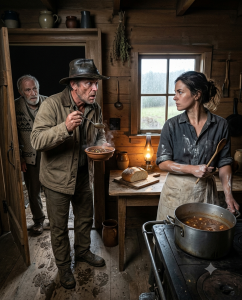
He stood just inside the kitchen doorway with rain dripping from the edge of his hat and mud drying on his boots, his broad shoulders filling the frame, his expression hard from habit more than temper. The day had been long, the fences on the south side had nearly washed out in the weather, one of the colts had thrown a shoe, and the ride back to Red Lantern Ranch had given him too much time to think.
Too much time to reconsider the woman he had brought home from Willow Bend.
He wasn’t a man who invited change. He didn’t trust it, didn’t go looking for it, and didn’t believe much good came from trouble that arrived with a polite face. Yet there he was, standing in a kitchen that smelled nothing like his kitchen had smelled in years.
Warm beef simmered low with onions and pepper. Fresh bread cooled on a cloth by the window. There was thyme in the air. Thyme and bay and something green and sweet that took him straight back to a version of home he had stopped expecting to feel again.
A bowl waited on the table.
Steam rose from it in quiet white ribbons.
And near the stove, sleeves rolled and hair pulled back with loose strands escaping around her face, stood the woman he had picked up from town like a decision he still didn’t know how to explain.
“Who made this stew?” he asked.
She turned at once. Her eyes were steady, dark with caution but not fear. “I did.”
His jaw tightened. “You were not supposed to be in my kitchen at all.”
The woman did not wilt. “Then it is fortunate someone ignored you.”
That answer should have irritated him.
Instead, it caught him off guard.
Maribel Bell had not come west to trade one uncertainty for another. Two days earlier, she had stepped off the stagecoach into Willow Bend with a carpet bag in one hand, a folded letter in the other, and the last of her hope packed so tightly inside her chest that she barely dared breathe around it.
The town was small enough to take in at a glance. A general store with warped porch steps. A blacksmith shop that smelled of iron and smoke. A church with white paint peeling in strips and a bell cracked somewhere along the rim. A boarding house that looked tired down to its hinges. The wind carried dust in restless swirls along the road and snapped loose strands of hair against her cheek.
She had searched the street for Walter Pike.
His letters had been simple, but that was what she’d liked about them. No grand poetry. No foolish declarations. He wrote like a man making an offer he intended to honor. He owned the general store. He needed a wife. He wanted a woman who could keep a house and stand beside him in a new place. And one sentence had rooted itself so deeply in her that she had read it again by lamplight more times than she would ever admit:
If you come west, you will never be unwanted again.
It had not taken much to persuade her after that. Her father had died the previous winter. Her brothers sold the farm before the ground had fully thawed. One had taken his share and gone north. The other stayed long enough for his wife to make it plain that an unmarried sister with no dowry and no claim was a burden that grew heavier every week.
Maribel had spent most of her life being useful in houses that were not hers. Cooking meals she did not sit to enjoy. Mending clothes she did not wear. Sleeping in corners that were lent, never given.
Walter’s letters had sounded like escape.
So when the stagecoach stopped in Willow Bend, she stepped down believing she had finally reached the place where she would be chosen.
Instead, a young clerk came out of the general store with pity all over his face.
“Miss Bell?” he asked.
“Yes.”
“Mr. Pike asked me to speak with you.”
She knew something was wrong before he finished the sentence. He wouldn’t look at her. The curtain in the store window shifted just slightly, and she caught the outline of someone standing behind it.
“Where is he?” she asked.
The clerk rubbed a hand along his sleeve. “He ain’t coming out, ma’am.”
The street did not stop for her humiliation. A wagon rolled past. A horse stamped near the rail. Someone laughed farther down by the smithy. The wind lifted grit around her boots.
The clerk held out an envelope.
“Mr. Pike says there’s been a change. He married Widow Hensley last Friday. Her family has land north of town and he figured it was best settled quick.”
Maribel stared at him.
“Last Friday?”
That had been the day she was halfway across Kansas in a stagecoach thick with dust, one child asleep against her shoulder, two old men arguing about weather at her back, believing every mile carried her toward a husband and a future.
“What’s in the envelope?” she asked.
“Money for a return ticket, I reckon.”
“Return to where?”
He had no answer for that. Of course he didn’t. He knew nothing about the dead father, the sold farm, or the brother’s wife who counted biscuits before supper and looked at Maribel like an extra plate no one had agreed to set.
She took the envelope because the whole street was watching.
That was the worst of Willow Bend in that moment. No one laughed. No one pointed. No one said anything openly cruel. They simply watched her stand there with nowhere to go.
Across the street, Caleb Rusk saw it happen.
He had come to town for nails, oats, lamp oil, and a hinge for the barn door. He was loading the last of it into his wagon when he heard enough to understand the shape of what had happened. A woman had come west on a man’s promise, and the man had sent a clerk to reject her while hiding behind a curtain.
Caleb did not like cowards.
He especially did not like men who shifted their shame onto someone else and called it practicality.
Still, he might have driven away if she had wept or pleaded. Not because he lacked compassion, but because he knew what it was to need dignity more than rescue. What stopped him was the way she stood there, back straight, chin lifted, one gloved hand wrapped around the handle of her carpet bag while the other tucked the envelope into her pocket like it disgusted her to touch it.
She looked wounded.
She did not look broken.
And Caleb knew something about surviving on pride when pride was all a person had left.
Three years earlier, fever had taken his mother in six days. His father, Silas Rusk, had survived her by sheer stubbornness and not much else. The ranch still ran because Caleb kept it running. He rose before sunrise, worked until dark, and did whatever was required without complaint. But the house had gone silent after her death, and silence had turned mean in the corners.
Silas barely spoke. He sat most days in a chair by the back window looking toward the ridge where his wife was buried. He ignored food unless Caleb put it in front of him. Half the time he left it untouched. Caleb could manage cattle and weather and broken machinery. He could not pull his father back from grief.
And looking at the woman abandoned in the middle of Willow Bend, he had the strangest thought.
Sometimes one kind of emptiness recognized another.
So he crossed the street.
“Ma’am,” he said, touching the brim of his hat, “I heard enough to know you’ve been treated poorly.”
Her eyes narrowed at once. “Then you heard more than you had a right to.”
He nearly smiled but didn’t. “Likely true.”
“Are you here to offer pity?”
“No.”
“Then what do you want?”
The wind had turned colder. Storm clouds were gathering over the mountains. Caleb glanced toward them and answered plainly.
“I run a ranch five miles east. My father is unwell. The house needs cooking, cleaning, and someone patient enough to keep it from falling entirely to dust. I can pay eight dollars a month, plus room and board. Honest work. Nothing more.”
She studied him for a long moment.
“Do you live alone with your father?”
“Yes.”
“Any wife?”
“No.”
The answer came quicker than he intended. Something in it must have told her more than the word itself, because her expression shifted just slightly.
“What is your name?” she asked.
“Caleb Rusk.”
“I’m Maribel Bell.”
“I know.”
That made her frown.
“The clerk said it loudly enough,” Caleb said, glancing toward the store.
For the first time, a ghost of a smile touched her mouth.
Then it was gone.
“If I come,” she said, “I work for wages. I keep my own room. And if I choose to leave, I leave.”
“Fair.”
“I don’t answer to any man who thinks kindness gives him ownership.”
Caleb met her gaze. “Nor should you.”
Something in those three words settled the decision. Not trust. Not yet. But enough.
She picked up her carpet bag and climbed into his wagon.
The ride to Red Lantern Ranch happened mostly in silence, broken only by the jolt of wheels over ruts and the first patter of rain across the canvas. The land opened wide east of town—rolling pasture, darkening sky, fences stretching long and weather-beaten across the hills. The ranch house stood broad and practical, built to endure more than to welcome. The barn sat beyond it, lantern glowing dimly through the slats. Cottonwoods leaned in the wind along the creek bed.
Maribel took one look at the place and knew exactly what kind of life it held.
Work. Cold mornings. Long days. Few words.
Inside, the house told the rest. Dust lingered in places a woman’s hand had once kept tidy. The curtains were clean but seldom drawn. A stack of plates sat near the basin as if washing them could always wait another hour. The piano in the front room had a thin film of neglect over the keys. A shawl still hung on a peg by the back door.
Dead women left traces that living men often did not know how to move.
Caleb showed her a small bedroom at the back of the hall. The quilt was old but clean. The washstand wobbled a little. The room held a narrow bed and one small window overlooking the side yard.
“This is yours while you’re here,” he said.
While you’re here.
Not forever. Not even for long. She appreciated that more than she expected.
Silas Rusk was in the back room when she first saw him, seated near the window, hands folded loosely over the blanket across his knees. He was not old enough to look as worn as he did. His eyes moved toward her when Caleb introduced them, then drifted back outside as though the effort of interest cost him too much.
“Evening, Mr. Rusk,” Maribel said.
He gave the faintest nod.
That first night, she unpacked her few things, folded Walter Pike’s envelope into the bottom of her bag, and lay awake listening to the wind lean against the house. She had no plan beyond morning. That was new. Strange and frightening, but also oddly clean. Nothing had been promised here except wages and a room. There was relief in that.
At dawn Caleb was already gone to the barn. By noon she had swept, dusted, shaken bedding, and opened windows long enough to drive out the stale smell. She found the pantry better stocked than the kitchen habits suggested. Potatoes. Carrots. Onions. Dried beans. Salt pork. A small crock of lard. Bundles of herbs hanging dry and forgotten. A chunk of beef from the cool cellar.
She stood there a long moment, then tied on an apron and set to work.
When Caleb came in at dusk and found the stew waiting, he was already irritated with himself for bringing her. The whole day he had told himself he had acted rashly. A strange woman in the house could become trouble in ten different ways, and he had neither the patience nor the desire for complication.
Then he tasted the stew.
The first spoonful stopped him cold.
His mother used to cook like that—not fancy, not rich, but with an understanding of how to take plain ingredients and give them comfort. The thyme hit first. Then pepper. Then the sweetness of onion cooked slow enough to soften without disappearing. It was as if some locked room in him had opened before he could stop it.
Maribel saw the change in his face. She saw him hate that she saw it.
“You had no right to take over this kitchen,” he said roughly.
She wiped her hands on her apron. “Someone had to.”
Then a voice from the doorway said, “I know that smell.”
Silas stood there.
Caleb had not seen him walk into the kitchen at supper in months.
For one stunned second, no one moved.
Then Maribel stepped toward the cupboard. “Would you like a bowl, Mr. Rusk?”
Silas looked from her to the pot. “My wife put thyme in hers.”
“So do I,” Maribel replied softly.
He sat down.
Caleb watched his father lift the spoon, take a bite, then another. The old man ate the entire bowl and even accepted a second half ladle before finally setting the spoon aside with a long, quiet breath.
“That was good,” he said.
It was only four words. Caleb could not remember the last time he’d heard his father offer even that much at the table.
From that evening forward, the rhythm of the house shifted.
Not all at once. Not magically. Grief did not vanish because a good meal appeared. But something moved. Curtains opened. Floors were scrubbed. Bread rose near the stove. The windows caught more light. Silas began coming to the kitchen more often, if only to sit while Maribel worked. She never pressed him for conversation. She simply included him in the room. Sometimes that was enough.
On the third day, she found him standing in the doorway to the pantry.
“Can I help you?” she asked.
He looked almost embarrassed. “You said there might be biscuits.”
She nearly laughed at the seriousness of it. “There are, if you can wait ten minutes.”
He glanced toward the clock as though ten minutes were outrageous. “I can try.”
When she handed him one hot from the pan, he took it with careful fingers and ate it standing there, butter running along the side.
“I haven’t seen him do that since my mother died,” Caleb said later.
Maribel kept her eyes on the dishwater. “Sometimes hunger comes back before the rest of a person does.”
He thought about that sentence all evening.
She was not talkative by nature, but when she did speak, it was with the kind of precision that made him listen. He learned small things. She rose early without complaint. She mended neatly. She favored old songs under her breath when she thought herself alone. She had a way of moving through the house that never felt intrusive, though signs of her were everywhere now—fresh cloths by the basin, herbs drying near the window, a lamp lit before the rooms grew dim.
He started listening for those signs.
That was when he should have been careful.
Instead, he found himself lingering in the kitchen doorway after supper, asking questions that had nothing to do with ranch accounts.
“Where’d you learn to cook?”
“My mother. Before she took sick.”
“You always use that much pepper?”
“Only when men keep pretending they don’t like flavor.”
One evening he came in from the barn and found her laughing softly at something Silas had said. The sound stopped him in the hall. He stood there longer than he should have, listening to his father’s voice answer hers with dry amusement.
It had been years since laughter belonged naturally in that house.
The moment that changed everything came four mornings after her arrival.
Maribel reached for a jar on the high pantry shelf, and a folded envelope slipped from her apron pocket to the floor near Caleb’s boots. He bent automatically and picked it up.
Walter Pike’s money.
Still sealed. Still untouched.
He looked at the envelope, then at her.
“You never used it.”
She went very still. “No.”
“Why not?”
A pause. Then: “Because there was nowhere to go.”
The answer hit harder than he expected.
He had known she’d been abandoned. He had not fully let himself understand what abandonment meant when there was no family home waiting, no safe direction to return to, no person expecting you anywhere. She had crossed half the country for a promise that dissolved on a dusty street. And when that happened, she had not become a scandal, or a bride, or even a traveler.
She had become a woman with nowhere left to take her own name.
“No family?” he asked quietly.
“Not any that wants me.”
There was no self-pity in it. That made it worse.
He looked down at the envelope again, thin and insulting in his hand. Enough money to move her elsewhere. Not enough to restore what had been done.
He thought of the way she had warmed his kitchen, drawn his father back to the table, and moved through their days as though care itself were work worth doing even when no one noticed. He thought of Walter Pike hiding behind a curtain while she stood alone in the road.
Something dark and hot settled low in his chest.
Before he could speak, wagon wheels sounded in the yard.
Maribel looked toward the window.
Caleb crossed the room and saw at once who had come.
Walter Pike climbed down from a wagon with his hat in his hands, the nervous look of a man attempting respectability after failing at decency. The same clerk sat beside him, mortified all over again.
Caleb stepped onto the porch before Walter reached the steps.
“State your business.”
Walter cleared his throat. “I came to speak with Miss Bell.”
“She works here,” Caleb said. “Say it.”
Walter’s gaze flicked past him to the kitchen door where Maribel now stood within sight.
“There’s been a misunderstanding,” Walter began.
Maribel’s face did not change, but her voice cut through the yard with surprising calm. “No. There was a decision.”
Walter shifted his weight. “Widow Hensley’s people expected more than they said. The land arrangement—well, it hasn’t turned out as hoped. I thought perhaps since you’re still in the area…”
Still in the area.
Caleb felt his hand close around the porch post.
Walter pressed on, mistaking silence for opportunity. “I’m prepared to make things right.”
Silas’s voice came from behind them, stronger than anyone had heard it in months.
“Boy,” he said to Caleb, “why is that man talking like she’s something he left on a shelf and came back to collect?”
Walter glanced toward the doorway and saw the old rancher standing there, one hand braced against the frame, eyes sharp for the first time in a long while.
That was when Maribel stepped past Caleb onto the porch.
She had been humiliated in public once. She was not going to let it happen again.
“You don’t get to come here and speak as though I have been waiting on your convenience,” she said.
Walter lifted both hands slightly. “Maribel, I know how this appears—”
“It appears exactly as it is.” Her voice remained level, but the force in it seemed to strip every excuse bare. “You asked me to leave my life behind. You let me travel all this way. You married another woman before I arrived. Then you sent a clerk to hand me money as if my dignity could be folded into an envelope.”
The clerk went crimson.
Walter’s face hardened with embarrassment. “I was trying to spare you a scene.”
“A scene?” she repeated. “You hid behind a curtain.”
Caleb had never admired anyone so quickly.
Walter tried a different tone, gentler and more dangerous because it carried entitlement under the politeness. “I’m offering you a proper home now.”
Maribel stared at him. “No. You’re offering me what remains after your better bargain disappointed you.”
The silence that followed was so complete that even the horses seemed to wait.
Walter’s eyes shifted to Caleb then, measuring him, resenting him. “And what exactly are you offering her?”
Caleb answered before Maribel had to. “Work. Respect. A roof she wasn’t lied into.”
Walter gave a short bitter laugh. “You expect me to believe that’s all?”
Caleb stepped down from the porch, not close enough to threaten, close enough to make the difference clear. “Believe whatever lets you leave fastest.”
For a second, it looked as though Walter might say something reckless.
Then Maribel spoke again, and her voice changed everything.
“I’m staying.”
Walter blinked. “With him?”
She drew herself up. “With my own decision.”
Something passed over Walter’s face then—wounded pride, disbelief, maybe the first real understanding that she had become impossible to control the moment he discarded her and she did not collapse.
He looked from her to Caleb, to Silas, back to her.
“This town will talk,” he said.
Maribel’s expression turned almost pitying. “Let it. For once they’ll have the right story.”
Walter stood a moment longer, stranded between anger and shame. Then he put his hat back on, climbed into the wagon, and snapped the reins harder than necessary. The clerk glanced back once, looking relieved on Maribel’s behalf, and then they were gone.
The yard remained quiet after the wheels faded.
Silas lowered himself into the porch chair with more energy than he had shown in weeks and let out a breath that sounded suspiciously like satisfaction. “I should’ve come outside sooner,” he muttered.
Maribel looked at him, startled, and then laughed.
Caleb joined them without thinking. The three of them stood in the late light while the storm clouds broke apart over the pasture, sunlight threading through in long gold bands.
It should have ended there.
In a way, the confrontation did.
But the real change came later that evening.
After supper, after Silas had gone to bed, Caleb found Maribel on the back porch. The air smelled of wet earth and cedar. Frogs had started up down by the creek. She stood with her hands around a tin cup, staring out into the dark like a person listening for the shape of her own future.
“You handled him well,” Caleb said.
She gave a tired half smile. “I handled him late.”
He leaned against the post beside her. “Still counts.”
For a while neither spoke.
Then she said, “I did not realize how angry I was until he stood there.”
“You had reason.”
“Yes.” She looked down into the cup. “I think I hated him less for choosing someone else than for deciding I would simply accept being treated like a thing passed from one arrangement to another.”
Caleb felt that sentence settle in him.
“I’m sorry,” he said, and meant far more than the words could hold.
She turned to him. “You didn’t do it.”
“No. But I asked who made the stew when I should’ve asked whether you had eaten. I told myself I brought you here because the house needed help.” He paused. “Truth is, I think I saw someone trying very hard not to fall apart and knew exactly how that looked.”
Her eyes softened then, not with weakness but recognition.
“Your father misses her every minute,” she said quietly.
“He does.”
“So do you.”
The honesty of it almost made him step back. No one had said that aloud in years.
“Yes,” he admitted.
The porch creaked under a shift of wind. Somewhere in the barn a horse knocked wood with a hoof.
“I don’t know what this house is meant to be now,” Caleb said, surprising himself as much as her.
Maribel looked out over the yard. “Maybe it doesn’t have to go back to what it was.”
He studied her profile in the low light, the loose strand of hair against her cheek, the stillness in her that wasn’t coldness but caution shaped by survival. And for the first time, the future did not look like a long repetition of duty and empty rooms.
It looked uncertain.
Alive.
A week later, Silas asked for second helpings at supper. Two weeks later, he came out to the barn and complained about the way Caleb had stacked feed sacks. Caleb nearly laughed in his face from sheer gratitude. The ranch house grew brighter. Maribel planted herbs in cracked pots near the kitchen steps. Caleb fixed the piano and one evening found her standing over the keys, not playing, just touching them as if deciding whether she was allowed.
“You should,” he said.
She looked over her shoulder. “I haven’t in years.”
“Then start badly.”
She laughed and sat down.
The first song was halting. The second was better. Silas listened from the doorway, pretending not to.
It was late autumn when Caleb finally said the thing he had been carrying for weeks.
They were in the kitchen again, where so much between them had begun, the first snow threatening outside, bread rising by the stove.
“When you first came here,” he said, “I was afraid a stranger wouldn’t last one day in my house.”
Maribel glanced up from the counter. “And now?”
He held her gaze. “Now I don’t know how to picture it without you.”
She went very still.
He crossed the room slowly, giving her every chance to retreat. “I’m not asking out of gratitude. And I’m not offering because you need somewhere to go. I know the difference.”
Her breath caught, but she didn’t move away.
“I’m asking because somewhere between that first pot of stew and the day you sent Walter Pike off my porch, this stopped being only my house.” He swallowed once. “It became the place where I learned I was lonely before you came. And where I stopped wanting to be.”
Tears filled her eyes, though they did not fall.
“Caleb…”
“You can say no.”
She shook her head almost before he finished. Then she laughed through the tears, one hand rising to cover her mouth. “I’m trying to think of something sensible to say.”
“You’ve never struck me as a woman who wastes time on that.”
That earned the smile he had been hoping for.
When she finally answered, her voice was soft and steady. “Yes.”
Silas, who had absolutely not been listening from the next room, immediately knocked something over.
The wedding was small. Willow Bend talked, as towns do, but not always cruelly. Some said Maribel had done well for herself. Others said Caleb had changed. A few remembered the day she arrived and seemed relieved the story had not ended there.
Walter Pike kept his distance.
Years later, when people asked how it all began, Caleb sometimes said, “She made stew in a kitchen I told her not to touch.”
And Maribel would answer, “He asked the wrong question first.”
But beneath the humor, they both knew the truth. It had begun much earlier than that—on a dusty street, in the wreckage of one promise, when a woman with nowhere left to go chose work over surrender, and a man who thought his house had gone cold forever opened the door anyway.
The house did not become perfect. No life ever does. There were hard winters, poor markets, sickness, loss, and the ordinary strain of building something real out of two stubborn people with scars. But the place was never hollow again.
And sometimes, years later, when thyme hit the air from a simmering pot and Silas called from the next room asking whether supper was ready, Caleb would pause in the doorway and watch Maribel at the stove.
Then he would think of Walter Pike hiding behind a curtain, too cowardly to face what he had thrown away.
And he would wonder whether the cruelest thing that ever happened to Maribel Bell had also been the strange mercy that led her to the only place she was never again unwanted.
Maybe that is what lingered in the story long after the ending settled: not whether Walter regretted his choice, or whether the town judged too quickly, or whether Caleb should have recognized sooner what was growing inside his own house.
It was this—
how close a life can come to being ruined by one person’s selfishness, and how unexpectedly it can still be remade by one honest offer, one warm kitchen, and one woman brave enough to stay only where she was finally seen.