She arrived at his ranch under a false name and with a real wound he never asked about.
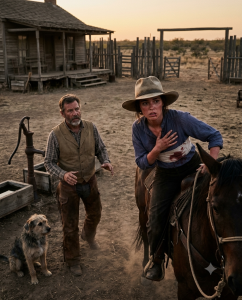
By the time the mare dragged itself through the open gate, the woman on its back looked like she had been held together by stubbornness alone. Summer heat rolled over Calvel County in wavering sheets, and the yard outside Rasco Warkens’s house shimmered with dust, sunlight, and the kind of silence that usually came before trouble.
Rasco had been working the pump when he saw her.
At first he thought he was looking at a boy. The hat was wrong for a woman, broad-brimmed and low. The shirt was plain and oversized. Her shoulders were narrow, but rigid. Then the mare stopped close enough for him to see the line of her jaw, the split in her lower lip, the burn of the sun across her face, and the dark patch of old blood stiffened over one side of her blouse.
She raised her head with visible effort.
“I was told a man named Warkens hired help.”
Her voice was dry and rough, as if every mile behind her had scraped it thinner.
Rasco looked from her face to the saddle, then to the mare—lathered, shaking, and clearly near spent. The woman sat crooked, one hand gripping the horn. She was fighting to stay conscious.
“First thing,” he said, stepping toward her, “we get you down.”
She gave him the look of someone who trusted no one and intended to keep it that way until death made the choice for her.
“I can manage.”
She could not.
The moment she shifted her weight, one boot slid, her body pitched, and if Rasco had not caught her she would have hit the dirt hard enough to finish what the knife had started. His hand landed against her side by accident. She flinched so violently he thought for a second she might strike him.
“I’m fine,” she bit out.
“Sure,” he said. “And I’m the governor of Texas.”
He half-carried her into the house while Chester, his old hound, followed with suspicious interest. Chester had barked at tax collectors, drifters, and one Methodist preacher who’d come by uninvited two winters running. The dog sniffed the woman’s skirt, sneezed, and then settled by the door as if that answered everything.
Rasco sat her on the kitchen bench. She stayed upright by sheer force of will.
The kitchen held the plain comfort of long habit: a scarred table, a cast-iron stove, shelves lined with jars, and a lamp that softened the rough corners of the room after dark. It had been a long time since anyone besides Rasco had moved through it daily. Since his mother died, meals had become an act of necessity rather than care. The place still functioned, but it no longer lived.
He heated water.
“I need to see the wound.”
She watched him with those dark, over-alert eyes.
“You can tell me to go to hell,” he added, “and get right back on that horse. But if you stay, I clean it.”
For a few moments she said nothing. Then she lifted the fabric at her side.
The cut was ugly. Deep. Angry. Someone had driven a blade beneath her ribs and missed killing her by inches. The edges were inflamed and dirty from travel. She had packed it in a hurry and ridden anyway.
Rasco cleaned it carefully, jaw tight, saying nothing more than necessary. He had seen knife wounds before. Men in Calvel County settled all kinds of disputes with steel. But there was something about the wound on her—its placement, its force, the way she braced against the pain without complaint—that told him this had not happened in the heat of a tavern brawl.
Whoever had done it had meant to make sure she did not get far.
“Name?” he asked while wrapping fresh linen around her ribs.
She hesitated long enough for him to notice.
“Clara Hines.”
It landed wrong, but he let it pass.
“Rasco Warkens.”
He set coffee and cornbread in front of her, and she ate with the quiet concentration of someone trying not to reveal how badly she needed it.
“I can cook,” she said after a few bites. “Mend. Keep books. Ride if needed. I’m not asking for charity.”
“I don’t give charity,” Rasco said. “Twelve pesos a month, meals, and a room with a lock.”
At that, something changed in her face. Not softness exactly. More like surprise that bordered on grief.
“A lock?”
“You heard me.”
“When do I start?”
“Tomorrow. Today you sleep.”
She slept sixteen hours.
The next morning Rasco expected to find her feverish or still unable to stand. Instead he found the kitchen swept, biscuits in the oven, coffee already poured, and Clara Hines—if that was her name—sitting at the table with his account books open as if she had lived there all her life.
“You’ve got errors,” she said without looking up.
“Morning to you too.”
She slid one ledger across the table and tapped a column with an ink-stained finger.
“This figure should be carried here, not there. You paid twice for feed in April. Or rather, you wrote that you did. You’ve also got three steers accounted for in sale and not removed from stock.”
Rasco stared.
By noon she had found forty pesos lost in a tangle of sloppy arithmetic. By supper she had reorganized the pantry so efficiently he could find things he had forgotten he owned. Within three days the house smelled like real food again. Within a week Chester had switched loyalties and taken to sleeping outside her room.
She earned her keep fast.
Still, Rasco watched.
He noticed how she checked windows before closing curtains. How she never sat with her back to a door unless exhaustion forced the mistake. How she crossed a room and glanced automatically into corners first. How she startled not at loud noises, but at sudden male voices.
He noticed the folded paper she kept tucked into the lining of her bag. She never read it in front of him, but sometimes he caught her touching it, just once, before bed.
He noticed she never asked whether anyone had ridden by looking for a dark-haired woman on a stolen mare.
And he noticed she never mentioned the mare at all.
The horse itself recovered in the corral and turned out to be a fine animal—too fine, really, for a woman with no money and no belongings besides spare clothes and secrets. Rasco said nothing. Sometimes a man learned more by not asking.
They settled into a rhythm that surprised him.
He handled the outer work of the ranch. She brought order to everything under the roof. He found himself lingering over supper. She stopped flinching when he entered a room unexpectedly. They spoke little at first, then more. About weather. Feed prices. Books. Her handwriting. His mother’s biscuits, which Clara—María—whoever she was, nearly duplicated on the second attempt.
She laughed one evening when Chester stole bacon off Rasco’s plate, and the sound startled both of them.
It was a small laugh. Brief. But Rasco did not forget it.
Weeks later they rode into Haskel for supplies. Clara sat straighter in the saddle than she had the day she arrived, color returned to her face, wound healing under clean bandages. To anyone passing by, they likely looked like employer and ranch hand, maybe neighbors. Nothing more.
Then they stopped outside the post office.
A man stepped out reading from a sheet of paper. He wore city boots dusted from travel, a dark vest, and the careless expression of somebody who expected the world to get out of his way. He never once looked toward them.
But Clara froze.
Rasco saw it happen in her shoulders before he saw it in her face. One second she was handing down a sack of flour. The next, she was motionless, breath held, eyes fixed on that man like prey watching a rifle swing in its direction.
The stranger folded the paper and walked away.
Only then did Clara move again.
“You all right?” Rasco asked.
“Yes.”
It was too quick.
“Did you know him?”
“No.”
The lie was clean. Practiced. Terrified.
Rasco did not press her in the street.
That night she sat at his kitchen table with the ledger open and the lamp burning low. The house felt too quiet. Outside, the ranch settled into darkness, boards creaking softly as the air cooled.
“I’m going to need to stay longer,” she said.
Rasco leaned against the doorframe. “I never gave you a leaving date.”
“Maybe you’ll want one once you know more.”
“I know enough.”
She finally looked up.
Enough to know she worked hard. Enough to know something had hunted her all the way to his gate. Enough to know he had not yet seen her do a single thing to deserve the fear she carried around like a second skin.
That answer did something to her. Relief, maybe. Or disbelief.
After that, the distance between them shifted.
Not quickly. Rasco was not a man for quickness in feeling, and she was not a woman built for easy trust. But evening after evening they found themselves on the porch after chores were done, saying little while the sky drained of color over the fields. Chester lay between them as if appointed guardian of the silence.
He learned she hated thunder because it sounded too much like doors being kicked in. He learned she liked coffee strong enough to wake the dead. He learned she read ledgers the way other people read weather signs—looking not just at numbers, but at what moved beneath them.
She learned that Rasco never cornered a frightened animal. That he did not ask questions simply because he wanted answers. That when he said a room had a lock, he meant no one would test it.
One night, with cicadas droning in the dark and the fields silver under a thin moon, she finally spoke.
“My name isn’t Clara Hines.”
Rasco kept his eyes on the yard.
“All right.”
She let out a breath that trembled.
“My name is María Tonent.”
He turned then, slowly enough not to startle her. Even now, after weeks in his house, after shared meals and shared quiet, she looked as though the truth itself might draw blood.
“And the man who cut me with that knife,” she said, “is still alive.”
Rasco sat back in his chair. “Do you want to tell me the rest?”
For a while she only listened to the insects and the wind. Then, in a low voice, she began.
She had worked in a large house south of Marlen, owned by a cattle broker named Edwin Voss. Respectable to the outside world. Generous at church suppers. Courteous in public. The kind of man people described as successful and solid, which in that part of Texas often meant dangerous in a suit instead of dangerous in spurs.
María had been hired because she was good with figures and careful with records. At first the work had seemed ordinary—sales, land parcels, stock movement, accounts payable. But the ledgers didn’t stay ordinary.
Brands changed between pages.
Cattle listed as sold appeared again under fresh marks.
Land transferred through names that belonged to men long dead.
Payments went out in quiet sums to sheriffs, registrars, and riders who never entered through the front.
At first she thought she was mistaken. Then she started copying entries. Quietly. Just enough to compare one book against another.
“I found a separate ledger,” she told Rasco, her voice flat with remembered dread. “Not in the office. Hidden.”
“What was in it?”
“Names. Amounts. Dates. Property. Men paid to lie. Men paid to disappear livestock. Men paid to file deeds that weren’t legal. Men paid to say a widow had sold land she’d never agreed to sell.”
Rasco’s face hardened.
María went on.
She had not meant to keep reading. But then she found her own name in a margin note. Not as an employee. Not as a witness. As a problem.
The notation was short. Chilling in its neatness.
Resolve before month’s end.
She had copied what she could onto a single folded sheet and hidden it. The next night, she tried to leave. Edwin Voss met her in the stable yard.
“He smiled,” María said, staring past the porch into the dark as if she still saw it happening. “That’s the part I remember most. Not rage. Not shouting. He smiled like I’d insulted him by making him come outside.”
She told Rasco how Voss had asked for the paper. How she had denied having anything. How he stepped close enough to smell of tobacco and pomade and said that women who confused themselves for useful often forgot how easily they could be erased.
She slapped him.
Rasco almost smiled despite himself.
Then María told him about the knife.
Voss had drawn it fast and driven it into her side before she even saw the blade. She remembered stumbling, his hand in her blouse searching for the paper, and the miracle of having hidden it in the lining of her bag instead. One of the stable boys had shouted from across the yard. Voss turned for just a second. María ran.
She took the first horse she could reach and rode with blood soaking her clothes, expecting every mile to be the one where she fell.
“How did you know to come here?” Rasco asked.
“A woman at a boarding house in Bell said you were hard but fair. Said you hired on work, not pity. Said your place was far enough out that a person could breathe before anyone started asking questions.”
Rasco grunted. “That sounds like Nora Bell.”
“It was.”
He nodded once. “Then she sized you right.”
María reached into her skirt pocket and took out the folded paper. This time she handed it to him.
Rasco opened it carefully.
The writing was cramped but precise. There were names he knew. A deputy in Marlen. A registrar in Haskel. Two cattle buyers. One judge’s clerk. Three properties transferred under suspicious timing. Amounts. Dates. Initials tied to Edwin Voss.
It was dynamite disguised as ink.
“Why not turn this over to the sheriff?” Rasco asked, though he suspected the answer.
She gave him a tired look. “Which sheriff?”
Fair enough.
The problem with corruption in small places was never just the man at the center. It was the circle around him—those who ate because he fed them, those who looked away because he frightened them, and those who preferred profit over conscience.
Rasco folded the paper again. “He’ll come for it.”
“He already has,” María said.
As if summoned by the words themselves, Chester’s head lifted. The dog did not bark. He growled.
Then came a knock from the front gate.
Slow. Deliberate.
María stood so fast her chair scraped the boards. “No lamp,” she whispered.
Rasco snuffed it with two fingers and moved to the edge of the porch. Moonlight was thin, but enough to silver the fence line. Enough to show the outline of a horse beyond the gate.
Another knock.
Then a man’s voice, calm and smooth.
“Don’t make this uglier than it already is, María.”
Rasco felt her go rigid behind him.
The voice came again. “You took something that doesn’t belong to you. Bring it out, and I’ll be merciful.”
Merciful. The kind of word certain men liked best when they meant the opposite.
Rasco looked back once. María’s hand was clenched around empty air now; he had the paper. Her face had gone pale, but her eyes were steady in a way they had not been on the day she arrived.
“That him?” Rasco asked quietly.
“Yes.”
The gate creaked open.
Rasco reached for the shotgun standing by the porch door. María grabbed his sleeve hard enough to stop him.
“No,” she whispered. “That’s what he wants. He brought witnesses.”
Rasco looked past the yard and saw movement where the moon caught metal. Not one rider. At least three. Maybe four, hanging back in the dark where they could claim later they’d seen only what suited them.
Edwin Voss stepped through the gate like a gentleman arriving for supper. He was taller than Rasco expected, clean-shaven, coat buttoned despite the heat. His confidence moved ahead of him like a scent.
“Mr. Warkens,” he called, as if this were a social call. “I apologize for the hour. The lady with you is in possession of private business records stolen from my household.”
“Funny,” Rasco said from the porch. “She told me she left your household with a knife in her ribs.”
Voss gave a small, regretful smile.
“She’s unstable. Imaginative. I was hoping to spare her the humiliation of public trouble.”
María let out a sound that might have become a laugh in another life. Here, in the dark, it came out like disbelief sharpened into contempt.
Voss looked toward her voice. “You’ve caused enough difficulty.”
“You tried to kill me.”
“I tried to stop a thief.”
Rasco could feel the balance of the night shifting. Men like Voss didn’t rely only on force. They relied on plausibility. On speaking calmly while others bled. On arriving with witnesses already primed to believe him.
He stepped down off the porch.
“Say I hand over the paper,” Rasco said. “You leave?”
Voss paused. “I take Miss Tonent with me.”
María’s breath caught once behind him.
“There it is,” Rasco said.
Voss’s expression cooled. The polished mask thinned enough to show the harder thing beneath it.
“She is not your concern.”
The wrongness of that sentence settled like iron in Rasco’s chest.
He had not known María long by the measure most people used. But he knew enough. Enough to know the difference between a liar protecting power and a woman cornered into silence. Enough to know that men like Voss survived because decent people kept mistaking patience for weakness.
Rasco held up the folded paper.
“You want this?”
Voss took a step forward.
“Come get it.”
Everything happened at once after that.
One of the riders in the yard moved too quickly. Chester lunged off the porch in a blur of teeth and noise. A horse shied. Someone shouted. Voss went for the pistol under his coat instead of the paper, proving exactly what sort of conversation he had come to have.
Rasco fired first.
The blast shattered the yard’s false civility. Voss’s gun spun from his hand and landed in the dirt. One of the witnesses bolted immediately, because men who come to stand near power rarely stay brave once lead starts flying. Another ducked behind the fence, cursing. Chester had a third by the pant leg and no intention of letting go.
María did not scream.
She moved.
Before Rasco could stop her, she ran down the porch steps, crossed the yard, and snatched Voss’s fallen pistol from the dirt. She stood over him with both hands on the grip, wound long healed but memory plainly fresh in every line of her body.
Voss stared up at her, finally stripped of elegance.
“You won’t shoot,” he said.
For a moment even the horses seemed to hold still.
María’s hands trembled.
Then she lowered the pistol an inch—not in surrender, but in judgment.
“No,” she said. “You don’t die easy enough for that.”
She turned to the riders hanging back in the dark.
“You all know who he is,” she shouted. “You know what he’s done. The cattle records, the forged deeds, the widow parcels, the bribes. You’ve seen it. You’ve been paid by it. You can run tonight, but you’ll still be tied to him when this paper reaches Austin.”
That hit them where the shotgun hadn’t.
Fear of gunfire was one thing. Fear of being named in writing was another.
Voss surged up from the dirt then, desperate and ugly, and Rasco hit him hard enough to put him down for good. When Voss tried again, Chester ended the debate by planting himself on the man’s chest with a growl that sounded like judgment.
By dawn, Rasco had Voss trussed in the barn and two of the riders gone entirely. The one Chester had chosen to keep had become surprisingly cooperative. Men often discovered honesty after a close look at consequences.
The next step was the dangerous one: getting the paper beyond local hands.
Rasco and María rode out at first light with two copies—one hidden in Rasco’s boot lining, the other sewn by María into the hem of her skirt. They bypassed Marlen, bypassed Haskel, and took the long road to a district office where Voss’s closest friends held no sway. It took testimony, persistence, and one furious widow who recognized her dead husband’s forged signature before the thing finally broke open.
Once it did, it broke wide.
Records were seized. Names surfaced. A registrar vanished before arrest, which proved almost as much as confession. A deputy was suspended. Two buyers turned state’s evidence when they realized Voss could no longer protect them. The land transfers were reviewed. Some could not be undone. Some could. Widows got hearings they should have had years earlier. Small ranchers learned why cattle had gone missing and debts had appeared from nowhere.
Edwin Voss stood trial not for one crime, but for a web of them.
Attempted murder was the simplest charge.
Fraud, conspiracy, bribery, coercion, falsified transfers—those took longer to untangle, but untangle they did. The polished man from church suppers and town meetings turned out to be exactly what María had said: a creature of ledgers and threats, one who believed he could erase people as neatly as he moved numbers from one column to another.
He was convicted.
Not because the system suddenly became pure. Not because justice arrived clean. But because one wounded woman had stolen proof before she bled out in a stable yard, and because one stubborn rancher had looked at a stranger dying in his dust and decided not to look away.
Months later, when autumn cooled the fields and Calvel County finally smelled less like heat and more like earth, María stood in the kitchen holding a letter. Chester sprawled at her feet. Rasco was repairing a hinge by the window.
“It’s final,” she said.
He looked up. “Which part?”
“The last of the disputed parcels. The widow Herrera gets her land back.”
Rasco nodded once, satisfied.
María set the letter down. The kitchen no longer felt like his old lonely room. It felt shaped by two people now—her order, his steadiness, shared mornings, shared labor, shared silence earned the hard way.
“You never asked me to leave,” she said quietly.
“No.”
“You never asked me to stay either.”
Rasco set the hinge aside and met her gaze.
“I figured if you stayed, it ought to be because you chose it.”
Something moved across her face then, something deeper than gratitude. Not the desperate relief of the night she arrived. Not the brittle caution of the weeks after. Something steadier.
“I’m choosing it,” she said.
Rasco smiled—not big, not dramatic, but real enough to change the whole room.
Chester thumped his tail once, as though this outcome had long been obvious to him.
Later, people in town would tell the story different ways. Some would say María Tonent brought down Edwin Voss with nothing but nerve and a folded page. Some would say Rasco Warkens took on a powerful man because he was too stubborn to fear him. Both were true, and neither was the whole truth.
The whole truth was messier.
It was about how evil often arrives well-dressed and reasonable. How danger can wear a pleasant smile. How a false name can still belong to an honest woman, and a respected name can hide a rotten man. It was about the difference between someone asking for charity and someone asking for the chance to stand back up.
And if there was one detail people argued over most afterward, it was not whether Edwin Voss deserved what came to him. It was whether the first red flag had been the hidden ledger, the forged land, or the knife.
María had her own answer.
It was the smile.
Because the moment a person can hurt you and still look kind doing it, the truth is already far worse than anyone wants to believe.