He wanted a wife to tend chickens. What he got instead was the woman who saved his land, uncovered a theft, and changed the story of Harrow Flats forever.
Maryanne Collins had already learned the hard way that a letter could lie.
For three months she had lived inside someone else’s promises. She had read and reread every line written by the man in Ohio who claimed he was lonely, respectable, and looking for a good woman to build a proper life with. His handwriting had been neat, steady, almost comforting. He had written about a small church, a decent house, and a future he said would be honest.
He had asked her to come.
Not blindly. Not recklessly. He had made it sound thoughtful, serious, even tender in his restrained way. Maryanne, who had spent enough of her life being overlooked, judged, or politely dismissed, allowed herself to believe that perhaps steadiness was better than charm. Perhaps a man who wrote plainly might live plainly too.
Before leaving Cincinnati, she packed carefully. She sold what she could not carry. She kept only what mattered. Among the last things she prepared was a blue dress she had sewn herself, fine enough for church, sturdy enough to last. He had once written that blue was his favorite color. Foolishly, privately, she took that to mean something. She folded the dress into a box and shipped it ahead so it would arrive before she did.
When Maryanne finally reached the church where they were meant to meet, she was tired, nervous, and trying very hard not to let either show on her face.
Then she saw another woman coming out on his arm.
The woman was laughing lightly, head tilted, pleased with herself in the way of people who have never had to doubt they belong where they stand.
She was wearing Maryanne’s blue dress.
For one strange second, Maryanne thought her exhausted mind was inventing cruelty. Then she saw the details only she could know: the tiny patch beneath the collar where the fabric had thinned, the imperfect seam in the left sleeve, the stitch that bent just slightly because she had sewn it by lamplight after midnight. The dress was hers. Her hands had made it. Her hope had traveled in it.
The woman passed without meeting her eyes.
The man did not even have the grace to look ashamed.
“You’re not what I expected,” he said.
Maryanne never forgot the calm in his voice. Not anger. Not embarrassment. Merely rejection, clean and efficient, as if he were refusing a shipment of goods.
She did not argue. Dignity was sometimes the only thing left to carry, and she would not set hers down in front of strangers. She turned around, walked back to the station, and held herself together until she was alone.
That night she burned every letter but one, and in the morning she burned the last one too.
By noon she had answered a different advertisement.
It was almost rude in its bluntness.
Ethan Callahan of Harrow Flats sought a woman able to work, cook, keep a house, and handle animals. No courtship promised. No comforts offered. Wages, food, shelter, and labor.
Maryanne read the notice twice.
No lies, she thought. That was already an improvement.
She wrote back yes.
The journey west was long enough for second thoughts, but Maryanne had run out of patience with regret. By the time the stagecoach rolled into Harrow Flats, she was sore, dusty, and done expecting kindness. The town looked weathered down to its bones. Paint peeled. Boards warped. Men moved like they had no energy to waste on strangers. Women measured newcomers quickly and turned back to their work. The heat fell hard and mercilessly.
There was no sign of Ethan Callahan.
Maryanne waited beside the stagecoach stop with her bag at her feet and the sun needling through her hat. Fifteen minutes passed. Then twenty. Nobody came. A stray dog sniffed her bag and lost interest. Two riders trotted by without speaking. In the general store window, a woman looked straight at Maryanne and then drew the curtain shut.
Maryanne picked up her bag and marched into the store.
The shopkeeper gave her one long look, lingering in the insulting way she had known since girlhood.
“I’m looking for Ethan Callahan,” she said.
“You the one answered his ad?”
“Yes.”
“The ranch is four miles north. Hard road.”
“I’ve walked harder ones.”
He named the direction but offered nothing more. Maryanne bought two rolls and some cheese. As she stepped back into the street, laughter followed her.
“With that size, she thinks Callahan’s gonna want her.”
The words struck, because cruel words always did. But Maryanne had been hit by them before. She knew the difference between pain and damage. She kept walking.
The road north was all dust, glare, and disappointment. Her city shoes were never meant for it. The strap of her bag chewed into her palm. Sweat dampened her collar and trickled down her spine. Still she kept moving, one mile, then another, each step a small refusal to break where others expected it.
About halfway there, an old man in a wagon pulled alongside and slowed.
“You heading to Callahan’s?”
“Yes.”
He studied her face, then her shoes, then the road behind her. “Get in before you fall over.”
His name was Henderson. He smelled of hay and weather and spoke like a man who had lived long enough to stop wasting words.
As the wagon bumped along, he told her what nobody in town had bothered to mention with sympathy.
“Carver’s wanted that land two years now. Ethan owes money. If he can’t show the ranch is producing by October, the bank’ll take it or Carver will manage something uglier.”
Maryanne looked toward the northern rise where the ranch sat somewhere beyond the heat shimmer.
“Then we’ll make it produce.”
Henderson turned to her in surprise, not mocking this time, just honestly startled. “You talk like that can be done.”
“The ranch still standing?”
“Barely.”
“Then it’s not dead.”
He made a low sound in his throat, half amusement, half doubt. At the gate, he let her climb down and said, “Land’s got good bones.”
The Callahan place looked like a body still breathing from stubbornness alone. The house leaned just enough to show strain. The chicken coop door hung crooked. Hens pecked wherever they pleased. Fence posts sagged. One side of the yard had gone half to weeds. The porch steps complained beneath her feet. Somewhere inside there was the smell of burnt coffee and stale air.
Then the front door opened and Ethan Callahan came out holding a hammer.
He was bigger than she had pictured from his letters, though his letters had been so brief they gave little away. Tall. Broad. Sun-browned. His face might once have been open, maybe even easy to read, but worry had pulled something shut behind his eyes.
“You came anyway,” he said.
“You said you’d be waiting.”
“I got held up.”
“And I got left to walk four miles in the sun carrying my own bag. Are you going to keep talking from that porch, or can I come inside?”
A flicker crossed his face. Not offense. Not quite humor. Something like respect interrupted by surprise. He stepped aside.
Her room was small but clean enough. Maryanne put down her bag and returned immediately to the kitchen, where a pan sat unwashed and coffee had scorched itself nearly black.
“The chickens are loose,” she said. “The latch is broken. The south fence is down two posts.”
“I know what’s broken.”
“I’m sure you do. I’m telling you what demands attention first.”
He bristled, but she had seen enough men confuse pride with authority to recognize the posture. Beneath it she saw his wrists were thinner than they should be and the tightness around his mouth looked less like temper than hunger.
“When did you last eat?” she asked.
“This morning.”
“What?”
“Coffee.”
Maryanne rolled up her sleeves. “Sit.”
“I didn’t hire you to order me around.”
“And I didn’t travel across four states to watch you starve in your own kitchen.”
It was the first moment he looked directly at her, really looked, not at her size or her sharp tongue but at the force of her standing there as if she had every right. Slowly, he pulled out a chair and sat.
She found beans, salt pork, stale meal, and a strip of smoked venison that had almost been forgotten. By the time she was done, the kitchen smelled alive. Ethan ate as if he meant to remain reserved, then abandoned the effort after three bites. Maryanne pretended not to notice how quickly his plate emptied.
After supper he went out to check the fence. Maryanne washed the dishes, dried her hands, and stood at the window facing the back field.
The land told stories if a person bothered to look. The grass near the house was poor but not dead. The east patch was too dry compared with the low bend by the creek. The chickens clustered oddly, scratching where the ground held more moisture. And near the creek itself, beneath weeds and dirt, there was a line that interrupted the natural slope.
Maryanne leaned closer.
It looked like a trench.
Old, partly hidden, but too straight to be chance.
When Ethan came back in, dust on his boots and fatigue in every line of him, she was still staring through the glass.
“What is it?” he asked.
She pointed. “Has that always been there?”
He came to the window. His eyes narrowed. “What am I looking at?”
“Someone cut the ground there once. See how it runs? Not with the hill. Against it.”
He was quiet for too long.
“Tomorrow,” he said at last. “I’ll check it tomorrow.”
Maryanne turned toward him. “Why tomorrow?”
“Because it’s near dark.”
“Which is exactly when people who don’t want to be seen prefer to work.”
His jaw hardened. “You don’t know this land.”
“No,” she said. “But I know what it looks like when someone is being robbed while everyone else calls it bad luck.”
He stared at her, and in that silence she understood two things. First, he had suspected something. Second, he had not wanted to name it because naming a threat makes it real.
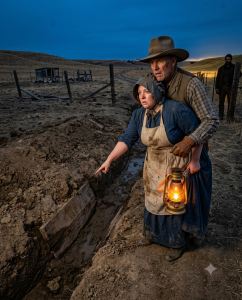
Finally he set the hammer down and reached for the lantern.
They crossed the yard in thickening dusk, the black hen raising a terrible racket behind them as if objecting to the entire expedition. Crickets had begun their evening chorus. The creek smelled of mud and heat. Maryanne crouched where she had seen the line and dug her fingers into the dirt. It came loose too easily from the top, packed too deliberately underneath.
“There,” she said.
Ethan knelt beside her and brushed away more soil. Under the dirt lay boards, old but placed with intention. A narrow man-made trench split off from the creek, redirecting water before it could reach the lower grazing section that should have fed Callahan’s herd.
Ethan went still.
“Someone diverted it,” Maryanne said softly.
“I can see that.”
“Who?”
His mouth flattened. “I don’t know.”
But his eyes gave him away.
“Carver?” she asked.
He exhaled through his nose. “I can’t prove it.”
“Yet.”
He looked at her sharply, as if the word itself had changed the shape of the night.
Then a twig snapped behind them.
Both of them turned.
A figure stood near the fence line, almost swallowed by dusk. Ethan lifted the lantern, and the yellow light climbed over boots, trousers, a coat, a jaw, and finally a face.
Maryanne’s pulse jumped.
She had seen that face before.
Not here, not on this land, but earlier that day in Harrow Flats—outside the general store, leaning in the shade, watching her with narrowed eyes while the others laughed. She remembered the lazy smirk, the look of a man who enjoyed carrying someone else’s contempt. Now the smirk was gone.
“What are you doing on my land?” Ethan called.
The man did not answer at first. Then he spat to one side and said, “Could ask you the same. Digging around after dark.”
“This is my ranch.”
“For now.”
The words hung in the air like a threat spoken too often to bother dressing up.
Ethan rose to his feet. “Tell Carver if he wants something from me, he can come say it himself.”
The man’s mouth twisted. “Mr. Carver don’t answer to broke men.”
Maryanne stood too, brushing dirt from her skirt. “Interesting,” she said. “We never mentioned Mr. Carver.”
The man glanced at her, and something contemptuous flashed in his face. “You should stay out of men’s matters.”
Maryanne gave him a calm look that had withered better men than him. “You first.”
He took one step forward, reconsidered when Ethan moved, and backed away instead.
“October’s coming,” he said. “Wouldn’t get too attached to this place.”
Then he disappeared into the dark.
For a moment only the creek could be heard.
Ethan stared after him with his shoulders rigid. “Damn him.”
“No,” Maryanne said. “Not him. The one who sent him.”
He looked at her. Lantern light sharpened the fatigue in his face, but something else was there now too—a dangerous, returning focus.
“We need proof,” she said.
“We need water.”
“We need both.”
The next morning began before sunrise. Maryanne woke to the smell of coffee attempted and failed again by Ethan, rescued the pot before it turned to tar, and set the kitchen in order as if she had always belonged there. Ethan said little. Men used to carrying everything alone often mistook silence for strength. Maryanne let him keep the habit where it did no harm.
By daylight the trench looked worse than either of them had thought. It had been dug carefully, widened in parts, hidden with brush and boards. It carried just enough water away to weaken the fields slowly, believably. Not disaster. Attrition. The kind of sabotage that could be blamed on drought, incompetence, or plain bad fortune.
Maryanne stood over it with her hands on her hips. “Whoever did this expected you to fail quietly.”
“That would be Carver’s style.”
“Then quiet is the last thing we should be.”
Ethan’s expression shifted. “What are you thinking?”
“Who in this town still likes you?”
He almost smiled. “That’s a short list.”
“Good. Then we start with the honest ones.”
Henderson came first. He climbed down from his wagon, squatted by the trench, and swore under his breath. Then came the blacksmith, who had no fondness for Ethan but even less for Carver. Then the bank clerk’s brother, who said nothing for a long time and then admitted Carver had been asking pointed questions about the Callahan place for months. By afternoon, there were enough eyes on the trench that it could not be dismissed as one man’s excuse.
Carver arrived before sunset.
He rode in with the ease of a man who believed the land had already decided to belong to him. He was smooth where Ethan was rough-edged, carefully dressed even in the dust, with the polished confidence of someone who won by letting others do the dirty work.
He glanced at the gathered townsmen, the trench, the boards stacked as evidence, and finally Maryanne.
“So this is the help you hired,” he said. “Unexpected.”
Maryanne held his gaze. “You’re the neighbor who steals water. Also unexpected, though less surprising.”
A few of the men looked down to hide smiles.
Carver’s own smile thinned. “Careful. Accusations have a cost.”
“So does theft.”
He turned to Ethan. “You can’t prove I did anything.”
“No,” Ethan said. “But your man could.”
Carver’s eyes sharpened. “My man?”
“The one snooping my fence line last night.”
For the first time, Carver looked genuinely inconvenienced. Tiny thing. Brief thing. But Maryanne saw it and knew she was not wrong.
Then Henderson spoke up. “Funny how often your riders are seen near Callahan Creek.”
Another man added, “And funny how your south pasture’s been greener than a bishop’s pocket through a dry spell.”
Murmurs rose. Carver realized too late that the crowd was no longer neutral.
He laughed, but the sound lacked warmth. “Even if water wandered, land disputes aren’t settled by gossip.”
“No,” Maryanne said. “They’re settled by witnesses.”
She had spent the afternoon doing more than gathering spectators. While Ethan and Henderson exposed more of the trench, Maryanne had gone to the general store and spoken to the shopkeeper’s wife instead of the shopkeeper himself. Women heard things men said too carelessly at supper. By the time Maryanne returned, she had learned that one of Carver’s ranch hands had bragged in town after whiskey that Callahan wouldn’t last till first frost. She had also learned the bank had postponed action twice because Carver kept insisting the ranch was beyond saving and better sold cheap.
Piece by piece, not enough for a court yet but enough for pressure, the story had started to form.
Now she used it.
“You were certain this ranch would fail,” she said to Carver. “Before anyone else was. Strange confidence for a man who claims no involvement.”
Carver took a slow breath, then smiled at Ethan in a way that made his contempt unmistakable. “You’re really going to let her fight this for you?”
Ethan’s voice was flat. “No. I’m going to stand beside her while she wins it.”
Something in the crowd changed then. Maryanne felt it as clearly as weather. Men who had laughed at her size a day earlier were now looking at her as if reassessing not just her, but themselves.
Carver must have felt it too.
He made one last attempt to regain control. “This proves nothing.”
A new voice cut in from the back.
“It proves enough for me.”
The speaker was Mr. Talbot from the bank, hat in hand, face set. No one had seen him arrive. He stepped forward, examined the trench, and looked at Carver with cool disgust.
“I delayed foreclosure because I believed Callahan’s losses might be due to mismanagement,” he said. “It appears I was too charitable in the wrong direction.”
Carver’s composure finally cracked. “You have no authority to—”
“I have every authority to suspend proceedings while this is investigated.”
The silence that followed was almost sweet.
Carver glanced around and understood that the mood had turned fully against him. He could not bully a whole town at once, not with witnesses gathered and the bank watching. Without another word, he wheeled his horse and rode off hard enough to throw dust in everyone’s face.
Nobody moved until he was gone.
Then Henderson barked a laugh. “Well, I’ll be damned.”
The blacksmith slapped Ethan on the shoulder. “Looks like your ranch just got a stay of execution.”
It took weeks to undo the damage. The trench had to be filled properly, the creek flow redirected, the lower pasture coaxed back to life. Fences were repaired. The chicken coop was rebuilt under Maryanne’s merciless supervision. She reorganized the feed room, counted every egg, bartered surplus butter in town, and discovered that the black hen everyone disliked laid more reliably than the others if spoken to politely and left alone.
Ethan stopped trying to hide his admiration somewhere around the second week.
He also stopped calling the kitchen “mine” and began saying “ours” without noticing.
The ranch changed because Maryanne did not see ruin where others did. She saw sequence. First food. Then water. Then shelter. Then production. She set hens where they would thrive, planted what could still take root, and pushed Ethan to think in months instead of disasters. When he fell into silence, she filled it with plans. When he pushed too hard, she ordered him to sit and eat. When men from town came by under the excuse of checking fence lines, she put them to work and sent them home talking about the woman who could outstare a drought.
By autumn, the lower field was green enough to draw comment. Egg production had doubled. The house no longer smelled like defeat. Even Harrow Flats had changed its tone. The same store that had laughed when Maryanne arrived now kept aside the good flour when they expected her in. The woman who had closed the curtain waved from the window. Men who had mocked her size tipped their hats and found reasons to speak respectfully.
And Ethan—
Ethan became dangerous in a different way.
Not because he was hard. He had always been hard. But because once his pride stopped fighting her, his tenderness emerged with equal force. It was in the way he repaired the kitchen shelf she merely mentioned was loose. The way he noticed when she was tired and took over chores badly but earnestly. The way his eyes rested on her when he thought she was not looking, full of something he did not yet dare say.
Maryanne noticed. Of course she did. She also noticed her own heart becoming less cautious every day she spent in a place where work was honest, conflict was plain, and respect had to be earned rather than begged for.
One evening, after the first proper rain in months, they stood on the porch together while the hens settled and the land drank deeply.
“You saved this place,” Ethan said.
Maryanne shook her head. “The land had good bones. Henderson said so.”
“You knew what to do with them.”
She looked out at the pasture, then at him. “You let me.”
He was quiet for a moment. “I almost didn’t.”
“I know.”
“And you stayed anyway.”
Maryanne smiled a little. “I’ve learned not to leave just because a man starts out foolish.”
He laughed then, a real laugh, rusty from disuse.
By winter, the bank had formally extended Ethan’s notes under terms far kinder than before. Carver’s influence in town had shrunk to a bitter echo. One of his former ranch hands, cornered by debt and whiskey, admitted enough to confirm what everyone already believed: the trench had been dug under orders meant to weaken Callahan’s land until sale became inevitable.
Carver never recovered his standing.
The Callahan ranch did more than survive. It became the place people pointed to when speaking of impossible turnarounds. Travelers heard versions of the story in saloons and stores. Some told it as a tale of sabotage exposed. Others told it as a tale of a desperate rancher saved by luck. But in Harrow Flats, among those who had watched it happen, the truth settled into something simpler.
A woman arrived after being humiliated by one man and underestimated by all the rest.
Then she saw what nobody else had bothered to see.
And she refused to let it die.
When Ethan finally asked Maryanne to marry him, he did not do it with polished speeches or practiced promises. He stood in the kitchen she had transformed, holding his hat in both hands like a man aware that sincerity was all he had worth offering.
“I first asked for someone to work,” he said. “Then I found out I needed someone brave. Then someone smart. Then someone kinder than I deserved. Somewhere along the way, the ranch stopped being what I was afraid of losing, because you became what I was most afraid to live without.”
Maryanne let him suffer in silence for one heartbeat more than necessary.
Then she said yes.
Years later people still talked about the day Maryanne Collins came to Harrow Flats in broken city shoes and walked into a ruined ranch like it was merely a difficult kitchen waiting to be put right. They talked about the stolen water, the exposed scheme, the season the fields came back greener than anyone believed possible.
But the part that lingered longest was not the scandal.
It was the correction.
Because in the end, the biggest mistake anyone made was not underestimating the ranch.
It was underestimating the woman who stepped off that stagecoach carrying humiliation in one hand and determination in the other—and turned both into a future.
Some said Ethan Callahan was lucky.
Some said Maryanne was stubborn.
Both were true.
But the real miracle of Harrow Flats was this: after all the lies, all the mockery, all the quiet cruelties that had tried to shrink her, Maryanne built a life in a place that finally grew to fit her worth.
And if there was any lesson left in the dust after the whole story settled, it was one the town never forgot:
The first red flag was never Maryanne’s size.
It was how many people mistook cruelty for judgment, and pride for truth.