When Marina Hayes pressed her inked thumb onto the contract, Lyall Granger smiled like a man finishing dirty business.
That smile told her everything she needed to know about how he saw her.
Not as a worker. Not as a woman. Not even as fully human.
Just something to move from one hard life into another.
“She’s deaf as stone,” Granger told Holt Callahan, nudging Marina forward as if she were livestock. “Doesn’t hear, doesn’t argue, doesn’t ask questions. She works, eats little, and sleeps wherever you put her.”
Marina kept her face still.
She had learned long ago that silence was safer than outrage, and that men who thought they were unobserved often revealed more than they meant to. In Granger’s case, the lie had begun weeks earlier in a cramped boardinghouse in Delwood. He had noticed how little she spoke, how carefully she watched, and decided to turn her silence into a story that made her easier to sell.
A deaf woman, in his mind, was useful.
A voiceless woman was profitable.
So he built a lie around her, and Marina let him.
Because what Granger never understood was that a woman people dismissed could hear things they would never say in front of anyone they considered dangerous.
Holt Callahan looked up only after Granger had finished talking. His expression was hard, tired, and almost painfully restrained. He had the face of a man who had once expected better things from life and had been taught otherwise one season at a time.
“Is she healthy?” he asked.
“Healthy enough,” Granger said. “And cheap.”
That word landed harder than Marina expected.
Cheap.
Not because she had never been judged before, but because Holt did not argue. He looked at the broken shape of his ranch behind him, tightened his jaw, and signed the paper anyway.
She understood then that he was desperate.
The Callahan ranch told its own story. Fences leaned where they should have stood straight. A step on the porch was cracked down the middle. The barns looked weather-beaten and overused. Even the yard carried the look of a place surviving out of stubbornness instead of security.
This was not a thriving ranch buying extra help.
This was a drowning house reaching for anything that would float.
Duly led Marina to a narrow room behind the kitchen, speaking gently even though he knew she supposedly could not hear him. That alone made her look at him twice. He was young, awkward, and a little too transparent for ranch life, where decent men usually learned to hide it.
As he set her bag near the cot, voices drifted through the walls.
Ree, amused and crude.
Straw, older and tense.
Holt, clipped and impatient.
Marina sat on the edge of the narrow bed and listened to all of them.
Ree laughed about “the mute.”
Straw muttered something about debts.
Holt snapped that if everyone had enough energy to talk, they had enough energy to work.
By dawn the next morning, Marina knew more about the household than anyone realized.
She also knew the kitchen was a disaster.
The stove pipe was half blocked. Dry goods were mixed with spoiled ones. A sack of flour had been left open to damp air. The shelves had no order. The coffee was weak. The bread box was nearly empty. Whoever had been managing the place before had either left, collapsed, or given up.
Marina did what she had always done in places where no one expected much from her.
She made herself indispensable.
She cleaned the flue with an old knife and a strip of rag. She sorted the pantry. She hung herbs near the window to dry. She kneaded dough while the sky was still dark and had fresh rolls ready just as the men drifted in.
Duly stopped dead when he smelled them.
“Good Lord,” he said softly.
He snatched up two while they were still too hot and burned his fingers. Marina nearly smiled.
The others came in with suspicion written plainly on their faces, but hunger overruled pride. They sat. Ate. Reached for coffee. Held out cups for refills without asking how she knew when they were empty.
Marina served and listened.
Ree complained that the last cattle run had brought in less than expected.
Straw said, too quietly, that Graves would not wait forever.
Holt shut him down at once.
“That’s enough.”
It was not enough for Marina.
She had lived too long around fear not to recognize its shape when it entered a room. The name Cornelius Graves changed the air. Men spoke it as if it belonged to weather, disease, and bad luck all at once.
Over the next two weeks, Marina learned the rhythms of the ranch.
Duly rose early and whistled when nervous.
Straw’s joints stiffened in cold mornings.
Ree worked hard but let contempt leak from him whenever he thought no one important was watching.
Holt slept too little, rode too far, and carried responsibility like a wound he had stopped expecting to heal.
He never spoke kindly just to hear himself do it. Yet he never treated Marina with the casual cruelty she had known elsewhere. He was curt. Distracted. Often severe. But there was discipline in him, not meanness. A line he still would not cross, even when worn down.
That difference mattered more to Marina than she wanted to admit.
On the fifteenth day, while looking for salt in the pantry, she noticed a warped board behind the lower shelf. She pried it back and found an account ledger wrapped in cloth.
The figures inside told the truth no one had wanted spoken aloud.
Two liens.
Heavy interest.
Missed deadlines.
And one brutal clause that allowed the lender to demand immediate full payment with thirty days’ notice.
Cornelius Graves was not simply waiting for repayment.
He was circling for possession.
Marina stood over the ledger while late afternoon light pooled across the kitchen table. By the time she closed it, she understood Holt Callahan’s exhaustion in a way she had not before. He was not fighting to rebuild a ranch.
He was fighting a countdown.
That night Holt came in covered with dust and silence. Marina set a plate in front of him. He looked around the kitchen and seemed to really see it for the first time. The repaired latch. The orderly shelves. The clean surfaces. The decent meal.
“Did you do all this yourself?”
She nodded.
His tired expression shifted, just barely.
“Well,” he said.
It was not much. But Marina had learned to measure sincerity by the ounce, and that one word held more respect than any flattery Granger had ever spoken.
The moment that changed everything came on a Thursday.
Ree stormed in muddy, impatient, and ugly in the way some men became when they needed someone weaker to stand beneath them. He demanded coffee and then made a filthy remark, smiling as he said it because he believed Marina could not understand.
She turned and looked directly at him.
No outrage.
No fear.
Just a long, level stare that stripped the grin off his face.
The back door opened behind him.
Holt stood there, taking in the room in one quick glance. He didn’t ask for explanations. He didn’t soften it.
“Ree. Fence line. Now.”
Ree muttered once under his breath, then left.
Holt washed his hands at the basin and dried them slowly, giving the silence room to settle. Then he looked at Marina.
“You all right?”
She nodded.
He paused at the doorway.
“That won’t happen again.”
After he left, Marina stared at the stove and tried not to feel too much. Gratitude was dangerous enough. Anything beyond it was foolish.
Still, something had shifted.
A few days later, she rode with Duly into Delwood for supplies. Duly had a habit of talking to fill empty space, and Marina used that to her advantage, nodding in the right places while counting doors, distances, and the time it would take to slip away unnoticed.
She found lawyer Aldis Fitch in a cramped office that smelled of paper and old wood polish.
He looked up, startled when she entered alone. Marina took a scrap of paper and wrote quickly:
What can be done if debt papers were filed wrong?
Fitch studied her over his spectacles.
“You’re not asking out of curiosity.”
She wrote another line.
Does it matter?
Something in that answer made him stop treating her like a servant who had wandered in by mistake. He asked a few short questions. She gave him careful, limited information. Not names yet. Not until she knew more. But enough.
Fitch leaned back.
“If a lien was recorded with the wrong legal description, or if dates conflict between filing and notice, enforcement can be challenged,” he said. “An acceleration clause is powerful, but it’s only as strong as the paperwork behind it. A man using one bad document as a weapon can lose the whole strike if the court sees the error.”
Marina memorized every word.
When she left the office, her pulse was beating so hard she could feel it in her wrists.
For the first time, hope entered the picture.
Not soft hope. Not comforting hope.
Sharp hope.
The kind that came with risk.
On the ride back, that risk deepened.
Straw fell from the hayloft and landed badly, crying out as he hit the ground. The others rushed in, but Marina was already at his side. She examined the arm quickly, calmed him with a hand on his shoulder, and wrapped the injury with practiced efficiency using strips torn from an old clean sack and a splint cut from scrap wood.
Everyone stared.
Holt most of all.
When she rose, his eyes were on her as if a door had opened in a wall he had assumed was solid.
“Marina,” he said.
She turned.
“That was well done. I don’t know what Granger told me about you, but I’m starting to think almost all of it was a lie.”
She met his gaze and felt a dangerous awareness pass between them.
He did not know the half of it.
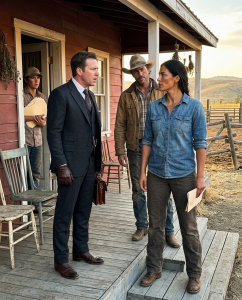
Three mornings later, Cornelius Graves arrived.
His wagon was polished. His boots were polished. Even his gloves looked expensive. He stepped down into the dust like a man entering property already mentally itemized and claimed.
Marina stood at the kitchen window with a dish towel in her hands and listened.
“You’ve had enough extensions,” Graves told Holt. “At this point, Callahan, you’re delaying the inevitable.”
Holt’s voice was cool. “Then why are you here in person?”
“Because I prefer to inspect what I acquire.”
Acquire.
There it was. Not recover. Not settle.
Acquire.
Marina moved onto the porch carrying a wash basin, her face composed, her body language blank and useful. Graves’s eyes skipped over her in an instant. To him she was furniture with feet.
That suited her perfectly.
Then he said the sentence that changed her understanding of everything.
“You should’ve sold when Granger told you to. It would have saved us both trouble.”
Us.
Not me.
Us.
The word hit Marina like cold water.
Granger and Graves were connected.
Maybe not casually.
Maybe not recently.
Connected enough that one referred to the other as a partner in the same problem.
She carried the basin inside before anyone could see the reaction on her face, but her mind was already moving. If Granger had planted her there knowingly, had he intended only cheap labor—or was he helping Graves watch the ranch from inside? Had her arrival been one more quiet pressure point in a larger scheme?
Outside, Holt said, “You seem unusually informed for a lender.”
Graves laughed. “A man protects his investments.”
When Holt came in later, the weariness in him looked close to physical collapse. Marina handed him a cup of water. Their fingers brushed, and he looked up sharply.
She had not hidden her anger in time.
For one suspended moment, he stared at her as if seeing several truths at once.
Then, quietly, he said, “You understood every word out there, didn’t you?”
Marina froze.
The lie that had protected her for weeks suddenly felt thin as smoke.
She could have denied it. She could have nodded vaguely. She could have retreated behind silence one more time.
Instead, for reasons she did not fully understand, she met his eyes and let him see the answer.
Yes.
Shock crossed his face first.
Then confusion.
Then something else.
Not betrayal.
Recognition.
As if he were rearranging every strange thing he had noticed about her and watching it make terrible, perfect sense.
Before either of them could speak, the kitchen door flew open and Duly rushed inside clutching folded papers in a shaking hand.
“Holt,” he said, breathless, “you need to look at this.”
“What is it?”
Duly swallowed. “County filing copy. I went in to check the livestock tax record and Mrs. Barlow let me see the index book. The lien listed on your south pasture—there’s a legal description on one page that doesn’t match the one Graves served.”
The room went still.
Holt snatched the document and read. His expression changed line by line.
Marina stepped closer.
Wrong acreage number.
Wrong parcel reference.
And the recording date looked altered.
Holt lifted his eyes to her, then to the paper, then back again.
“You knew,” he said quietly.
She nodded once.
His voice dropped even lower. “How?”
Marina hesitated, then crossed to the table and pulled a stub of pencil from the shelf. On the back of an old feed invoice she wrote four words.
I am not deaf.
Duly made a sound like all the air had left him at once.
Holt stared at the words, then at her.
“Since when?”
She wrote again.
Never was.
His hand went to the back of a chair. For a second Marina thought he might be furious. Not because she had heard, but because she had hidden it. Because she had lived under his roof listening to conversations never meant for her.
Instead he gave one short, disbelieving laugh that held no humor at all.
“Granger,” he said. “Of course.”
Marina wrote quickly now, telling them only what mattered: Granger invented it. Graves mentioned him. Fitch said recording errors could break enforcement. We need the full filing copies now.
Holt read every line with growing intensity. Then the exhaustion vanished from him, replaced by something she had not seen before.
Fight.
Real fight.
Within an hour, Holt, Marina, and Duly were on their way to Delwood.
Fitch met them after dark and examined the documents under lamplight. He said little at first, which stretched the tension until Duly looked ready to crack. Finally the lawyer set one paper aside and tapped the margin.
“This notation was amended after recording,” he said. “Badly. Whoever did this thought no one would compare the county copy to the served notice. There’s also a parcel discrepancy. If Graves tries to enforce based on this description, he opens himself to challenge.”
“Challenge,” Holt repeated. “Or stop him?”
Fitch folded his hands. “With this? Possibly stop him cold. Especially if we can show intent.”
Intent.
That brought Granger back into the center of it.
The next step came faster than Marina expected. Graves returned to the ranch two days later, this time with an air of certainty that bordered on celebration. He expected surrender. He expected signatures. He expected a tired man with no options.
Instead he found Holt waiting on the porch with Fitch beside him, Duly standing rigid near the steps, and Marina in plain sight by the open front door.
Graves smiled when he saw the lawyer. “You’re wasting money you don’t have.”
Fitch said, “That depends on how much a forged amendment costs these days.”
Graves’s smile faltered.
Only slightly.
But Marina saw it.
Holt stepped forward and held up the county copy.
“You filed one description and served another,” he said. “You altered a date. And unless I miss my guess, you and Lyall Granger have been trying to force a default long enough to divide the land before the dust settled.”
Graves recovered quickly. “Careful, Callahan.”
“No,” said a voice from the doorway.
Everyone turned.
Marina.
Graves looked irritated at first, then puzzled, because she had spoken clearly, steadily, and in front of all of them.
“You,” he said.
“Yes,” Marina answered. “Me.”
For the first time since arriving at the ranch, she let every mask drop.
“I heard you the other day. I heard you say Granger warned Holt to sell. I heard you call this an acquisition before it was lawfully yours. And I heard enough before that to know you were counting on confusion, pressure, and exhaustion to get what you wanted.”
Graves’s face hardened. “No one will take the word of a servant.”
Fitch replied before Marina could. “A court might take the county clerk’s records. It might also take interest in conspiracy if Granger was placing labor under false terms while assisting a creditor with a coercive debt claim.”
That landed.
Hard.
Because the crime was no longer hidden under custom, or meanness, or the convenient fog powerful men relied on. It had shape now. Language. Evidence.
Graves tried anger next.
Then contempt.
Then he made the mistake men like him always made when cornered.
He talked too much.
He called Granger a fool for mishandling details.
He claimed Callahan would have lost the land anyway.
He snapped that everyone knew desperate men signed anything.
By the time he realized how much he had said, Holt had gone very still and Fitch’s expression had turned cold with certainty.
“Thank you,” the lawyer said. “That was remarkably useful.”
Graves left without another word, but his confidence was gone.
The case that followed was ugly, expensive, and humiliating—but not for Holt.
The court challenge delayed enforcement immediately. The mismatched descriptions, altered dates, and chain of correspondence between Graves and Granger cracked open under scrutiny. What had looked at first like aggressive debt collection began to look very much like a coordinated effort to push a ranch into forced transfer through defective filings and pressure tactics.
Granger folded first.
Men like him usually did.
Faced with liability, he blamed Graves, claimed he had only done what he was told, and tried to paint Marina as a misunderstanding. But by then no one cared about his excuses. His boardinghouse lie, his labor contract, and his arrangement with Graves had all become part of a pattern.
Graves lost the enforcement action.
The liens were thrown into dispute.
The acceleration attempt failed.
It did not erase Holt’s financial trouble overnight. Saving the ranch still took sales, brutal work, and months of careful rebuilding. But the immediate threat—the one that had been tightening around his throat one notice at a time—was broken.
And once the pressure eased, the place began to change.
Not all at once.
Not like magic.
But enough to notice.
Repairs were made properly instead of patched in panic. Duly laughed more. Straw healed. Ree, after one final warning and one long look from Holt, learned where the line was and stopped testing it. The kitchen stayed full. The books stayed honest. And the house no longer felt like it was holding its breath.
As for Marina, she was no longer introduced by lies.
The first time Holt corrected someone in town, it happened so naturally she almost missed it.
A storekeeper asked, “That your deaf house girl?”
And Holt answered, without changing expression, “That’s Marina Hayes. And no.”
Just no.
Simple.
Clean.
Final.
Later, riding back from town, Marina said, “You didn’t have to answer him.”
Holt kept his eyes on the road. “Yes,” he said. “I did.”
There were other conversations after that. Harder ones. Honest ones.
About why she had stayed silent.
About why he had signed that first contract.
About what desperation made people overlook.
About the humiliation of being cornered, judged, and underestimated.
None of it was easy.
But truth rarely was.
What surprised Marina most was not that Holt forgave the deception. It was that he understood it. He knew something about endurance. About letting people think less of you while you carried more than they could imagine.
By the first cold turn of the season, the ranch looked different.
Still worn.
Still weathered.
Still earned by labor.
But alive.
One evening Marina stood on the porch watching the sun sink across repaired fencing and fields that no longer belonged to a predator waiting in town. Holt came out beside her with two mugs of coffee and handed her one.
“No herbs in this?” he asked.
She took a sip, pretending to consider. “Depends how much you want to know.”
He laughed—a real laugh this time, unguarded and warm—and leaned against the post.
For a moment neither of them spoke.
They didn’t need to.
The silence between them was no longer the kind that hid things. It was the kind built after surviving them.
People in Delwood kept talking for months. About the case. About Graves’s arrogance. About Granger’s lies. About the “deaf” woman who wasn’t deaf at all and heard the one sentence that started the whole collapse.
Some said Marina had deceived everyone.
Some said she had saved the ranch.
Most said both.
Maybe they were right.
Because the truth was not tidy.
She had hidden herself to stay safe.
She had listened where she was not invited.
She had stepped across a line and changed people’s lives with what she heard.
But Graves had counted on silence of a different kind—the silence of men too tired to fight, workers too poor to object, and women too powerless to matter.
That was the gamble he lost.
In the end, the biggest red flag was not the debt, or even the forged paper.
It was every moment he assumed the person standing quietly nearby did not count.