He almost didn’t unlock the door that morning.
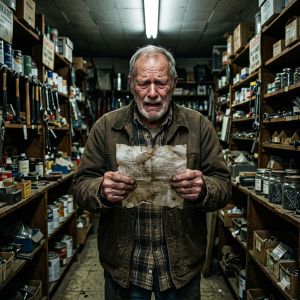
Fifty-one years, Earl Hutchins had opened Hutchins Hardware on Strand Street every single day but Christmas and the day they buried Ruth. And today, six months after losing her, he still reached for her coffee mug out of habit every morning before he remembered.
But he unlocked the door. Because what else do you do?
It was 11 a.m. when she stumbled in.
Young woman. Maybe twenty-five. A little girl on her hip, couldn’t have been more than two years old, face flushed the color of a boiled shrimp. The mother’s shoulders were already burning — that particular shade of red that means the sun won the argument hours ago.
She was asking about sunscreen. Trying to sound casual.
But Earl noticed what she was holding.
Pressed flat against her chest with one arm, like she was shielding it from the world — a battered envelope. Waterlogged, edges soft and wavy like it had been wet and dried more than once. Brown-stained. Sealed. She hadn’t opened it.
He noticed because she never once set it down.
Not when she dug through her purse for change. Not when she shifted the toddler to her other hip. That envelope stayed right there, tucked against her heart like something sacred. Or something she was terrified to lose.
Earl handed her the sunscreen. “On the house.”
She started to argue. He waved her off the way Ruth always waved off nonsense.
“It’s a hundred and four degrees and the heat advisory’s been up since yesterday,” he said. “You got a place to cool down?”
She hesitated just a beat too long.
That beat told Earl everything.
“My back office has AC,” he said. “It’s nothing fancy. A couch that’s seen better days and a mini fridge with juice boxes my grandkids left last Easter. You’re welcome to it.”
She looked at him the way people look at an unexpected kindness — like they’re trying to figure out if there’s a catch.
There wasn’t one. There never had been with Earl.
Her name was Brianna. The little girl was Cora. They sat in that back office for two hours while the heat index outside climbed to 107. Earl brought them sandwiches from the deli two doors down. Cora fell asleep on the old plaid couch clutching a plastic measuring tape she’d found on the shelf like it was a stuffed animal.
Brianna didn’t say much about herself. Earl didn’t push.
But he saw the way she kept touching that envelope. Pressing it. Like she was checking that it was still real.
He almost asked. He stopped himself.
Around two o’clock, she gathered Cora up and thanked him so many times it started to hurt to listen to.
“Which motel you at?” Earl asked, casual as he could manage.
She told him. The one on 61st. The one Earl knew charged by the night and had a checkout policy that didn’t bend.
After she left, he called over there.
Paid what she owed through the end of the week. Left his name off it. Told the front desk to just say it was taken care of.
Ruth would have done the same thing. Ruth would have done more.
That night Earl sat on his porch and watched the Gulf go dark and felt something he hadn’t felt since January.
Not happiness exactly. Just — less empty.
He slept better than he had in months.
—
He found it when he unlocked the store the next morning.
Slipped under the door. A single sheet of paper, folded once, tucked inside a plain envelope — different from hers, clean and dry — with his name written on the outside in careful handwriting.
Earl,
I don’t know how to explain what brought me to Galveston. I’ve been driving for four days trying to find the courage to deliver something that doesn’t belong to me anymore.
The envelope I’ve been carrying — it’s not mine to open.
It belonged to someone who helped me three years ago when I had nothing. She made me promise to find her family if anything ever happened to her. She said they’d want to know she wasn’t alone at the end.
Her name is at the top of the letter inside.
I think you already knew her.
Earl’s hands had stopped working right. He unfolded the single sheet of paper inside, the waterlogged one, the one Brianna had carried flat against her chest for four days and hundreds of miles.
And the name written at the top — the name of the person she’d been trying to reach — was his wife’s.
Ruth Ann Hutchins.
He sat down on the stool behind the register. The one he kept there because his knees weren’t what they used to be. He sat down and he did not move for a long time.
The handwriting wasn’t Ruth’s. It was someone else’s — younger, uneven in places, like the person writing it had been either exhausted or emotional or both.
He made himself read it.
—
The letter was from a woman named Deborah Sims. She had been living out of her car in a Walmart parking lot in Beaumont in the spring of 2021 — Cora not yet born, not yet even showing — when a woman in a silver Camry had knocked on her window and asked if she was okay.
She wasn’t okay. She told the woman that. She didn’t know why she told her the truth. Something about the way she asked, she wrote. Like she genuinely wanted to know and wasn’t going to be scared off by the answer.
The woman bought her breakfast at the Waffle House across the frontage road. Then she paid for two nights at the Extended Stay down the block. She left Deborah her phone number and told her to call if she needed anything.
Deborah called twice. Ruth answered both times.
The second time, Ruth had helped her find a job at a laundry facility in Port Arthur and made a call on her behalf to a women’s shelter that had a six-month waiting list. Somehow, after Ruth’s call, the list got shorter.
I never asked her how she did that, Deborah wrote. I figured she probably just knew how to talk to people. How to make them feel like helping was their own idea.
She described Ruth exactly right. Earl had to stop reading for a minute after that part.
Deborah had gotten back on her feet. She’d had Cora. She’d moved twice, rebuilt slowly, kept Ruth’s phone number in her wallet even after she got a new phone and lost all her contacts — she’d written it on an actual piece of paper like it was something she couldn’t afford to lose.
She’d called it eight months ago, when things got hard again.
A man answered. He said Ruth had passed in January. He said it gently, she wrote. He didn’t know who I was. I didn’t explain. I just said I was sorry and hung up.
That had been Earl. He remembered a handful of calls like that in those first weeks. People who knew Ruth from angles he hadn’t known about. He’d been gentle with all of them because it was all he could do.
Deborah had written the letter the same night.
She wrote it to Ruth, first. Told her she’d kept her promise to get herself right. That Cora was healthy and loud and already trying to climb everything in the apartment. That she thought about that Waffle House breakfast more than Ruth probably knew — the way Ruth had just talked to her like a regular person, not a project, not a charity case. Just a person having a hard time.
Then she’d written a second section, addressed to Ruth’s family, whoever they were. Telling them what Ruth had done for her. Telling them that Ruth had talked about her husband and her store on the seawall and how he was the steadiest person she’d ever known.
She called you the ballast, Deborah wrote. She said Earl was her ballast. I didn’t know exactly what that meant when she said it but I looked it up later. I think she meant you kept her level. Kept her from tipping over when she gave too much of herself away, which she said she had a tendency to do.
Earl had to put the letter down again.
He looked out the front window at Strand Street. A family was walking past with a stroller, ice cream cones already melting down their hands in the morning heat. A pelican was making its prehistoric way along the roofline across the street.
He picked the letter back up.
Deborah explained that she’d sealed the letter meaning to mail it, then talked herself out of it a dozen times over eight months. It felt like too much to send to a stranger, she wrote. It felt like either the most important thing I could do or the most intrusive, and I couldn’t figure out which.
Then her own situation had gotten unsteady again — a job lost, the apartment gone, a decision to move and start over somewhere with family in Florida — and she’d packed the letter with her like it was something she couldn’t abandon. Like Ruth’s unfinished business was also hers.
She’d driven through Galveston on her route and something made her get off the highway. She said she knew the store was on Strand Street because Ruth had mentioned it. She said she’d driven past it twice before she stopped, trying to work up the nerve.
She hadn’t expected the man behind the counter to be so kind that she lost the nerve completely.
I should have just given it to you, she wrote. I’m sorry I didn’t. I panicked. You reminded me of her — the way you didn’t make a fuss, the way you just helped. It knocked the words right out of me.
I hope this finds you. I hope it brings you something good instead of more sadness. She talked about you like you hung the moon, Mr. Hutchins. I thought you ought to know that someone out there whose life she changed knows it, and is grateful, and isn’t going to forget her.
The letter was signed, Deborah Sims, and below that in parentheses, with a small, almost shy addition: the woman from the Walmart parking lot.
Below her name, she had written a phone number. And one more line.
Brianna doesn’t know what’s in the letter. She just knew it was important to me. She agreed to deliver it because she is a better person than she gives herself credit for. I think maybe you already noticed that about her too.
—
Earl sat with that letter for a good while.
Then he folded it carefully along its original creases and set it on the counter like it was made of something that could break.
He thought about Ruth in that Waffle House in Beaumont. The way she must have looked at that young woman in the parking lot and just — decided. No deliberation. No committee meeting about it. Just Ruth, seeing someone who needed something and having the thing they needed and giving it.
He’d watched her do that his whole life. He’d never once told her he thought it was remarkable because it had always seemed to him like simply the way she was. Like pointing at water and calling it wet.
He wished, with a sharpness that surprised him, that he had told her anyway.
He picked up the phone. He almost called his daughter, Marlene, who handled things like this better than he did. He almost called his son, David, up in Houston.
Instead he dialed the number at the bottom of the letter.
It rang four times. He was composing himself to leave a voicemail when she answered, out of breath, a child making noise somewhere in the background.
“Hello?”
“Is this Deborah?”
A pause. “Yes.”
“This is Earl Hutchins. In Galveston.”
The silence on the other end lasted long enough that he thought the call had dropped. Then he heard her exhale. It was the sound of someone who had been carrying something heavy a long way and had just been allowed to set it down.
“Mr. Hutchins,” she said. Her voice was careful the way voices get when they’re working to stay level. “I wasn’t sure you’d call.”
“I almost didn’t,” he said. Which was true. “I almost didn’t do a lot of things lately.”
He told her he’d read the letter. He told her what it meant. He fumbled some of it — he was a hardware man, not a speechmaker — but he got the shape of it out.
She cried a little. She apologized for crying. He told her not to apologize.
“She was something,” he said finally. “You described her right.”
“She saved my life,” Deborah said. “I don’t mean that like an expression.”
“I know,” he said. “I don’t think she knew how many times she did that for people. She just thought she was being neighborly.”
“Is that what you call it in Galveston?”
Earl laughed. An actual laugh, the first real one he could remember since January. It startled him a little, how intact it still was, waiting there.
“I guess so,” he said.
They talked for almost an hour. She told him about Cora’s father, who was out of the picture. She told him about the new job she was starting in Tampa. She told him about the night she wrote the letter — how she’d sat at the kitchen table after Cora was asleep and written it in one go, like something was moving her hand.
He told her about the store. About fifty-one years on Strand Street. About how he’d been planning to retire when Ruth got sick and had ended up not knowing what else to do with himself but keep opening the door.
“She said that about you too,” Deborah told him. “She said you were the most reliable person she’d ever met. She said it like it was the best thing a person could be.”
Earl looked out at Strand Street again. The family with the stroller was long gone. The pelican had moved on.
“What was Brianna’s situation?” he asked. “If you know.”
Deborah told him what she knew. A difficult year. A custody matter. Cora’s father had been making things complicated from a distance, lots of legal noise without much substance, but enough to drain money and energy and sleep. She’d been staying with a friend in Houston, trying to figure out her next move.
Earl nodded at the phone.
“She’s a good person,” he said.
“She drove four hours out of her way to deliver a letter for someone she barely knew,” Deborah said. “Because I asked her to and she could tell it mattered. Yeah. She is.”
—
Before he closed the store that afternoon, Earl wrote two notes.
The first was short. He put it in an envelope and addressed it to Brianna at the motel on 61st, care of the front desk.
It said: Your week is covered. Take the time you need. There’s a good attorney in this city named Patricia Okafor who does family law and has a sliding scale — I’ve known her since she was my neighbor’s kid. I took the liberty of calling her this morning. She’s expecting to hear from you. No obligation, just a conversation. Her number is below. Earl.
He included a twenty-dollar Whataburger gift card that had been in his register drawer since Christmas, left by a grateful customer. He figured Cora looked like a girl who had opinions about chicken strips.
The second note he wrote longer, and he wrote it to Ruth, the way you write something when you’re not sure where it goes but you need to write it anyway.
He told her about the day. He told her about Brianna and Cora, about the envelope, about Deborah’s voice on the phone. He told her he thought she’d done more in that Waffle House parking lot than she’d ever known. He told her that Deborah was going to be okay.
He told her she was still out here, in the way that mattered. In the people she’d nudged back upright and sent on their way.
He told her he was sorry he hadn’t said that more when she was here to hear it.
Then he folded the note and put it in the small cedar box on his dresser at home, where he’d been putting things he wanted her to know.
—
Two days later, Brianna stopped back in.
Cora had a little more color back and considerably more energy. She made a beeline for the display of door hinges near the floor, which Earl considered excellent taste.
Brianna stood at the counter and looked at him for a moment.
“You called Patricia Okafor,” she said.
“I did.”
“She called me yesterday. We talked for forty-five minutes. She said she thinks my situation is more straightforward than I think.”
Earl nodded. “She’s sharp. She was always the sharpest kid on the block.”
Brianna’s jaw worked for a second. “You didn’t have to do that.”
“I know it.”
“I don’t understand why you keep — ” She stopped. Started again. “I didn’t do anything to deserve any of this. I almost didn’t even come in here. I was scared.”
Earl leaned on the counter. He was quiet for a second.
“Ruth used to say that showing up scared still counts as showing up,” he said. “I think she was right about that. She was right about most things, in my experience.”
Brianna looked down at Cora, who had gotten hold of a small brass cabinet pull and was examining it with tremendous seriousness.
“The letter,” she said. “Was it — did it help? That’s all I wanted to know. I just wanted to know it wasn’t a crazy thing to