The day Boone Jessup bought Clara Jensen’s debt, Pine Bluffs reacted as if the sky itself had cracked open just to amuse them.
Laughter rolled through Elias Cobb’s general store before the money had even changed hands. Not because anyone found debt amusing, or because they pitied Clara Jensen enough to grieve what was about to happen to her. No, the people of Pine Bluffs laughed because cruelty had become a kind of local sport, and Clara had long been one of their favorite targets.
She was the blind widow on the edge of town. The woman with the ruined land. The one whose husband had died trying to build something too big for his skill and too expensive for his means. The one who still walked to market with her gray shawl, her walnut cane, and that stubborn way of holding her chin high even when the whole street went quiet to watch her pass.
So when Hiram Gable, the town banker, announced in his smooth churchgoing voice that Clara owed sixty dollars and would lose everything by noon, the room leaned in as if promised entertainment.
Clara stood still while Gable flourished the foreclosure notice in front of her blind eyes.
“It’s over,” he said. “I’ve shown patience long enough.”
“I have twenty,” Clara replied. “I sold my hens. Give me one month.”
Gable smiled, which was always worse than if he had shouted. “And how would you make the rest? Sewing by touch? Begging? The church cellar has room for a cot.”
A few men chuckled. A woman near the flour sacks covered her grin with a gloved hand.
Then the store door opened, and Boone Jessup walked in carrying a bundle of winter pelts.
His arrival always changed the air.
Boone was one of those men towns decided what to think of before learning a single true thing about him. He was too large, too rough, too silent, too at ease with wilderness to make decent people comfortable. He trapped in the mountains above Pine Bluffs, came down only to trade, and left before supper whenever he could. Children stared. Men mocked him once he was out of earshot. Women called him uncivilized unless they were whispering that he looked dangerous in a way that made them straighten their collars.
Boone heard enough to know what the town thought of him, and cared little. But he cared a great deal about men who used power like a boot heel.
He dropped the pelts on Cobb’s counter.
“Eighty-five,” Cobb said after a quick count.
Boone’s attention had already shifted to Clara. She looked pale, but not weak. Humiliated, but not broken. He noticed that first—not her blindness, not the old shawl, not the cane. It was the set of her jaw that stopped him. She was cornered, yet she refused to sound grateful even while begging for time. She still sounded like someone defending what was hers.
Gable had already turned away, as though the matter were settled.
Boone stepped forward.
“Sixty pays the debt.”
The room went quiet.
Gable stared. “This is none of your concern.”
“Write the receipt.”
“That property is worthless.”
Boone did not raise his voice. “Write.”
There are men who dominate a room by shouting and men who do it by refusing to. Boone belonged to the second kind. Gable felt it. Everyone did. The banker pulled a receipt from his ledger with fingers tighter than before, and Boone counted out the money from his fur payment.
He tucked the folded paper into Clara’s pocket.
“Why?” she asked, turning toward him.
“Need a place for winter.”
It was not true. Boone had his own cabin deep in the timberline, a hard place but serviceable. Still, the lie came easily because the real reason would have sounded sentimental, and Boone did not trust sentimental men.
The real reason was simple. He had seen too many decent people ruined by paper while cowards called it law.
Clara’s mouth tightened. “I don’t need saving.”
“Good,” Boone said. “I’m not offering salvation. I work. You keep your land.”
She held out her hand then, feeling the air until he placed his own in it.
Her grip was firmer than he expected.
By Friday, the town had transformed the arrangement into a scandal.
The reverend, a narrow-faced man named Ezra Miller who preached loudly against temptation and quietly enjoyed influence, informed them that no respectable church could allow an unmarried man and woman to live under one roof. He wrapped accusation in righteousness until it sounded almost holy.
Boone nearly struck him.
Clara stopped him with a hand on his wrist.
“Laughter doesn’t chop wood,” she murmured when the townspeople snickered during the ceremony.
They were married in the church vestibule with a wind knifing through the cracks and twelve curious onlookers sitting in back to witness the absurdity. Boone slid a cheap iron ring onto her finger. Someone laughed. Boone’s face darkened. Clara only lifted her chin.
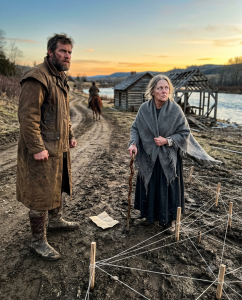
The ride to her property took them along the Snake River, where late-season wind scraped the grass flat and the water ran cold and hard against the bank. When Boone saw the place clearly, he understood why Gable called it worthless.
The cabin leaned. The roof sagged. One shutter hung by a single hinge. Near the river stood the remains of an unfinished mill: timbers blackened by weather, supports rotted at the base, a wheel frame split and listing toward the water like an old skeleton refusing burial.
“It’s a disaster,” Boone said.
“I know,” Clara answered.
She climbed down from the wagon without help and walked directly to the ruined structure. Boone watched her pause with one palm against the old beam as if greeting a ghost.
“My husband was a good man,” she said. “He believed effort could replace understanding. It cannot.”
“You mean he built it wrong.”
“Yes.”
Boone waited for grief in her voice, but what he heard instead was precision.
“He set the frame too close to the waterline. Used the wrong angle on the feed race. Trusted soft ground. Carried weight where the bank would shift. The whole design fought the river instead of using it.”
Boone blinked. “How do you know all that?”
Clara reached into her pocket and pulled out a coil of string.
“Take an end.”
He obeyed.
“Walk inland until your boot finds granite.”
He looked at her for a moment, then did as told.
That evening changed everything Boone thought he understood about Clara Jensen.
For over an hour she moved across the property like someone reading lines carved into the earth. She counted steps under her breath. She asked where the wind struck his cheek strongest. She knelt to touch the ground, tested the slope with the end of her cane, listened to the river’s velocity, and had him drive stakes at intervals so precise they seemed absurd until the pattern began to emerge. She corrected him when he planted one too deep. She asked him to shift another three inches west. She tied string from stake to stake until the muddy field became a geometric web.
By sunset, Boone was no longer humoring a widow with impossible ideas.
He was staring at a design.
“What is this?” he asked.
“The new foundation.”
“For what?”
“A sawmill.”
He laughed once, not unkindly, only in disbelief. “The only mill within fifty miles would need more than hope.”
Clara turned toward him. Her blind eyes were pale and still, but her expression had changed into something almost fierce.
“I did not spend three years in darkness mourning only,” she said. “When Thomas was alive, he talked through every failure. Every beam. Every brace. Every load. He thought I was resting. I was listening. After the fever took my sight, hearing became sharper than grief. I remembered everything he said wrong, and everything the river answered back.”
She tapped one of the stakes with her cane.
“This ground is stable here. Not there. The wheel must sit higher. The intake narrower. The frame braced against downstream pull. The storage shed set north to dry the boards faster. Pine, cottonwood, and fir all float down from those upper bends every spring. Pine Bluffs imports cut lumber from thirty miles south because no one here knows how to build with what the river already offers. I do.”
Boone said nothing for a long moment.
Then he smiled, slow and genuine.
“All right, Mrs. Jessup,” he said. “Tell me where we begin.”
From the road came the shout that cracked the moment open.
A rider from town tossed a folded document near the gate and called out, “Gable says ask about the other paper.”
The boy sped away before Boone could reach him.
Boone unfolded the notice and read it in fading light. The muscles in his jaw hardened.
“What is it?” Clara asked.
“A lien,” he said. “Timber rights tied to any operating mill on this land.”
She went still. “Thomas never purchased equipment.”
“That’s not the worst of it.”
“Then say it.”
Boone took a breath. “It’s witnessed by Reverend Miller.”
Silence dropped heavy between them.
Clara’s voice came quieter now, but far colder. “Read every name.”
Boone did. Hiram Gable. Ezra Miller. Thomas Jensen, supposedly. A date from two weeks before Thomas died.
Clara listened without interrupting. Then she said, “Thomas was delirious that week. He could barely hold a cup. And the reverend came twice after dark.”
Boone looked up sharply.
“I heard them by the door,” she continued. “I did not understand then. Thomas kept saying, ‘Not the land. Not all of it.’ Gable told him it was temporary. Miller said the Lord helps those who sign in faith.”
Boone folded the paper carefully. “You remember their exact words?”
“Yes.”
“What else?”
“The sound of Thomas trying to sit up. A chair dragged across the floor. The scratch of a pen. Gable telling him where to place his hand.”
Boone’s face darkened. “Then they forged the rest.”
For the first time since leaving town, fear moved through him—not fear for himself, but the realization that Clara had not merely been exploited. She had been studied. Set up. Cornered from the moment her husband began failing.
The next weeks became a war disguised as labor.
By day Boone cut timber in the hills, floated logs downstream, hauled stone, dug postholes, and rebuilt the land according to Clara’s directions. She worked beside him in every way she could: measuring by rope, marking beams by touch, sorting lengths, planning the water flow, and keeping each piece of the mill in her mind so exactly that Boone began trusting her memory more than his own eyesight.
At night he read aloud by lamplight from old engineering pamphlets he borrowed under false excuses from a trader in the next town over. Clara listened, compared the drawings to what she already knew, then changed half the plans because the pamphlets had been written for flatland mills, not mountain-fed rivers.
The more Boone watched her, the more the town’s laughter curdled in his memory.
She was not merely intelligent. She was exact. Tireless. Unsentimental. She never asked whether the work was too much. She asked how many beams remained, how much stone had been graded, whether the south brace sounded solid when struck with iron, whether the current pitched higher at dawn or dusk after rain.
And slowly, almost against his will, Boone became protective of things that had nothing to do with ownership and everything to do with respect.
Pine Bluffs noticed the progress.
Men who had mocked the marriage began riding by on casual errands just to stare at the rising frame. Women carrying baskets slowed their wagons at the road. Children counted the new beams aloud. Reverend Miller rode past once and announced that industriousness was admirable in any lawful household, though his smile looked strained when he said it.
Gable never came himself. But he sent eyes.
One evening Boone found the storage shed lock scratched and a brace line cut halfway through. Another morning a stack of cured planks had been shoved into the mud. Clara listened to Boone describe the damage and said only, “He’s worried.”
“How can you tell?”
“Because men like Gable don’t interfere until they think they might lose.”
The trouble arrived properly at the first town council meeting after the mill wheel was mounted.
Boone and Clara entered together. Pine Bluffs filled the room with the restless pleasure of people anticipating a public fight. Gable stood near the front with Reverend Miller on one side and two councilmen on the other. He held a ledger and that same soft voice that always sounded gentler than the things he did.
He claimed the lien gave the bank rights to a share of the mill’s output. He claimed Clara’s husband had entered the agreement knowingly. He claimed Boone Jessup, having married Clara after the fact, was trying to exploit confusion for profit.
The room murmured.
Then Clara rose.
She did not ask anyone to guide her. She found the center aisle by memory from years of church attendance and stood facing the sound of Gable’s breathing.
“Read the date aloud,” she said.
Gable did.
“Now ask Reverend Miller what hymns were sung at Thomas Jensen’s bedside that week.”
Miller blinked. “What?”
“You visited twice after dark. I heard your boots. I heard your voice. If you witnessed my husband’s signature, tell this room what hymn you sang after prayer. You always sing after prayer, Reverend. Which one was it?”
Miller’s face lost color.
He stammered that grief clouded memories.
Clara turned slightly. “Then ask the doctor when Thomas lost control of his right hand.”
The town doctor, who had hoped to remain unnoticed in the back row, shifted uncomfortably.
“It was… several days before his death,” he admitted. “He had no steady grip by then.”
Clara nodded once. “And Thomas wrote with his right hand. Always.”
A murmur spread stronger this time.
Boone watched Gable’s expression sharpen from confidence into calculation.
But Clara was not done.
She reached into her shawl pocket and withdrew a folded sheet Boone had helped her prepare. “My husband kept notes,” she said. “Boone read them to me. One page describes a conversation with Mr. Gable about a temporary loan against future lumber. Thomas rejected it because the terms would ‘strip the land clean before the first board dried.’ Those are his words.”
Boone handed the page to the nearest councilman.
Gable objected immediately. “Anyone could claim that.”
“Not anyone,” Clara said. “My husband marked his private pages with a carpenter’s notch in the upper left corner because he hated strangers reading his work. That notch is there. And if you compare the mark on your so-called lien signature with the way Thomas wrote even six months earlier, you will see the lie.”
The room began to tilt away from Gable.
Then Boone added the blow Gable had not expected.
“I rode south yesterday,” Boone said. “Spoke to the equipment supplier named in the lien. He never sold Thomas Jensen a single blade, axle, or gear. But he did sell ledger paper to Hiram Gable in that same month.”
Now the room erupted.
Reverend Miller tried to calm people. Gable tried to call Boone a savage and a liar. But once public certainty fractures, it rarely mends in time. Questions flew from every side. Why had the reverend forced the marriage? Why file a lien on a blind widow’s failed property? Why was the doctor never asked to verify Thomas’s condition? Why had Gable been so eager to seize land he himself called worthless?
Clara stood in the center of the noise with one hand resting on her cane.
She did not look triumphant.
She looked ready.
And that frightened Boone more than rage would have, because it meant she had been waiting for this fight for far longer than he understood.
The council suspended the lien pending review, but that was not the end. Men like Gable did not fold because truth appeared. They folded when power abandoned them.
That abandonment came from the river.
Three days later the mill ran.
Boone and Clara stood beside the wheel at dawn while the first rush of water struck the paddles. The wheel groaned, resisted, then turned cleanly. The shaft caught. The blade assembly shuddered once and settled into rhythm. Boone fed the first log. Clara listened with her head slightly inclined, as if hearing music no one else deserved.
The cut came smooth.
Not perfect, but true.
By noon, three farmers from neighboring properties had arrived asking rates for custom boards. By evening a man from the next settlement downriver rode in to ask whether Clara Jessup would buy standing timber rights before winter. Two days later, Cobb’s store ordered shelving planks. The week after that, a freight broker offered transport south.
Money began moving toward the property instead of away from it.
Pine Bluffs stopped laughing.
Some pretended they had always believed in the enterprise. Some avoided the road entirely. Some tried kindness so sudden it insulted everyone involved. Women who once watched Clara’s humiliation now asked where she found such strength. Men who called Boone uncivilized now praised his workmanship while trying not to notice that the mill’s design had not come from him at all.
As for Reverend Miller, he resigned his duties before the church could formally question him. He left town under the excuse of ministering to an ailing sister. No one missed him enough to verify the sister existed.
Gable lasted a little longer.
The forgery investigation reached the county seat. His records were reviewed. Other irregularities surfaced. Debts inflated. payment dates altered. parcels seized under suspicious timing. He fled one night before deputies arrived, leaving behind a locked office, three ledgers, and a wife who claimed ignorance with a little too much practice.
Boone did not chase him.
“Why not?” Clara asked when she heard the news.
He looked out toward the river and the turning wheel. “Because men like him rot fastest when the whole world sees what they are.”
She accepted that.
Winter settled over the valley, but the Jessup mill kept working. Smoke climbed from the repaired cabin. The storage shed filled. Boone built a wider porch because Clara liked the sound of snow collecting under open eaves. Clara began training herself to map every board, hinge, and corner of the expanded property until she moved through it with such certainty visitors forgot to pity her.
One evening, after the last order before Christmas had been stacked for shipment, Boone found her standing by the new mill frame with a bare hand resting on the timber.
“You’re checking the vibration again,” he said.
“It changed in the cold.”
“Is that a problem?”
“No.” A pause. Then, quieter: “I wanted to hear whether it still sounds like mine.”
Boone stepped beside her. “And?”
“It does.”
There were many things Boone might have said then. That it had always been hers. That the town had been blind long before she was. That he had never met anyone who could turn grief into architecture.
Instead he said the thing that mattered most.
“They were wrong about you.”
A faint smile touched her mouth. “They were wrong about you too.”
Boone looked at the wheel turning in the dusk. “Maybe.”
“No,” she said. “They saw a brute and missed the man. Same way they saw a blind widow and missed the mind.”
For once, Boone had no answer.
The river kept moving, carrying broken branches, winter light, and the kind of silence that follows after a hard season finally bends in your favor.
By spring the mill had become the center of more than one livelihood. By summer, Pine Bluffs was no longer buying cut timber from the south. Wagons lined the road outside Clara’s property. Men who once laughed now waited for her rates. Women who had pitied her now sent sons to learn measuring and joinery under Boone’s eye. Some nights the cabin glowed late with ledger work, planning, and the low murmur of two people who had begun as a bargain and become something harder to name and stronger to trust.
People told the story differently depending on what kind of ending they preferred.
Some said Boone Jessup saved Clara Jensen.
That was the version lazy people liked, because it kept the world simple. It made the large man the rescuer and the blind widow the rescued. It let Pine Bluffs imagine the old order had only been interrupted, not exposed.
But those who had watched closely knew better.
Boone paid sixty dollars and gave Clara time.
Clara built the future.
And if Pine Bluffs learned anything from it, the lesson was not that charity can change a life. It was that contempt can make fools of a whole town. They had stared at Clara Jensen and seen darkness. They had stared at worthless land and seen ruin. They had stared at Boone Jessup and seen only roughness.
They were wrong every time.
The funniest part, if anyone in Pine Bluffs still had the courage to call it funny, was that the town had mocked a marriage it believed was built from desperation, scandal, and necessity.
Yet in the end, the only thing more powerful than Clara’s memory or Boone’s labor was this: when the whole town came to profit from the mill they laughed at, they had to do it under the name stamped across every invoice, every contract, every shipment crate that left the river road.
Jessup & Jensen.
And more than once, people left that property wondering the same thing long after business was done—whether the bigger crime had been the forged paper that nearly stole Clara’s land, or the blindness of everyone who looked straight at her and still failed to see what she was capable of.